
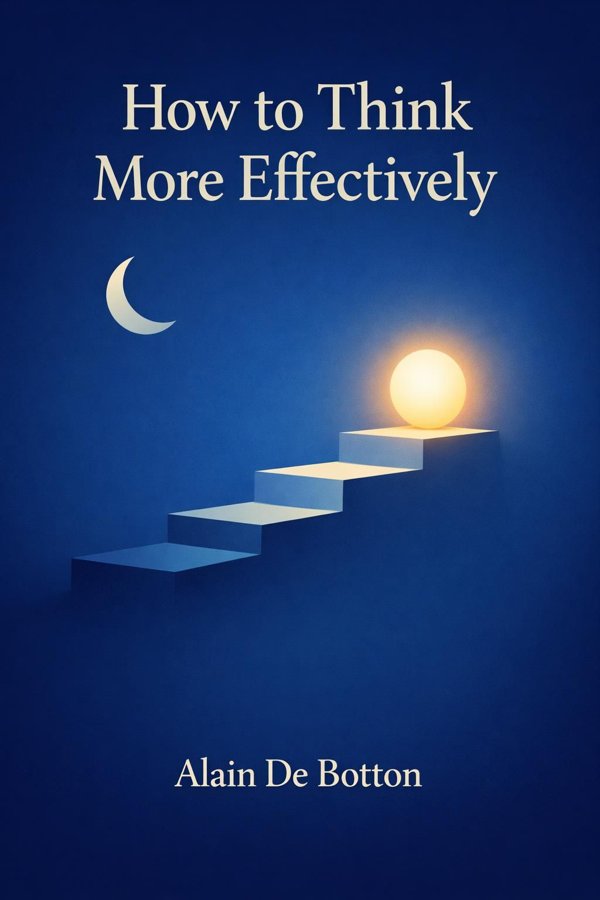
How to Think More Effectively: A Guide to Greater Productivity, Insight and Creativity: Summary & Key Insights
 10 min13 chaptersAudio available
What Is How to Think More Effectively: A Guide to Greater Productivity, Insight and Creativity About?
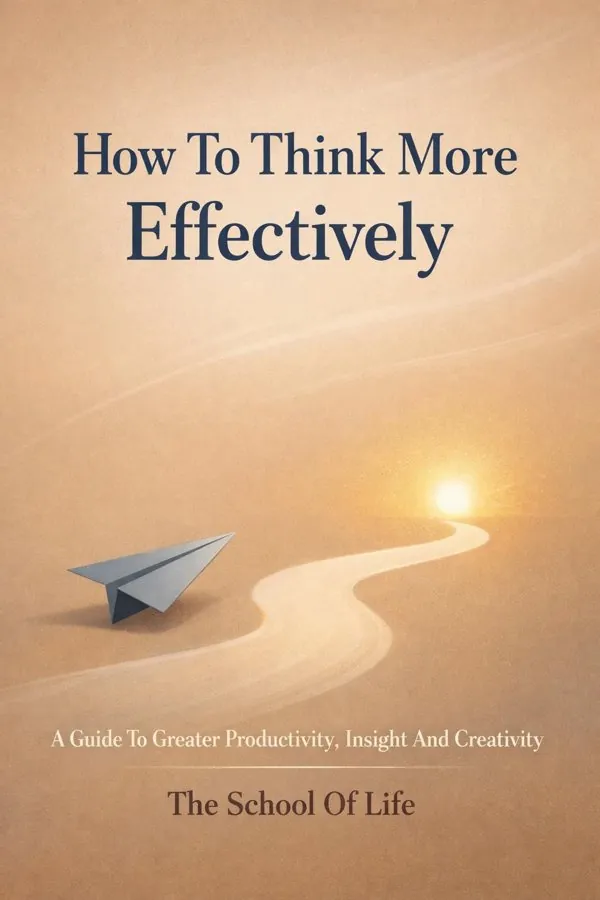
How to Think More Effectively: A Guide to Greater Productivity, Insight and Creativity by Alain De Botton is a mindset book spanning 13 pages. A guide to identifying, nurturing, and growing our insight and creativity for more effective thinking. The book explores fifteen distinct thinking styles, each offering a different approach to problem-solving, creativity, and decision-making. It encourages readers to understand and refine their mental processes to achieve greater clarity, originality, and emotional intelligence.
This FizzRead summary covers all 13 key chapters of How to Think More Effectively: A Guide to Greater Productivity, Insight and Creativity in approximately 10 minutes, distilling the most important ideas, arguments, and takeaways from Alain De Botton's work. Also available as an audio summary and Key Quotes Podcast.
How to Think More Effectively: A Guide to Greater Productivity, Insight and Creativity
A guide to identifying, nurturing, and growing our insight and creativity for more effective thinking. The book explores fifteen distinct thinking styles, each offering a different approach to problem-solving, creativity, and decision-making. It encourages readers to understand and refine their mental processes to achieve greater clarity, originality, and emotional intelligence.
Who Should Read How to Think More Effectively: A Guide to Greater Productivity, Insight and Creativity?
This book is perfect for anyone interested in mindset and looking to gain actionable insights in a short read. Whether you're a student, professional, or lifelong learner, the key ideas from How to Think More Effectively: A Guide to Greater Productivity, Insight and Creativity by Alain De Botton will help you think differently.
- ✓Readers who enjoy mindset and want practical takeaways
- ✓Professionals looking to apply new ideas to their work and life
- ✓Anyone who wants the core insights of How to Think More Effectively: A Guide to Greater Productivity, Insight and Creativity in just 10 minutes
Want the full summary?
Get instant access to this book summary and 100K+ more with Fizz Moment.
Get Free SummaryAvailable on App Store • Free to download
Key Chapters
Before we can think more effectively, we must understand what thinking actually is. Our thoughts emerge not from a cold and neutral machine but from a mind that is continuously shaped by feeling, habit, and circumstance. We often imagine clear thinking as a purely logical sequence of causes and effects, but in truth, emotions guide our reasoning more than we acknowledge. Fear can distort an argument; hope can illuminate possibilities logic alone cannot see.
In this part of the book, I explore how our mental life grows in layers. There are the rapid, intuitive flashes—often emotional—and then the slower, analytic sequences that justify or refine what intuition proposes. To know ourselves is to recognize how these two modes interact. When we believe that rationality excludes emotion, we rob ourselves of richness. Clear thinking begins when we stop suppressing feelings and instead treat them as signals, as data that add depth to our conclusions.
This awareness also exposes the obstacles that hinder understanding: distraction, lack of patience, fear of being wrong. Our mind, much like a room crowded with noise, needs quiet and order to function well. Such clarity cannot be imposed through willpower alone—it must be cultivated by kindness toward our own confusion. Every error is a clue; every hesitation, a chance to notice what the mind resists. Thinking effectively, I suggest, is a gentle discipline of listening inwardly before speaking outwardly.
Modern culture often warns us against mixing feeling with thought, urging us to suppress emotion for the sake of objectivity. Yet much of our insight comes from the emotional currents that run beneath reasoning. In *How to Think More Effectively*, I argue that emotions are not enemies of thought—they are its most faithful companions. To think emotionally is to recognize the wisdom embedded in anger, sadness, desire, and confusion.
Consider how love sharpens perception, how grief lends depth to reflection, how irritation signals values being violated. Each emotion, when understood rather than ignored, reveals what matters to us. The challenge lies not in having feelings, but in interpreting them well. Effective thinkers learn to translate their emotional experience into meaning. One may find, for instance, that envy does not simply express bitterness but highlights unfulfilled aspirations; that anxiety might point to an overidealized notion of control.
By engaging with emotion, we gain access to parts of the mind resistant to direct reasoning. Creativity, empathy, and philosophical insight depend on this continuity between affect and intellect. The most original ideas are born when we stop treating emotions as irrational intrusions and begin to see them as messages from our deeper nature. Emotional thinking demands humility—it asks us to trust that intelligence is not only located in logic but also in the tender movements of the heart.
+ 11 more chapters — available in the FizzRead app
All Chapters in How to Think More Effectively: A Guide to Greater Productivity, Insight and Creativity
About the Author
Alain De Botton is a Swiss-born British philosopher and author known for his works on love, travel, architecture, and philosophy. He founded The School of Life, an organization devoted to developing emotional intelligence through culture and education.
Get This Summary in Your Preferred Format
Read or listen to the How to Think More Effectively: A Guide to Greater Productivity, Insight and Creativity summary by Alain De Botton anytime, anywhere. FizzRead offers multiple formats so you can learn on your terms — all free.
Available formats: App · Audio · PDF · EPUB — All included free with FizzRead
Download How to Think More Effectively: A Guide to Greater Productivity, Insight and Creativity PDF and EPUB Summary
Key Quotes from How to Think More Effectively: A Guide to Greater Productivity, Insight and Creativity
“Before we can think more effectively, we must understand what thinking actually is.”
“Modern culture often warns us against mixing feeling with thought, urging us to suppress emotion for the sake of objectivity.”
Frequently Asked Questions about How to Think More Effectively: A Guide to Greater Productivity, Insight and Creativity
How to Think More Effectively: A Guide to Greater Productivity, Insight and Creativity by Alain De Botton is a mindset book that explores key ideas across 13 chapters. A guide to identifying, nurturing, and growing our insight and creativity for more effective thinking. The book explores fifteen distinct thinking styles, each offering a different approach to problem-solving, creativity, and decision-making. It encourages readers to understand and refine their mental processes to achieve greater clarity, originality, and emotional intelligence.
More by Alain De Botton

You Might Also Like


Browse by Category
Ready to read How to Think More Effectively: A Guide to Greater Productivity, Insight and Creativity?
Get the full summary and 100K+ more books with Fizz Moment.