
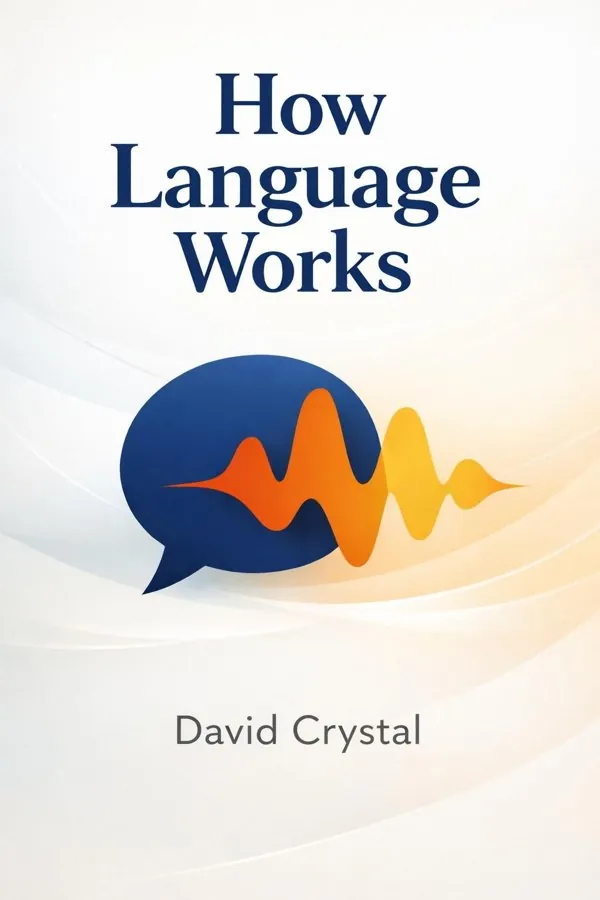
How Language Works: How Babies Babble, Words Change Meaning, and Languages Live or Die: Summary & Key Insights
 10 min13 chaptersAudio available
What Is How Language Works: How Babies Babble, Words Change Meaning, and Languages Live or Die About?
How Language Works: How Babies Babble, Words Change Meaning, and Languages Live or Die by David Crystal is a cognition book spanning 13 pages. This book explores the nature, structure, and evolution of human language. David Crystal examines how languages are formed, how they change over time, and how they influence human communication and culture. It provides insights into phonetics, grammar, semantics, and sociolinguistics, offering readers a comprehensive understanding of how language functions in everyday life.
This FizzRead summary covers all 13 key chapters of How Language Works: How Babies Babble, Words Change Meaning, and Languages Live or Die in approximately 10 minutes, distilling the most important ideas, arguments, and takeaways from David Crystal's work. Also available as an audio summary and Key Quotes Podcast.
How Language Works: How Babies Babble, Words Change Meaning, and Languages Live or Die
This book explores the nature, structure, and evolution of human language. David Crystal examines how languages are formed, how they change over time, and how they influence human communication and culture. It provides insights into phonetics, grammar, semantics, and sociolinguistics, offering readers a comprehensive understanding of how language functions in everyday life.
Who Should Read How Language Works: How Babies Babble, Words Change Meaning, and Languages Live or Die?
This book is perfect for anyone interested in cognition and looking to gain actionable insights in a short read. Whether you're a student, professional, or lifelong learner, the key ideas from How Language Works: How Babies Babble, Words Change Meaning, and Languages Live or Die by David Crystal will help you think differently.
- ✓Readers who enjoy cognition and want practical takeaways
- ✓Professionals looking to apply new ideas to their work and life
- ✓Anyone who wants the core insights of How Language Works: How Babies Babble, Words Change Meaning, and Languages Live or Die in just 10 minutes
Want the full summary?
Get instant access to this book summary and 100K+ more with Fizz Moment.
Get Free SummaryAvailable on App Store • Free to download
Key Chapters
To begin understanding language, we must discern what it is and what it is not. Human language differs fundamentally from any other communication system in the natural world. Birds sing, bees dance, apes gesture—but none of them possess a structured grammar capable of infinite expression. Our linguistic capacity is built upon a distinctive feature: creativity. With a finite set of sounds, we can generate an endless number of meaningful sentences.
Linguists have long debated whether language is an instinct or an invention. I take the view that it is both—a biologically endowed potential realized through social experience. The sounds we make rely on our physiology, but the meanings these sounds carry are governed by culture and history. Every time we speak, we enact a social contract: we agree to use arbitrarily chosen symbols to represent the world.
This dual nature makes language a defining characteristic of our humanity. It is how we plan, remember, dream, and share. Understanding this distinction between language and communication is crucial, for language is not just a means to convey information—it is a tool for thinking. Through it, we can talk about things that do not exist, imagine futures yet to come, and reflect on the past. This recursive quality distinguishes us from every other species on the planet.
Of all the wonders of language, none is more astonishing than a baby’s journey from random noise to meaningful conversation. Long before they say their first word, infants are already busy decoding the sounds around them, identifying rhythm and melody in speech. Babbling—so often dismissed as meaningless chatter—is in fact a crucial practice session where the mouth learns the motions of communication.
By the end of their first year, babies have already tuned their perceptions to the sounds of the language they hear most often. A Japanese infant will grow sensitive to pitch changes; an English child will focus on stress and consonants. Slowly, the flood of sound resolves into words, and those words into patterns. Around eighteen months, a linguistic explosion occurs: vocabulary multiplies, words link together, and grammar—without ever being explicitly taught—begins to emerge.
What fascinates me most about this process is its universality. No matter where a child is born, the stages are strikingly similar. This points to a biological foundation—a linguistic endowment of the human mind. Yet input matters too. The more language children hear, especially interactive conversation, the richer their linguistic competence becomes. Language development, therefore, mirrors our most human trait: growth through interaction and imitation.
+ 11 more chapters — available in the FizzRead app
All Chapters in How Language Works: How Babies Babble, Words Change Meaning, and Languages Live or Die
About the Author
David Crystal is a British linguist, academic, and author known for his extensive work on the English language and linguistics. He has written numerous books on language, including 'The Cambridge Encyclopedia of Language' and 'The Stories of English'. Crystal is recognized for making complex linguistic topics accessible to general readers.
Get This Summary in Your Preferred Format
Read or listen to the How Language Works: How Babies Babble, Words Change Meaning, and Languages Live or Die summary by David Crystal anytime, anywhere. FizzRead offers multiple formats so you can learn on your terms — all free.
Available formats: App · Audio · PDF · EPUB — All included free with FizzRead
Download How Language Works: How Babies Babble, Words Change Meaning, and Languages Live or Die PDF and EPUB Summary
Key Quotes from How Language Works: How Babies Babble, Words Change Meaning, and Languages Live or Die
“To begin understanding language, we must discern what it is and what it is not.”
“Of all the wonders of language, none is more astonishing than a baby’s journey from random noise to meaningful conversation.”
Frequently Asked Questions about How Language Works: How Babies Babble, Words Change Meaning, and Languages Live or Die
How Language Works: How Babies Babble, Words Change Meaning, and Languages Live or Die by David Crystal is a cognition book that explores key ideas across 13 chapters. This book explores the nature, structure, and evolution of human language. David Crystal examines how languages are formed, how they change over time, and how they influence human communication and culture. It provides insights into phonetics, grammar, semantics, and sociolinguistics, offering readers a comprehensive understanding of how language functions in everyday life.
More by David Crystal
You Might Also Like
A Field Guide to Lies: Critical Thinking in the Information Age
Daniel J. Levitin
10 min
A Theory of Cognitive Dissonance
Leon Festinger
10 min
Black-And-White Thinking: The Burden of a Binary Brain in a Complex World
Kevin Dutton
10 min
Born Liars: Why We Can’t Live Without Deceit
Ian Leslie
10 min
Collective Illusions: Conformity, Complicity, and the Science of Why We Make Bad Decisions
Todd Rose
10 min
Concrete Mathematics: A Foundation for Computer Science
Ronald L. Graham, Donald E. Knuth, Oren Patashnik
10 minBrowse by Category
Ready to read How Language Works: How Babies Babble, Words Change Meaning, and Languages Live or Die?
Get the full summary and 100K+ more books with Fizz Moment.