
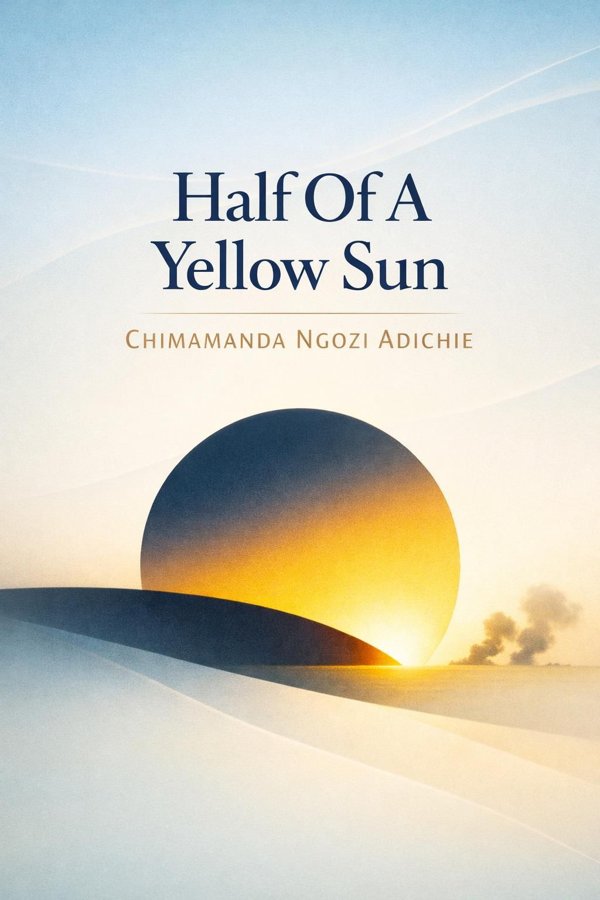
Half Of A Yellow Sun: Summary & Key Insights
 10 min8 chaptersAudio available
Key Takeaways from Half Of A Yellow Sun
History often enters a life quietly, long before it arrives with gunfire.
Privilege can protect a person from hardship, but it cannot protect them from history.
Good intentions do not automatically produce understanding.
War is often remembered through maps, speeches, and casualty counts, but its deepest damage lies in what it does to ordinary routines.
The most painful histories are often the ones most vulnerable to silence.
What Is Half Of A Yellow Sun About?
Half Of A Yellow Sun by Chimamanda Ngozi Adichie is a world_history book spanning 5 pages. Half Of A Yellow Sun is a sweeping historical novel that turns the Nigerian Civil War into an intimate human story. Set in the 1960s, it follows three unforgettable figures whose lives become deeply entangled: Ugwu, a village boy who goes to work for a radical university professor; Olanna, an educated and privileged woman who chooses love and conviction over comfort; and Richard, a British writer drawn into Nigeria’s emotional and political upheaval. Through them, Chimamanda Ngozi Adichie reveals how war reshapes homes, bodies, language, memory, and morality. What makes this novel so powerful is that it does not treat history as a distant timeline of leaders and battles. Instead, it shows how national collapse is lived in kitchens, classrooms, refugee camps, and strained relationships. Adichie writes with unusual authority: she is one of the most important contemporary African novelists, and her family history is closely connected to the Biafran war, giving the book emotional depth as well as historical seriousness. The result is a novel about love, class, colonial legacy, and survival that helps readers understand both Nigeria’s past and the universal human cost of political violence.
This FizzRead summary covers all 8 key chapters of Half Of A Yellow Sun in approximately 10 minutes, distilling the most important ideas, arguments, and takeaways from Chimamanda Ngozi Adichie's work. Also available as an audio summary and Key Quotes Podcast.
Half Of A Yellow Sun
Half Of A Yellow Sun is a sweeping historical novel that turns the Nigerian Civil War into an intimate human story. Set in the 1960s, it follows three unforgettable figures whose lives become deeply entangled: Ugwu, a village boy who goes to work for a radical university professor; Olanna, an educated and privileged woman who chooses love and conviction over comfort; and Richard, a British writer drawn into Nigeria’s emotional and political upheaval. Through them, Chimamanda Ngozi Adichie reveals how war reshapes homes, bodies, language, memory, and morality.
What makes this novel so powerful is that it does not treat history as a distant timeline of leaders and battles. Instead, it shows how national collapse is lived in kitchens, classrooms, refugee camps, and strained relationships. Adichie writes with unusual authority: she is one of the most important contemporary African novelists, and her family history is closely connected to the Biafran war, giving the book emotional depth as well as historical seriousness. The result is a novel about love, class, colonial legacy, and survival that helps readers understand both Nigeria’s past and the universal human cost of political violence.
Who Should Read Half Of A Yellow Sun?
This book is perfect for anyone interested in world_history and looking to gain actionable insights in a short read. Whether you're a student, professional, or lifelong learner, the key ideas from Half Of A Yellow Sun by Chimamanda Ngozi Adichie will help you think differently.
- ✓Readers who enjoy world_history and want practical takeaways
- ✓Professionals looking to apply new ideas to their work and life
- ✓Anyone who wants the core insights of Half Of A Yellow Sun in just 10 minutes
Want the full summary?
Get instant access to this book summary and 100K+ more with Fizz Moment.
Get Free SummaryAvailable on App Store • Free to download
Key Chapters
History often enters a life quietly, long before it arrives with gunfire. Ugwu’s journey begins in this quieter register, and that is precisely why he becomes the novel’s moral center. He comes from a rural village to serve in the home of Odenigbo, a university professor in Nsukka. At first, he is a boy of curiosity and awe, dazzled by running water, books, educated conversation, and the sophistication of urban life. Through his eyes, readers enter a world of ideas, class difference, and possibility.
Ugwu’s education is not only practical; it is intellectual and moral. He learns how households function, how class marks behavior, and how language can open doors. He also witnesses debates about colonialism, tribal identity, and the future of post-independence Nigeria. In Odenigbo’s home, politics is not abstract. It is argued over dinner, shaped by ethnic tension, and felt in the emotional distance between privilege and poverty.
As war unfolds, Ugwu’s innocence is steadily dismantled. He experiences displacement, hunger, military conscription, and moral compromise. His transformation is one of the novel’s most painful achievements because it shows how war does not merely wound victims; it can deform the conscience of those trying to survive. This makes Ugwu more than a coming-of-age character. He embodies how historical violence enters the self.
In practical terms, Ugwu’s arc reminds readers that education is never just schooling. We are shaped by the rooms we enter, the people we serve, the stories we absorb, and the systems that claim us. To understand any crisis, start with the lives of ordinary people living through it. Actionable takeaway: when studying history, focus not only on major events but on how those events alter the inner lives of everyday individuals.
Privilege can protect a person from hardship, but it cannot protect them from history. Olanna enters the novel as the daughter of a wealthy Nigerian family, educated, poised, and accustomed to access. She could remain inside the insulated world of elite comfort, but instead she chooses a different life with Odenigbo in Nsukka. That decision is romantic, intellectual, and political all at once. She rejects the transactional logic of class and enters a world shaped by ideas rather than status.
Yet Adichie refuses to turn Olanna into a simple symbol of idealism. Her privilege follows her, shaping how others see her and how she understands suffering. She moves between two Nigerias: one of social influence, imported luxury, and political convenience; the other of academic aspiration, grassroots nationalism, and vulnerability. Through Olanna, the novel explores class fracture within a nation supposedly united by independence.
Her emotional life also reveals how war intensifies personal betrayal. Love, resentment, family loyalty, motherhood, and grief become harder to navigate when the world itself is unstable. Olanna is not only surviving a civil war; she is negotiating broken trust, trauma, and the impossible pressure to remain composed. One of the novel’s deepest insights is that emotional devastation and political catastrophe often arrive together.
For modern readers, Olanna’s story is useful because it shows that ethical choices always involve loss. Leaving comfort for conviction sounds noble, but it also exposes hidden dependencies, old wounds, and difficult truths about identity. People who wish to live by their values must accept discomfort, ambiguity, and change. Actionable takeaway: examine where your comfort comes from, and ask what values you are willing to defend when comfort is no longer guaranteed.
Good intentions do not automatically produce understanding. Richard, the British expatriate and aspiring writer, is one of the novel’s most complex figures because he genuinely loves Nigeria and wants to belong, yet he can never fully escape the reality of being an outsider. Drawn especially to Kainene and to Igbo-Ukwu art, he tries to root himself in a place marked by colonial history and anti-colonial struggle. His admiration is sincere, but sincerity alone does not erase power, distance, or misreading.
Through Richard, Adichie interrogates the role of foreign witnesses in African history. He wants to tell Biafra’s story, but the novel keeps asking whether that story is truly his to tell. His discomfort is productive: it exposes how easily empathy can slide into appropriation, and how outsiders may center themselves even when attempting solidarity. Richard’s struggle is not simply that he is British in a postcolonial setting; it is that he must confront the limits of his perspective.
At the same time, the novel does not dismiss him. Richard’s emotional attachment, moral outrage, and helplessness during the war make him deeply human. He sees the brutality of the conflict and recognizes the failures of the international community. His presence broadens the novel’s scope by showing how Biafra was not only a Nigerian tragedy but also a global moral failure shaped by foreign indifference and inherited colonial arrangements.
In contemporary life, Richard’s character offers a valuable lesson for readers, journalists, and activists who engage with communities not their own. Solidarity requires humility, listening, and a willingness to decenter oneself. It is possible to care deeply without claiming ownership of another people’s pain. Actionable takeaway: when engaging with stories outside your own experience, lead with attention and humility before interpretation or advocacy.
War is often remembered through maps, speeches, and casualty counts, but its deepest damage lies in what it does to ordinary routines. One of the central achievements of Half Of A Yellow Sun is showing how the Nigerian Civil War dismantles the everyday fabric of life. Before open conflict erupts, the characters inhabit a world of university conversations, family visits, romantic tensions, and domestic rhythms. Once violence intensifies, these routines become fragile and then nearly impossible.
The break is not only physical but psychological. Homes are abandoned, meals become scarce, children are displaced, and once-certain futures vanish. Intellectual confidence gives way to fear, improvisation, and exhaustion. The novel captures the gradual normalization of crisis: people discuss air raids while cooking, measure hope against rumors, and learn to continue despite hunger and grief. This is how catastrophe enters life—not always in one dramatic moment, but through the steady shrinking of what can be trusted.
Adichie also shows that war destroys ideals as much as infrastructure. Nationalism, independence, academic optimism, and romantic faith are all tested by brutality. Some convictions endure; others collapse under pressure. This does not make ideals meaningless. Rather, it reveals their true cost. Beliefs become real when they must survive deprivation, fear, and compromise.
Readers can apply this insight beyond military conflict. Any social crisis—economic collapse, displacement, political repression, or communal violence—first appears in daily habits and intimate spaces. Paying attention to disrupted routines can reveal the seriousness of a wider problem before official narratives do. Actionable takeaway: to understand the human impact of any crisis, look closely at how it changes meals, movement, relationships, and the small rituals that make life feel stable.
The most painful histories are often the ones most vulnerable to silence. Half Of A Yellow Sun is deeply concerned with memory: who gets remembered, who is forgotten, and how private grief survives when public history moves on. The novel suggests that war ends unevenly. Armies may stop fighting, but memory continues in the bodies, habits, absences, and unspoken burdens of those left behind.
Loss in the book is not limited to death. Characters lose homes, innocence, social status, certainty, and versions of themselves they assumed would endure. Some losses are visible; others are harder to name. Adichie is especially interested in how traumatic memory resists neat conclusion. The novel’s emotional force comes partly from this refusal to simplify suffering into redemption. There is survival, but survival is not the same as restoration.
The theme of remembrance is also embedded in writing itself. The question of who tells the story of Biafra becomes morally charged. To remember is not only to archive facts but to honor human complexity. This is particularly important in histories shaped by propaganda or official neglect. Literature becomes a form of resistance against forgetting.
For readers today, this idea has broad relevance. Communities emerging from violence often need more than policy or reconstruction; they need truthful storytelling, witness, and space for mourning. On a personal level, families also carry inherited histories that shape identity even when rarely discussed. Memory can be painful, but silence often deepens the wound.
Actionable takeaway: preserve difficult histories by asking older generations questions, reading firsthand accounts, and making room for honest remembrance rather than convenient forgetting.
Love does not exist outside politics; it is tested by them. One of the novel’s quiet triumphs is its insistence that relationships are not separate from historical events but transformed by them. The bonds among Olanna, Odenigbo, Kainene, Richard, and Ugwu reveal that affection, loyalty, jealousy, forgiveness, and resentment all intensify when the surrounding world becomes unstable. War does not create every fracture, but it magnifies whatever was already fragile.
Adichie portrays love as both shelter and burden. Intimacy gives characters reasons to endure, yet it also exposes them to deeper vulnerability. Betrayal hurts more in a collapsing world because there are fewer structures left to hold a person together. Parenting, friendship, and partnership become acts of emotional labor under impossible conditions. Small gestures—sharing food, offering comfort, staying present—carry enormous weight when scarcity and fear dominate life.
This is especially evident in the relationships between sisters, lovers, and chosen family. The novel resists sentimental portrayals. Love is rarely pure or simple. It is mixed with pride, dependency, class tension, and desire for recognition. What gives these relationships depth is not perfection but endurance: the willingness to remain morally engaged with another person despite disappointment and pain.
In practical terms, the book reminds readers that crises reveal the quality of relationships more clearly than periods of comfort do. Under pressure, empty rhetoric falls away and care becomes visible in actions. Checking in, sharing resources, listening without defensiveness, and showing up consistently matter far more than dramatic declarations.
Actionable takeaway: strengthen relationships before crisis comes, and during hardship, focus less on grand words and more on reliable acts of care, honesty, and presence.
A nation can become independent without becoming internally equal. Half Of A Yellow Sun is set in the years after Nigeria’s independence, and one of its sharpest insights is that colonial rule leaves behind more than foreign governments. It leaves inherited structures of inequality, mistrust, and administrative division that continue shaping national life. The novel explores this through the overlapping tensions of class, ethnicity, education, and regional power.
Characters inhabit different social worlds even when they share national identity. Wealthy families maneuver through patronage and influence. Intellectuals debate the future in university circles. Domestic workers and villagers experience politics more through consequence than control. Alongside this class complexity runs ethnic fracture, particularly the rising danger faced by Igbo people as political instability deepens. Adichie makes clear that civil conflict does not emerge from nowhere; it develops from unresolved historical wounds and competing claims to belonging.
What gives the novel depth is its refusal to simplify these divisions into caricature. People are shaped by structures, but they are not reducible to them. The educated can be naïve, the privileged can suffer, and the marginalized can act with startling insight. This complexity helps readers see postcolonial society as dynamic rather than symbolic.
The broader application is significant. Many contemporary states still wrestle with the afterlives of empire, artificial borders, uneven development, and political systems that reward division. Understanding present conflict requires attention to long histories of hierarchy and exclusion.
Actionable takeaway: when evaluating social unrest, look beyond immediate events and ask how class inequality, historical division, and inherited political systems have prepared the ground for crisis.
When history is contested, storytelling becomes a moral act. Half Of A Yellow Sun is not only a novel about war; it is also a meditation on why stories matter after collective trauma. Adichie suggests that literature can do what official records often cannot: restore texture, contradiction, intimacy, and human dignity to events flattened by politics. Facts tell us what happened. Storytelling helps us feel what it meant.
This idea runs through the novel’s concern with authorship and testimony. Who has the right to narrate suffering? What happens when some voices are amplified while others disappear? These questions give the book an additional layer of self-awareness. The act of writing about Biafra is presented not as neutral documentation but as ethical responsibility. To tell the story well, one must resist simplification, spectacle, and erasure.
Storytelling also serves a reparative function. It cannot undo death or displacement, but it can challenge the second violence of being forgotten. For individuals, narrating experience can create coherence after chaos. For societies, shared stories can preserve memory across generations and resist false official narratives. This is especially crucial where trauma has been politically denied or reduced to statistics.
Readers can apply this lesson in everyday life. Listening carefully to family histories, reading literature from conflict zones, supporting independent journalism, and preserving community memory are all forms of civic participation. Stories shape what societies value and what they allow themselves to forget.
Actionable takeaway: treat stories as a form of historical responsibility—seek out voices closest to lived experience, and support truthful narratives that protect human complexity from simplification.
All Chapters in Half Of A Yellow Sun
About the Author
Chimamanda Ngozi Adichie is a Nigerian writer celebrated for her novels, essays, and public lectures on literature, identity, history, and feminism. Born in Enugu and raised in Nsukka, Nigeria, she emerged as one of the most influential contemporary voices in English-language fiction. Her major works include Purple Hibiscus, Half Of A Yellow Sun, Americanah, and The Thing Around Your Neck. Adichie is widely admired for her ability to weave intimate personal stories with large political and cultural questions, especially those shaped by colonialism, migration, gender, and race. Half Of A Yellow Sun is particularly significant because of her family’s connection to the Biafran experience, which informs the novel’s emotional and historical depth. Through both fiction and nonfiction, Adichie has helped broaden global understanding of African experiences and storytelling.
Get This Summary in Your Preferred Format
Read or listen to the Half Of A Yellow Sun summary by Chimamanda Ngozi Adichie anytime, anywhere. FizzRead offers multiple formats so you can learn on your terms — all free.
Available formats: App · Audio · PDF · EPUB — All included free with FizzRead
Download Half Of A Yellow Sun PDF and EPUB Summary
Key Quotes from Half Of A Yellow Sun
“History often enters a life quietly, long before it arrives with gunfire.”
“Privilege can protect a person from hardship, but it cannot protect them from history.”
“Good intentions do not automatically produce understanding.”
“War is often remembered through maps, speeches, and casualty counts, but its deepest damage lies in what it does to ordinary routines.”
“The most painful histories are often the ones most vulnerable to silence.”
Frequently Asked Questions about Half Of A Yellow Sun
Half Of A Yellow Sun by Chimamanda Ngozi Adichie is a world_history book that explores key ideas across 8 chapters. Half Of A Yellow Sun is a sweeping historical novel that turns the Nigerian Civil War into an intimate human story. Set in the 1960s, it follows three unforgettable figures whose lives become deeply entangled: Ugwu, a village boy who goes to work for a radical university professor; Olanna, an educated and privileged woman who chooses love and conviction over comfort; and Richard, a British writer drawn into Nigeria’s emotional and political upheaval. Through them, Chimamanda Ngozi Adichie reveals how war reshapes homes, bodies, language, memory, and morality. What makes this novel so powerful is that it does not treat history as a distant timeline of leaders and battles. Instead, it shows how national collapse is lived in kitchens, classrooms, refugee camps, and strained relationships. Adichie writes with unusual authority: she is one of the most important contemporary African novelists, and her family history is closely connected to the Biafran war, giving the book emotional depth as well as historical seriousness. The result is a novel about love, class, colonial legacy, and survival that helps readers understand both Nigeria’s past and the universal human cost of political violence.
More by Chimamanda Ngozi Adichie
You Might Also Like
The Age of Capital
Eric Hobsbawm
10 min
The Gulag Archipelago
Aleksandr Solzhenitsyn
10 min
Jerusalem: The Biography
Simon Sebag Montefiore
10 min
The Anglo-Saxons
James Campbell
10 min
The Boer War
Thomas Pakenham
10 min
The Industrial Revolutionaries: The Making of the Modern World 1776–1914
Gavin Weightman
10 minBrowse by Category
Ready to read Half Of A Yellow Sun?
Get the full summary and 100K+ more books with Fizz Moment.