
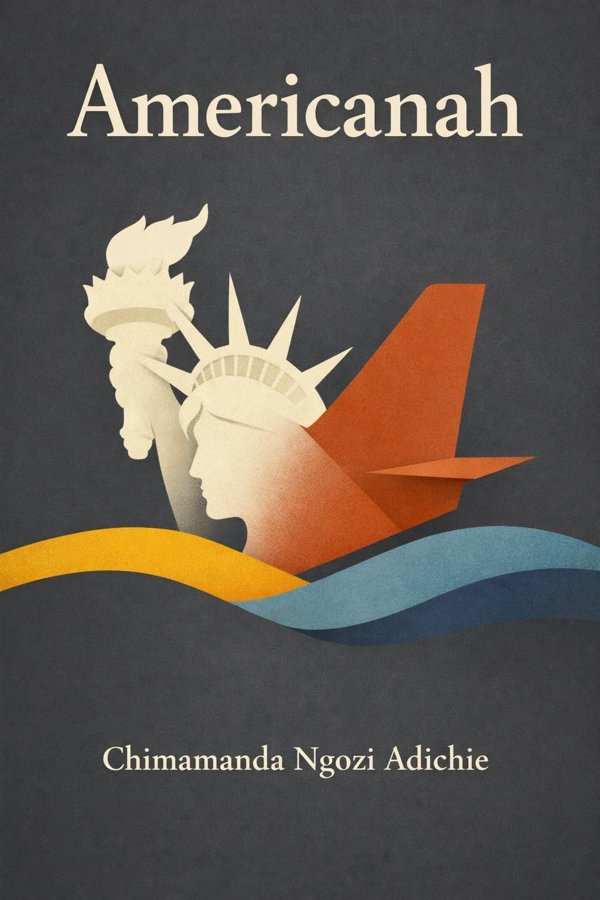
Americanah: Summary & Key Insights
 10 min9 chaptersAudio available
Key Takeaways from Americanah
A first love often feels private, but in Americanah it is shaped by an entire nation.
Sometimes the most disorienting discovery is not that a new country is different, but that it tells you who you are in a language you have never needed before.
Exile is not only being far from home; it is being reduced to a problem in somebody else’s system.
Finding a public voice can begin with naming what everyone else has learned to ignore.
What looks like a beauty choice is often a political negotiation.
What Is Americanah About?
Americanah by Chimamanda Ngozi Adichie is a bestsellers book spanning 5 pages. Americanah is a sweeping, intimate novel about love, migration, race, and the difficult search for a self that can survive reinvention. Chimamanda Ngozi Adichie follows Ifemelu and Obinze, two intelligent, ambitious Nigerians whose youthful romance is interrupted when they leave Nigeria and build separate lives abroad. Ifemelu moves to the United States, where she discovers that becoming an immigrant also means becoming “black” in a new and politically charged way. Obinze, unable to join her after 9/11, goes to the United Kingdom and confronts the humiliations of illegality, invisibility, and social exclusion. Years later, their lives curve back toward Nigeria, where return proves as complicated as departure. What makes Americanah so powerful is that it is both emotionally absorbing and intellectually sharp. Adichie combines the momentum of a love story with a piercing examination of class, accent, beauty, race, and belonging in a globalized world. Few contemporary novelists write with her clarity, wit, and authority on the lived realities of postcolonial identity. This is a novel that not only tells a compelling story, but also changes the way readers notice the social rules that shape everyday life.
This FizzRead summary covers all 9 key chapters of Americanah in approximately 10 minutes, distilling the most important ideas, arguments, and takeaways from Chimamanda Ngozi Adichie's work. Also available as an audio summary and Key Quotes Podcast.
Americanah
Americanah is a sweeping, intimate novel about love, migration, race, and the difficult search for a self that can survive reinvention. Chimamanda Ngozi Adichie follows Ifemelu and Obinze, two intelligent, ambitious Nigerians whose youthful romance is interrupted when they leave Nigeria and build separate lives abroad. Ifemelu moves to the United States, where she discovers that becoming an immigrant also means becoming “black” in a new and politically charged way. Obinze, unable to join her after 9/11, goes to the United Kingdom and confronts the humiliations of illegality, invisibility, and social exclusion. Years later, their lives curve back toward Nigeria, where return proves as complicated as departure.
What makes Americanah so powerful is that it is both emotionally absorbing and intellectually sharp. Adichie combines the momentum of a love story with a piercing examination of class, accent, beauty, race, and belonging in a globalized world. Few contemporary novelists write with her clarity, wit, and authority on the lived realities of postcolonial identity. This is a novel that not only tells a compelling story, but also changes the way readers notice the social rules that shape everyday life.
Who Should Read Americanah?
This book is perfect for anyone interested in bestsellers and looking to gain actionable insights in a short read. Whether you're a student, professional, or lifelong learner, the key ideas from Americanah by Chimamanda Ngozi Adichie will help you think differently.
- ✓Readers who enjoy bestsellers and want practical takeaways
- ✓Professionals looking to apply new ideas to their work and life
- ✓Anyone who wants the core insights of Americanah in just 10 minutes
Want the full summary?
Get instant access to this book summary and 100K+ more with Fizz Moment.
Get Free SummaryAvailable on App Store • Free to download
Key Chapters
A first love often feels private, but in Americanah it is shaped by an entire nation. Ifemelu and Obinze meet as teenagers in Lagos and form an intense bond built on curiosity, humor, and intellectual recognition. Their relationship grows in a Nigeria marked by military rule, economic uncertainty, and a persistent sense that talent alone is not enough. Adichie shows that even the most intimate relationships are never separate from politics, class, and social instability.
Their early life together matters because it gives the novel its emotional center. Ifemelu is bold, observant, and unwilling to flatter people. Obinze is thoughtful, idealistic, and deeply drawn to literature and possibility. They are not simply romantic partners; they are mirrors for each other’s best selves. Yet the world around them narrows their options. University strikes, corruption, and limited opportunity make migration feel less like adventure and more like necessity.
This Lagos beginning also establishes one of the novel’s key tensions: the contrast between who people are at home and who they must become abroad. Before migration, Ifemelu and Obinze possess cultural ease. They understand the codes around them. Once they leave, that ease disappears.
In practical terms, this part of the novel invites readers to think about how environment influences ambition, relationships, and identity. The people we become are often responses to systems larger than us. A useful takeaway is to examine your own “starting context”: what social pressures, economic realities, or inherited assumptions are quietly shaping your choices today?
Sometimes the most disorienting discovery is not that a new country is different, but that it tells you who you are in a language you have never needed before. When Ifemelu arrives in the United States, she expects difficulty, but she does not expect the psychological force of race. In Nigeria, she did not think of herself primarily as black. In America, race becomes unavoidable, structuring interactions, opportunities, beauty standards, and belonging.
Adichie portrays immigration not as a neat upward journey but as a series of humiliations, adjustments, and moral compromises. Ifemelu struggles to find work, money, and emotional footing. Her isolation deepens when financial desperation pushes her into an experience she finds degrading, an event that contributes to her silence toward Obinze and the collapse of their relationship. The American dream here is not denied, but stripped of fantasy. Success exists, yet it often demands emotional cost and strategic performance.
This section of the novel is especially powerful because it distinguishes between formal inclusion and genuine belonging. Ifemelu can study, work, and build a life in America, but she is constantly reminded that she is being read through assumptions she did not write. Her accent, hair, body, and opinions all become sites of interpretation.
For readers, the practical lesson is to notice how systems classify people before individuals speak for themselves. Whether in school, work, or public life, identity is often socially assigned. An actionable takeaway is to ask: what labels structure my interactions with others, and how might I challenge the lazy assumptions attached to them?
Exile is not only being far from home; it is being reduced to a problem in somebody else’s system. Obinze’s journey to London offers a different but equally devastating view of migration. Unable to obtain a U.S. visa after 9/11, he goes to the United Kingdom, where his dreams shrink under the pressure of undocumented life. He takes menial jobs, borrows identities, and lives with the constant fear of discovery.
Obinze’s chapters expose the mythology of the West as a universal space of opportunity. In London, he is educated and capable, yet those qualities become irrelevant in a social order that first asks whether he is legally legible. Adichie is especially perceptive about the humiliation of dependency. Obinze must rely on networks, favors, and silence. He is forced into transactions that deny dignity long before they deny safety.
What makes his story so resonant is its quietness. There is no glamorous rebellion, only the daily erosion produced by uncertainty. Through him, the novel explores masculinity under pressure: what happens when a thoughtful, promising man cannot protect his autonomy, status, or future? His deportation becomes both a personal collapse and an unexpected turning point. Back in Nigeria, he eventually builds material success, but the memory of powerlessness remains.
Readers can apply this insight by rethinking simplistic narratives about migration and merit. Legal categories often shape life chances more than talent does. A practical takeaway is to cultivate empathy for the hidden administrative burdens others may carry, and to question success stories that ignore the unequal structures determining who gets to move freely and who does not.
Finding a public voice can begin with naming what everyone else has learned to ignore. Ifemelu’s blog, with its sharp commentary on race in America, becomes one of the novel’s most original devices. Through it, she transforms private confusion into public analysis. What once felt like isolated discomfort becomes legible as pattern: the rules of politeness around race, the performance of progressive language, the burden placed on minorities to educate others, and the subtle hierarchy of accents, neighborhoods, and cultural tastes.
The blog matters because it gives Ifemelu more than an audience; it gives her interpretive power. She is no longer merely reacting to America. She is reading it. Her posts are witty, provocative, and often uncomfortable, precisely because they say aloud what social etiquette encourages people to soften or avoid. Adichie uses these sections to blend fiction with essay-like insight, allowing the novel to think as well as feel.
This is also a lesson in the relationship between expression and identity. By writing regularly, Ifemelu clarifies herself. Her observations are not detached intellectual exercises; they are a way of surviving confusion and reclaiming agency. The blog eventually brings status and income, but its deeper value is internal. It gives shape to experience.
In everyday life, many people move through workplaces or institutions sensing something is off but lacking words for it. Writing, speaking, or discussing patterns can turn vague unease into understanding. The actionable takeaway is simple: document your observations. Whether in a journal, essay, or conversation, naming recurring dynamics is often the first step toward seeing yourself and your environment more clearly.
What looks like a beauty choice is often a political negotiation. One of Americanah’s most memorable achievements is its treatment of black women’s hair as a serious subject rather than a superficial detail. Through Ifemelu’s experiences in salons, professional spaces, and relationships, Adichie shows how hair becomes entangled with race, assimilation, desirability, and self-worth.
In the United States, Ifemelu learns that natural African hair is often treated as unprofessional, unruly, or in need of correction. Relaxing her hair is not just grooming; it is a response to institutional pressure. Wearing it naturally becomes a form of reclamation. Adichie understands that the politics of appearance work through ordinary routines. People are judged, excluded, or rewarded based on how closely they align with dominant standards of acceptability.
Hair in the novel also creates community. Salons become spaces of storytelling, performance, and cultural exchange among African immigrants and black Americans. These scenes are vivid because they show how identity is negotiated collectively, not just privately. Beauty standards do not live in magazines alone; they live in conversations, workplaces, romantic expectations, and family advice.
The broader application is clear: pay attention to which parts of yourself feel easiest to change in order to fit in. Often, that pressure reveals where power operates most quietly. An actionable takeaway is to audit one “normal” standard in your environment, whether about appearance, language, or behavior, and ask who benefits from it, who is burdened by it, and whether you want to keep obeying it without question.
Love does not survive on feeling alone; it must also survive time, shame, ambition, and the people we become when nobody who knew us first is watching. At its heart, Americanah is a love story between Ifemelu and Obinze, but Adichie refuses sentimental shortcuts. Their separation is not caused by a single misunderstanding. It emerges from migration’s deeper forces: economic hardship, trauma, missed timing, and the emotional asymmetry of living in different worlds.
Ifemelu’s silence after her degrading early experience in America fractures the bond between them. Obinze, meanwhile, develops his own life, including marriage and fatherhood. When they reconnect years later, they are no longer the young people who once imagined the future together. The novel asks a difficult question: can love recover after identity has been rebuilt in pieces?
Their reunion in Nigeria is compelling because it is neither pure nostalgia nor simple destiny. What draws them back together is not just memory, but recognition. Each still sees something essential in the other that survived transformation. Yet the path is ethically and emotionally messy. Adichie allows desire, regret, loyalty, and selfishness to coexist.
This aspect of the novel offers a useful insight for anyone thinking about relationships under pressure. Distance does not merely test commitment; it changes the conditions under which commitment makes sense. The actionable takeaway is to ask not only whether a relationship contains love, but whether it creates enough honesty for both people to admit how they have changed. Without that, longing can become a substitute for reality.
Leaving home can make it mythic; returning makes it real again. When Ifemelu goes back to Nigeria after years in the United States, she discovers that return is not a reversal. Home has changed, and so has she. Lagos is familiar yet newly strange. She is perceived through the lens of having been abroad, and the label “Americanah” carries both admiration and skepticism. It marks her as someone altered by foreign life, perhaps privileged, perhaps pretentious, certainly no longer uncomplicatedly local.
Adichie handles return with unusual nuance. Many migration stories end with settlement abroad, but Americanah insists that going back is its own complex migration. Ifemelu must relearn rhythms, expectations, friendships, and professional culture. She recognizes corruption, absurdity, energy, and beauty with both insider intimacy and outsider distance. This double vision becomes one of her strengths.
Return also complicates the fantasy that identity can be restored by geography alone. Moving back to Nigeria does not return Ifemelu to her former self. Instead, it creates a hybrid consciousness: she belongs and does not belong, understands and misreads, critiques and cherishes. This is one of the novel’s most modern insights. In a globalized world, many people live in-between, carrying multiple cultural grammars at once.
The practical takeaway is relevant far beyond migration. Whenever we revisit an old environment, family system, workplace, hometown, or former role, we expect familiarity to simplify us. It rarely does. An actionable step is to approach return not as recovery of the past, but as negotiation between who you were and who you have become.
The deepest question in Americanah is not where a person lives, but where a person can exist without constant translation. Across Nigeria, the United States, and the United Kingdom, Adichie shows that belonging is emotional, social, and political at once. It is shaped by who understands your references, who grants you complexity, and who allows you to appear without performing gratitude or explanation.
No single country in the novel offers perfect belonging. Nigeria contains love, memory, and cultural fluency, but also inequality, sexism, and frustration. America offers opportunity and reinvention, but also racialization and coded exclusion. Britain offers access to global prestige, but can reduce immigrants to invisible labor or legal anxiety. The point is not that everywhere fails equally, but that modern identity often forms in tension with multiple imperfect homes.
This insight is what makes Americanah more than a migration novel. It is a study of how people assemble a liveable self across dislocation. Ifemelu and Obinze are most fully themselves not when they achieve social approval, but when they stop outsourcing their value to systems that misrecognize them. Belonging, the novel suggests, begins internally but is tested socially.
Readers can apply this idea by reflecting on where they feel least fragmented. Which spaces require you to shrink, edit, or overexplain yourself? Which relationships let your full history be legible? The actionable takeaway is to build more of the latter. Belonging may never be perfect, but it becomes more possible when you choose communities, habits, and commitments that reduce the need for constant self-translation.
All Chapters in Americanah
About the Author
Chimamanda Ngozi Adichie is a Nigerian author whose fiction and essays have made her one of the most influential literary voices of her generation. Born in Enugu, Nigeria, in 1977 and raised in Nsukka, she is known for exploring race, identity, gender, migration, and postcolonial history with unusual clarity and emotional intelligence. Her major works include Purple Hibiscus, Half of a Yellow Sun, and Americanah, all of which earned international acclaim. Beyond fiction, Adichie is also celebrated for essays and talks such as We Should All Be Feminists, which brought her ideas to a wide global audience. Her writing is admired for its elegance, wit, and ability to connect intimate personal stories with larger social and political realities.
Get This Summary in Your Preferred Format
Read or listen to the Americanah summary by Chimamanda Ngozi Adichie anytime, anywhere. FizzRead offers multiple formats so you can learn on your terms — all free.
Available formats: App · Audio · PDF · EPUB — All included free with FizzRead
Download Americanah PDF and EPUB Summary
Key Quotes from Americanah
“A first love often feels private, but in Americanah it is shaped by an entire nation.”
“Sometimes the most disorienting discovery is not that a new country is different, but that it tells you who you are in a language you have never needed before.”
“Exile is not only being far from home; it is being reduced to a problem in somebody else’s system.”
“Finding a public voice can begin with naming what everyone else has learned to ignore.”
“What looks like a beauty choice is often a political negotiation.”
Frequently Asked Questions about Americanah
Americanah by Chimamanda Ngozi Adichie is a bestsellers book that explores key ideas across 9 chapters. Americanah is a sweeping, intimate novel about love, migration, race, and the difficult search for a self that can survive reinvention. Chimamanda Ngozi Adichie follows Ifemelu and Obinze, two intelligent, ambitious Nigerians whose youthful romance is interrupted when they leave Nigeria and build separate lives abroad. Ifemelu moves to the United States, where she discovers that becoming an immigrant also means becoming “black” in a new and politically charged way. Obinze, unable to join her after 9/11, goes to the United Kingdom and confronts the humiliations of illegality, invisibility, and social exclusion. Years later, their lives curve back toward Nigeria, where return proves as complicated as departure. What makes Americanah so powerful is that it is both emotionally absorbing and intellectually sharp. Adichie combines the momentum of a love story with a piercing examination of class, accent, beauty, race, and belonging in a globalized world. Few contemporary novelists write with her clarity, wit, and authority on the lived realities of postcolonial identity. This is a novel that not only tells a compelling story, but also changes the way readers notice the social rules that shape everyday life.
More by Chimamanda Ngozi Adichie




You Might Also Like

The Godfather
Mario Puzo
10 min
The Handmaid's Tale
Margaret Atwood
10 min
The Hunger Games
Suzanne Collins
10 min
The Nightingale
Kristin Hannah
10 min
The Seven Husbands of Evelyn Hugo
Taylor Jenkins Reid
10 min
Backwater Justice
Fern Michaels
10 minBrowse by Category
Ready to read Americanah?
Get the full summary and 100K+ more books with Fizz Moment.