
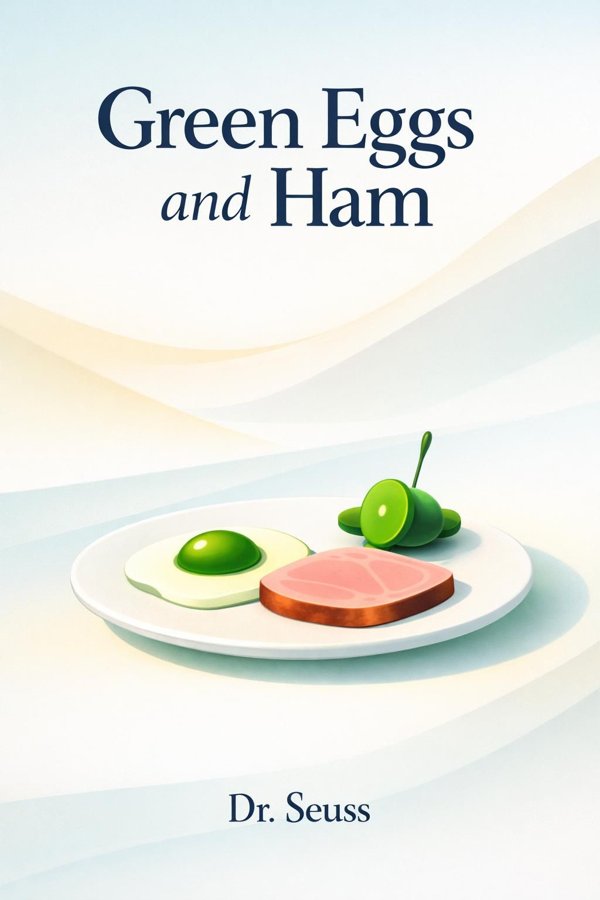
Green Eggs and Ham: Summary & Key Insights
by Dr. Seuss
 10 min9 chaptersAudio available
Key Takeaways from Green Eggs and Ham
We often say “no” long before we know what we are refusing.
Persuasion is most powerful when it is energetic without becoming cruel.
Transformation often does not require certainty; it requires only one honest experiment.
What seems repetitive in Green Eggs and Ham is actually carefully designed education.
People lower their defenses when they laugh.
What Is Green Eggs and Ham About?
Green Eggs and Ham by Dr. Seuss is a fiction book published in 1960 spanning 3 pages. Green Eggs and Ham is one of the simplest children’s books ever written—and one of the most profound. First published in 1960, Dr. Seuss’s classic follows the tireless Sam-I-Am as he urges a stubborn companion to try an unusual dish. The plot is famously small: one character refuses, another persists, and a single bite changes everything. Yet inside that playful exchange lies a lesson that reaches far beyond childhood. The book speaks to hesitation, prejudice, habit, curiosity, and the surprising rewards of staying open to experience. What makes this story matter is not only its message, but its method. Dr. Seuss uses repetition, rhyme, rhythm, and comic escalation to turn a simple reading exercise into a memorable emotional journey. Young readers enjoy the silliness; older readers recognize the psychological truth beneath it. We often reject things before understanding them, then discover that our certainty was built on fear rather than fact. Dr. Seuss, born Theodor Seuss Geisel, was a master of making big ideas accessible through humor and musical language. In Green Eggs and Ham, he proves that a few words, used brilliantly, can teach a lifetime lesson: don’t decide too quickly what you refuse to try.
This FizzRead summary covers all 9 key chapters of Green Eggs and Ham in approximately 10 minutes, distilling the most important ideas, arguments, and takeaways from Dr. Seuss's work. Also available as an audio summary and Key Quotes Podcast.
Green Eggs and Ham
Green Eggs and Ham is one of the simplest children’s books ever written—and one of the most profound. First published in 1960, Dr. Seuss’s classic follows the tireless Sam-I-Am as he urges a stubborn companion to try an unusual dish. The plot is famously small: one character refuses, another persists, and a single bite changes everything. Yet inside that playful exchange lies a lesson that reaches far beyond childhood. The book speaks to hesitation, prejudice, habit, curiosity, and the surprising rewards of staying open to experience.
What makes this story matter is not only its message, but its method. Dr. Seuss uses repetition, rhyme, rhythm, and comic escalation to turn a simple reading exercise into a memorable emotional journey. Young readers enjoy the silliness; older readers recognize the psychological truth beneath it. We often reject things before understanding them, then discover that our certainty was built on fear rather than fact.
Dr. Seuss, born Theodor Seuss Geisel, was a master of making big ideas accessible through humor and musical language. In Green Eggs and Ham, he proves that a few words, used brilliantly, can teach a lifetime lesson: don’t decide too quickly what you refuse to try.
Who Should Read Green Eggs and Ham?
This book is perfect for anyone interested in fiction and looking to gain actionable insights in a short read. Whether you're a student, professional, or lifelong learner, the key ideas from Green Eggs and Ham by Dr. Seuss will help you think differently.
- ✓Readers who enjoy fiction and want practical takeaways
- ✓Professionals looking to apply new ideas to their work and life
- ✓Anyone who wants the core insights of Green Eggs and Ham in just 10 minutes
Want the full summary?
Get instant access to this book summary and 100K+ more with Fizz Moment.
Get Free SummaryAvailable on App Store • Free to download
Key Chapters
Persuasion is most powerful when it is energetic without becoming cruel. Sam-I-Am represents a remarkable kind of persistence: he does not surrender, but he also does not become bitter. He keeps asking, keeps suggesting, and keeps reframing the invitation in new settings and combinations. His approach is playful rather than forceful, which is why the story remains charming instead of oppressive.
This matters because many people misunderstand persistence. They think it means repeating the same demand louder and louder. But Green Eggs and Ham shows a more effective model. Sam-I-Am varies the context: in a house, with a mouse, in a box, with a fox, on a train, in the rain, and more. Each suggestion is a creative attempt to lower resistance. He is not only insistent; he is adaptable. He understands that people do not always need more pressure—they need a new angle.
In real life, this lesson applies to parenting, teaching, leadership, and relationships. A parent encouraging a child to read may succeed better by trying comic books, bedtime stories, or audiobooks rather than repeating “reading is important.” A manager introducing a new process may need demonstrations, small pilot tests, and examples rather than commands. A friend helping another person broaden their horizons may need patience, humor, and empathy.
At the same time, the story opens a useful conversation about boundaries. Persistence works best when rooted in care and invitation, not domination. Sam-I-Am’s enthusiasm is persuasive because it feels joyful, not manipulative. He genuinely believes the experience will be rewarding.
Actionable takeaway: When trying to encourage someone—or yourself—toward something worthwhile, do not just repeat the message. Change the frame, lighten the tone, and keep the invitation warm.
Transformation often does not require certainty; it requires only one honest experiment. The turning point in Green Eggs and Ham arrives when the reluctant character finally agrees to taste the dish. He does not need a complete philosophical conversion first. He simply takes one bite. That small act of trial breaks the power of all the resistance that came before.
This is one of the book’s deepest truths. People frequently believe they must feel ready before trying something new. In reality, readiness often comes after action, not before it. The character’s eventual delight proves that direct experience can overturn assumptions more effectively than any argument. Sam-I-Am can talk endlessly, but the real evidence appears only when the food is tasted.
This idea extends far beyond children’s literature. Someone convinced they “hate exercise” may discover they enjoy dancing, swimming, or walking with friends after trying one class. A person who believes they are “bad at art” may feel differently after a single sketching session. A reader intimidated by poetry may change their mind after one accessible poem. The first step need not be dramatic. It only needs to be real.
The story also suggests something hopeful: many disappointments and missed joys come not from trying and failing, but from never trying at all. We can spend enormous energy defending our preferences without testing them. A tiny experiment can reveal more than long debate.
The key is not reckless openness to everything. It is willingness to test assumptions when the stakes are low and the opportunity is meaningful. Curiosity becomes powerful when it moves from idea to action.
Actionable takeaway: Pick one harmless thing you’ve been dismissing—food, hobby, book, routine, conversation—and give it one sincere try before deciding against it.
What seems repetitive in Green Eggs and Ham is actually carefully designed education. Dr. Seuss repeats phrases, structures, and sounds not because he lacks variety, but because repetition helps ideas sink in. Children recognize patterns before they fully analyze meaning, and that recognition creates confidence. As lines return in slightly altered forms, readers begin to anticipate the rhythm, join in, and feel mastery over the text.
This technique is central to why the book became a foundational early reader. Repetition reduces cognitive overload. Instead of confronting entirely new language on every page, the child meets familiar building blocks arranged in playful combinations. The reading experience becomes less intimidating and more participatory. Language turns into a game.
Yet repetition serves the theme as well as the reading level. Every repeated refusal highlights the depth of the character’s resistance. Every renewed offer from Sam-I-Am emphasizes persistence. The recurring structure becomes part of the drama. Readers feel the tension accumulate: how long can someone continue saying no? When the eventual yes arrives, it feels earned precisely because the no was repeated so thoroughly.
There is a practical lesson here for communication of any kind. People rarely absorb new information after hearing it once. Teachers repeat concepts with examples. Coaches drill fundamentals. Leaders restate values. Personal habits are built through repeated practice, not isolated insight. Repetition, when done with variation and purpose, creates familiarity—and familiarity can reduce fear.
In our own lives, we can use repetition to learn skills, encourage children, remember priorities, or replace negative self-talk with healthier language. The trick is to repeat without becoming lifeless. Variety inside structure keeps attention alive.
Actionable takeaway: When learning or teaching something important, repeat the core idea consistently, but vary the example or setting so the lesson stays memorable.
People lower their defenses when they laugh. One reason Green Eggs and Ham works so well is that it never presents its lesson as a lecture. Instead, Dr. Seuss wraps the message in absurdity, rhyme, visual comedy, and escalating silliness. The result is that readers absorb a meaningful lesson while smiling. Humor turns a moral into an experience.
This is more powerful than it first appears. When someone feels judged, they tend to harden. But when they feel amused, they become more flexible. The unnamed character’s refusal is funny rather than hateful, and Sam-I-Am’s persistence is comically exaggerated rather than severe. Because the stakes remain playful, readers can recognize themselves in the reluctant character without feeling attacked.
The same principle works in daily life. A teacher correcting mistakes with warmth and lightness may help students stay engaged. A parent encouraging a child to try something new can use play instead of pressure. Even adults in tense environments benefit from humor that relieves anxiety without dismissing the issue. In teams, humor can soften resistance to change. In friendships, it can make difficult conversations less threatening.
Of course, not all humor is equally helpful. Mockery humiliates; playful humor invites. Dr. Seuss models the second kind. The world of the book is ridiculous in a generous way. Nobody is shamed for being hesitant. Instead, the ridiculousness of the situation creates space for change.
Humor also helps memory. Many readers can recite lines from this book decades after childhood because the playful rhythm and comic images stay vivid. Serious lessons often last longer when delivered lightly.
Actionable takeaway: When encouraging openness—whether in a child, a colleague, or yourself—replace some pressure with play. A lighter tone may open doors that argument keeps shut.
Great writing is not always complicated writing. Green Eggs and Ham is famous for using a very limited vocabulary, yet it explores surprisingly rich themes: resistance, persuasion, experimentation, and self-discovery. Dr. Seuss demonstrates that clarity and simplicity do not weaken an idea; they often make it stronger.
This achievement matters especially in a culture that sometimes confuses complexity with intelligence. The book proves that a simple sentence, repeated with rhythm and imagination, can reach deeper than a dense explanation. A child understands the plot easily, but an adult can still reflect on its emotional truth. That dual accessibility is the mark of exceptional craft.
There is a lesson here for anyone who communicates—writers, teachers, leaders, parents, marketers, or friends. If your message cannot be understood, it cannot create change. Simplicity does not mean dumbing things down. It means identifying the core idea and expressing it so clearly that it becomes memorable. Dr. Seuss removes clutter, then adds music. The result is elegant communication.
In practical terms, this means we can often improve our own speaking and writing by trimming unnecessary words, choosing vivid images, and repeating the essential message. A manager explaining a new goal should use direct language. A teacher introducing a concept should start with a concrete example. A parent giving guidance should be specific and clear. Even personal journaling can become more useful when thoughts are expressed plainly.
Green Eggs and Ham also shows that simple language can still be emotionally textured. The words are easy; the meaning is layered. That is not a limitation. It is artistry.
Actionable takeaway: When you need to communicate something important, ask yourself: “How would I say this more simply without losing the truth?” Then revise until the message feels clear and memorable.
Many pleasures in life arrive disguised as things we almost refused. That is the emotional payoff of Green Eggs and Ham. The reluctant character finally tastes the dish and discovers not mere tolerance, but enthusiasm. He likes green eggs and ham. His reversal is dramatic because it reveals how mistaken his certainty was. The thing he resisted most becomes something he happily accepts.
This moment captures a broader life principle: openness is not only virtuous, it is rewarding. Staying curious does not guarantee every new experience will be enjoyable, but it dramatically increases the chances of surprise, growth, and delight. Closed-mindedness protects us from discomfort in the short term, yet it can quietly deprive us of pleasure, connection, and opportunity.
Consider how often people define themselves by what they “don’t do.” They don’t travel alone. They don’t eat spicy food. They don’t speak in public. They don’t listen to certain music. Sometimes those preferences are valid. But sometimes they are inherited assumptions rather than informed choices. A little openness can reshape identity. Someone who reluctantly joins a hiking trip may discover a lifelong love of nature. A child who reluctantly attends a music lesson may find a passion. A professional who reluctantly learns a new tool may unlock a better career path.
The book does not say that every strange thing is wonderful. Its deeper message is that certainty should be earned, not assumed. Openness gives reality a chance to speak for itself.
This is especially important in relationships and communities. Openness to unfamiliar people, traditions, and perspectives can expand empathy. In that sense, the green eggs and ham become a symbol of anything strange that might turn out to be valuable.
Actionable takeaway: This week, deliberately say yes to one low-risk experience you would normally dismiss, and approach it with curiosity rather than suspicion.
Some books tell readers what to think; Green Eggs and Ham invites them to feel the lesson unfolding. Because the structure is repetitive and interactive, listeners and readers naturally begin predicting lines, reciting rhymes, and anticipating the turning point. They are not passive observers. They become participants in the process of resistance and eventual discovery.
This participatory quality is part of why the book endures across generations. Children enjoy joining the rhythm, but that participation also reinforces the theme. As the refusals pile up, readers begin wanting the character to just try the dish already. They experience impatience, curiosity, and suspense. When the bite finally happens, the resolution feels satisfying because they have traveled the emotional road alongside him.
This suggests an important principle about learning: people absorb ideas more deeply when they are involved rather than merely instructed. A child learns confidence by reading aloud, not just by hearing someone else read. An employee understands a new process better by practicing it than by sitting through a lecture. A student learns science more deeply through experiments than explanations alone. Participation creates ownership.
The book also models how literature can become social. Parents and children often read it together, performing voices, emphasizing rhymes, and laughing at repetition. That shared reading turns literacy into connection. The lesson about openness is then linked not only to words on a page, but to a positive emotional experience.
In a wider sense, Green Eggs and Ham reminds us that persuasion often works best when people arrive at a conclusion themselves. Sam-I-Am cannot force genuine liking. The character must taste and decide.
Actionable takeaway: Whenever you want someone to learn or embrace something new, create a chance for active participation instead of relying only on explanation.
The books that last are rarely only for children. Green Eggs and Ham is often introduced as an early reader, but its emotional and philosophical reach extends much further. Adults can see in the unnamed character the many ways they themselves cling to preference, identity, and routine. They can also see in Sam-I-Am the energy required to challenge stagnation—whether in oneself, a loved one, or a culture.
At an adult level, the story becomes a meditation on bias and habit. We often construct opinions before experience and then defend them to preserve consistency. We may reject a new colleague, technology, neighborhood, genre, or idea because it feels outside our familiar world. The book’s humor makes this pattern visible without becoming accusatory. It gently asks: how much of your life is shaped by examined choice, and how much by reflexive refusal?
There is also wisdom here about humility. The reluctant character must eventually admit he was wrong. That can be difficult at any age. Adults especially may resist changing their minds because they confuse revision with weakness. But one of the healthiest capacities in life is the ability to update beliefs in light of experience. The final moment of delight is also a moment of surrender: he lets reality correct him.
This is why the book remains relevant in families, schools, and workplaces. It offers a model of curiosity, adaptability, and modest self-correction. It reminds readers that growth often begins where certainty ends.
Actionable takeaway: Revisit one firm opinion you hold about a harmless topic—food, art, technology, routine, or pastime—and test whether it still reflects experience or merely habit.
All Chapters in Green Eggs and Ham
About the Author
Dr. Seuss was the pen name of Theodor Seuss Geisel (1904–1991), one of the most influential children’s authors of all time. An American writer, illustrator, and cartoonist, he created beloved classics such as The Cat in the Hat, Horton Hears a Who!, How the Grinch Stole Christmas!, and Green Eggs and Ham. His work is known for its inventive rhymes, playful nonsense words, unforgettable characters, and colorful visual style. Geisel had a rare talent for blending entertainment with meaningful lessons, making reading feel joyful while encouraging imagination, empathy, and curiosity. His books have sold millions of copies worldwide and remain central to childhood literacy. Decades after publication, Dr. Seuss’s stories continue to shape how children learn to read and how adults remember the magic of language.
Get This Summary in Your Preferred Format
Read or listen to the Green Eggs and Ham summary by Dr. Seuss anytime, anywhere. FizzRead offers multiple formats so you can learn on your terms — all free.
Available formats: App · Audio · PDF · EPUB — All included free with FizzRead
Download Green Eggs and Ham PDF and EPUB Summary
Key Quotes from Green Eggs and Ham
“We often say “no” long before we know what we are refusing.”
“Persuasion is most powerful when it is energetic without becoming cruel.”
“Transformation often does not require certainty; it requires only one honest experiment.”
“What seems repetitive in Green Eggs and Ham is actually carefully designed education.”
“People lower their defenses when they laugh.”
Frequently Asked Questions about Green Eggs and Ham
Green Eggs and Ham by Dr. Seuss is a fiction book that explores key ideas across 9 chapters. Green Eggs and Ham is one of the simplest children’s books ever written—and one of the most profound. First published in 1960, Dr. Seuss’s classic follows the tireless Sam-I-Am as he urges a stubborn companion to try an unusual dish. The plot is famously small: one character refuses, another persists, and a single bite changes everything. Yet inside that playful exchange lies a lesson that reaches far beyond childhood. The book speaks to hesitation, prejudice, habit, curiosity, and the surprising rewards of staying open to experience. What makes this story matter is not only its message, but its method. Dr. Seuss uses repetition, rhyme, rhythm, and comic escalation to turn a simple reading exercise into a memorable emotional journey. Young readers enjoy the silliness; older readers recognize the psychological truth beneath it. We often reject things before understanding them, then discover that our certainty was built on fear rather than fact. Dr. Seuss, born Theodor Seuss Geisel, was a master of making big ideas accessible through humor and musical language. In Green Eggs and Ham, he proves that a few words, used brilliantly, can teach a lifetime lesson: don’t decide too quickly what you refuse to try.
More by Dr. Seuss
You Might Also Like



Browse by Category
Ready to read Green Eggs and Ham?
Get the full summary and 100K+ more books with Fizz Moment.