
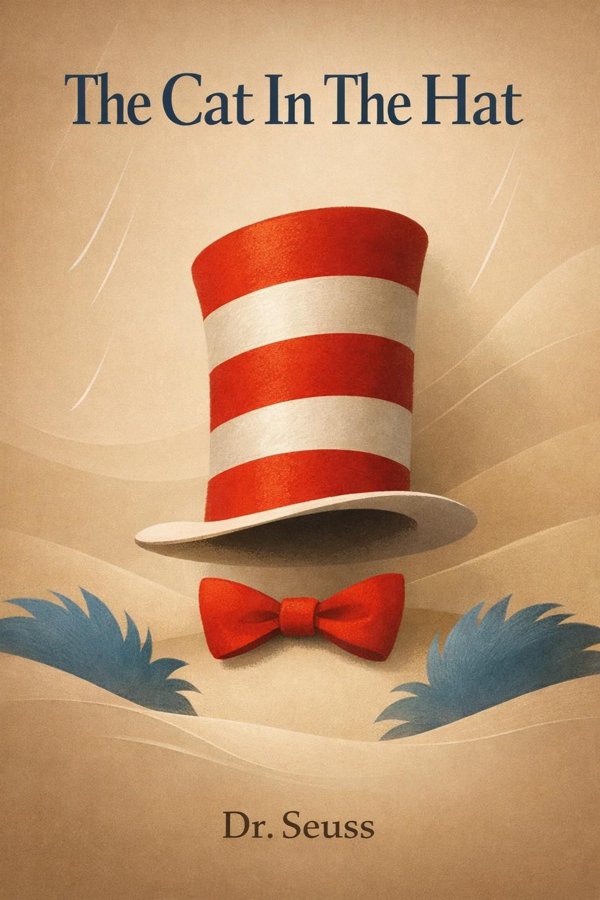
The Cat In The Hat: Summary & Key Insights
by Dr. Seuss
 10 min8 chaptersAudio available
Key Takeaways from The Cat In The Hat
Boredom is often treated like a problem to eliminate, but The Cat In The Hat suggests that boredom is also an opening.
Not every interruption is unwelcome; some disruptions reveal what routine has been hiding.
Fun becomes ethically interesting the moment someone asks, “Should we be doing this?
Trouble rarely arrives all at once; it multiplies when no one stops it early.
The real test of character often comes after the excitement ends.
What Is The Cat In The Hat About?
The Cat In The Hat by Dr. Seuss is a classics book spanning 4 pages. The Cat In The Hat is far more than a playful story about a rainy afternoon gone wildly off course. In this landmark children’s classic, Dr. Seuss introduces two bored siblings, Sally and her brother, who are stuck inside while their mother is away. Into their quiet, rule-bound day bursts the Cat in the Hat: confident, comic, and delightfully disruptive. What follows is a chain of escalating antics involving balancing tricks, household chaos, and the unforgettable arrival of Thing One and Thing Two. What makes the book matter is not only its charm, but its cultural impact. Published in 1957, The Cat In The Hat helped reshape early reading by proving that beginner books could be imaginative, rhythmic, and genuinely entertaining. Dr. Seuss wrote the story using a tightly controlled vocabulary, showing that simple words did not have to produce dull stories. The result was a revolution in children’s literature: a book that teaches reading through momentum, sound, surprise, and fun. Dr. Seuss brought rare authority to this mission. As both writer and illustrator, he understood how language, image, and rhythm could work together to capture a child’s attention. The Cat In The Hat remains a classic because it speaks to timeless questions: How far should fun go? What happens when order breaks down? And can imagination and responsibility coexist?
This FizzRead summary covers all 8 key chapters of The Cat In The Hat in approximately 10 minutes, distilling the most important ideas, arguments, and takeaways from Dr. Seuss's work. Also available as an audio summary and Key Quotes Podcast.
The Cat In The Hat
The Cat In The Hat is far more than a playful story about a rainy afternoon gone wildly off course. In this landmark children’s classic, Dr. Seuss introduces two bored siblings, Sally and her brother, who are stuck inside while their mother is away. Into their quiet, rule-bound day bursts the Cat in the Hat: confident, comic, and delightfully disruptive. What follows is a chain of escalating antics involving balancing tricks, household chaos, and the unforgettable arrival of Thing One and Thing Two.
What makes the book matter is not only its charm, but its cultural impact. Published in 1957, The Cat In The Hat helped reshape early reading by proving that beginner books could be imaginative, rhythmic, and genuinely entertaining. Dr. Seuss wrote the story using a tightly controlled vocabulary, showing that simple words did not have to produce dull stories. The result was a revolution in children’s literature: a book that teaches reading through momentum, sound, surprise, and fun.
Dr. Seuss brought rare authority to this mission. As both writer and illustrator, he understood how language, image, and rhythm could work together to capture a child’s attention. The Cat In The Hat remains a classic because it speaks to timeless questions: How far should fun go? What happens when order breaks down? And can imagination and responsibility coexist?
Who Should Read The Cat In The Hat?
This book is perfect for anyone interested in classics and looking to gain actionable insights in a short read. Whether you're a student, professional, or lifelong learner, the key ideas from The Cat In The Hat by Dr. Seuss will help you think differently.
- ✓Readers who enjoy classics and want practical takeaways
- ✓Professionals looking to apply new ideas to their work and life
- ✓Anyone who wants the core insights of The Cat In The Hat in just 10 minutes
Want the full summary?
Get instant access to this book summary and 100K+ more with Fizz Moment.
Get Free SummaryAvailable on App Store • Free to download
Key Chapters
Boredom is often treated like a problem to eliminate, but The Cat In The Hat suggests that boredom is also an opening. The story begins with stillness: rain against the windows, a mother away from home, and two children with nothing to do. Sally and her brother are not in danger, not in motion, and not distracted. They are simply stuck. That plain, quiet discomfort is the exact condition that allows the Cat to enter the story with such force.
Dr. Seuss deliberately starts with a familiar domestic scene because it reflects a common childhood reality. Before the Cat appears, the world feels small and dull. The children sit and wait. This mood matters because it makes the arrival of play feel electric. The contrast between a gray afternoon and the Cat’s colorful, theatrical energy creates the book’s emotional spark.
The idea extends beyond children’s literature. In everyday life, empty moments often trigger creativity. A child invents a game on a rainy day. A parent turns a routine evening into a storytelling session. A teacher transforms a restless classroom by introducing rhythm, play, or surprise. The book reminds us that boredom is not always a dead end; it can be the start of invention.
At the same time, Dr. Seuss does not romanticize idleness for its own sake. The children’s boredom makes them vulnerable to influence. They are eager for stimulation, which means they may welcome excitement without considering consequences. That tension gives the story depth. Imagination is powerful, but the source and direction of that imagination matter.
A practical lesson emerges here: instead of rushing to fill every quiet moment, use boredom as a creative prompt. Ask what game, idea, drawing, or conversation could emerge from the pause. The actionable takeaway is simple: when routine feels flat, do not just escape it—turn it into the starting point for imaginative engagement.
Not every interruption is unwelcome; some disruptions reveal what routine has been hiding. The Cat in the Hat arrives uninvited, but he also arrives with energy, confidence, and a refusal to accept boredom as inevitable. He does not gently suggest entertainment. He declares that he knows how to make a rainy day fun, positioning himself as the opposite of passivity.
This makes the Cat one of children’s literature’s great trickster figures. He challenges the idea that a house must remain quiet, controlled, and predictable in order to be good. His red-and-white striped hat, oversized smile, and theatrical entrance signal that he belongs to a world of spectacle. He is not realistic; he is transformational. The moment he steps into the room, the emotional climate changes.
Yet the Cat’s disruption is complicated. He is charming, but he ignores boundaries. He means to entertain, but he also assumes the right to take over someone else’s space. That duality is central to the book’s enduring appeal. The Cat represents the intoxicating side of freedom: spontaneity, confidence, and the thrill of saying yes to something unexpected. But he also represents the risk that comes when fun is detached from responsibility.
In practical life, we meet “Cats” in many forms: a bold teacher who revives a stale lesson, a friend who introduces a new adventure, or a creative idea that breaks a routine. Disruption can refresh a tired system. But not every disruption is wise, and not every entertaining force is trustworthy. The challenge is learning to distinguish between enlivening change and reckless intrusion.
Dr. Seuss captures this tension without flattening the Cat into either hero or villain. He is both liberator and troublemaker. That complexity invites readers to think rather than simply obey. The actionable takeaway: welcome healthy disruption when life feels stagnant, but always ask whether the excitement you are embracing respects people, spaces, and consequences.
Fun becomes ethically interesting the moment someone asks, “Should we be doing this?” In The Cat In The Hat, that question is voiced most clearly by the fish, who functions as the book’s conscience. While the Cat performs balancing tricks and converts the living room into a stage, the fish repeatedly warns that the children’s mother is away and that the Cat should not be in the house. This creates one of the story’s most important dynamics: delight versus caution.
The Cat’s games are not malicious in intent. He wants to amaze, entertain, and overpower boredom. But his version of play quickly strains the limits of safety and order. Books, cups, furniture, and household objects are swept into performance. The children watch with fascination because the Cat embodies possibility. The fish watches with alarm because he sees consequences.
This contrast matters because childhood often involves learning that enjoyment and judgment must coexist. A game can be exciting and still go too far. A joke can be funny and still create harm. A risk can feel thrilling and still violate trust. The fish is not merely annoying or overly strict; he represents the part of moral development that asks children to think ahead.
In families and classrooms, this tension appears constantly. One child wants to turn cushions into a fort. Another worries the room will be ruined. A group activity becomes louder and wilder until someone has to ask whether fun is turning into disorder. The story gives readers a vivid, memorable version of that everyday conflict.
What makes the book effective is that it does not remove the appeal of chaos. It allows readers to feel why the Cat is tempting. That honesty makes the fish’s warnings more meaningful. The actionable takeaway is to build a habit of pairing excitement with reflection: when something seems fun, pause long enough to ask what could go wrong, who might be affected, and where the line should be drawn.
Trouble rarely arrives all at once; it multiplies when no one stops it early. That is the role of Thing One and Thing Two in The Cat In The Hat. If the Cat’s antics introduce disorder, the Things transform it into full-scale chaos. Released from the box by the Cat, they do not simply entertain. They race, fly kites indoors, tear through the house, and turn manageable mess into uncontrollable mayhem.
Their design is part of their brilliance. They are nearly identical, energetic, and difficult to distinguish as individuals. This makes them feel less like characters with inner motives and more like pure unleashed impulse. They are playful force without restraint. In that sense, they symbolize what happens when excitement is detached from supervision. What begins as a funny visit becomes a situation spiraling beyond anyone’s easy control.
This is a familiar pattern in real life. A relaxed afternoon activity becomes too rough. A small joke turns into a disruption because others join in. A digital distraction meant to last five minutes becomes an hour of scrolling or gaming. The Things embody escalation: once momentum takes over, stopping becomes much harder than starting.
The children’s response is important too. They are no longer merely watching. The narrative pressure increases because the consequences are becoming impossible to ignore. The fish’s concerns now seem justified. The story shows that permissiveness often feels harmless at first, but unchecked behavior can overwhelm good intentions very quickly.
Parents, teachers, and children can all apply this lesson. Setting limits early is easier than restoring order later. Catch the moment when playful energy is tipping into damage. If a room is getting too wild, redirect before it becomes destructive. If a group is getting rowdy, pause before momentum takes over. The actionable takeaway: pay attention to escalation. When a small disorder starts multiplying, step in early rather than hoping it will calm itself.
The real test of character often comes after the excitement ends. In The Cat In The Hat, the house is left in disastrous condition just before the mother’s return. This shift from playful spectacle to urgent cleanup is crucial. The story stops being about whether chaos is fun and becomes about whether damage can be faced honestly and repaired responsibly.
The Cat does not simply vanish and leave the children with the consequences. He returns with a machine and cleans the house at astonishing speed, restoring order before the mother walks in. On one level, this rescue is comic and satisfying. On another, it introduces a meaningful idea: if you create disorder, you bear some obligation to repair it.
For children, this is a vital moral lesson because much early learning involves understanding consequences in concrete ways. Toys left scattered must be picked up. Paint spilled on a table must be wiped away. A promise broken requires apology and repair. Dr. Seuss wraps this principle in whimsical action, but its ethical core is serious. Fun is not exempt from responsibility.
There is also a subtle complication here. The Cat’s cleanup seems almost too easy, as if consequences can be erased with speed and cleverness. But the emotional tension remains. The children still experienced uncertainty, and the question of whether the day’s events should be revealed remains unresolved. That lingering discomfort reminds readers that some messes are visible and some are moral.
In practical life, accountability means more than avoiding punishment. It means recognizing impact and taking action to fix what can be fixed. Children can learn this through routines: clean up after crafts, apologize after hurtful behavior, restore what was disrupted. Adults can model it too by admitting mistakes rather than hiding them. The actionable takeaway: after any mistake, ask not only “What happened?” but “How can I make this right?”
Great writing does not depend on difficult vocabulary; it depends on precision, rhythm, and imagination. One of Dr. Seuss’s greatest achievements in The Cat In The Hat is that he created a lively, memorable story using a limited set of simple words. This was not an accident. The book was designed to help beginning readers, proving that early reading material could be engaging without becoming linguistically overwhelming.
At the time, many beginner books were repetitive in ways that felt lifeless. Dr. Seuss responded by showing that constraints could fuel creativity. He used short words, recurring sounds, and strong verbal patterns to create momentum. The language bounces. It invites reading aloud. It rewards repetition without becoming stale. Children are not merely decoding words; they are participating in a performance.
This matters for literacy because confidence grows when reading feels pleasurable. A child who laughs at a rhyme or anticipates a repeated phrase is already building fluency. The illustrations support this process by giving visual cues that reinforce meaning. Text and image work together, reducing frustration while increasing engagement.
The lesson reaches beyond early readers. In communication of any kind, clarity often beats complexity. Teachers who explain ideas simply tend to be understood better. Parents who use rhythmic repetition help children remember routines. Writers who choose vivid, concrete language often create stronger effects than those who hide behind abstraction.
If you are helping a child learn to read, books like this offer a practical model. Read aloud with expression. Pause at repeated patterns. Let children predict the next rhyme. Celebrate the music of language, not just the mechanics. The actionable takeaway: whether reading, teaching, or writing, aim for language that is simple enough to enter easily and vivid enough to stay in the mind.
Children are often told to obey, but The Cat In The Hat asks a more interesting question: what makes rule-breaking feel exciting in the first place? The Cat does not appeal to cruelty or malice. He appeals to curiosity, novelty, and the thrill of crossing boundaries. That is why the story resonates so strongly. It understands that rebellion, especially in childhood, often feels like play before it feels like wrongdoing.
The children are not hardened rule-breakers. They are hesitant observers drawn into a situation that becomes increasingly difficult to control. Their moral uncertainty mirrors real childhood experiences. A child may know a parent would disapprove and still feel tempted by the fun of trying something unusual. The line between harmless rebellion and genuine irresponsibility is not always obvious in the moment.
Dr. Seuss captures this ambiguity without turning the story into a lecture. He does not deny the appeal of breaking routine. Instead, he lets readers experience its seduction while gradually exposing the costs. That structure is psychologically astute. Children do not learn well from stories that pretend temptation does not exist. They learn from stories that acknowledge temptation honestly and then show its consequences.
This insight is useful for adults too. Instead of framing every boundary issue as simple defiance, parents and educators can ask what need lies underneath. Is the child seeking stimulation, agency, attention, or novelty? Often, constructive alternatives can satisfy that desire without causing harm. A supervised indoor game may work better than repeated scolding. A creative challenge may channel restless energy more effectively than punishment alone.
The actionable takeaway is to respond to rebellious energy with curiosity as well as limits. Ask what exciting need is trying to express itself, then create safer ways for that energy to be explored without ignoring the importance of rules.
Some of the best children’s books do not end with a neat answer; they end with a question that lingers. The Cat In The Hat closes after the house has been cleaned and the mother returns. On the surface, all visible evidence of chaos has disappeared. Yet the narrator asks a striking final question: what would you do if your mother asked you what happened that day? This ending transforms the story from simple adventure into moral reflection.
That final question matters because it shifts responsibility back to the reader. The book does not tell us exactly how to judge the day. Was it harmless fun because no lasting damage remained? Was it wrong because the children allowed disorder while unsupervised? Is concealing the event acceptable if everything is restored? Dr. Seuss refuses to settle the matter completely.
This open-endedness is part of the book’s sophistication. It invites conversation about honesty, secrecy, consequences, and intent. Children can discuss whether cleaning up removes the need to tell the truth. Adults can explore the difference between avoiding trouble and acting with integrity. The story becomes a springboard for ethical thinking rather than a fixed lesson.
In classrooms, this makes the book especially valuable. Teachers can ask students to defend different responses. At home, parents can use the ending to discuss family expectations around truthfulness and mistakes. The unresolved question encourages children to practice moral reasoning instead of simply memorizing a rule.
Many real-life dilemmas work the same way. You fix a mistake before anyone notices. Do you still admit it? You break trust but repair the visible problem. Is silence enough? The book suggests that restoring order is important, but honesty may still matter. The actionable takeaway: when a problem is hidden but your conscience remains active, do not ask only whether you got away with it—ask what truthfulness requires.
All Chapters in The Cat In The Hat
About the Author
Dr. Seuss was the pen name of Theodor Seuss Geisel, an American author, illustrator, and cartoonist whose work transformed children’s literature. Born in 1904, he became famous for combining playful rhyme, inventive vocabulary, surreal imagery, and memorable characters in books that delighted children while often carrying deeper moral or social themes. His best-known titles include The Cat In The Hat, Green Eggs and Ham, Horton Hears a Who!, Oh, the Places You’ll Go!, and How the Grinch Stole Christmas! With The Cat In The Hat in particular, he helped revolutionize early reading by showing that beginner books could be both educational and genuinely exciting. His influence remains enormous, and his stories continue to shape how children learn to read, imagine, and think.
Get This Summary in Your Preferred Format
Read or listen to the The Cat In The Hat summary by Dr. Seuss anytime, anywhere. FizzRead offers multiple formats so you can learn on your terms — all free.
Available formats: App · Audio · PDF · EPUB — All included free with FizzRead
Download The Cat In The Hat PDF and EPUB Summary
Key Quotes from The Cat In The Hat
“Boredom is often treated like a problem to eliminate, but The Cat In The Hat suggests that boredom is also an opening.”
“Not every interruption is unwelcome; some disruptions reveal what routine has been hiding.”
“Fun becomes ethically interesting the moment someone asks, “Should we be doing this?”
“Trouble rarely arrives all at once; it multiplies when no one stops it early.”
“The real test of character often comes after the excitement ends.”
Frequently Asked Questions about The Cat In The Hat
The Cat In The Hat by Dr. Seuss is a classics book that explores key ideas across 8 chapters. The Cat In The Hat is far more than a playful story about a rainy afternoon gone wildly off course. In this landmark children’s classic, Dr. Seuss introduces two bored siblings, Sally and her brother, who are stuck inside while their mother is away. Into their quiet, rule-bound day bursts the Cat in the Hat: confident, comic, and delightfully disruptive. What follows is a chain of escalating antics involving balancing tricks, household chaos, and the unforgettable arrival of Thing One and Thing Two. What makes the book matter is not only its charm, but its cultural impact. Published in 1957, The Cat In The Hat helped reshape early reading by proving that beginner books could be imaginative, rhythmic, and genuinely entertaining. Dr. Seuss wrote the story using a tightly controlled vocabulary, showing that simple words did not have to produce dull stories. The result was a revolution in children’s literature: a book that teaches reading through momentum, sound, surprise, and fun. Dr. Seuss brought rare authority to this mission. As both writer and illustrator, he understood how language, image, and rhythm could work together to capture a child’s attention. The Cat In The Hat remains a classic because it speaks to timeless questions: How far should fun go? What happens when order breaks down? And can imagination and responsibility coexist?
More by Dr. Seuss

You Might Also Like



Browse by Category
Ready to read The Cat In The Hat?
Get the full summary and 100K+ more books with Fizz Moment.