
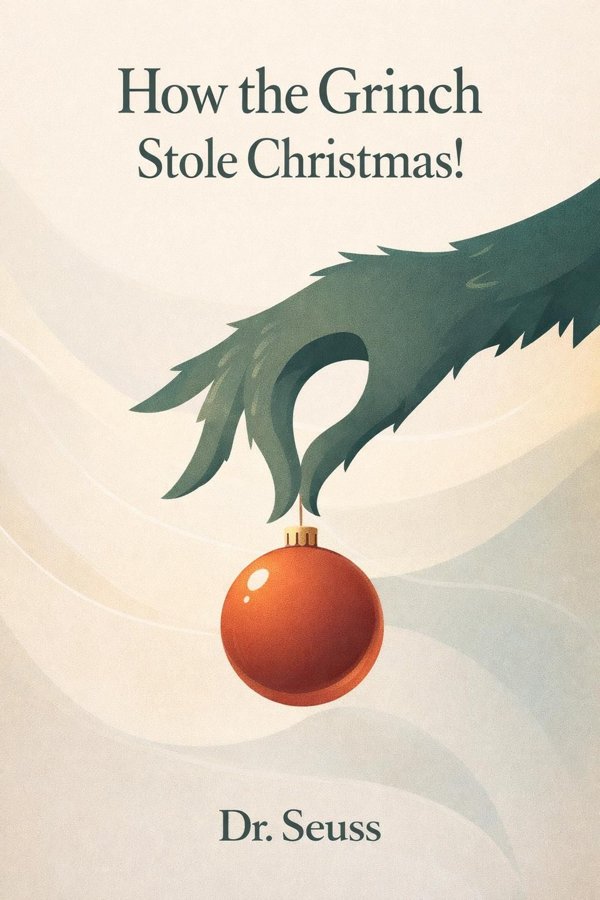
How the Grinch Stole Christmas!: Summary & Key Insights
by Dr. Seuss
 10 min8 chaptersAudio available
Key Takeaways from How the Grinch Stole Christmas!
Bitterness often grows fastest where connection is missing.
When we misunderstand what gives people joy, we often attack the symbols instead of the source.
People rarely see themselves as villains; they invent stories that make their behavior feel necessary.
A single innocent question can interrupt a hardened heart.
What matters most is often what remains after everything visible is gone.
What Is How the Grinch Stole Christmas! About?
How the Grinch Stole Christmas! by Dr. Seuss is a classics book spanning 5 pages. How the Grinch Stole Christmas! is one of those rare children’s books that feels simple on the surface yet grows richer with every rereading. In a few memorable scenes, Dr. Seuss tells the story of the Grinch, a bitter, isolated creature who cannot stand the festive happiness of Whoville and decides to stop Christmas by stealing everything the Whos have prepared for it. What follows is a funny, suspenseful, and unexpectedly moving journey from resentment to revelation. Beneath the playful rhymes and whimsical illustrations lies a timeless reflection on loneliness, envy, community, and the difference between the outer symbols of celebration and its deeper meaning. The book matters because it speaks to both children and adults: children enjoy the adventure and transformation, while adults recognize the emotional truth behind the Grinch’s anger and the Whos’ resilience. Dr. Seuss, one of the most beloved creators in children’s literature, had a gift for using musical language, imaginative characters, and moral clarity without becoming preachy. This holiday classic endures because it reminds us that joy cannot be stolen when it lives in the heart.
This FizzRead summary covers all 8 key chapters of How the Grinch Stole Christmas! in approximately 10 minutes, distilling the most important ideas, arguments, and takeaways from Dr. Seuss's work. Also available as an audio summary and Key Quotes Podcast.
How the Grinch Stole Christmas!
How the Grinch Stole Christmas! is one of those rare children’s books that feels simple on the surface yet grows richer with every rereading. In a few memorable scenes, Dr. Seuss tells the story of the Grinch, a bitter, isolated creature who cannot stand the festive happiness of Whoville and decides to stop Christmas by stealing everything the Whos have prepared for it. What follows is a funny, suspenseful, and unexpectedly moving journey from resentment to revelation. Beneath the playful rhymes and whimsical illustrations lies a timeless reflection on loneliness, envy, community, and the difference between the outer symbols of celebration and its deeper meaning. The book matters because it speaks to both children and adults: children enjoy the adventure and transformation, while adults recognize the emotional truth behind the Grinch’s anger and the Whos’ resilience. Dr. Seuss, one of the most beloved creators in children’s literature, had a gift for using musical language, imaginative characters, and moral clarity without becoming preachy. This holiday classic endures because it reminds us that joy cannot be stolen when it lives in the heart.
Who Should Read How the Grinch Stole Christmas!?
This book is perfect for anyone interested in classics and looking to gain actionable insights in a short read. Whether you're a student, professional, or lifelong learner, the key ideas from How the Grinch Stole Christmas! by Dr. Seuss will help you think differently.
- ✓Readers who enjoy classics and want practical takeaways
- ✓Professionals looking to apply new ideas to their work and life
- ✓Anyone who wants the core insights of How the Grinch Stole Christmas! in just 10 minutes
Want the full summary?
Get instant access to this book summary and 100K+ more with Fizz Moment.
Get Free SummaryAvailable on App Store • Free to download
Key Chapters
Bitterness often grows fastest where connection is missing. At the beginning of How the Grinch Stole Christmas!, Dr. Seuss places the Grinch high above Whoville on Mount Crumpit, physically and emotionally removed from everyone below. His home is cold, barren, and silent except for the company of his patient dog, Max. In contrast, Whoville glows with warmth, music, laughter, decorations, and shared traditions. This sharp contrast is not just visual; it reveals the emotional divide that drives the story. The Grinch is not simply mean for the sake of being mean. He is cut off from community, and his isolation has hardened into contempt.
The Whos, meanwhile, represent the opposite condition. Their happiness comes not only from gifts or feasts but from belonging to one another. Their Christmas preparations are collective acts. They decorate together, sing together, and look forward together. The Grinch mistakes this visible joy for shallow noise and excess, but Seuss subtly suggests that what really irritates him is the reminder of what he does not have.
This idea matters beyond the page. In real life, people who seem cynical, hostile, or dismissive of others’ joy are sometimes responding to their own disconnection. A co-worker who mocks holiday enthusiasm, a neighbor who avoids celebrations, or even our own moments of irritation may point to loneliness rather than simple bad character. Recognizing that does not excuse harmful behavior, but it can deepen our understanding.
Dr. Seuss uses the mountain and the town almost like emotional landscapes: one elevated yet empty, the other humble yet full. The setup teaches readers that isolation can distort perception. The Grinch looks down on Whoville, believing he sees clearly, but his distance prevents him from understanding what gives the town life.
Actionable takeaway: When someone’s negativity seems outsized, ask what loneliness or exclusion might be behind it—and take one step toward connection, whether by reaching out, including someone, or examining your own distance from others.
When we misunderstand what gives people joy, we often attack the symbols instead of the source. The Grinch becomes convinced that Christmas is contained in the things the Whos display: presents, trees, stockings, decorations, and holiday feasts. If those objects disappear, he reasons, their celebration will collapse. From his perspective, Christmas is an inventory list. This mistaken belief leads him to design his infamous plan: sneak into Whoville on Christmas Eve, steal every visible sign of the holiday, and leave the town empty and grieving by morning.
The plan reveals several things about the Grinch. First, he is clever. He studies the Whos, thinks ahead, improvises a disguise as Santa Claus, and uses Max as a makeshift reindeer. Second, he is deeply reactive. His intelligence is not directed toward understanding others but toward sabotaging them. Third, he projects his own assumptions onto everyone else. Because he sees material things as central, he assumes the Whos do too.
This is a useful lesson in everyday life. We often make similar errors when we think success is just money, friendship is just social activity, or a meaningful holiday is just shopping. We can also misjudge other people’s motives based on our own values. A person may cherish a family meal for the togetherness, while another observer sees only expense and effort. Misreading values can lead to conflict, resentment, or dismissiveness.
The Grinch’s plan also shows how negativity can become strategic. Rather than merely complaining, he commits himself to proving that joy is fragile. Many people do something milder but similar when they try to puncture enthusiasm, dismiss traditions, or predict failure before something good begins. It is easier to tear down a celebration than to ask why it matters.
Seuss makes the plan comic, but its emotional logic is serious. The Grinch wants evidence that joy is superficial because that would justify his scorn. If Christmas can be stolen, then his bitterness has been right all along.
Actionable takeaway: Before criticizing a tradition, achievement, or relationship, ask yourself whether you understand what it truly means to the people involved—or whether you are reacting only to its outward symbols.
People rarely see themselves as villains; they invent stories that make their behavior feel necessary. One of the most fascinating parts of the Grinch’s mission is not just that he steals Christmas, but that he dresses as Santa Claus to do it. The disguise is comic and absurd, yet psychologically revealing. By putting on the costume of a giver while acting as a thief, the Grinch blurs the line between appearance and reality. He hides his intentions not only from the Whos but almost from himself.
The Santa disguise suggests that harmful actions often come wrapped in acceptable language or familiar forms. In adult life, this happens all the time. A person may call gossip “concern,” exclusion “standards,” harshness “honesty,” or selfishness “self-care.” The Grinch is performing generosity while carrying out destruction. That contradiction captures the ease with which people justify behavior when they no longer examine their motives.
Dr. Seuss also shows the Grinch as highly organized and strangely disciplined. He creates a costume, prepares his sleigh, gives Max antlers, and moves house to house with determined efficiency. This matters because harmful behavior is not always chaotic or impulsive. It can be planned, rational, and even impressive in its execution. Competence without empathy is dangerous.
At another level, the disguise reflects the Grinch’s hidden relationship to Christmas. He mocks it, but he knows its rituals intimately enough to imitate them. This is often true of resentment: we are most reactive toward things that still matter to us. Indifference does not usually produce obsession. The Grinch’s elaborate performance suggests that he is more entangled with the holiday than he admits.
For readers, this key idea is a prompt to examine where we might be masking our intentions. Are we participating with sincerity, or merely going through the motions? Are we using the language of care to conceal control or frustration? The book invites moral self-awareness without sounding heavy-handed.
Actionable takeaway: When your actions and your stated values do not match, pause and name the real motive honestly; clarity is the first step toward integrity.
A single innocent question can interrupt a hardened heart. During the Grinch’s nighttime raid on Whoville, he slips from house to house taking toys, decorations, food, and stockings with mechanical focus. The sequence is playful and suspenseful, but its emotional center arrives when little Cindy-Lou Who catches him in the act. Her presence changes the tone instantly. She is small, trusting, and without suspicion. Instead of responding with fear or accusation, she simply asks why “Santa” is taking the Christmas tree.
This scene matters because Cindy-Lou represents the moral clarity of innocence. She does not expose the Grinch through force. She confronts him with a gentle, uncomplicated expectation of goodness. Her question assumes care rather than malice, and that assumption briefly puts the Grinch in contact with a different way of being seen. For a moment, he is treated as if he were kind. He improvises an excuse, sends her back to bed, and continues stealing—but something important has happened. The machinery of his cruelty has been interrupted by human trust.
In real life, moments like this often carry unusual power. A child asking a direct question, a friend expressing confidence in our better nature, or a stranger offering unguarded kindness can expose the gap between how we are acting and who we might still become. Not everyone changes instantly, of course, but such encounters can lodge in the conscience.
The scene also highlights the vulnerability of goodness. Cindy-Lou is not naïve in a foolish sense; she reflects a world in which trust is still possible. The Grinch could have responded much more harshly, but Seuss allows the moment to remain tender. That tenderness helps preserve the story’s faith in redemption. The Grinch is still doing wrong, yet the world he is trying to spoil remains morally luminous.
For parents, teachers, and readers, Cindy-Lou’s role is a reminder that gentleness is not weakness. It can reveal truth more effectively than confrontation. Her brief appearance anchors the emotional stakes of the entire story.
Actionable takeaway: Do not underestimate the power of simple, sincere questions; sometimes calm innocence exposes wrongdoing more effectively than anger does.
What matters most is often what remains after everything visible is gone. The Grinch believes that by stealing the Whos’ gifts, feast, tree, ornaments, and stockings, he has removed Christmas itself. He expects sorrow, outrage, and silence at dawn. Instead, when morning comes, the Whos gather and sing. Their joy survives the loss of every object he thought was essential. This is the turning point of the book, and it carries its most enduring insight: celebration is deeper than consumption.
Dr. Seuss does not deny the charm of material traditions. The presents and decorations are part of the world’s delight. But he insists they are not the foundation. Christmas “means a little bit more,” as the Grinch realizes, than things that can be bought, wrapped, displayed, or taken away. The Whos’ song proves that meaning lives in shared spirit, gratitude, memory, and belonging.
This lesson remains strikingly relevant. Modern holidays can easily become stressful performances centered on spending, comparison, and appearance. Families may feel pressure to buy more, decorate better, host perfectly, or create ideal memories. The story gently dismantles that pressure. A meaningful celebration can survive a modest budget, a disrupted plan, or an imperfect gathering if love and togetherness remain intact.
This idea applies beyond Christmas too. Birthdays, weddings, graduations, and even ordinary meals can become overburdened by symbols and logistics. We may think the event is ruined if a cake collapses, a gift is late, or decorations are sparse. Seuss reminds us that the core experience lies elsewhere: in people choosing to be present with one another.
The Whos’ response is also radical because they do not need to deny the loss in order to sing. Their joy is not dependent on pretending nothing happened. It is rooted in something stronger than circumstances. That is one reason the story continues to speak to readers facing financial strain, grief, or disappointment during the holidays.
Actionable takeaway: When planning a celebration, identify one non-material element you want to protect most—such as singing together, sharing stories, or eating as a family—and make that the true center of the day.
Real transformation often begins when a false belief collapses. The Grinch waits on Mount Crumpit for the Whos’ devastated reaction, certain he has finally proved his point. Instead, he hears singing rise from Whoville. That sound forces him to confront the fact that he has misunderstood Christmas and, by extension, the people he despised. In one of literature’s most memorable images, his heart grows three sizes. The phrase is whimsical, but it captures a profound inner change: his capacity for empathy, joy, and participation suddenly expands.
The heart-growth image is powerful because it turns emotional development into something vivid and bodily. The Grinch does not merely revise an opinion; he becomes larger inside. His world was previously narrowed by resentment. Now it opens. He recognizes that there is a kind of happiness not based on possession. This revelation frees him from the defensive logic that governed his actions.
In everyday life, people often change not through lectures but through disconfirming experiences. Someone who believes a group is shallow may encounter unexpected generosity. A person convinced that vulnerability leads only to pain may experience sincere care. A cynic may witness resilience that cannot be explained away. Such moments can be unsettling because they threaten an identity built on superiority or distrust. Yet they also create the possibility of growth.
The Grinch’s transformation is sudden because it is a fable, but Seuss still communicates an important truth: insight can arrive in a flash after a long season of hardness. Change may be prepared invisibly by many frustrations, observations, and inner tensions before it becomes visible. The Grinch has spent the whole story circling Christmas; only now does he understand it.
The image of the enlarged heart also suggests that joy is relational. His change is not complete until it moves him back toward others. Emotion that never becomes action remains incomplete. The revelation matters because it leads him down the mountain, not just into private reflection.
Actionable takeaway: When reality contradicts a negative belief you hold, resist the urge to dismiss it; let the contradiction teach you something that could enlarge your perspective.
Redemption becomes real when it repairs what was damaged. After the Grinch’s inner transformation, he does not stop at feeling moved. He turns the sleigh around, saves the overloaded load from disaster, and returns to Whoville with everything he stole. Most importantly, he joins the Whos rather than remaining a distant observer. The final image of him carving the roast beast signals more than holiday participation; it marks his reentry into community.
This is a crucial moral point. Genuine change includes restitution. The Grinch has taken joy, security, and trust from the Whos, even if only briefly. His response is to restore what he can and then share in the celebration he once tried to destroy. The story does not dwell on punishment, shame, or suspicion. Instead, it emphasizes welcome and reintegration. The Whos’ ability to receive him completes the arc.
That does not mean accountability is irrelevant. Rather, Seuss suggests that the best outcome of wrongdoing is not permanent exile but transformation followed by renewed belonging. In many personal relationships, apologies matter most when paired with concrete repair. If you neglect a friendship, you rebuild it through time and attention. If you hurt a family member, you show change through behavior, not just emotion. The Grinch embodies this principle in a child-friendly way.
The communal feast also contrasts with his earlier solitude. On the mountain, he consumed his own anger. In Whoville, he shares food and song. The movement from isolation to participation completes the story’s emotional logic. We are not made whole through private insight alone but through restored bonds.
For readers, this ending offers hope without sentimentality. It says people can become different, and communities can make room for that difference. It also reminds us that welcoming someone back may be part of healing, provided there is genuine evidence of change.
Actionable takeaway: If you have wronged someone, pair your apology with one clear act of repair; if someone shows sincere change, consider what a wise form of welcome might look like.
Stories teach most effectively when they delight before they instruct. One reason How the Grinch Stole Christmas! has lasted for generations is that Dr. Seuss never delivers its moral lessons as dry commandments. Instead, he uses bouncing rhyme, invented names, comic exaggeration, and unforgettable imagery to draw readers into a world where ethical insight feels playful rather than forced. The Grinch’s sour expressions, Max’s reluctant role, the absurd Santa disguise, and the rhythmic language all make the story enjoyable even before its message fully lands.
This matters because moral imagination is often shaped by form as much as content. Children remember the Grinch’s sneaking, slithering, and scheming because the language is musical and visual. Adults remember the phrase about the heart growing three sizes because it captures a psychological truth in a whimsical metaphor. Seuss understands that imagination opens the door through which wisdom enters.
Humor also creates emotional safety. The story deals with loneliness, resentment, theft, and redemption, but it never becomes frightening or oppressive. Its comic tone allows readers to engage difficult emotions at a manageable distance. This is one of the great strengths of children’s literature: it can address serious realities in symbolic ways that invite reflection without overwhelming the reader.
The book’s style offers a practical lesson for parents, teachers, and communicators. People often resist direct moralizing, but they respond to story, image, rhythm, and character. A lesson about generosity may be forgotten if presented abstractly. The Grinch makes the same lesson memorable because he embodies the opposite first. We understand warmth more clearly after walking through his coldness.
Seuss’s playful language also encourages rereading aloud, making the book a shared social experience. That suits its message. The medium reinforces the meaning: a story about communal joy is often enjoyed communally.
Actionable takeaway: When trying to teach a value, use story, humor, and vivid imagery rather than relying only on explanation; people remember truths they can feel and picture.
All Chapters in How the Grinch Stole Christmas!
About the Author
Dr. Seuss was the pen name of Theodor Seuss Geisel, an American writer, illustrator, and one of the most influential creators in children’s literature. Born in 1904, he built a remarkable career by combining playful rhyme, imaginative worlds, and unforgettable characters with stories that were both entertaining and meaningful. His books, including The Cat in the Hat, Green Eggs and Ham, Horton Hears a Who!, and How the Grinch Stole Christmas!, helped make reading exciting and accessible for generations of children. Geisel’s work is instantly recognizable for its rhythmic language, whimsical creatures, and visual inventiveness. Although written for young readers, his stories often contain deeper themes about kindness, imagination, fairness, and community. Dr. Seuss remains a defining literary voice whose books continue to be read aloud, studied, and loved around the world.
Get This Summary in Your Preferred Format
Read or listen to the How the Grinch Stole Christmas! summary by Dr. Seuss anytime, anywhere. FizzRead offers multiple formats so you can learn on your terms — all free.
Available formats: App · Audio · PDF · EPUB — All included free with FizzRead
Download How the Grinch Stole Christmas! PDF and EPUB Summary
Key Quotes from How the Grinch Stole Christmas!
“Bitterness often grows fastest where connection is missing.”
“When we misunderstand what gives people joy, we often attack the symbols instead of the source.”
“People rarely see themselves as villains; they invent stories that make their behavior feel necessary.”
“A single innocent question can interrupt a hardened heart.”
“What matters most is often what remains after everything visible is gone.”
Frequently Asked Questions about How the Grinch Stole Christmas!
How the Grinch Stole Christmas! by Dr. Seuss is a classics book that explores key ideas across 8 chapters. How the Grinch Stole Christmas! is one of those rare children’s books that feels simple on the surface yet grows richer with every rereading. In a few memorable scenes, Dr. Seuss tells the story of the Grinch, a bitter, isolated creature who cannot stand the festive happiness of Whoville and decides to stop Christmas by stealing everything the Whos have prepared for it. What follows is a funny, suspenseful, and unexpectedly moving journey from resentment to revelation. Beneath the playful rhymes and whimsical illustrations lies a timeless reflection on loneliness, envy, community, and the difference between the outer symbols of celebration and its deeper meaning. The book matters because it speaks to both children and adults: children enjoy the adventure and transformation, while adults recognize the emotional truth behind the Grinch’s anger and the Whos’ resilience. Dr. Seuss, one of the most beloved creators in children’s literature, had a gift for using musical language, imaginative characters, and moral clarity without becoming preachy. This holiday classic endures because it reminds us that joy cannot be stolen when it lives in the heart.
More by Dr. Seuss


You Might Also Like






Browse by Category
Ready to read How the Grinch Stole Christmas!?
Get the full summary and 100K+ more books with Fizz Moment.