
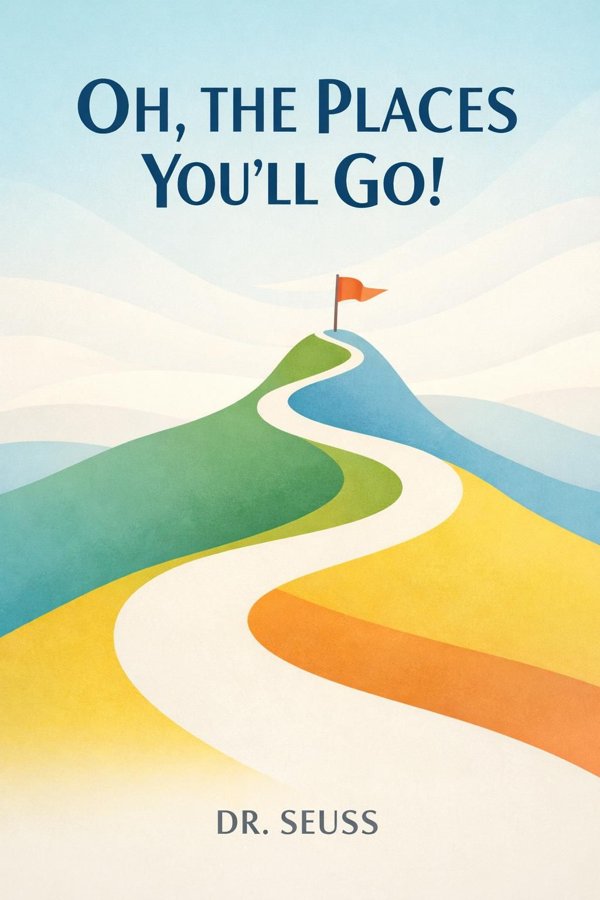
Oh, The Places You'll Go!: Summary & Key Insights
by Dr. Seuss
 10 min8 chaptersAudio available
Key Takeaways from Oh, The Places You'll Go!
Every meaningful journey begins long before the first step; it begins with the decision to believe you can move.
Freedom sounds glorious until it demands a decision.
Victory can be as disorienting as struggle if you mistake momentum for permanence.
Some of life’s hardest moments are not dramatic failures but quiet periods when nothing seems to move.
Courage is not the absence of fear; it is the refusal to let fear narrate your entire life.
What Is Oh, The Places You'll Go! About?
Oh, The Places You'll Go! by Dr. Seuss is a classics book spanning 6 pages. Oh, The Places You'll Go! is one of Dr. Seuss’s most beloved works because it speaks to a truth that never gets old: life is an adventure filled with promise, uncertainty, setbacks, and renewal. On the surface, it is a short, playful picture book written in Seuss’s signature rhythm and nonsense-rich style. Beneath that simplicity, however, lies a surprisingly wise meditation on growing up, making choices, facing fear, and continuing forward when life feels confusing or stalled. The book addresses readers directly, turning them into the hero of the journey and making its message feel personal, immediate, and unforgettable. What makes this book matter is its rare ability to comfort and challenge at the same time. It celebrates ambition without pretending that success is easy. It acknowledges loneliness, indecision, and disappointment without surrendering to them. Dr. Seuss, born Theodor Seuss Geisel, had a unique gift for transforming big emotional truths into language children understand and adults remember for life. That is why this slim classic is read at graduations, gifted during transitions, and returned to again and again: it offers hope that feels honest.
This FizzRead summary covers all 8 key chapters of Oh, The Places You'll Go! in approximately 10 minutes, distilling the most important ideas, arguments, and takeaways from Dr. Seuss's work. Also available as an audio summary and Key Quotes Podcast.
Oh, The Places You'll Go!
Oh, The Places You'll Go! is one of Dr. Seuss’s most beloved works because it speaks to a truth that never gets old: life is an adventure filled with promise, uncertainty, setbacks, and renewal. On the surface, it is a short, playful picture book written in Seuss’s signature rhythm and nonsense-rich style. Beneath that simplicity, however, lies a surprisingly wise meditation on growing up, making choices, facing fear, and continuing forward when life feels confusing or stalled. The book addresses readers directly, turning them into the hero of the journey and making its message feel personal, immediate, and unforgettable.
What makes this book matter is its rare ability to comfort and challenge at the same time. It celebrates ambition without pretending that success is easy. It acknowledges loneliness, indecision, and disappointment without surrendering to them. Dr. Seuss, born Theodor Seuss Geisel, had a unique gift for transforming big emotional truths into language children understand and adults remember for life. That is why this slim classic is read at graduations, gifted during transitions, and returned to again and again: it offers hope that feels honest.
Who Should Read Oh, The Places You'll Go!?
This book is perfect for anyone interested in classics and looking to gain actionable insights in a short read. Whether you're a student, professional, or lifelong learner, the key ideas from Oh, The Places You'll Go! by Dr. Seuss will help you think differently.
- ✓Readers who enjoy classics and want practical takeaways
- ✓Professionals looking to apply new ideas to their work and life
- ✓Anyone who wants the core insights of Oh, The Places You'll Go! in just 10 minutes
Want the full summary?
Get instant access to this book summary and 100K+ more with Fizz Moment.
Get Free SummaryAvailable on App Store • Free to download
Key Chapters
Every meaningful journey begins long before the first step; it begins with the decision to believe you can move. In Oh, The Places You'll Go!, Dr. Seuss opens with a direct and energizing assurance: you have brains in your head and feet in your shoes, and that means you possess both the intelligence and agency to shape your path. This is not empty encouragement. It is a reminder that progress starts with self-trust, even when the destination is still unclear.
The brilliance of this opening lies in how it frames life as active rather than passive. You are not being carried along by events alone. You can steer, choose, adapt, and begin. That message matters especially at moments of transition: starting school, graduating, changing careers, moving cities, ending a relationship, or recovering after disappointment. New beginnings often feel exciting and terrifying at once. Dr. Seuss captures that energy by presenting the world as wide, whimsical, and full of possibility.
In practical terms, this idea encourages readers to stop waiting for total certainty before acting. A student choosing a major, an artist sharing work publicly, or a professional applying for a new role may not know exactly what will happen. But confidence does not require perfect foresight. It requires a willingness to begin with what you already have.
The deeper lesson is that identity grows through motion. You do not discover who you are only by thinking; you discover it by going, trying, stumbling, and learning. Action reveals character.
Actionable takeaway: When facing a new chapter, write down one reason you are capable and one small step you can take today. Confidence grows faster when it is paired with movement.
Freedom sounds glorious until it demands a decision. One of the most enduring insights in Oh, The Places You'll Go! is that life’s roads are not clearly labeled, and the power to choose can feel as heavy as it feels exciting. Dr. Seuss shows that sooner or later, every traveler faces forks in the road, strange streets, and uncertain directions. The challenge is not merely finding a path. It is accepting responsibility for choosing one.
This is where the book becomes quietly profound. Many people assume that difficulty comes only from obstacles, but often the harder struggle comes from indecision. Should you stay or leave? Follow security or passion? Speak up or remain silent? Delay or commit? The book suggests that confusion is not a sign of failure; it is part of the human experience of navigating possibility.
In daily life, this lesson appears everywhere. A recent graduate may wonder whether to pursue further education or start working. A manager may need to decide between a safer strategy and a bold innovation. A parent may question which values to prioritize when raising a child. In each case, there is rarely a perfect answer. Waiting for flawless certainty can become its own trap.
Dr. Seuss does not promise that every choice will be correct. Instead, he emphasizes that agency matters more than perfection. Wrong turns, delays, and revisions are built into the journey. What matters is the courage to engage with uncertainty rather than freeze before it.
The emotional wisdom here is subtle but powerful: choosing is part of becoming. Every decision teaches you something about your priorities, your fears, and your resilience. Even an imperfect path can become meaningful if walked with attention and honesty.
Actionable takeaway: When stuck between options, identify the choice that aligns most closely with your values, not just your fears. Then commit to one next step instead of endlessly rehearsing every possible outcome.
Victory can be as disorienting as struggle if you mistake momentum for permanence. In its celebratory passages, Oh, The Places You'll Go! recognizes the thrill of winning, soaring, and moving ahead with confidence. Dr. Seuss acknowledges that there will be moments when things click: you will succeed, rise, stand out, and feel the exhilarating lift of progress. These are the highs that make effort feel worthwhile.
Yet the book’s wisdom lies in how it treats success not as the endpoint, but as one phase in a much larger journey. Triumph is real, but it is not final. Achievements can boost confidence, open doors, and create energy, but they can also tempt people into overconfidence, complacency, or the illusion that life now follows a straight upward line.
This lesson applies broadly. A student who excels in one academic year may assume future performance will come easily. An entrepreneur whose first product succeeds may neglect careful planning. A person who has recently improved their health or relationships may believe old habits can never return. Success is valuable, but only if paired with humility and continued attention.
Dr. Seuss’s playful tone keeps this insight from feeling severe. He invites readers to enjoy their victories fully while remembering that life remains dynamic. The point is not to distrust happiness, but to hold it wisely. Celebrate progress, yes, but do not build your identity entirely around applause or favorable circumstances.
The healthiest version of success strengthens gratitude, not ego. It reminds you what is possible while preparing you for future challenges. In this way, the highs become training grounds, not resting places.
Actionable takeaway: When something goes well, pause to celebrate it and then ask: what habits, help, and mindset made this possible? Preserve those foundations instead of assuming success will automatically continue.
Some of life’s hardest moments are not dramatic failures but quiet periods when nothing seems to move. One of the most memorable sections of Oh, The Places You'll Go! is the description of the “Waiting Place,” where people wait for trains, opportunities, answers, calls, weather, luck, or rescue. Dr. Seuss captures a universal emotional state: stagnation. It is the feeling of being suspended between intention and action, hope and outcome.
What makes this idea so powerful is its honesty. Many inspirational stories focus on ambition and victory, but few speak so directly about the long, dull stretches in between. Waiting can become its own form of suffering because it creates the illusion that life is happening elsewhere, to other people, while you remain paused. You may be waiting for confidence before applying, for perfect timing before creating, or for someone else’s approval before beginning.
In real life, the Waiting Place appears when a job search drags on, when a creative project stalls, when grief clouds motivation, or when uncertainty makes every option feel risky. It can also show up internally, when someone is outwardly busy but inwardly avoiding a necessary decision.
Dr. Seuss does not romanticize this state. He presents it as dreary, limiting, and emotionally numbing. The implicit message is clear: waiting may sometimes be unavoidable, but living in permanent postponement is dangerous. Growth requires re-entry into motion.
The crucial distinction is between strategic patience and passive delay. Some things truly do need time. But if waiting has become a habit, then it is likely fear in disguise.
Actionable takeaway: Identify one area where you have been “waiting” for the right moment. Replace passive hope with a concrete action: send the email, make the appointment, draft the page, start the conversation, or set the deadline.
Courage is not the absence of fear; it is the refusal to let fear narrate your entire life. Oh, The Places You'll Go! stands out because it does not present the journey as endlessly cheerful. Dr. Seuss acknowledges that there will be frightening places, lonely stretches, and moments when the world feels strange or overwhelming. This honesty is one reason the book resonates so deeply across ages. It understands that growing up means encountering emotional weather you cannot fully control.
Fear often arrives when plans collapse, relationships shift, or identity feels uncertain. Loneliness can emerge even in crowded places when you feel misunderstood or out of step with others. Confusion appears when old beliefs no longer fit and new ones have not yet formed. The book gives readers permission to recognize these states without concluding that they are broken.
This insight has practical force. A young adult leaving home may feel both liberated and isolated. Someone changing careers may feel embarrassed by not knowing what comes next. A child facing a new school may struggle with social uncertainty. In each case, the emotional challenge is not simply external difficulty, but the internal interpretation of that difficulty. Fear says, “You cannot handle this.” The book replies, gently but firmly, that difficult feelings are part of the journey, not evidence that the journey should end.
Dr. Seuss offers no formula for eliminating discomfort. Instead, he normalizes it and positions it within a larger movement of life. That reframing matters. When fear becomes expected, it becomes less paralyzing.
Actionable takeaway: The next time you feel overwhelmed, name the feeling precisely—fear, loneliness, uncertainty, shame—then ask what one supportive action you need most. Clarity reduces emotional fog, and small acts of care help restore direction.
What defines a life is not whether you avoid setbacks, but whether you know how to rise after them. In one of its most enduring promises, Oh, The Places You'll Go! assures readers that, despite bang-ups and hang-ups, they can get through. This is the heart of the book’s resilience message. Dr. Seuss does not deny failure, embarrassment, or hardship. He simply refuses to grant them the final word.
Resilience here is not loud heroism. It is the everyday strength to begin again after disappointment. It is what helps a student recover from a poor exam, a writer continue after rejection, a family rebuild after loss, or a person return to hope after a season of confusion. Importantly, resilience is not identical to toughness. Toughness suppresses pain; resilience acknowledges pain and keeps moving anyway.
The book also highlights self-reliance, but not in a cold or isolating sense. Rather, it suggests that there are moments when no one can choose, persist, or recover for you. Encouragement from others matters, but ultimately you must engage your own will. That is a demanding truth, yet also an empowering one. It means you are not helpless before difficulty.
In practical life, resilience grows through repeated practice: reflecting instead of quitting, adjusting instead of collapsing, learning instead of self-condemning. A setback can become a teacher if you resist the urge to interpret it as an identity verdict.
Dr. Seuss’s optimism works because it is earned through realism. He has already shown the hard parts. So when he says you can move mountains, the statement feels motivational rather than naïve.
Actionable takeaway: After your next setback, ask three questions: What happened? What did it teach me? What is my next attempt? Turning failure into process is one of the strongest forms of resilience.
One of the book’s boldest claims is that personal responsibility remains meaningful even in an unpredictable world. Oh, The Places You'll Go! repeatedly returns to the idea that you are the one who will decide where to go next. This message does not deny luck, social realities, or external hardship. Rather, it insists that within those conditions, your choices still matter.
That idea is deeply liberating because it shifts attention away from total control—which no one has—and toward practical agency—which everyone can cultivate. You cannot control every event, opinion, delay, loss, or opportunity. But you can control your response, your effort, your integrity, and your willingness to act.
This principle applies in ordinary ways every day. You may not control whether an employer replies, but you control whether you prepare thoughtfully. You may not control whether a friendship changes, but you control how honestly and kindly you communicate. You may not control economic conditions, but you control whether you learn new skills, manage your habits, and keep adapting.
Dr. Seuss presents this truth in a child-friendly voice, but its philosophical depth is striking. Human life is a mix of randomness and agency. Suffering often increases when we confuse the two, blaming ourselves for everything or surrendering responsibility for anything. The book offers a healthier middle path: accept uncertainty, but do not abandon initiative.
Agency also strengthens dignity. When you act, even imperfectly, you stop relating to yourself as a spectator. You become a participant in your own life.
Actionable takeaway: Make a simple two-column list: what is outside my control, and what is within it? Then direct your energy toward one controllable action today. Agency grows when attention becomes disciplined.
A truly lasting classic is one that changes meaning as the reader changes. Although Oh, The Places You'll Go! is often shelved as a children’s picture book, its emotional reach extends far beyond childhood. Dr. Seuss crafted a work that can be read by a child as an adventure, by a graduate as encouragement, by an adult as reassurance, and by an older reader as a reflective map of life’s cycles.
This multi-layered quality explains why the book is so often given at milestones. At graduation, it affirms possibility. During career change, it validates uncertainty. In times of grief or reinvention, it reminds readers that confusion and recovery are normal parts of movement. Even parents reading it aloud may hear a message meant for themselves: no one ever fully outgrows beginnings, choices, waiting, fear, success, and renewal.
Its adaptability also reveals something important about wisdom. The strongest life lessons are usually simple enough to remember but deep enough to revisit. Dr. Seuss uses rhyme, repetition, and bright imagery to embed truths that stay accessible over time. A young child may focus on the whimsical places; an adult may recognize the emotional symbolism beneath them.
In practical terms, this means the book can serve as a useful conversation starter across generations. Teachers can use it to discuss courage and decision-making. Families can use it to talk about transitions. Individuals can return to it as a compact form of perspective when life feels either exciting or unsettled.
Actionable takeaway: Revisit one meaningful book or message from an earlier stage of your life and ask what it says to you now. Often, growth is visible in how familiar words suddenly deepen.
All Chapters in Oh, The Places You'll Go!
About the Author
Dr. Seuss was the pen name of Theodor Seuss Geisel, one of the most influential children’s authors of the twentieth century. Born in 1904 in Springfield, Massachusetts, Geisel combined inventive language, rhythmic storytelling, and distinctive illustrations to create books that entertained children while conveying deeper emotional and moral truths. His most famous works include The Cat in the Hat, Green Eggs and Ham, Horton Hears a Who!, How the Grinch Stole Christmas!, and Oh, The Places You'll Go! Before becoming a literary icon, he worked in advertising and cartooning, experiences that helped shape his memorable visual style. Dr. Seuss’s books have sold millions of copies worldwide and remain cultural touchstones because they speak to readers with humor, warmth, and surprising wisdom.
Get This Summary in Your Preferred Format
Read or listen to the Oh, The Places You'll Go! summary by Dr. Seuss anytime, anywhere. FizzRead offers multiple formats so you can learn on your terms — all free.
Available formats: App · Audio · PDF · EPUB — All included free with FizzRead
Download Oh, The Places You'll Go! PDF and EPUB Summary
Key Quotes from Oh, The Places You'll Go!
“Every meaningful journey begins long before the first step; it begins with the decision to believe you can move.”
“Freedom sounds glorious until it demands a decision.”
“Victory can be as disorienting as struggle if you mistake momentum for permanence.”
“Some of life’s hardest moments are not dramatic failures but quiet periods when nothing seems to move.”
“Courage is not the absence of fear; it is the refusal to let fear narrate your entire life.”
Frequently Asked Questions about Oh, The Places You'll Go!
Oh, The Places You'll Go! by Dr. Seuss is a classics book that explores key ideas across 8 chapters. Oh, The Places You'll Go! is one of Dr. Seuss’s most beloved works because it speaks to a truth that never gets old: life is an adventure filled with promise, uncertainty, setbacks, and renewal. On the surface, it is a short, playful picture book written in Seuss’s signature rhythm and nonsense-rich style. Beneath that simplicity, however, lies a surprisingly wise meditation on growing up, making choices, facing fear, and continuing forward when life feels confusing or stalled. The book addresses readers directly, turning them into the hero of the journey and making its message feel personal, immediate, and unforgettable. What makes this book matter is its rare ability to comfort and challenge at the same time. It celebrates ambition without pretending that success is easy. It acknowledges loneliness, indecision, and disappointment without surrendering to them. Dr. Seuss, born Theodor Seuss Geisel, had a unique gift for transforming big emotional truths into language children understand and adults remember for life. That is why this slim classic is read at graduations, gifted during transitions, and returned to again and again: it offers hope that feels honest.
More by Dr. Seuss
You Might Also Like



Browse by Category
Ready to read Oh, The Places You'll Go!?
Get the full summary and 100K+ more books with Fizz Moment.