
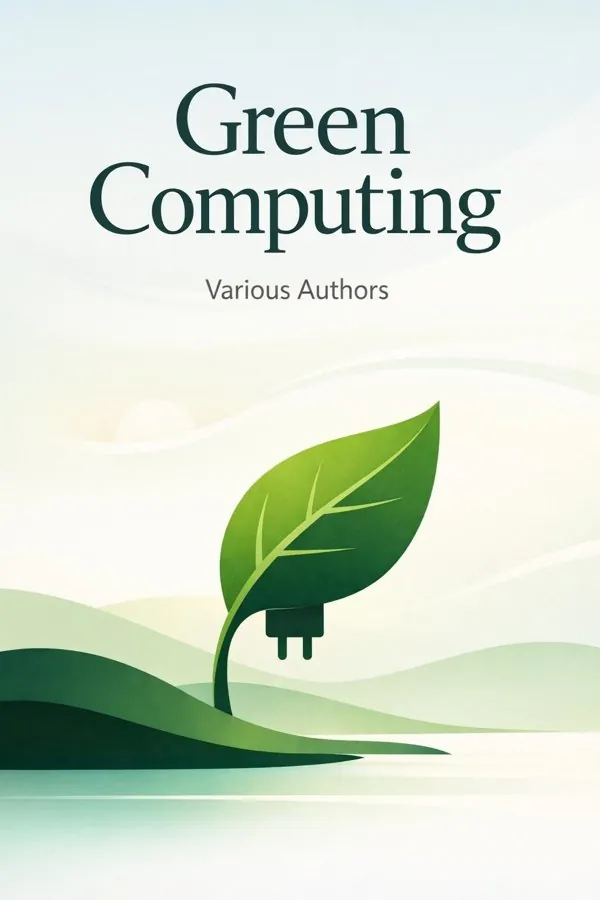
Green Computing: Summary & Key Insights
 10 min6 chaptersAudio available
What Is Green Computing About?
Green Computing by Various Authors is a environment book spanning 6 pages. Green Computing explores environmentally sustainable computing practices, focusing on energy-efficient hardware, software optimization, and responsible e-waste management. It discusses strategies for reducing the carbon footprint of IT systems and promoting eco-friendly technology development.
This FizzRead summary covers all 6 key chapters of Green Computing in approximately 10 minutes, distilling the most important ideas, arguments, and takeaways from Various Authors's work. Also available as an audio summary and Key Quotes Podcast.
Green Computing
Green Computing explores environmentally sustainable computing practices, focusing on energy-efficient hardware, software optimization, and responsible e-waste management. It discusses strategies for reducing the carbon footprint of IT systems and promoting eco-friendly technology development.
Who Should Read Green Computing?
This book is perfect for anyone interested in environment and looking to gain actionable insights in a short read. Whether you're a student, professional, or lifelong learner, the key ideas from Green Computing by Various Authors will help you think differently.
- ✓Readers who enjoy environment and want practical takeaways
- ✓Professionals looking to apply new ideas to their work and life
- ✓Anyone who wants the core insights of Green Computing in just 10 minutes
Want the full summary?
Get instant access to this book summary and 100K+ more with Fizz Moment.
Get Free SummaryAvailable on App Store • Free to download
Key Chapters
The book begins by mapping the global patterns of electricity use within information technology. Over the past decades, computing power has expanded exponentially, but so has its appetite for energy. Servers, routers, personal devices, and data storage facilities together claim several percent of the world’s total electricity output, a figure rising each year. This trend presents not just a technical challenge, but an ecological emergency.
We explore how inefficiencies arise—often invisibly—in outdated architectures, over-provisioned data centers, and software that wastes processor cycles. These inefficiencies translate directly into carbon emissions. The authors emphasize that sustainability is not only about reducing usage; it's about optimizing computation itself. Systems should be designed for intelligence, not excess, where every watt consumed yields maximum informational value.
Through documented cases, such as major IT corporations’ carbon audit results, we show how small changes in operational policy—such as adjusting cooling temperatures or utilizing server virtual machines—can yield dramatic energy savings. Sustainability begins with awareness: understanding where resources flow and where they leak. And with that awareness comes the capacity for redesign.
Readers are urged to view computing as part of a larger ecological web. Every line of code, every system configuration, exists within a chain of energy transformations. Recognizing this interconnectedness forms the moral imperative behind sustainable technology. Thus, the first major lesson is simple yet profound: technological progress divorced from environmental consideration is regression masked as advancement.
Hardware lies at the foundation of green computing. In this section, we delve into how semiconductor engineers and system architects are rallying to produce components that deliver high performance per watt rather than sheer clock speed. Low-power processors—using advanced fabrication methods, voltage scaling, and sleep-state controls—represent a revolution parallel to the move towards renewable energy.
We describe how microarchitectures have evolved specifically for energy proportionality, where components consume power relative to their workload. Multi-core processors, adaptive cooling fans, solid-state drives, and intelligent power distribution units collectively form the backbone of energy-efficient hardware.
One major focus is the transformation of data centers. Once symbols of digital progress, data centers have also been notorious for their power hunger. The authors document how facilities worldwide—Google’s, Facebook’s, and Microsoft’s among them—now strive to operate with near-zero carbon footprints. Advances in liquid cooling, modular infrastructure, and geographic placement near renewable energy sources illustrate that efficiency is not innovation’s enemy but its evolution.
The narrative presents the data center not as an isolated technical entity but as a reflection of global energy policy. Reimagined through green computing, it becomes a miniature ecosystem—balancing thermal output, electrical efficiency, and network performance. The lesson resonates across industries: hardware sustainability begins with design philosophy. Every circuit etched in silicon carries an ecological narrative, and redesigning those circuits reshapes our technological destiny.
+ 4 more chapters — available in the FizzRead app
All Chapters in Green Computing
About the Author
This volume is a collaborative work by multiple experts in computer science, environmental engineering, and information technology, each contributing research and insights into sustainable computing solutions.
Get This Summary in Your Preferred Format
Read or listen to the Green Computing summary by Various Authors anytime, anywhere. FizzRead offers multiple formats so you can learn on your terms — all free.
Available formats: App · Audio · PDF · EPUB — All included free with FizzRead
Download Green Computing PDF and EPUB Summary
Key Quotes from Green Computing
“The book begins by mapping the global patterns of electricity use within information technology.”
“Hardware lies at the foundation of green computing.”
Frequently Asked Questions about Green Computing
Green Computing by Various Authors is a environment book that explores key ideas across 6 chapters. Green Computing explores environmentally sustainable computing practices, focusing on energy-efficient hardware, software optimization, and responsible e-waste management. It discusses strategies for reducing the carbon footprint of IT systems and promoting eco-friendly technology development.
More by Various Authors




You Might Also Like

A Life on Our Planet: My Witness Statement and a Vision for the Future
David Attenborough
10 min
A Sky Full Of Birds
Matt Merritt
10 min
Carbon Zero: Imagining Cities That Can Save the Planet
Alex Steffen
10 min
Eaarth: Making a Life on a Tough New Planet
Bill McKibben
10 min
The Social Contract and Environmental Governance
Various Editors
10 min
The Wild Places
Robert Macfarlane
10 minBrowse by Category
Ready to read Green Computing?
Get the full summary and 100K+ more books with Fizz Moment.