
Gödel, Escher, Bach: An Eternal Golden Braid: Summary & Key Insights
 10 min9 chaptersAudio available
Key Takeaways from Gödel, Escher, Bach: An Eternal Golden Braid
One of the deepest shocks in intellectual history is that mathematics can speak about itself.
Sometimes a drawing can expose a truth that philosophy takes pages to describe.
Music can think in patterns long before language explains them.
What if the feeling of being a self is not a mysterious substance, but a loop?
The form of a book can embody its argument.
What Is Gödel, Escher, Bach: An Eternal Golden Braid About?
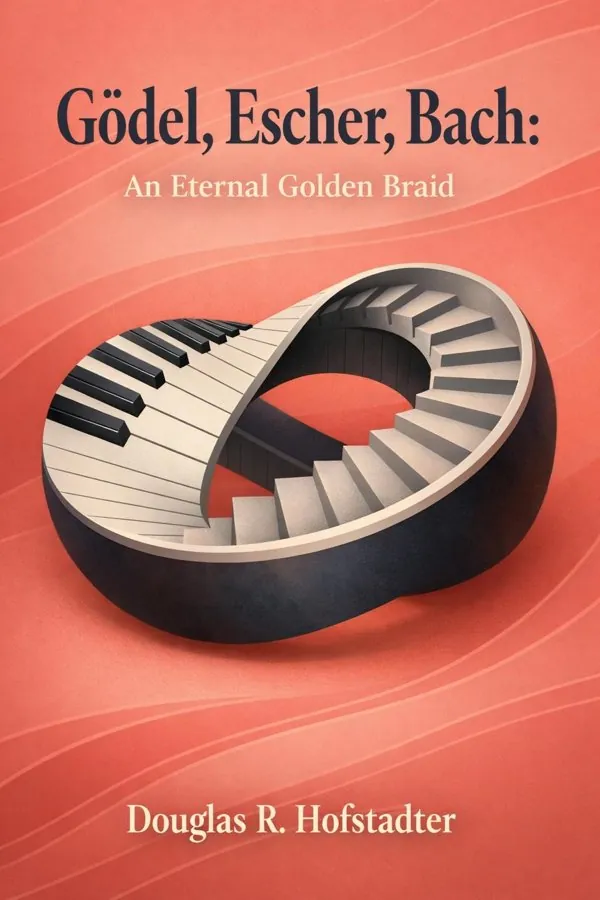
Gödel, Escher, Bach: An Eternal Golden Braid by Douglas R. Hofstadter is a cognition book spanning 5 pages. Douglas R. Hofstadter’s Gödel, Escher, Bach: An Eternal Golden Braid is one of the most ambitious books ever written about the mind. First published in 1979, it weaves together mathematics, art, music, philosophy, computer science, and cognitive psychology to ask a startling question: how can meaning, selfhood, and consciousness arise from lifeless symbols and mechanical rules? Hofstadter explores this through the work of three geniuses—logician Kurt Gödel, artist M. C. Escher, and composer Johann Sebastian Bach—showing that each, in a different medium, revealed the power of self-reference, recursion, and layered structure. What makes the book so enduring is that it does not merely explain ideas; it performs them. Through playful dialogues, paradoxes, and conceptual loops, Hofstadter invites readers to experience the strange beauty of systems that can turn back on themselves and, in doing so, generate intelligence. His authority comes from rare interdisciplinarity: he is a cognitive scientist and writer deeply versed in logic, artificial intelligence, language, and the philosophy of mind. The result is a classic that remains essential for anyone curious about how thought itself may emerge from pattern.
This FizzRead summary covers all 9 key chapters of Gödel, Escher, Bach: An Eternal Golden Braid in approximately 10 minutes, distilling the most important ideas, arguments, and takeaways from Douglas R. Hofstadter's work. Also available as an audio summary and Key Quotes Podcast.
Gödel, Escher, Bach: An Eternal Golden Braid
Douglas R. Hofstadter’s Gödel, Escher, Bach: An Eternal Golden Braid is one of the most ambitious books ever written about the mind. First published in 1979, it weaves together mathematics, art, music, philosophy, computer science, and cognitive psychology to ask a startling question: how can meaning, selfhood, and consciousness arise from lifeless symbols and mechanical rules? Hofstadter explores this through the work of three geniuses—logician Kurt Gödel, artist M. C. Escher, and composer Johann Sebastian Bach—showing that each, in a different medium, revealed the power of self-reference, recursion, and layered structure.
What makes the book so enduring is that it does not merely explain ideas; it performs them. Through playful dialogues, paradoxes, and conceptual loops, Hofstadter invites readers to experience the strange beauty of systems that can turn back on themselves and, in doing so, generate intelligence. His authority comes from rare interdisciplinarity: he is a cognitive scientist and writer deeply versed in logic, artificial intelligence, language, and the philosophy of mind. The result is a classic that remains essential for anyone curious about how thought itself may emerge from pattern.
Who Should Read Gödel, Escher, Bach: An Eternal Golden Braid?
This book is perfect for anyone interested in cognition and looking to gain actionable insights in a short read. Whether you're a student, professional, or lifelong learner, the key ideas from Gödel, Escher, Bach: An Eternal Golden Braid by Douglas R. Hofstadter will help you think differently.
- ✓Readers who enjoy cognition and want practical takeaways
- ✓Professionals looking to apply new ideas to their work and life
- ✓Anyone who wants the core insights of Gödel, Escher, Bach: An Eternal Golden Braid in just 10 minutes
Want the full summary?
Get instant access to this book summary and 100K+ more with Fizz Moment.
Get Free SummaryAvailable on App Store • Free to download
Key Chapters
One of the deepest shocks in intellectual history is that mathematics can speak about itself. Hofstadter uses Gödel’s incompleteness theorem to show that any sufficiently rich formal system contains statements that refer, indirectly but precisely, to their own unprovability. This is not just a technical result in logic; it is a demonstration that self-reference can create cracks in even the most rigorous symbolic worlds.
Gödel achieved this by assigning numbers to statements and proofs, allowing arithmetic to encode claims about arithmetic itself. The result was a sentence equivalent to “This statement is not provable within this system.” If the system proves it, it becomes inconsistent; if it cannot prove it, then the statement is true but unprovable. Hofstadter sees in this not only a theorem but a model of how higher-level meaning can emerge from lower-level rules.
In practical terms, this helps us understand why complex systems—legal codes, software, organizations, even personal belief systems—often struggle when they must evaluate their own assumptions. A company can optimize every workflow yet fail to question the framework behind those workflows. A person can be logical in daily decisions while remaining blind to the story they tell about themselves.
Hofstadter’s key insight is that intelligence begins to appear when a system can represent itself from within. To apply this idea, look for self-reference in your own thinking: ask not only “What am I doing?” but “What rules am I using to judge what I’m doing?” That second-order question is where deeper understanding begins.
Sometimes a drawing can expose a truth that philosophy takes pages to describe. Hofstadter turns to M. C. Escher because his images are visual laboratories for recursion, paradox, and level-crossing. In works like Drawing Hands, Ascending and Descending, and Waterfall, Escher creates scenes that appear coherent locally but impossible globally. Each element makes sense on its own, yet the entire structure folds back into contradiction.
These images matter because they train the mind to notice how perception constructs order. We assume that if each step seems reasonable, the whole must also be reasonable. Escher shows that this is false. A staircase can seem to rise at every segment and still return to where it began. A hand can appear to draw the very hand that draws it. In Hofstadter’s framework, these are examples of strange loops: structures in which moving upward through levels brings you unexpectedly back to the starting point.
This idea has everyday applications. In social systems, for example, individuals may follow sensible incentives that collectively produce absurd outcomes. In productivity, you may optimize tasks so aggressively that you lose sight of purpose. In online discourse, local reactions can spiral into global misinformation. Escher’s lesson is that coherence at one level does not guarantee coherence at another.
To use this insight, periodically zoom out. Whenever a process, habit, or argument seems airtight, ask whether the larger pattern is stable or merely persuasive in pieces. The actionable takeaway is simple: do not trust local logic without checking the whole structure.
Music can think in patterns long before language explains them. Hofstadter uses Johann Sebastian Bach’s fugues and canons to illustrate how repetition with transformation can create extraordinary richness from simple rules. A fugue introduces a theme, repeats it in different voices, shifts it in timing or key, and develops it through interwoven echoes. What emerges is not mere duplication but a living structure in which parts reflect, answer, and reinterpret one another.
For Hofstadter, Bach demonstrates that formal systems need not be sterile. Structure can generate beauty, surprise, and even emotional depth. A canon that mirrors itself or a fugue that folds one voice into another resembles the recursive patterns found in logic and visual paradox. The same conceptual DNA appears across different domains: a rule-bound process gives rise to something that feels expressive, unified, and meaningful.
This matters far beyond classical music. In writing, a powerful essay often returns to a central motif in new contexts. In leadership, repeated principles gain force when adapted rather than rigidly imposed. In learning, spaced repetition works because the same idea revisited from different angles becomes more durable and nuanced. Bach teaches that intelligent design often depends on variation within order, not freedom from order.
Hofstadter’s broader claim is that minds may work similarly: they replay patterns, map them onto new situations, and generate significance through structured recurrence. To apply this, identify one important idea you want to master and revisit it across multiple contexts—conversation, note-taking, teaching, and reflection. The actionable takeaway: use deliberate repetition with variation to turn information into understanding.
What if the feeling of being a self is not a mysterious substance, but a loop? Hofstadter’s most famous concept is the strange loop: a pattern in which a system ascends through layers of representation only to circle back and encounter itself. This is the bridge he builds from Gödel’s theorem, Escher’s paradoxes, and Bach’s musical recursions to the problem of consciousness.
A strange loop is more than repetition. It is hierarchical feedback that produces the illusion—or perhaps the reality—of an “I.” In the brain, countless neurons follow electrochemical rules without knowing anything. Yet at a higher symbolic level, those interactions can form stable representations: memories, concepts, goals, and eventually a model of the organism itself. When the system contains a sufficiently rich internal representation of itself, selfhood emerges. The “I” is not a separate controller but a high-level pattern generated by lower-level processes.
This idea changes how we think about identity. Instead of treating the self as fixed, we can see it as dynamic and continuously updated through language, memory, and social interaction. It also helps explain why habits shape identity: repeated actions reinforce the symbolic model you carry of who you are. Say “I am disorganized” often enough, and the loop strengthens. Practice competence, and the self-model shifts.
Hofstadter does not reduce consciousness to something trivial; he shows how something profound can emerge from complexity. The practical takeaway is to intervene at the level of representation. Change the stories, routines, and feedback loops that define you, because your sense of self is partly built from them.
The form of a book can embody its argument. Hofstadter structures Gödel, Escher, Bach through whimsical dialogues—often featuring Achilles and the Tortoise—that mirror the book’s themes of recursion, echo, inversion, and layered interpretation. These exchanges are not decorative interruptions. They train readers to think flexibly, to inhabit multiple levels of meaning at once, and to see concepts from the inside rather than merely receiving explanations.
The dialogues perform several functions. First, they dramatize abstraction, turning difficult ideas into memorable scenes. Second, they model inquiry as a conversation rather than a monologue. Third, they reveal that understanding often depends on shifting between literal and metaphorical levels. A joke can encode a theorem; a parable can clarify a technical distinction. By making structure itself meaningful, Hofstadter demonstrates unity between content and style.
This has practical implications for learning and problem-solving. People often mistake passive exposure for comprehension. But real understanding tends to emerge when ideas are questioned, reframed, argued with, and translated into different forms. Teaching someone else, staging an internal debate, or writing a dialogue between two opposing views can expose assumptions that summary notes never reveal.
In professional settings, this is equally valuable. Teams that only present polished conclusions miss the recursive process by which insight grows. Better decisions often come from structured dialogue in which participants challenge premises and test analogies. The actionable takeaway is to turn difficult ideas into conversations. If you want to master a concept, make two voices debate it until the hidden structure becomes clear.
A symbol by itself is nothing; meaning appears when a system can use it. One of Hofstadter’s central concerns is how inert marks—numbers on a page, notes in a score, signals in a brain, bits in a computer—come to stand for something. Formal systems manipulate symbols according to rules, but meaning does not reside in the symbols alone. It emerges from patterns of interpretation embedded in larger systems.
This is why Hofstadter is fascinated by the boundary between syntax and semantics. A computer can process strings without understanding them in the human sense. Yet humans also rely on rule-governed symbol manipulation all the time: language, arithmetic, and logic all involve mechanical operations. The mystery is how enough structure, connected to perception, memory, and self-modeling, can give rise to semantics. Meaning, in this view, is not magical; it is relational and layered.
This has clear modern relevance. In an age of algorithms, chatbots, search engines, and automated workflows, people constantly confuse output with understanding. A system can produce convincing results without possessing human-like comprehension. On a personal level, the same warning applies to our own lives: repeating slogans, goals, or values does not make them meaningful unless they are connected to lived context and action.
Hofstadter encourages readers to ask not just whether a system processes information, but how symbols are grounded. The actionable takeaway is to connect every important abstraction to concrete experience. If you use a term like “success,” “strategy,” or “truth,” define what it points to in practice. Meaning grows when symbols are anchored in reality.
A recurring lesson in the book is that the same system can look entirely different depending on the level from which you view it. At the lowest level, a Bach fugue is vibrations and air pressure; at another, it is notes; at another, motifs and counterpoint; at still another, emotional experience. Similarly, the brain can be described as neurons firing, circuits interacting, symbols combining, or a person thinking. None of these levels is simply false, but they are not equally useful for every question.
Hofstadter insists that higher-level patterns are real, even if they depend on lower-level mechanisms. You do not understand a chess game by listing the molecular structure of the pieces. You need the right descriptive level: strategy, position, threat, sacrifice. This insight is crucial for understanding cognition. If we ask only about neurons, we may miss the symbolic and conceptual patterns that make thought intelligible.
This perspective is highly practical. In work, many problems persist because they are attacked at the wrong level. A manager may treat a morale problem as a scheduling issue when it is really a meaning issue. A student may treat confusion as a memory failure when the real problem is conceptual structure. A person may treat burnout as lack of discipline when the issue is a broken narrative about purpose.
The actionable takeaway is to diagnose before you fix. Whenever you face a complex problem, ask: what is the most useful level of description here? Move up or down a level until the pattern becomes visible.
Human intelligence often advances not by deduction alone, but by noticing resemblance across difference. Although Gödel, Escher, Bach is famous for logic and paradox, it is equally a celebration of analogy. Hofstadter repeatedly shows that the same underlying structure can appear in mathematics, art, music, language, and mind. This is not superficial comparison; it is a claim that cognition thrives by mapping one domain onto another.
Analogy allows us to compress complexity. When we say a company is “siloed,” a memory is “stored,” or a nation is at a “crossroads,” we import structure from one domain into another. Scientific breakthroughs often arise this way: electricity described as flow, DNA as code, the brain as computation. Analogies are imperfect, but they are indispensable scaffolds for understanding. Hofstadter suggests that flexible pattern recognition may be more central to intelligence than rigid rule-following.
This matters for learning, creativity, and communication. If a concept feels impenetrable, an analogy can unlock it. If a team is stuck, borrowing a model from another field can reveal options. If you want to persuade, the right metaphor can organize confusion into insight. But analogies must be tested, not worshipped; they illuminate some features while distorting others.
A practical habit follows from this: when facing a hard problem, ask what else it is like. Compare your challenge to a game, ecosystem, traffic system, musical composition, or negotiation. Then check where the analogy breaks down. The actionable takeaway is to use analogy deliberately—as a tool for discovery, not a shortcut to certainty.
Many readers come to Hofstadter fearing that a mechanistic account of mind will strip human life of wonder. His answer is the opposite: understanding mechanism can deepen mystery rather than diminish it. Gödel, Escher, Bach argues that consciousness may arise from formal and physical processes, but this does not make it cheap or unreal. Emergence means that astonishing properties can appear when simpler elements interact in the right way.
Consider language. Individual sounds are meaningless, yet from them emerge words, syntax, poetry, argument, and identity. Consider life itself: chemistry gives rise to metabolism, adaptation, desire, and culture. Hofstadter’s point is not that humans are “just machines,” but that the distinction between mechanism and meaning is too crude. A sufficiently intricate self-referential system may generate genuine subjectivity. The miracle lies not outside structure, but within it.
This helps reconcile scientific curiosity with existential seriousness. You can study habits, attention, memory, and neural mechanisms without denying love, grief, creativity, or moral responsibility. In fact, understanding the machinery may improve how we care for those experiences. Therapy, education, interface design, and AI safety all benefit from taking structure seriously while respecting lived reality.
The actionable takeaway is to resist false oppositions. When you encounter a scientific explanation of something human, ask not “Does this reduce it away?” but “What richer appreciation becomes possible if I understand how it works?”
All Chapters in Gödel, Escher, Bach: An Eternal Golden Braid
About the Author
Douglas R. Hofstadter is an American cognitive scientist, author, and professor known for his wide-ranging work on consciousness, analogy, creativity, language, and artificial intelligence. Born in 1945, he developed a reputation for combining technical rigor with literary playfulness, drawing on mathematics, music, philosophy, psychology, and computer science. His best-known book, Gödel, Escher, Bach: An Eternal Golden Braid, won the Pulitzer Prize in 1980 and established him as one of the most original interdisciplinary thinkers of his generation. Hofstadter has also written influential books such as Metamagical Themas, Fluid Concepts and Creative Analogies, and I Am a Strange Loop. Across his work, he explores how minds create meaning, how symbols become thought, and how self-reference may help explain the mystery of consciousness.
Get This Summary in Your Preferred Format
Read or listen to the Gödel, Escher, Bach: An Eternal Golden Braid summary by Douglas R. Hofstadter anytime, anywhere. FizzRead offers multiple formats so you can learn on your terms — all free.
Available formats: App · Audio · PDF · EPUB — All included free with FizzRead
Download Gödel, Escher, Bach: An Eternal Golden Braid PDF and EPUB Summary
Key Quotes from Gödel, Escher, Bach: An Eternal Golden Braid
“One of the deepest shocks in intellectual history is that mathematics can speak about itself.”
“Sometimes a drawing can expose a truth that philosophy takes pages to describe.”
“Music can think in patterns long before language explains them.”
“What if the feeling of being a self is not a mysterious substance, but a loop?”
“The form of a book can embody its argument.”
Frequently Asked Questions about Gödel, Escher, Bach: An Eternal Golden Braid
Gödel, Escher, Bach: An Eternal Golden Braid by Douglas R. Hofstadter is a cognition book that explores key ideas across 9 chapters. Douglas R. Hofstadter’s Gödel, Escher, Bach: An Eternal Golden Braid is one of the most ambitious books ever written about the mind. First published in 1979, it weaves together mathematics, art, music, philosophy, computer science, and cognitive psychology to ask a startling question: how can meaning, selfhood, and consciousness arise from lifeless symbols and mechanical rules? Hofstadter explores this through the work of three geniuses—logician Kurt Gödel, artist M. C. Escher, and composer Johann Sebastian Bach—showing that each, in a different medium, revealed the power of self-reference, recursion, and layered structure. What makes the book so enduring is that it does not merely explain ideas; it performs them. Through playful dialogues, paradoxes, and conceptual loops, Hofstadter invites readers to experience the strange beauty of systems that can turn back on themselves and, in doing so, generate intelligence. His authority comes from rare interdisciplinarity: he is a cognitive scientist and writer deeply versed in logic, artificial intelligence, language, and the philosophy of mind. The result is a classic that remains essential for anyone curious about how thought itself may emerge from pattern.
You Might Also Like
A Field Guide to Lies: Critical Thinking in the Information Age
Daniel J. Levitin
10 min
A Theory of Cognitive Dissonance
Leon Festinger
10 min
Black-And-White Thinking: The Burden of a Binary Brain in a Complex World
Kevin Dutton
10 min
Born Liars: Why We Can’t Live Without Deceit
Ian Leslie
10 min
Collective Illusions: Conformity, Complicity, and the Science of Why We Make Bad Decisions
Todd Rose
10 min
Concrete Mathematics: A Foundation for Computer Science
Ronald L. Graham, Donald E. Knuth, Oren Patashnik
10 minBrowse by Category
Ready to read Gödel, Escher, Bach: An Eternal Golden Braid?
Get the full summary and 100K+ more books with Fizz Moment.