
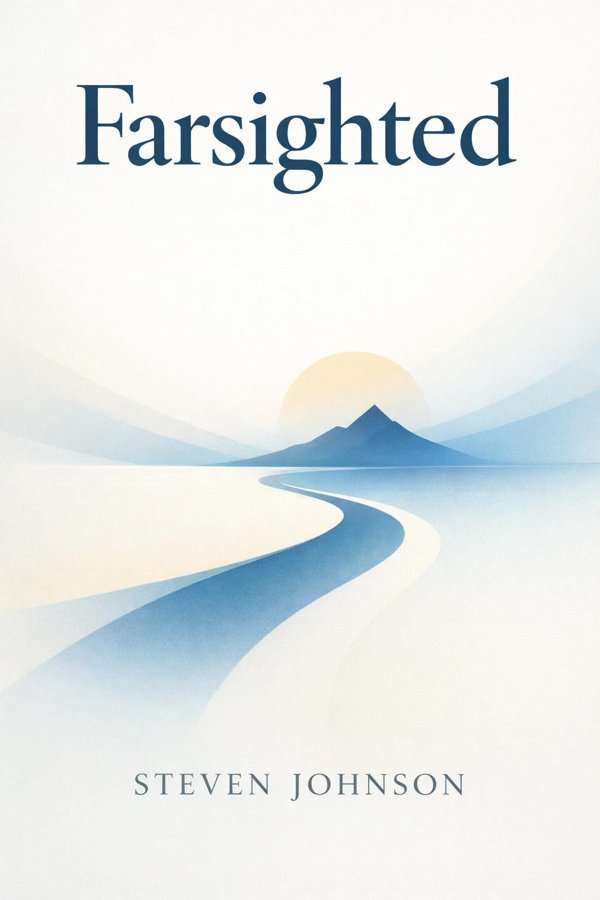
Farsighted: How We Make the Decisions That Matter the Most: Summary & Key Insights
 10 min9 chaptersAudio available
What Is Farsighted: How We Make the Decisions That Matter the Most About?
Farsighted: How We Make the Decisions That Matter the Most by Steven Johnson is a cognition book spanning 9 pages. In 'Farsighted', Steven Johnson explores the science and art of decision-making, focusing on how people and organizations can make better long-term choices. Drawing from cognitive science, psychology, and history, Johnson examines how complex decisions are made and how we can improve our foresight in uncertain situations.
This FizzRead summary covers all 9 key chapters of Farsighted: How We Make the Decisions That Matter the Most in approximately 10 minutes, distilling the most important ideas, arguments, and takeaways from Steven Johnson's work. Also available as an audio summary and Key Quotes Podcast.
Farsighted: How We Make the Decisions That Matter the Most
In 'Farsighted', Steven Johnson explores the science and art of decision-making, focusing on how people and organizations can make better long-term choices. Drawing from cognitive science, psychology, and history, Johnson examines how complex decisions are made and how we can improve our foresight in uncertain situations.
Who Should Read Farsighted: How We Make the Decisions That Matter the Most?
This book is perfect for anyone interested in cognition and looking to gain actionable insights in a short read. Whether you're a student, professional, or lifelong learner, the key ideas from Farsighted: How We Make the Decisions That Matter the Most by Steven Johnson will help you think differently.
- ✓Readers who enjoy cognition and want practical takeaways
- ✓Professionals looking to apply new ideas to their work and life
- ✓Anyone who wants the core insights of Farsighted: How We Make the Decisions That Matter the Most in just 10 minutes
Want the full summary?
Get instant access to this book summary and 100K+ more with Fizz Moment.
Get Free SummaryAvailable on App Store • Free to download
Key Chapters
Most of the decisions we make each day are simple and reversible. Choosing breakfast or what email to answer first rarely changes the arc of a life. But complex decisions — whether to start a company, declare a war, end a relationship, or move to a new city — are different in kind, not just degree. They exist at the intersection of uncertainty, long-term consequence, and multi-variable complexity.
In my exploration, I draw from cognitive science to show that these decisions strain our cognitive limits. We crave simplicity; our brains evolved to manage immediate, comprehensible problems. Yet modern life forces us to grapple with situations where the effects stretch decades ahead and involve interacting systems we can’t easily model in our minds.
Complex decisions require a broader temporal lens and a tolerance for ambiguity. They often provoke analysis paralysis precisely because the right answer cannot be known upfront. What distinguishes farsighted thinkers, therefore, is not clairvoyance, but process. They cultivate methods for exploring alternate futures, weighing probabilities, and integrating moral vision into pragmatic judgment. The art of complexity lies in resisting reduction — in learning to hold multiple, conflicting models of the world in mind while searching for coherence.
From this perspective, complexity is not the enemy of clarity; it is the terrain on which wisdom operates. Only by embracing the messiness of large-scale decisions do we begin to make sense of their patterns.
One of the most powerful — and least appreciated — tools we possess for navigating uncertainty is narrative. When we imagine the future, we don’t calculate it like an algorithm; we tell ourselves stories. This storytelling instinct allows us to simulate how choices might unfold and to empathize with perspectives different from our own.
I explore how both individuals and organizations rely on narrative simulation when facing critical junctures. Whether a novelist mapping out a plot twist, a policymaker predicting the aftermath of an intervention, or a parent guiding a child’s life, each engages in mental time travel. We step into hypothetical versions of ourselves and our worlds.
However, narrative can both illuminate and mislead. Our stories are prone to bias — they privilege vivid outcomes over probable ones, moral drama over mundane complexity. Thus, cultivating farsightedness means learning to tell better stories: imagining not just our favorite futures but those that seem awkward, risky, or morally ambiguous.
Good decision-makers use narrative simulation as a sandbox, a creative testing ground. They visualize consequences, stress-test values, and expand empathy by rehearsing futures rich with human texture. The goal is not prediction but preparation: to build a portfolio of narratives that expand the possible range of our responses.
+ 7 more chapters — available in the FizzRead app
All Chapters in Farsighted: How We Make the Decisions That Matter the Most
About the Author
Steven Johnson is an American author and media theorist known for his works on the intersection of science, technology, and personal experience. His books, including 'Where Good Ideas Come From' and 'The Ghost Map', have been bestsellers and widely acclaimed for their accessible exploration of complex ideas.
Get This Summary in Your Preferred Format
Read or listen to the Farsighted: How We Make the Decisions That Matter the Most summary by Steven Johnson anytime, anywhere. FizzRead offers multiple formats so you can learn on your terms — all free.
Available formats: App · Audio · PDF · EPUB — All included free with FizzRead
Download Farsighted: How We Make the Decisions That Matter the Most PDF and EPUB Summary
Key Quotes from Farsighted: How We Make the Decisions That Matter the Most
“Most of the decisions we make each day are simple and reversible.”
“One of the most powerful — and least appreciated — tools we possess for navigating uncertainty is narrative.”
Frequently Asked Questions about Farsighted: How We Make the Decisions That Matter the Most
Farsighted: How We Make the Decisions That Matter the Most by Steven Johnson is a cognition book that explores key ideas across 9 chapters. In 'Farsighted', Steven Johnson explores the science and art of decision-making, focusing on how people and organizations can make better long-term choices. Drawing from cognitive science, psychology, and history, Johnson examines how complex decisions are made and how we can improve our foresight in uncertain situations.
More by Steven Johnson
How We Got to Now: Six Innovations That Made the Modern World
Steven Johnson
10 min
Where Good Ideas Come From: The Natural History of Innovation
Steven Johnson
10 min
The Ghost Map: The Story of London's Most Terrifying Epidemic – and How It Changed Science, Cities, and the Modern World
Steven Johnson
10 min
The Innovator’s Cookbook: Essentials for Inventing What Is Next
Steven Johnson
10 minYou Might Also Like
A Field Guide to Lies: Critical Thinking in the Information Age
Daniel J. Levitin
10 min
A Theory of Cognitive Dissonance
Leon Festinger
10 min
Black-And-White Thinking: The Burden of a Binary Brain in a Complex World
Kevin Dutton
10 min
Born Liars: Why We Can’t Live Without Deceit
Ian Leslie
10 min
Collective Illusions: Conformity, Complicity, and the Science of Why We Make Bad Decisions
Todd Rose
10 min
Concrete Mathematics: A Foundation for Computer Science
Ronald L. Graham, Donald E. Knuth, Oren Patashnik
10 minBrowse by Category
Ready to read Farsighted: How We Make the Decisions That Matter the Most?
Get the full summary and 100K+ more books with Fizz Moment.