
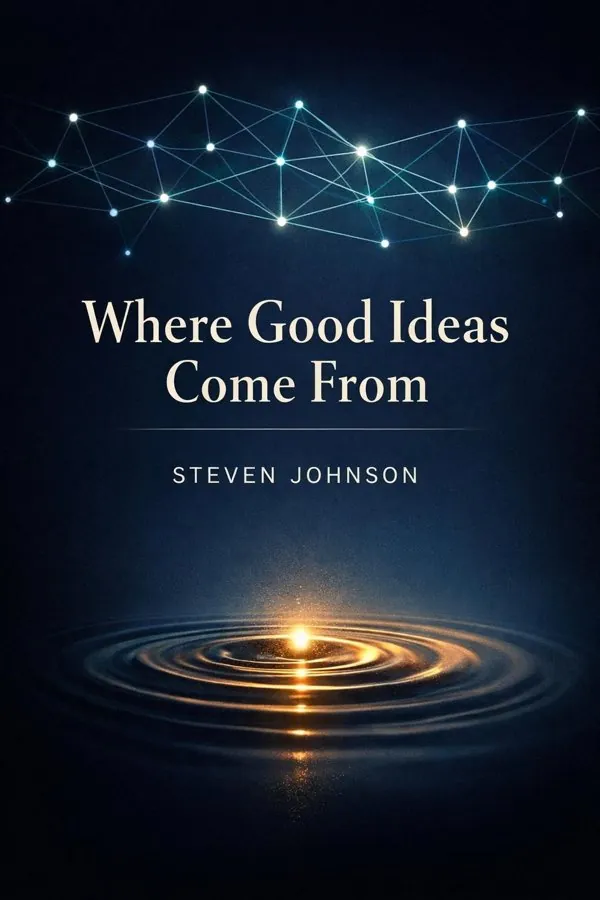
Where Good Ideas Come From: The Natural History of Innovation: Summary & Key Insights
 10 min8 chaptersAudio available
What Is Where Good Ideas Come From: The Natural History of Innovation About?
Where Good Ideas Come From: The Natural History of Innovation by Steven Johnson is a creativity book spanning 8 pages. In this book, Steven Johnson explores the origins of innovation and creativity, arguing that groundbreaking ideas emerge not from isolated 'Eureka!' moments but from environments that foster connectivity and collaboration. He identifies seven key patterns that recur throughout history and across disciplines, showing how networks, slow hunches, and shared spaces drive progress in science, technology, and culture.
This FizzRead summary covers all 8 key chapters of Where Good Ideas Come From: The Natural History of Innovation in approximately 10 minutes, distilling the most important ideas, arguments, and takeaways from Steven Johnson's work. Also available as an audio summary and Key Quotes Podcast.
Where Good Ideas Come From: The Natural History of Innovation
In this book, Steven Johnson explores the origins of innovation and creativity, arguing that groundbreaking ideas emerge not from isolated 'Eureka!' moments but from environments that foster connectivity and collaboration. He identifies seven key patterns that recur throughout history and across disciplines, showing how networks, slow hunches, and shared spaces drive progress in science, technology, and culture.
Who Should Read Where Good Ideas Come From: The Natural History of Innovation?
This book is perfect for anyone interested in creativity and looking to gain actionable insights in a short read. Whether you're a student, professional, or lifelong learner, the key ideas from Where Good Ideas Come From: The Natural History of Innovation by Steven Johnson will help you think differently.
- ✓Readers who enjoy creativity and want practical takeaways
- ✓Professionals looking to apply new ideas to their work and life
- ✓Anyone who wants the core insights of Where Good Ideas Come From: The Natural History of Innovation in just 10 minutes
Want the full summary?
Get instant access to this book summary and 100K+ more with Fizz Moment.
Get Free SummaryAvailable on App Store • Free to download
Key Chapters
Every new idea builds upon what already exists; nothing emerges from absolute void. I borrow the phrase ‘the adjacent possible’ from theoretical biologist Stuart Kauffman to describe the boundary that separates what is currently real from what could become real next. The adjacent possible is like a shadow future that hovers at the edges of the present—a map of all the ways the existing configuration of ideas and technologies could recombine to create something new.
Biology illustrates this vividly. When life first evolved on Earth, the chemical soup of early oceans contained only limited components. Yet each new biological discovery—the emergence of cell walls, photosynthesis, multicellular cooperation—expanded that adjacent possible, unlocking new pathways for further evolution. So too in human innovation: each technological or conceptual advance opens up new spaces of possibility, new combinations never before imaginable. The computer made possible not only faster calculations but also the Internet, social media, and countless emergent phenomena that were once invisible.
Understanding the adjacent possible gives us a crucial insight: innovation is incremental and combinatory. The most revolutionary ideas are often built from ordinary components rearranged in extraordinary ways. Progress therefore depends on the richness of the environment—the more diverse and well-connected the existing ideas, the more expansive the adjacent possible becomes. If you want to innovate, you need to dwell at those edges, exploring what lies next to what you already know. That is where the future hides, waiting for someone to open the next door.
When molecules move freely in a liquid, they collide, recombine, and occasionally form new structures. The same dynamics govern the birth of ideas. In a ‘liquid network’—an environment where ideas flow between individuals freely and unpredictably—innovations are more likely to occur. Contrast this with a solid state, where the elements are locked in fixed positions and the flow of information stagnates.
History offers many examples of such creative liquids. In the Enlightenment era, coffeehouses across London and Paris became bustling intellectual hubs. They replaced alcohol with caffeine and conversation with collaboration, drawing together scientists, merchants, and artists who shared information across boundaries. The modern city functions in much the same way. Urban density accelerates creative collisions: people from diverse backgrounds cross paths, exchange fragments of knowledge, and sometimes, from those collisions, new ideas crystallize.
In the digital age, our liquid networks take place online as much as in physical space. Open-source communities, collaborative research projects, and networked learning platforms all exhibit the same ecology of ideas. Innovation here is not about top-down direction but about distributed flows—an expanding swarm of minds connected by curiosity and proximity.
For you to cultivate your own liquid network, you must invite connection, not isolation. Seek interdisciplinary conversations. Expose yourself to ideas unlike your own. Great innovations depend less on solitary genius than on the fertility of the environments through which thoughts move. The lesson is simple but powerful: when we create spaces where ideas can mingle freely, creativity becomes almost inevitable.
+ 6 more chapters — available in the FizzRead app
All Chapters in Where Good Ideas Come From: The Natural History of Innovation
About the Author
Steven Johnson is an American author and media theorist known for his books on science, technology, and innovation. His works include The Ghost Map, The Invention of Air, and Everything Bad Is Good for You. He is recognized for his ability to connect complex ideas from multiple fields and make them accessible to a broad audience.
Get This Summary in Your Preferred Format
Read or listen to the Where Good Ideas Come From: The Natural History of Innovation summary by Steven Johnson anytime, anywhere. FizzRead offers multiple formats so you can learn on your terms — all free.
Available formats: App · Audio · PDF · EPUB — All included free with FizzRead
Download Where Good Ideas Come From: The Natural History of Innovation PDF and EPUB Summary
Key Quotes from Where Good Ideas Come From: The Natural History of Innovation
“Every new idea builds upon what already exists; nothing emerges from absolute void.”
“When molecules move freely in a liquid, they collide, recombine, and occasionally form new structures.”
Frequently Asked Questions about Where Good Ideas Come From: The Natural History of Innovation
Where Good Ideas Come From: The Natural History of Innovation by Steven Johnson is a creativity book that explores key ideas across 8 chapters. In this book, Steven Johnson explores the origins of innovation and creativity, arguing that groundbreaking ideas emerge not from isolated 'Eureka!' moments but from environments that foster connectivity and collaboration. He identifies seven key patterns that recur throughout history and across disciplines, showing how networks, slow hunches, and shared spaces drive progress in science, technology, and culture.
More by Steven Johnson
How We Got to Now: Six Innovations That Made the Modern World
Steven Johnson
10 min
The Ghost Map: The Story of London's Most Terrifying Epidemic – and How It Changed Science, Cities, and the Modern World
Steven Johnson
10 min
The Innovator’s Cookbook: Essentials for Inventing What Is Next
Steven Johnson
10 min
Extra Life: A Short History of Living Longer
Steven Johnson
10 minYou Might Also Like
Dimensions Of Creativity
Margaret A. Boden
10 min
How to Fly a Horse: The Secret History of Creation, Invention, and Discovery
Kevin Ashton
10 min
Imagine: How Creativity Works
Jonah Lehrer
10 min
The Accidental Creative: How to Be Brilliant at a Moment's Notice
Todd Henry
10 min
The Origins of Creativity
Edward O. Wilson
10 min
Wired to Create: Unraveling the Mysteries of the Creative Mind
Scott Barry Kaufman, Carolyn Gregoire
10 minBrowse by Category
Ready to read Where Good Ideas Come From: The Natural History of Innovation?
Get the full summary and 100K+ more books with Fizz Moment.