
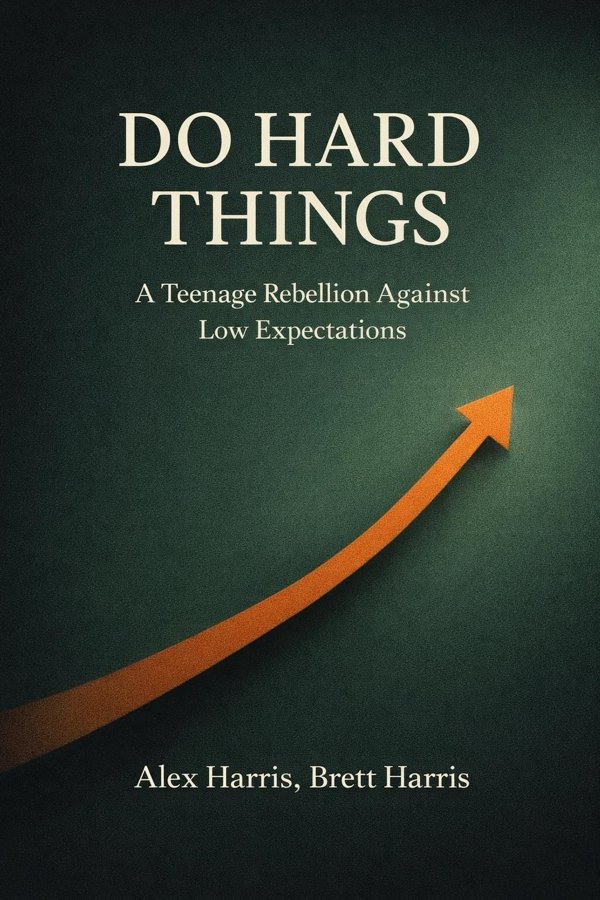
Do Hard Things: Summary & Key Insights
 10 min8 chaptersAudio available
Key Takeaways from Do Hard Things
One of the most dangerous lies in modern culture is not that teenagers are incapable, but that they should expect little from themselves.
The teenage years become powerful when they are seen not as a pause before adulthood, but as training for a meaningful life.
Not all difficulty is the same, and the authors strengthen their argument by showing that “hard things” come in different forms.
Big ideas become believable when we can see them embodied in real people.
Effort becomes more sustainable when it is tied to meaning larger than achievement.
What Is Do Hard Things About?
Do Hard Things by Steve Magness is a self-help book published in 2008 spanning 5 pages. Do Hard Things is a bold challenge to the modern idea that the teenage years are mainly for comfort, entertainment, and low responsibility. Written by Alex and Brett Harris, the book argues that young people are capable of far more than society expects from them. Instead of accepting a culture that treats adolescence as a waiting room for real life, the authors call teens to pursue meaningful work, personal discipline, leadership, and service. Their central idea, which they call the “rebelution,” is simple but powerful: rebellion against low expectations can transform both individual lives and entire communities. What makes the book matter is its refusal to flatter its audience. Rather than telling teenagers they are special just as they are, it invites them to grow by doing difficult things that stretch character and deepen purpose. The Harris brothers build their case through personal stories, testimonies from other teens, and practical encouragement grounded in Christian faith. The result is an energizing self-help book for young readers, parents, mentors, and educators who believe that maturity begins when people stop waiting for permission to live with courage and responsibility.
This FizzRead summary covers all 8 key chapters of Do Hard Things in approximately 10 minutes, distilling the most important ideas, arguments, and takeaways from Steve Magness's work. Also available as an audio summary and Key Quotes Podcast.
Do Hard Things
Do Hard Things is a bold challenge to the modern idea that the teenage years are mainly for comfort, entertainment, and low responsibility. Written by Alex and Brett Harris, the book argues that young people are capable of far more than society expects from them. Instead of accepting a culture that treats adolescence as a waiting room for real life, the authors call teens to pursue meaningful work, personal discipline, leadership, and service. Their central idea, which they call the “rebelution,” is simple but powerful: rebellion against low expectations can transform both individual lives and entire communities.
What makes the book matter is its refusal to flatter its audience. Rather than telling teenagers they are special just as they are, it invites them to grow by doing difficult things that stretch character and deepen purpose. The Harris brothers build their case through personal stories, testimonies from other teens, and practical encouragement grounded in Christian faith. The result is an energizing self-help book for young readers, parents, mentors, and educators who believe that maturity begins when people stop waiting for permission to live with courage and responsibility.
Who Should Read Do Hard Things?
This book is perfect for anyone interested in self-help and looking to gain actionable insights in a short read. Whether you're a student, professional, or lifelong learner, the key ideas from Do Hard Things by Steve Magness will help you think differently.
- ✓Readers who enjoy self-help and want practical takeaways
- ✓Professionals looking to apply new ideas to their work and life
- ✓Anyone who wants the core insights of Do Hard Things in just 10 minutes
Want the full summary?
Get instant access to this book summary and 100K+ more with Fizz Moment.
Get Free SummaryAvailable on App Store • Free to download
Key Chapters
One of the most dangerous lies in modern culture is not that teenagers are incapable, but that they should expect little from themselves. Alex and Brett Harris argue that adolescence, as we commonly understand it, is not simply a biological stage but a cultural invention shaped by low expectations. Society often treats teenagers as irresponsible, self-absorbed, and not yet ready for meaningful contribution. Over time, many young people absorb these assumptions and begin acting according to them.
The authors challenge this story by pointing out that throughout history, young people often took on serious responsibilities much earlier than they do today. In many periods and communities, teens worked, led, served, and contributed in tangible ways. The problem, then, is not age itself. The problem is the expectation that youth should be a time of passivity and triviality. Once a person believes that little is expected, little is usually attempted.
This idea matters because expectations shape identity. If a teenager is constantly told that these years are for entertainment, confusion, and mistakes, then disciplined effort can feel abnormal. But if young people are told they can create value, lead others, and develop excellence now, their behavior often rises to meet that standard.
A practical way to apply this idea is to examine the labels you accept. Do you excuse laziness, distraction, or irresponsibility by saying, “That’s just what teenagers do”? Replace that belief with a higher one. Look for one area of life where you have been settling for the minimum, whether in school, work, habits, or relationships, and raise your standard this week. The actionable takeaway: reject low expectations by identifying one limiting belief about your age and replacing it with a concrete responsibility you will begin taking seriously.
The teenage years become powerful when they are seen not as a pause before adulthood, but as training for a meaningful life. The Harris brothers insist that youth is not a free pass to drift. It is a strategic season for building habits, convictions, and courage. If these years are spent only chasing comfort, popularity, or entertainment, then a priceless opportunity is wasted. But if they are used intentionally, they can become the launching pad for lifelong maturity.
The authors reframe adolescence as a time for preparation through action. This does not mean becoming joyless or overly serious. It means understanding that growth comes through challenge, not ease. A student who learns discipline in study, honesty in relationships, and initiative in service is already becoming the kind of adult they hope to be. Character is not suddenly formed at eighteen or twenty-five. It is built through repeated choices long before then.
This message is liberating because it gives young people agency. Instead of waiting for some future version of themselves to become capable, they can start now. That could mean taking schoolwork seriously, seeking mentors, learning real-world skills, serving family members, or choosing friends who encourage growth rather than apathy. The point is not to imitate adulthood superficially, but to practice maturity where you already are.
A useful application is to create a personal definition of what you want your teen or early adult years to represent. Write down three words such as discipline, service, and courage, then choose weekly actions that align with them. The actionable takeaway: stop treating your current season as an intermission and define one meaningful goal that makes these years count.
Not all difficulty is the same, and the authors strengthen their argument by showing that “hard things” come in different forms. This matters because many people hear the phrase and imagine only dramatic accomplishments. In reality, growth often comes through ordinary but demanding acts of faithfulness. The book highlights several types of hard things, including doing what goes beyond expectations, taking on challenges that require sacrifice, standing for what is right when it is unpopular, persevering through fear or failure, and acting in ways that honor a bigger purpose.
Some hard things are public, like organizing an event, starting a project, or speaking up for a cause. Others are private, like waking up early to study, breaking a destructive habit, apologizing sincerely, or staying committed when no one is watching. The key insight is that difficulty itself is not the goal. Purposeful challenge is. Hard things should stretch your character and increase your capacity to serve.
This framework is practical because it broadens the definition of bravery. You do not need to become extraordinary overnight. A teenager caring for siblings responsibly, a student tackling a difficult subject instead of avoiding it, or a young employee showing unusual reliability at work is already practicing the book’s philosophy. The hard thing is whatever demands growth from you right now.
To apply this, make a short list of hard things in different categories: one academic, one relational, one spiritual or ethical, and one personal habit. Choose the one you have been avoiding most. Then break it into a first step small enough to begin today. The actionable takeaway: define a hard thing that matters in your real life and commit to the first uncomfortable action within the next 24 hours.
Big ideas become believable when we can see them embodied in real people. One reason Do Hard Things resonates is that it does not rely only on theory. The Harris brothers fill the book with examples of teenagers who stepped beyond the boundaries of what others expected. These stories show young people starting initiatives, helping communities, developing leadership, and choosing responsibility over passivity. Their examples make the argument concrete: ordinary teens can do meaningful things now, not later.
The power of these stories lies in how they reshape imagination. Many people do not fail because they lack ability; they fail because they cannot picture themselves living differently. When a reader sees someone their own age launching a service project, learning a difficult skill, or persevering through a challenge, possibility expands. Role models do not remove the difficulty of action, but they make courage more thinkable.
Importantly, the stories in the book are not meant to create unhealthy comparison. The lesson is not that every teenager must become highly visible or impressive. Rather, the lesson is that age is not an excuse for disengagement. Every reader has a different calling, set of gifts, and context. The examples simply prove that maturity and impact are available much earlier than culture suggests.
A practical use of this idea is to intentionally study peers or young leaders who demonstrate discipline, service, or initiative. Ask: what habits, attitudes, and decisions make them effective? Then adapt those lessons to your own life. You might also share stories within your school, family, or community to create a healthier culture of expectation. The actionable takeaway: find one real example of someone your age doing something meaningful, identify one habit behind their success, and practice that habit yourself this week.
Effort becomes more sustainable when it is tied to meaning larger than achievement. In Do Hard Things, Christian faith provides the deeper foundation for taking on challenge. The authors do not present discipline and responsibility merely as tools for success or self-improvement. They frame them as responses to God’s calling, opportunities for service, and expressions of stewardship. In that sense, doing hard things is not about building a personal brand. It is about living faithfully.
This perspective matters because ambition alone can burn out quickly. If a person pursues hard things only to impress others, gain status, or prove worth, difficulty eventually becomes crushing. But when challenge is connected to purpose, perseverance has roots. The book encourages readers to see their abilities, time, and opportunities as gifts to use well. Hard work then becomes less about ego and more about obedience, contribution, and love.
Even for readers outside a religious framework, this principle still holds: people endure difficulty better when they know why it matters. Whether grounded in faith, service, family, or moral conviction, purpose transforms struggle from pointless pain into meaningful effort. A student can study hard not only for grades but to prepare to help others. A young leader can take initiative not to be admired, but to solve real problems.
To apply this idea, ask yourself why your current hard thing matters beyond your own comfort or image. Write a one-sentence purpose statement for a challenge you are facing. For example: “I am learning discipline in order to become dependable for the people who need me.” The actionable takeaway: connect one difficult goal to a deeper purpose so your effort is fueled by meaning, not just pressure.
Character is rarely formed in one dramatic moment; it is usually built through repeated small decisions that most people overlook. The authors emphasize that doing hard things is not only about major achievements. It is also about daily discipline, consistency, and integrity. A person becomes trustworthy by doing what they said they would do. They become resilient by not quitting when the work gets boring. They become humble by accepting correction. These small acts are easy to dismiss, but they are the true workshop of maturity.
This idea is especially important for young readers living in a culture obsessed with visibility. Social media can make impact seem glamorous and public. But most growth is hidden. Getting homework done on time, keeping a commitment, controlling your words during conflict, showing up prepared, reading instead of scrolling, or helping at home without being asked are all hard things in miniature. They shape the inner life that later supports larger responsibility.
The Harris brothers’ broader message gains credibility here: if teens are capable of meaningful contribution, then they are also capable of the habits that make such contribution possible. Grand dreams without disciplined routines usually collapse. Character is the bridge between aspiration and action.
A practical approach is to identify one “small hard thing” you can practice every day for a month. It should be modest but demanding enough to require effort, such as making your bed, reviewing class notes for 20 minutes, limiting phone use during meals, or writing one thank-you message each week. The actionable takeaway: choose one daily act of discipline that feels minor but strengthens the kind of person you want to become.
Many people wait to feel ready before attempting something difficult, but readiness is often the result of action, not the prerequisite for it. Do Hard Things repeatedly pushes against the habit of waiting for confidence. The authors show that courage develops when people move forward despite discomfort, uncertainty, or fear. If you wait until a challenge feels easy, you may wait forever.
This insight helps explain why low expectations are so damaging. They encourage hesitation and passivity. A teenager who assumes they are too young, too inexperienced, or too unprepared will avoid opportunities that could develop strength. Yet when that same person volunteers, speaks up, starts a project, or tries something difficult, they begin building evidence that they can handle more than they thought.
In practical life, this may look like trying out for a team when you fear rejection, applying for a leadership role without guaranteed success, initiating a difficult conversation, or taking responsibility for a mistake. None of these actions require complete confidence. They require willingness. Over time, each act of courage enlarges a person’s sense of agency.
The important distinction is that courage is not recklessness. The book does not advocate foolish risks for the sake of drama. Rather, it encourages thoughtful action in the direction of growth, service, and obedience. Fear may still be present, but it no longer gets the final word.
To apply this idea, identify one important action you have been postponing because you do not feel ready. Ask what the smallest brave step would be: sending the email, asking the question, joining the meeting, or beginning the first page. The actionable takeaway: stop waiting for confidence and take one specific step before your feelings fully catch up.
All Chapters in Do Hard Things
About the Author
Steve Magness is an American performance expert, coach, writer, and speaker known for his work on resilience, mental toughness, and sustainable excellence. He has coached elite athletes at the high school, collegiate, Olympic, and professional levels, and he is widely respected for blending science, psychology, and practical coaching insight. Magness has written extensively about how people perform under pressure, how they respond to stress, and how real toughness differs from simplistic “push harder” advice. His books and articles often challenge conventional ideas about grit by emphasizing self-awareness, adaptability, and inner stability. Although Do Hard Things is actually written by Alex and Brett Harris, Steve Magness is a prominent author in the self-help and performance space whose work also explores how people grow through challenge.
Get This Summary in Your Preferred Format
Read or listen to the Do Hard Things summary by Steve Magness anytime, anywhere. FizzRead offers multiple formats so you can learn on your terms — all free.
Available formats: App · Audio · PDF · EPUB — All included free with FizzRead
Download Do Hard Things PDF and EPUB Summary
Key Quotes from Do Hard Things
“One of the most dangerous lies in modern culture is not that teenagers are incapable, but that they should expect little from themselves.”
“The teenage years become powerful when they are seen not as a pause before adulthood, but as training for a meaningful life.”
“Not all difficulty is the same, and the authors strengthen their argument by showing that “hard things” come in different forms.”
“Big ideas become believable when we can see them embodied in real people.”
“Effort becomes more sustainable when it is tied to meaning larger than achievement.”
Frequently Asked Questions about Do Hard Things
Do Hard Things by Steve Magness is a self-help book that explores key ideas across 8 chapters. Do Hard Things is a bold challenge to the modern idea that the teenage years are mainly for comfort, entertainment, and low responsibility. Written by Alex and Brett Harris, the book argues that young people are capable of far more than society expects from them. Instead of accepting a culture that treats adolescence as a waiting room for real life, the authors call teens to pursue meaningful work, personal discipline, leadership, and service. Their central idea, which they call the “rebelution,” is simple but powerful: rebellion against low expectations can transform both individual lives and entire communities. What makes the book matter is its refusal to flatter its audience. Rather than telling teenagers they are special just as they are, it invites them to grow by doing difficult things that stretch character and deepen purpose. The Harris brothers build their case through personal stories, testimonies from other teens, and practical encouragement grounded in Christian faith. The result is an energizing self-help book for young readers, parents, mentors, and educators who believe that maturity begins when people stop waiting for permission to live with courage and responsibility.
More by Steve Magness

You Might Also Like

Featured In
Browse by Category
Ready to read Do Hard Things?
Get the full summary and 100K+ more books with Fizz Moment.