
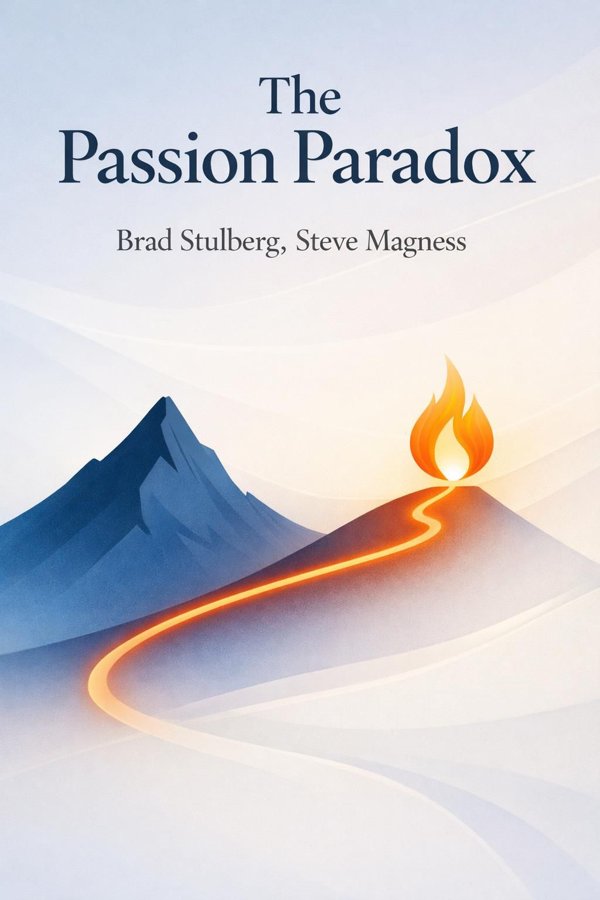
The Passion Paradox: A Guide to Going All In, Finding Success, and Discovering the Benefits of an Unbalanced Life: Summary & Key Insights
by Brad Stulberg, Steve Magness
 10 min10 chaptersAudio available
Key Takeaways from The Passion Paradox: A Guide to Going All In, Finding Success, and Discovering the Benefits of an Unbalanced Life
Passion feels like destiny, but it often starts as chemistry.
The biggest myth about passion is that it arrives fully formed.
What makes passion so attractive is also what makes it dangerous.
Not all passion is created equal.
A powerful life can become a fragile life when identity gets too narrow.
What Is The Passion Paradox: A Guide to Going All In, Finding Success, and Discovering the Benefits of an Unbalanced Life About?
The Passion Paradox: A Guide to Going All In, Finding Success, and Discovering the Benefits of an Unbalanced Life by Brad Stulberg, Steve Magness is a psychology book spanning 10 pages. Passion is often sold as the ultimate answer to a meaningful life: find what you love, go all in, and success will follow. In The Passion Paradox, Brad Stulberg and Steve Magness challenge that comforting story. They argue that passion is powerful, but it is also volatile. The same force that energizes creativity, excellence, and purpose can just as easily lead to obsession, anxiety, burnout, and a fragile sense of self. Rather than rejecting passion, the authors show how to work with it wisely. Drawing from psychology, neuroscience, performance science, and real-world examples from athletes, entrepreneurs, artists, and high achievers, Stulberg and Magness explain why passion can become destabilizing when it fuses too tightly with identity or is pursued without recovery and perspective. Their message is both practical and deeply humane: sustainable success requires intensity, but also restraint. Readers learn how passion develops, how it turns unhealthy, and how to build habits that protect well-being without dulling ambition. For anyone who wants to pursue meaningful work without being consumed by it, this book offers a smarter and more balanced path.
This FizzRead summary covers all 10 key chapters of The Passion Paradox: A Guide to Going All In, Finding Success, and Discovering the Benefits of an Unbalanced Life in approximately 10 minutes, distilling the most important ideas, arguments, and takeaways from Brad Stulberg, Steve Magness's work. Also available as an audio summary and Key Quotes Podcast.
The Passion Paradox: A Guide to Going All In, Finding Success, and Discovering the Benefits of an Unbalanced Life
Passion is often sold as the ultimate answer to a meaningful life: find what you love, go all in, and success will follow. In The Passion Paradox, Brad Stulberg and Steve Magness challenge that comforting story. They argue that passion is powerful, but it is also volatile. The same force that energizes creativity, excellence, and purpose can just as easily lead to obsession, anxiety, burnout, and a fragile sense of self. Rather than rejecting passion, the authors show how to work with it wisely.
Drawing from psychology, neuroscience, performance science, and real-world examples from athletes, entrepreneurs, artists, and high achievers, Stulberg and Magness explain why passion can become destabilizing when it fuses too tightly with identity or is pursued without recovery and perspective. Their message is both practical and deeply humane: sustainable success requires intensity, but also restraint. Readers learn how passion develops, how it turns unhealthy, and how to build habits that protect well-being without dulling ambition. For anyone who wants to pursue meaningful work without being consumed by it, this book offers a smarter and more balanced path.
Who Should Read The Passion Paradox: A Guide to Going All In, Finding Success, and Discovering the Benefits of an Unbalanced Life?
This book is perfect for anyone interested in psychology and looking to gain actionable insights in a short read. Whether you're a student, professional, or lifelong learner, the key ideas from The Passion Paradox: A Guide to Going All In, Finding Success, and Discovering the Benefits of an Unbalanced Life by Brad Stulberg, Steve Magness will help you think differently.
- ✓Readers who enjoy psychology and want practical takeaways
- ✓Professionals looking to apply new ideas to their work and life
- ✓Anyone who wants the core insights of The Passion Paradox: A Guide to Going All In, Finding Success, and Discovering the Benefits of an Unbalanced Life in just 10 minutes
Want the full summary?
Get instant access to this book summary and 100K+ more with Fizz Moment.
Get Free SummaryAvailable on App Store • Free to download
Key Chapters
Passion feels like destiny, but it often starts as chemistry. One of the book’s most useful insights is that passion is not initially a grand philosophical revelation. It begins with attention, reward, and repetition. Certain activities trigger dopamine, the brain chemical associated with motivation, anticipation, and learning. This creates a feedback loop: we do something, feel energized or rewarded, and want to do it again. Over time, the repeated cycle of interest and reward can deepen into something that feels central to who we are.
This matters because it demystifies passion. Many people believe they are missing out because they have not yet experienced a dramatic calling. Stulberg and Magness show that passion is usually built, not suddenly discovered. The early phase may look less like certainty and more like curiosity. A student who enjoys solving one difficult problem may gradually become fascinated by mathematics. A runner who starts training for fitness may become devoted to the discipline, community, and challenge of the sport.
Understanding the brain’s role also explains why passion can become addictive. The same reward circuitry that fuels commitment can also make us chase more achievement, more validation, and more stimulation. Without awareness, what begins as joy can become compulsion.
A practical application is to pay close attention to activities that create energized focus rather than instant prestige. Instead of asking, “What is my one true passion?” ask, “What keeps drawing me back?” Treat passion like a pattern to observe and cultivate.
Actionable takeaway: stop waiting for lightning to strike; notice repeated sparks of curiosity and build a disciplined practice around them.
The biggest myth about passion is that it arrives fully formed. In reality, passion usually emerges through doing, not daydreaming. Stulberg and Magness argue that action often precedes clarity. People become passionate after they invest effort, build competence, and start seeing meaning in progress. What feels like love at first sight is more often love strengthened by attention and time.
This idea is liberating because it replaces pressure with experimentation. If passion must be discovered in a single perfect insight, every career choice feels overwhelming. But if passion is cultivated, then exploration becomes essential. A young professional may try several roles before feeling deeply engaged by one. An amateur musician may only become truly passionate after months of frustrating practice finally turn into fluency and expression.
The authors emphasize that competence feeds passion. We tend to enjoy what we get better at, and we get better at what we practice. This creates a virtuous cycle. But it also means that passion rarely feels effortless in the beginning. Beginners often mistake discomfort for a sign they have chosen the wrong thing, when in fact struggle may be part of the path toward deeper commitment.
In practical terms, this means sampling widely but committing deeply once something resonates. Volunteer, take classes, test projects, and pursue side interests. Instead of waiting to feel certain before acting, use action as the tool that reveals what matters.
Actionable takeaway: choose one promising interest and give it sustained, structured effort for a meaningful period before deciding whether it is truly for you.
What makes passion so attractive is also what makes it dangerous. Passion provides energy, focus, resilience, and a sense of purpose. It can help people endure hardship, overcome boredom, and achieve unusually high levels of performance. But those same qualities can become liabilities when passion goes unchecked. The drive that keeps someone practicing, building, or creating can also make it hard to stop, step back, or see clearly.
The paradox is that passion intensifies life while also narrowing it. A committed founder may build a company through relentless effort, yet begin to sacrifice sleep, relationships, and perspective. An athlete may gain identity and discipline through training, yet feel emotionally shattered by one injury or poor performance. Passion magnifies both the highs and the lows.
Stulberg and Magness do not argue that we should become less committed. Instead, they urge readers to respect passion’s volatility. A force this strong needs boundaries. The more meaningful the pursuit, the more important it is to guard against overinvestment in a single outcome. Without that guardrail, passion can produce anxiety, perfectionism, and a constant sense that enough is never enough.
A practical way to apply this is to audit the costs of your devotion. Ask not only what your passion gives you, but also what it is taking. Are you sleeping enough? Are you becoming more alive or more brittle? Are setbacks painful but manageable, or emotionally devastating?
Actionable takeaway: keep a regular check on the hidden costs of your ambition so your passion remains a source of vitality rather than self-destruction.
Not all passion is created equal. One of the book’s most valuable distinctions is between harmonious passion and obsessive passion. Harmonious passion arises when an activity is deeply important but still exists in balance with other parts of life. You choose it freely, derive meaning from it, and can step away when necessary. Obsessive passion, by contrast, takes control. The activity begins to dictate your worth, your mood, and your sense of stability. You feel compelled rather than called.
This distinction is subtle but crucial. Two people might both work long hours or train intensely, yet their inner experience can be very different. A harmonious musician may practice with dedication, then rest and enjoy family life. An obsessively passionate musician may feel guilty any time they are not working and panicked when external recognition dips. The behavior may look similar from the outside, but psychologically the difference is enormous.
The authors connect unhealthy passion to insecurity and external validation. When success, praise, or productivity become the only proof that we matter, passion becomes brittle. Failure no longer feels like feedback; it feels like identity collapse.
To cultivate healthy passion, it helps to reconnect with intrinsic motives: the craft itself, the challenge, the contribution, the growth. It also helps to maintain choice. If you cannot imagine taking a day off, modifying goals, or changing direction, passion may be controlling you rather than serving you.
Actionable takeaway: ask whether your passion is something you deeply love or something you fear losing, and strengthen routines that keep the answer closer to love.
A powerful life can become a fragile life when identity gets too narrow. Stulberg and Magness warn that one of passion’s greatest risks is identity fusion: the tendency to define yourself entirely by one role, one pursuit, or one measure of success. When that happens, setbacks become existential. If you are not just someone who writes, but a writer and nothing else, rejection hits harder. If you are not just someone who competes, but an athlete at your core, injury can feel like erasure.
The problem is not commitment. It is overidentification. The more tightly your worth is tied to one domain, the more vulnerable you become to stress, comparison, and fear. This often leads to defensive behavior: avoiding risks that could threaten your image, overworking to preserve status, or spiraling when results fluctuate.
The solution is not detachment from meaningful work, but multiplicity. Build an identity broad enough to survive inevitable change. You can be a leader, friend, parent, learner, runner, neighbor, and creator. This does not dilute excellence; it protects it. A wider identity gives emotional resilience because failure in one area does not define the whole self.
In practice, this means investing in roles and values beyond your primary passion. Maintain friendships not based solely on work. Keep hobbies where performance does not matter. Describe yourself in terms of qualities, not just titles: curious, disciplined, generous, thoughtful.
Actionable takeaway: write down five roles or values that define you beyond your main pursuit, and consciously strengthen at least one of them every week.
Passion does not manage itself. Left alone, it tends to escalate. The more invested we become, the easier it is to justify extra hours, harsher self-criticism, and constant mental engagement. That is why the authors emphasize regulation. If passion is powerful fuel, then discipline is the steering wheel. Sustainable high performance requires not just drive, but the ability to direct and contain it.
Managing passion means creating systems that prevent your strongest impulses from taking over. This includes setting work boundaries, defining enough, limiting comparison, and regularly stepping back to evaluate whether your behavior aligns with your deeper goals. For example, an entrepreneur might decide that no work happens after a certain evening hour. A student may set performance goals but also rules around sleep and social time. An artist may commit to daily output while refusing to tie self-worth to reviews or likes.
The book also highlights the importance of emotional awareness. People often assume burnout arrives suddenly, but it usually builds gradually through irritability, cynicism, fatigue, compulsive checking, and the inability to disengage. If you wait until collapse, you have waited too long.
One useful strategy is to create friction against excess. Schedule breaks before you think you need them. Use training plans instead of always pushing harder. Share goals with someone who can notice when your commitment turns unhealthy.
Actionable takeaway: build at least two nonnegotiable guardrails around your passion, such as a hard stop time, one full recovery day, or a weekly check-in on your energy and mood.
Modern culture celebrates relentless upward motion, but the book argues that real success is rarely linear and never endlessly accelerating. Passion often tricks people into thinking that if some effort is good, more effort must be better. Yet biology and psychology impose limits. Performance improves through cycles of stress and adaptation, not nonstop strain. When we ignore this, we may achieve short bursts of output but undermine long-term excellence.
Stulberg and Magness draw heavily from performance science: elite performers do not train at maximum intensity all the time. They alternate hard work with easier sessions, progress with consolidation, focus with renewal. The same principle applies outside sport. Knowledge workers need mental recovery. Creatives need periods of incubation. Leaders need distance to think strategically rather than reactively.
Sustainable success also depends on patience. Passion can create urgency, making every moment feel decisive. But mastery compounds over years. People who endure are often less extreme than they appear; they simply stay consistent longer than everyone else. The person who can keep going thoughtfully for ten years often outperforms the one who burns bright for two.
In daily life, this means designing your work in rhythms. Use seasons, cycles, and priorities. Push hard when needed, but make that intensity intentional and temporary. Ask whether your current pace is one you could maintain without resentment, decline, or collapse.
Actionable takeaway: replace the question “How much more can I do?” with “What pace allows me to improve and still be strong a year from now?”
One of the most countercultural ideas in The Passion Paradox is that recovery is not laziness, weakness, or a reward for work well done. It is an essential component of growth. Passionate people often resist rest because stopping feels threatening. If your identity is tied to progress and output, recovery can feel like falling behind. But the authors show that rest is where adaptation happens. It restores cognitive capacity, emotional stability, creativity, and physical resilience.
Without recovery, effort becomes self-defeating. Sleep deprivation impairs judgment and emotional regulation. Chronic stress narrows thinking and reduces motivation. Constant work can even make people less connected to the activity they love, turning meaningful engagement into mechanical grind.
The authors encourage readers to broaden their view of recovery. Rest is not only sleep, though sleep is foundational. It also includes unstructured time, reflective walks, playful activities, conversations, time in nature, and anything that allows the nervous system to shift out of relentless activation. Deep recovery can also come from periods of complete disengagement, where attention is no longer captured by metrics, notifications, or unfinished tasks.
A practical example is treating recovery with the same seriousness as effort. Put it on the calendar. Protect evenings. Take deload weeks. Avoid filling every open hour with self-improvement.
Actionable takeaway: schedule recovery before your calendar fills up, and treat sleep, downtime, and mental disengagement as performance tools rather than optional luxuries.
If success is defined only by more—more money, more recognition, more output—passion becomes a treadmill. The authors argue that many high achievers are driven not only by aspiration, but by an unstable definition of success. Because external benchmarks constantly move, even major accomplishments bring only temporary satisfaction. What once felt extraordinary quickly becomes normal, and the appetite for achievement grows stronger.
This is where passion can quietly turn into emptiness. You may reach goals yet feel strangely unfulfilled because the pursuit has lost contact with deeper values. The book encourages readers to define success in richer and more personal terms. Achievement matters, but so do integrity, relationships, craftsmanship, service, health, and freedom. A life organized around these broader measures is less vulnerable to the emotional whiplash of external validation.
Redefining success also changes how you relate to ambition. You can still strive greatly, but your striving is anchored. A promotion matters, but not at the cost of your health. Winning matters, but not if losing destroys your dignity. Creative success matters, but not if it severs you from the joy of making.
A useful exercise is to write a personal scorecard. Instead of relying only on public metrics, identify a handful of standards that you respect. Did I act according to my values? Did I do focused work? Did I recover well? Did I show up for people I care about?
Actionable takeaway: create your own definition of success so your passion serves your life, rather than forcing your life to serve an endless chase.
The healthiest ambition is not small ambition. It is ambition woven into a larger life. The final lesson of the book is that passion works best when it is integrated rather than isolated. In other words, your deepest pursuit should enrich your life, not consume every corner of it. This does not mean perfect balance every day. The authors acknowledge that meaningful goals often require periods of intense, even unbalanced effort. But those periods should exist within a broader framework of humanity, perspective, and choice.
Integration means knowing when to lean in and when to pull back. It means recognizing that relationships, health, reflection, and play are not distractions from greatness; they are part of what allows greatness to remain sustainable and meaningful. It also means accepting that passion evolves. What consumed you at twenty may not fit at forty, and that is not failure. It is growth.
This perspective is especially helpful for people who fear that moderation will weaken excellence. Stulberg and Magness show the opposite: when your life has emotional and psychological depth beyond one pursuit, you often perform better within that pursuit. You think more clearly, recover faster, and remain grounded through inevitable volatility.
In practice, integration looks like seasons of focus supported by stable routines, caring relationships, and flexible identity. You can go all in without going all away.
Actionable takeaway: design your passion around the kind of life you want to live, not just around the next milestone you want to hit.
All Chapters in The Passion Paradox: A Guide to Going All In, Finding Success, and Discovering the Benefits of an Unbalanced Life
About the Authors
Brad Stulberg is a writer, coach, and speaker focused on the intersection of performance, health, and sustainable success. His work often explores how people can pursue excellence without sacrificing well-being, and he is known for turning complex psychological and scientific research into practical guidance. Steve Magness is a performance coach, author, and expert in sports science and human development. He has coached elite athletes and written extensively about motivation, resilience, and the mental side of achievement. Together, Stulberg and Magness bring a rare combination of scientific literacy, coaching experience, and accessible storytelling. Their previous collaboration, Peak Performance, helped establish them as thoughtful voices on how to thrive under pressure, making The Passion Paradox a natural extension of their shared work.
Get This Summary in Your Preferred Format
Read or listen to the The Passion Paradox: A Guide to Going All In, Finding Success, and Discovering the Benefits of an Unbalanced Life summary by Brad Stulberg, Steve Magness anytime, anywhere. FizzRead offers multiple formats so you can learn on your terms — all free.
Available formats: App · Audio · PDF · EPUB — All included free with FizzRead
Download The Passion Paradox: A Guide to Going All In, Finding Success, and Discovering the Benefits of an Unbalanced Life PDF and EPUB Summary
Key Quotes from The Passion Paradox: A Guide to Going All In, Finding Success, and Discovering the Benefits of an Unbalanced Life
“Passion feels like destiny, but it often starts as chemistry.”
“The biggest myth about passion is that it arrives fully formed.”
“What makes passion so attractive is also what makes it dangerous.”
“One of the book’s most valuable distinctions is between harmonious passion and obsessive passion.”
“A powerful life can become a fragile life when identity gets too narrow.”
Frequently Asked Questions about The Passion Paradox: A Guide to Going All In, Finding Success, and Discovering the Benefits of an Unbalanced Life
The Passion Paradox: A Guide to Going All In, Finding Success, and Discovering the Benefits of an Unbalanced Life by Brad Stulberg, Steve Magness is a psychology book that explores key ideas across 10 chapters. Passion is often sold as the ultimate answer to a meaningful life: find what you love, go all in, and success will follow. In The Passion Paradox, Brad Stulberg and Steve Magness challenge that comforting story. They argue that passion is powerful, but it is also volatile. The same force that energizes creativity, excellence, and purpose can just as easily lead to obsession, anxiety, burnout, and a fragile sense of self. Rather than rejecting passion, the authors show how to work with it wisely. Drawing from psychology, neuroscience, performance science, and real-world examples from athletes, entrepreneurs, artists, and high achievers, Stulberg and Magness explain why passion can become destabilizing when it fuses too tightly with identity or is pursued without recovery and perspective. Their message is both practical and deeply humane: sustainable success requires intensity, but also restraint. Readers learn how passion develops, how it turns unhealthy, and how to build habits that protect well-being without dulling ambition. For anyone who wants to pursue meaningful work without being consumed by it, this book offers a smarter and more balanced path.
You Might Also Like
The Body Keeps the Score
Bessel van der Kolk
10 min
Surrounded by Idiots
Thomas Erikson
10 min
Emotional Intelligence
Daniel Goleman
10 min
Attached
Amir Levine
10 min
Why Does He Do That
Lundy Bancroft
10 min
Women Who Run with the Wolves
Clarissa Pinkola Estés
10 minBrowse by Category
Ready to read The Passion Paradox: A Guide to Going All In, Finding Success, and Discovering the Benefits of an Unbalanced Life?
Get the full summary and 100K+ more books with Fizz Moment.