
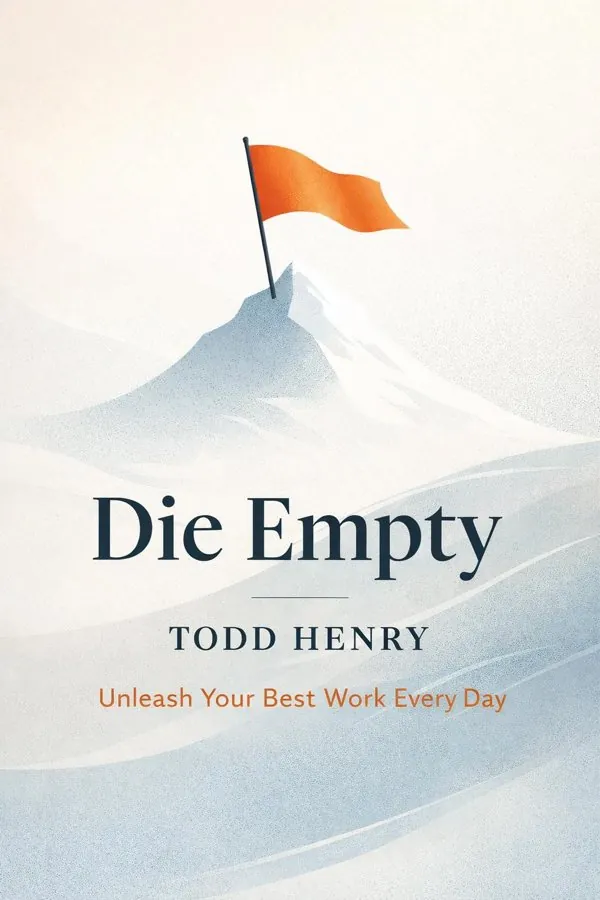
Die Empty: Unleash Your Best Work Every Day: Summary & Key Insights
by Todd Henry
 10 min9 chaptersAudio available
Key Takeaways from Die Empty: Unleash Your Best Work Every Day
Few people choose a mediocre life on purpose; they simply slide into one by default.
Mediocrity is not usually caused by a lack of talent; it is fueled by habits that slowly sabotage contribution.
When people feel stuck, they often assume they need more time, more motivation, or better tools.
A fulfilling career is not built only by working hard; it is built by understanding the specific contribution you are positioned to make.
Most people live as if they have unlimited tomorrows, and that assumption quietly robs the present of intensity.
What Is Die Empty: Unleash Your Best Work Every Day About?
Die Empty: Unleash Your Best Work Every Day by Todd Henry is a productivity book spanning 11 pages. Die Empty by Todd Henry is a sharp, practical call to stop living on autopilot and start bringing your best ideas, effort, and contribution into the world while you still can. Built around the memorable question, “What do you want to be empty of when you die?”, the book argues that many talented people drift into comfortable mediocrity not because they lack ability, but because they fail to work with clarity, urgency, and intention. Henry challenges readers to reject passivity and to treat their time, energy, and creative capacity as precious and finite resources. What makes the book especially useful is its blend of inspiration and discipline. This is not a vague motivational manifesto about following your passion. It is a structured guide to doing meaningful work consistently, even amid pressure, distractions, and fear. Henry writes with authority as the founder of Accidental Creative, where he has spent years helping professionals and teams generate ideas and perform creatively under deadlines. For anyone who senses they are capable of more than their current routine reflects, Die Empty offers a bracing framework for reclaiming focus, contribution, and purpose.
This FizzRead summary covers all 9 key chapters of Die Empty: Unleash Your Best Work Every Day in approximately 10 minutes, distilling the most important ideas, arguments, and takeaways from Todd Henry's work. Also available as an audio summary and Key Quotes Podcast.
Die Empty: Unleash Your Best Work Every Day
Die Empty by Todd Henry is a sharp, practical call to stop living on autopilot and start bringing your best ideas, effort, and contribution into the world while you still can. Built around the memorable question, “What do you want to be empty of when you die?”, the book argues that many talented people drift into comfortable mediocrity not because they lack ability, but because they fail to work with clarity, urgency, and intention. Henry challenges readers to reject passivity and to treat their time, energy, and creative capacity as precious and finite resources.
What makes the book especially useful is its blend of inspiration and discipline. This is not a vague motivational manifesto about following your passion. It is a structured guide to doing meaningful work consistently, even amid pressure, distractions, and fear. Henry writes with authority as the founder of Accidental Creative, where he has spent years helping professionals and teams generate ideas and perform creatively under deadlines. For anyone who senses they are capable of more than their current routine reflects, Die Empty offers a bracing framework for reclaiming focus, contribution, and purpose.
Who Should Read Die Empty: Unleash Your Best Work Every Day?
This book is perfect for anyone interested in productivity and looking to gain actionable insights in a short read. Whether you're a student, professional, or lifelong learner, the key ideas from Die Empty: Unleash Your Best Work Every Day by Todd Henry will help you think differently.
- ✓Readers who enjoy productivity and want practical takeaways
- ✓Professionals looking to apply new ideas to their work and life
- ✓Anyone who wants the core insights of Die Empty: Unleash Your Best Work Every Day in just 10 minutes
Want the full summary?
Get instant access to this book summary and 100K+ more with Fizz Moment.
Get Free SummaryAvailable on App Store • Free to download
Key Chapters
Few people choose a mediocre life on purpose; they simply slide into one by default. That is one of Todd Henry’s most unsettling insights. Mediocrity rarely looks like dramatic failure. More often, it appears as busyness, comfort, routine, and the slow erosion of ambition. You answer emails, attend meetings, complete assignments, and keep everything moving. Outwardly, you seem productive. Inwardly, however, your best ideas remain undeveloped, your convictions are muted, and your work becomes increasingly reactive rather than meaningful.
Henry argues that this kind of drift is dangerous because it feels normal. The familiar patterns of professional life reward visible responsiveness more than deep contribution. Over time, people stop asking whether their effort is aligned with their gifts and values. They settle for being useful instead of being fully engaged. The tragedy is not that they become incompetent, but that they become merely adequate.
This idea matters because many ambitious people assume burnout and laziness are the only enemies of great work. Henry shows that comfort can be just as destructive. A well-managed, respectable, efficient life can still be a wasted one if it never demands your fullest contribution.
A practical way to spot creeping mediocrity is to review your week and ask: What did I create? What problem did I solve at a deep level? Where did I take emotional or intellectual risk? If your days are full but your answers are thin, you may be drifting.
Actionable takeaway: conduct a weekly “mediocrity audit��� by identifying one area where routine has replaced intention, and choose one concrete step to reintroduce challenge, creativity, or purpose.
Mediocrity is not usually caused by a lack of talent; it is fueled by habits that slowly sabotage contribution. Henry describes seven recurring patterns that keep capable people from doing their best work: aimlessness, boredom, comfort, delusion, ego, fear, and chaos. These are not abstract moral flaws. They are everyday tendencies that distort focus and weaken execution.
Aimlessness shows up when you are active but not directed. Boredom appears when curiosity disappears and work becomes emotionally flat. Comfort makes you protect the familiar rather than pursue growth. Delusion causes you to overestimate your effectiveness or ignore feedback. Ego prevents learning and collaboration. Fear keeps you from shipping, speaking up, or stretching beyond your current competence. Chaos destroys consistency by replacing intentional process with constant reaction.
What makes these “sins” powerful is that they reinforce one another. Comfort breeds aimlessness. Aimlessness leads to boredom. Fear creates chaos because delayed decisions pile up into crisis. Ego prevents correction. Soon, a talented person becomes trapped in a loop of underperformance while still appearing busy.
Henry’s framework is useful because it turns vague frustration into diagnosis. If you can name the pattern, you can interrupt it. For example, someone stuck in comfort may need a deliberate challenge, while someone trapped in chaos needs structure rather than more motivation.
Try applying the framework to your current season of work. Which of the seven is most active in your life right now? A manager might notice ego in defensive meetings. A writer might identify fear in endless revisions. An entrepreneur may see chaos in a calendar with no thinking time.
Actionable takeaway: choose the one “sin” currently doing the most damage to your work, and design a counter-habit for the next two weeks, such as seeking feedback, scheduling deep work, or taking on a stretch assignment.
When people feel stuck, they often assume they need more time, more motivation, or better tools. Henry argues that what they usually need first is clarity. Without a clear sense of what matters, what you are trying to build, and how you uniquely contribute, effort gets scattered. You become busy in many directions and effective in none.
Clarity begins with identifying your principles, your areas of responsibility, and the kind of impact you want to make. Henry does not frame this as a luxury exercise for people with lots of free time. In his view, clarity is a practical necessity. It helps you decide what deserves your best energy, what to say no to, and how to evaluate opportunities. It also protects you from confusing urgent requests with important work.
This is especially relevant in modern professional life, where noise is constant and priorities shift quickly. A person with no internal filter gets hijacked by every message, meeting, and expectation. A clear person is not necessarily less busy, but is less fragmented.
A useful application is to create a personal “clarity map.” List your core values, the outcomes your role truly requires, the strengths people consistently rely on in you, and the kinds of work that leave you feeling most alive. Then compare your calendar to that map. If your schedule reflects none of it, your issue may not be effort but misalignment.
Clarity also creates confidence. When you know what your work is for, discipline becomes easier because your actions are connected to meaning rather than obligation.
Actionable takeaway: write a one-sentence personal contribution statement that defines the value you want to create, and use it as a filter for your commitments, priorities, and weekly planning.
A fulfilling career is not built only by working hard; it is built by understanding the specific contribution you are positioned to make. Henry encourages readers to move beyond generic productivity and ask a more demanding question: What is mine to do? This reframes work from task completion to meaningful stewardship of talent, experience, and opportunity.
Many people define themselves too narrowly by their job description. Henry pushes against that limitation. Your role may tell you what the organization expects, but your deeper contribution comes from how your strengths, passions, perspective, and relationships intersect. Two people can hold the same title and make radically different impacts because one is simply executing while the other is intentionally contributing something distinct.
Mapping contribution requires reflection. What problems naturally draw your attention? What themes recur in the feedback you receive? Where do your skills meet a real need? Perhaps you are a project manager whose true contribution is creating calm and alignment in chaotic teams. Perhaps you are a teacher whose unique gift is awakening confidence in discouraged students. Perhaps you are a founder whose greatest value is not vision alone, but the ability to translate vision into momentum.
Once you identify your contribution, decisions become simpler. You can accept projects that strengthen that contribution, delegate tasks that do not require your unique strengths, and build expertise in the areas where you create uncommon value.
This is not selfish. In Henry’s framework, contribution is how you serve others at your highest level. The point is not self-expression for its own sake, but refusing to hide your best work behind vague busyness.
Actionable takeaway: list three strengths, three recurring needs in your environment, and three activities that feel deeply meaningful; then identify the overlap and turn it into a focused plan for where to invest your next 90 days of effort.
Most people live as if they have unlimited tomorrows, and that assumption quietly robs the present of intensity. Henry’s central metaphor of “dying empty” is meant to create urgency, not fear. He wants readers to remember that time is finite, opportunity is temporary, and the cost of delay is real. Ideas postponed too long often become regret.
Urgency, in this sense, is not frantic hustle. Henry is not advocating exhaustion or constant acceleration. Instead, he is urging readers to treat each day as a meaningful opportunity to advance their best work. Healthy urgency sharpens focus. It forces hard choices. It reveals which ambitions matter enough to deserve action now rather than endless intention.
This perspective changes how you approach ordinary days. Rather than waiting for a perfect season, a better boss, more confidence, or ideal conditions, you begin where you are. A professional who has wanted to mentor others starts with one conversation this week. A designer who has delayed building a portfolio publishes one project. A leader who knows a difficult conversation is necessary stops postponing it.
Henry’s point is that urgency turns values into behavior. Without it, purpose remains sentimental. With it, you become more decisive, more courageous, and more willing to trade comfort for contribution.
One practical way to cultivate urgency is to ask at the start of each day: If today were one of my last opportunities to contribute in this role, what would matter most? That question can quickly expose trivial work and clarify the one action worth prioritizing.
Actionable takeaway: identify one meaningful task you have been delaying for at least a month, schedule a non-negotiable time to begin it within 48 hours, and define the smallest visible step you can complete.
Great work is rarely the product of inspiration alone. Henry insists that professionals who consistently produce value do not wait to feel ready; they build rhythms that make contribution more likely. This is one of the book’s most practical and liberating ideas. Instead of relying on mood, talent, or sporadic motivation, you create structure that supports creativity and focus under real-world conditions.
Rhythm includes routines for thinking, making, recovering, and reviewing. It may mean protecting morning hours for deep work, reserving one afternoon for strategic reflection, holding weekly planning sessions, or using recurring prompts to generate ideas. The details differ by person, but the principle remains: discipline creates freedom. A rhythm reduces friction and helps your best work emerge more consistently.
Henry’s experience with creative professionals is especially relevant here. Many people assume creativity requires spontaneity. He argues the opposite: creativity thrives when it has a container. A writer who sits down at the same time each day is more likely to produce than one who waits for inspiration. A manager who schedules regular one-on-ones creates trust more reliably than one who improvises communication.
Rhythm also protects against burnout. When work has a sustainable cadence, it becomes easier to recognize when energy is dropping, when commitments are unrealistic, and when rest is necessary. In that sense, rhythm is not rigid control. It is a system of wise stewardship.
If your work currently feels chaotic, start small. Create a repeatable beginning-of-day ritual, a fixed weekly review, or a dedicated device-free block for concentrated effort. Small rhythms compound into identity.
Actionable takeaway: design a simple weekly rhythm with three anchors, one planning session, one deep-work block, and one review period, and follow it for the next month before making adjustments.
The work that matters most often feels the most uncomfortable. Henry reminds readers that fear is not always a sign to stop; often it is evidence that you are approaching something significant. Resistance appears when a task threatens your identity, exposes your limitations, or carries the possibility of judgment. That is why people procrastinate on books they want to write, ideas they need to pitch, and conversations they know they must have.
Henry’s argument is not that fear disappears with maturity or confidence. Instead, productive people learn to work through fear rather than waiting beyond it. They recognize that emotional resistance is part of the cost of meaningful contribution. The goal is not fearlessness, but obedience to purpose.
This shift matters because many talented people misread discomfort. They assume that if a project creates anxiety, it must be wrong, premature, or beyond them. In reality, deep work often demands vulnerability. A leader may fear disappointing others by setting boundaries. An artist may fear criticism. A professional changing careers may fear losing status. These are real concerns, but they are not sufficient reasons to stay hidden.
One practical strategy is to reduce the emotional weight of hard work by breaking it into visible, manageable steps. Instead of “launch the business,” the next step may be “email three potential customers.” Instead of “write the book,” the next step may be “draft 300 words.” Momentum lowers the volume of fear.
Henry’s broader point is that courage becomes a habit. Each time you move toward important work despite discomfort, you expand your capacity for future contribution.
Actionable takeaway: name the project or conversation you have been avoiding out of fear, identify the smallest uncomfortable action that would move it forward, and complete that action today.
Productivity is not simply about time management; it is about directing finite energy and attention toward what matters most. Henry emphasizes that every day you wake up with a limited reservoir of mental, emotional, and physical capacity. If you spend it carelessly on distraction, conflict, low-value tasks, and endless reaction, your best work will remain trapped inside you.
This is a crucial distinction. Many people optimize calendars while ignoring the quality of the energy they bring to their work. Henry encourages a more holistic view. Protecting your contribution may require sleep, exercise, margin, strategic breaks, and deliberate transitions between modes of work. It also requires the ability to concentrate deeply in a world designed to fragment attention.
Consider a knowledge worker who spends the first two hours of each day answering messages. By the time important creative work begins, their best focus is gone. Or a leader who allows every interruption to redirect the day may feel productive, but never creates the space needed for clear thinking. Henry argues that reclaiming attention is not selfish; it is responsible stewardship of your capacity to serve others well.
A practical application is to identify your peak energy periods and match them to your highest-value tasks. Administrative work can happen when energy dips. Strategic thinking, writing, designing, and problem solving should happen when your mind is sharpest. You can also reduce attention leakage by batching communication, silencing notifications, and creating clear boundaries around deep work.
When managed well, energy and focus turn ordinary days into meaningful output. When neglected, even long hours produce little of value.
Actionable takeaway: for one week, track when your energy is highest and lowest, then reorganize your schedule so your most important work happens during your strongest mental window.
People often think of legacy as something distant, grand, and abstract, but Henry brings it down to the level of ordinary choices. Your legacy is not formed only by major achievements at the end of life. It is built day by day through patterns of attention, generosity, discipline, courage, and contribution. In that sense, legacy is less about what people say about you later and more about what you consistently give while you are here.
This perspective helps correct two common mistakes. The first is postponing meaningful living until some future milestone, when there will supposedly be more time. The second is imagining legacy in purely public terms, as fame, scale, or visible success. Henry’s view is broader and more humane. A person leaves a legacy through the problems they solve, the standards they uphold, the people they develop, and the work they release into the world.
That means collaboration and influence matter. Your best work is not only what you personally produce, but also what you help others unlock. Encouraging a teammate, mentoring a younger colleague, or creating systems that allow a team to flourish can be part of dying empty. So can bringing integrity to repetitive but necessary work. Intentionality dignifies the daily.
To live this way, Henry recommends practices that keep purpose close at hand: regular reflection, honest self-assessment, clear boundaries, and conscious choices about where your time goes. Small repeated actions shape the person who eventually leaves a mark.
A powerful question to ask is: If someone experienced my work today, what would they receive from me besides competence? Calm, excellence, creativity, courage, generosity? Those qualities define legacy in motion.
Actionable takeaway: choose one daily practice that reinforces the kind of legacy you want to build, such as five minutes of reflection, one act of mentorship, or a commitment to complete one piece of meaningful work before reacting to demands.
All Chapters in Die Empty: Unleash Your Best Work Every Day
About the Author
Todd Henry is an American author, speaker, and consultant best known for his work on creativity, productivity, and purposeful leadership. He is the founder of Accidental Creative, a consultancy and platform dedicated to helping individuals and organizations generate brilliant ideas consistently, especially under pressure. Over the years, Henry has worked with teams and leaders across a wide range of industries, giving him a practical understanding of the challenges professionals face when trying to do meaningful work in demanding environments. His writing focuses on how to avoid creative drift, build sustainable disciplines, and contribute at a higher level. Through books, keynote talks, and coaching, Henry has become a respected voice for people who want to combine effectiveness with deeper intentionality in their daily work and long-term careers.
Get This Summary in Your Preferred Format
Read or listen to the Die Empty: Unleash Your Best Work Every Day summary by Todd Henry anytime, anywhere. FizzRead offers multiple formats so you can learn on your terms — all free.
Available formats: App · Audio · PDF · EPUB — All included free with FizzRead
Download Die Empty: Unleash Your Best Work Every Day PDF and EPUB Summary
Key Quotes from Die Empty: Unleash Your Best Work Every Day
“Few people choose a mediocre life on purpose; they simply slide into one by default.”
“Mediocrity is not usually caused by a lack of talent; it is fueled by habits that slowly sabotage contribution.”
“When people feel stuck, they often assume they need more time, more motivation, or better tools.”
“A fulfilling career is not built only by working hard; it is built by understanding the specific contribution you are positioned to make.”
“Most people live as if they have unlimited tomorrows, and that assumption quietly robs the present of intensity.”
Frequently Asked Questions about Die Empty: Unleash Your Best Work Every Day
Die Empty: Unleash Your Best Work Every Day by Todd Henry is a productivity book that explores key ideas across 9 chapters. Die Empty by Todd Henry is a sharp, practical call to stop living on autopilot and start bringing your best ideas, effort, and contribution into the world while you still can. Built around the memorable question, “What do you want to be empty of when you die?”, the book argues that many talented people drift into comfortable mediocrity not because they lack ability, but because they fail to work with clarity, urgency, and intention. Henry challenges readers to reject passivity and to treat their time, energy, and creative capacity as precious and finite resources. What makes the book especially useful is its blend of inspiration and discipline. This is not a vague motivational manifesto about following your passion. It is a structured guide to doing meaningful work consistently, even amid pressure, distractions, and fear. Henry writes with authority as the founder of Accidental Creative, where he has spent years helping professionals and teams generate ideas and perform creatively under deadlines. For anyone who senses they are capable of more than their current routine reflects, Die Empty offers a bracing framework for reclaiming focus, contribution, and purpose.
More by Todd Henry
You Might Also Like
Browse by Category
Ready to read Die Empty: Unleash Your Best Work Every Day?
Get the full summary and 100K+ more books with Fizz Moment.