
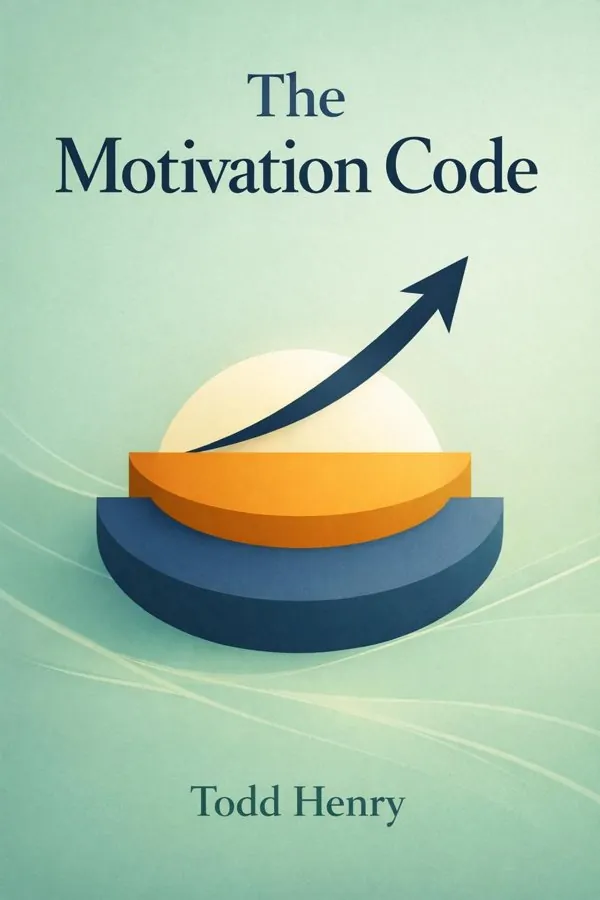
The Motivation Code: Discover the Hidden Forces That Drive Your Best Work: Summary & Key Insights
by Todd Henry
 10 min9 chaptersAudio available
Key Takeaways from The Motivation Code: Discover the Hidden Forces That Drive Your Best Work
One of the most costly mistakes in work and leadership is assuming that people are mainly driven by rewards and punishments.
Self-awareness is often treated as a vague ideal, but Henry turns it into a concrete discipline.
These families do not erase individuality; they provide a practical map for understanding how different people pursue significance through work.
A reliable way to discover motivation is to study moments of peak contribution rather than moments of vague preference.
Many high performers assume that if they work hard enough, they can succeed anywhere.
What Is The Motivation Code: Discover the Hidden Forces That Drive Your Best Work About?
The Motivation Code: Discover the Hidden Forces That Drive Your Best Work by Todd Henry is a leadership book spanning 6 pages. Why do some people come alive when solving difficult problems while others feel most energized when serving a mission, building relationships, or bringing order to chaos? In The Motivation Code, Todd Henry argues that our best work does not come merely from talent, discipline, or external rewards. It comes from understanding the hidden internal drives that consistently spark our effort, creativity, and persistence. Drawing on years of research and thousands of data points, Henry offers a practical framework for identifying the deeper motives behind how we work, lead, and make decisions. This matters because many professionals spend years chasing the wrong goals. They accept jobs that look impressive, pursue rewards that do not satisfy them, and adopt productivity strategies that clash with their natural wiring. The result is frustration, disengagement, and underperformance. Henry, known for his work on creativity, productivity, and meaningful work, brings both research and real-world experience to the topic. His central promise is powerful: when you understand your motivational code, you can make better choices, contribute more effectively, and design a life and career that draw out your most valuable work.
This FizzRead summary covers all 9 key chapters of The Motivation Code: Discover the Hidden Forces That Drive Your Best Work in approximately 10 minutes, distilling the most important ideas, arguments, and takeaways from Todd Henry's work. Also available as an audio summary and Key Quotes Podcast.
The Motivation Code: Discover the Hidden Forces That Drive Your Best Work
Why do some people come alive when solving difficult problems while others feel most energized when serving a mission, building relationships, or bringing order to chaos? In The Motivation Code, Todd Henry argues that our best work does not come merely from talent, discipline, or external rewards. It comes from understanding the hidden internal drives that consistently spark our effort, creativity, and persistence. Drawing on years of research and thousands of data points, Henry offers a practical framework for identifying the deeper motives behind how we work, lead, and make decisions.
This matters because many professionals spend years chasing the wrong goals. They accept jobs that look impressive, pursue rewards that do not satisfy them, and adopt productivity strategies that clash with their natural wiring. The result is frustration, disengagement, and underperformance. Henry, known for his work on creativity, productivity, and meaningful work, brings both research and real-world experience to the topic. His central promise is powerful: when you understand your motivational code, you can make better choices, contribute more effectively, and design a life and career that draw out your most valuable work.
Who Should Read The Motivation Code: Discover the Hidden Forces That Drive Your Best Work?
This book is perfect for anyone interested in leadership and looking to gain actionable insights in a short read. Whether you're a student, professional, or lifelong learner, the key ideas from The Motivation Code: Discover the Hidden Forces That Drive Your Best Work by Todd Henry will help you think differently.
- ✓Readers who enjoy leadership and want practical takeaways
- ✓Professionals looking to apply new ideas to their work and life
- ✓Anyone who wants the core insights of The Motivation Code: Discover the Hidden Forces That Drive Your Best Work in just 10 minutes
Want the full summary?
Get instant access to this book summary and 100K+ more with Fizz Moment.
Get Free SummaryAvailable on App Store • Free to download
Key Chapters
One of the most costly mistakes in work and leadership is assuming that people are mainly driven by rewards and punishments. Bonuses, promotions, public recognition, and fear of failure can influence behavior for a while, but they rarely explain why someone feels deeply alive in one kind of work and drained by another. Todd Henry’s core insight is that motivation is not just about what gets us moving; it is about what makes our effort feel meaningful, natural, and sustainable.
This distinction matters because many people build careers around external markers of success rather than internal sources of energy. Someone may accept a prestigious promotion, only to discover that the role requires constant political management when what truly motivates them is solving hard problems or building systems. Another person may seem unambitious because they are not chasing status, when in reality they are driven by creating beauty, serving others, or bringing clarity where there is confusion.
Henry encourages readers to look beneath surface preferences. Two people can enjoy the same job for entirely different reasons. A teacher might be motivated by developing potential in students, while another loves creating structured environments where learning can happen. A project manager might enjoy hitting targets, but the deeper reason could be restoring order, influencing outcomes, or helping a team feel secure.
The practical implication is simple but powerful: stop asking only, “What do I want?” and start asking, “Why does this kind of work energize me?” Track moments when you feel fully engaged, proud, or unusually resilient. Look for patterns in those moments. Actionable takeaway: for the next two weeks, record three moments each day when you felt energized or depleted, and note the underlying reason. Your motivation is often hidden inside those patterns.
Self-awareness is often treated as a vague ideal, but Henry turns it into a concrete discipline. Through the MCode Assessment, he and his team sought to identify recurring motivational patterns rooted in extensive research and large-scale data collection. The goal was not to label people in simplistic ways, but to uncover the consistent drives that shape how they contribute best.
What makes this approach useful is that it goes beyond personality. Personality tests often describe tendencies: whether you are outgoing, analytical, adaptable, or organized. The MCode asks a different question: what inner reward are you pursuing when you are at your best? That is a more actionable insight for career decisions, team design, and leadership development. You may be perfectly capable of performing many tasks, but your core motivation helps explain which tasks will sustain your excellence over time.
Henry’s research identified recurring themes across thousands of participants. People often recognize themselves not in job titles or industry categories, but in the emotional pattern of why they work. For example, a marketer, surgeon, entrepreneur, and nonprofit director might all share a drive to make an impact, restore order, or serve a cause. That common motive can be more important than their professional differences.
This matters in practical life because many frustrations are not failures of discipline but failures of alignment. If your role constantly demands motives that do not naturally energize you, your performance may become effortful and brittle. When you understand your motivational code, you can redesign responsibilities, communicate needs more clearly, and seek projects that activate your strengths.
Actionable takeaway: use any structured reflection tool available to identify your top recurring motives, then compare them with your current role. Ask, “Where am I naturally aligned, and where am I constantly compensating?” That gap reveals important decisions.
People often assume motivation is infinitely personal and impossible to categorize, yet Henry shows that human drive tends to cluster into a small set of recognizable motivational families. These families do not erase individuality; they provide a practical map for understanding how different people pursue significance through work. The value of the model is that it helps explain not just what people do, but the deeper pattern behind their best contributions.
Across the book, Henry describes six broad families of motivation, each containing more specific themes. Some people are energized by achievement and influence, wanting to move outcomes and make visible progress. Others are driven by mastery, improvement, and the challenge of solving complex problems. Some are motivated by service, connection, and the opportunity to help others flourish. Others come alive when they can create, organize, harmonize, or protect what matters.
The point is not to force yourself into a narrow box. It is to recognize that the same workplace can contain radically different motivational logics. One employee wants autonomy because it allows them to build something original. Another wants autonomy because it lets them execute efficiently without unnecessary friction. A third wants it because they need room to serve people in a more personalized way. On the surface, all three are asking for freedom. Underneath, their motives are different.
This framework becomes especially powerful in teams. Conflict often arises not from bad intentions but from mismatched motivational assumptions. The visionary sees endless possibilities; the stabilizer sees hidden risks; the helper notices overlooked human needs. Each may think they are seeing the obvious truth, when they are actually expressing different motivational priorities.
Actionable takeaway: identify your likely motivational family and then ask three colleagues what seems to energize them most. Use those answers to improve how you delegate, collaborate, and interpret behavior.
A reliable way to discover motivation is to study moments of peak contribution rather than moments of vague preference. Henry emphasizes that your motivational code is often most visible when you are doing work that feels both effective and deeply satisfying. In those moments, effort may still be intense, but it feels worthwhile. You are not just productive; you are personally invested.
This is important because people often try to identify motivation by asking what they like. But liking is too broad. You may enjoy travel, conversation, problem-solving, or recognition in many situations. Motivation becomes clearer when you ask: what specific kind of contribution makes me feel that I mattered? For one person, it is turning confusion into clarity. For another, it is helping someone gain confidence. For another, it is winning trust, repairing broken systems, or generating new possibilities.
Henry suggests looking backward. Think about the projects you are proudest of, the roles where you thrived, and the moments when you were willing to do more than expected without being asked. Often, there is a hidden through-line. Maybe you repeatedly stepped up when people needed calm direction. Maybe you loved situations where you could take fragmented information and organize it. Maybe your best moments always involved unlocking another person’s potential.
These clues matter because they reveal not just your strengths but the conditions under which your strengths become reliable. A person who is excellent at analysis may still feel disengaged unless the analysis leads to improvement. A gifted communicator may feel flat unless the communication creates genuine connection or influence.
Actionable takeaway: write down five professional moments you are most proud of. For each one, answer: “What exactly made this meaningful to me?” Look for repeated verbs such as build, solve, serve, organize, inspire, protect, or transform.
Many high performers assume that if they work hard enough, they can succeed anywhere. Henry challenges this belief by showing that sustained excellence depends less on constant effort than on motivational alignment. You can force yourself to perform in a misaligned environment for a season, but over time the cost becomes visible in fatigue, frustration, inconsistency, or emotional detachment.
This does not mean you should only do work that feels easy. Difficult work is often deeply rewarding when it connects to your core motives. A person driven to make things better may gladly wrestle with a messy turnaround. Someone motivated by service may willingly endure emotional labor to support clients or patients. Hard work is not the problem. Misaligned hard work is.
Consider two managers with similar capabilities. One is energized by mentoring and development, but most of their day is spent navigating bureaucracy and producing reports. The other is motivated by structure and order, yet their environment is chaotic and constantly changing. Both may still perform acceptably, but each is paying a hidden tax. The first feels disconnected from what matters most; the second feels perpetually unsettled. In both cases, motivation leakage reduces the quality and sustainability of their contribution.
Henry’s point is not that everyone should quit their job immediately. Often, alignment can be improved by reshaping tasks, renegotiating responsibilities, or understanding why certain assignments are especially draining. Leaders can also redesign roles so that people spend more time in work that activates their best energy.
Actionable takeaway: make two lists: tasks that energize you even when difficult, and tasks that drain you even when you do them well. Then ask how you can shift your schedule, role, or collaboration patterns to spend more time in the first category.
Career advice often focuses on opportunity, compensation, prestige, or skill fit. Henry adds a more important filter: motivational fit. A role can look ideal on paper and still be wrong if it consistently asks you to operate outside the motives that bring out your best work. Understanding your motivation code helps you evaluate opportunities with more honesty and far less confusion.
This is especially useful when facing crossroads. Many people ask, “Am I ready for this promotion?” or “Should I make this change?” Henry would add, “Will this path draw on the motives that make me effective and fulfilled?” For example, someone driven by creating new ideas may struggle in a role centered on maintenance and process control. Someone motivated by developing people may feel stranded in a position that rewards individual output over relational leadership. Someone who loves restoring order may thrive in operations but feel anxious in highly ambiguous innovation environments.
Motivational clarity also protects against envy. It is easy to compare your path with someone else’s and assume their version of success should be yours. But if their role is fueled by motives you do not share, imitating them may lead you away from your own best contribution. A high-status role that rewards competition and visibility may be deeply fulfilling for one person and quietly exhausting for another.
Used well, this insight does not narrow your options; it sharpens them. It helps you ask smarter questions in interviews, seek projects where you can excel, and define success in a way that is both ambitious and sustainable.
Actionable takeaway: before saying yes to a new role, write a short “motivation fit review” answering three questions: What kind of work will I do most? Which motives will this activate? Which of my strongest motivations might be neglected?
Creativity is often treated as a matter of technique, inspiration, or discipline, but Henry argues that motivation plays a central role in whether creative effort becomes consistent and meaningful. People produce their best ideas not only when they have talent, but when the creative challenge resonates with the inner forces that matter most to them. Motivation does not replace craft; it supplies the emotional fuel that keeps craft alive.
This explains why two people can face the same creative assignment and respond very differently. One person becomes animated because the project offers a chance to shape something original. Another is energized because the work could solve a pressing problem. Another cares because the final product will help people, heal confusion, or create beauty. The output may look similar from the outside, but the inner driver changes the quality of attention and persistence.
Henry’s broader message is that creativity is not only for artists. Leaders, teachers, engineers, managers, and entrepreneurs all rely on creative problem-solving. When they understand what motivates them, they can create better conditions for original work. A team member motivated by impact should see how ideas influence outcomes. Someone motivated by mastery should be challenged with difficult questions. Someone driven by service should understand whom the work benefits.
This also helps when creative energy fades. Instead of assuming you are lazy or blocked, ask whether the work has become disconnected from your motivational core. Sometimes the solution is not to push harder but to reconnect the project to a meaningful human, strategic, or structural purpose.
Actionable takeaway: take one current project and write a sentence completing this phrase: “This work matters to me because it allows me to…” If the sentence feels flat, identify how the project could be reframed or redesigned to connect with your deeper motives.
Leadership becomes far more effective when it shifts from managing behavior to understanding motive. Henry shows that people can appear equally committed while being driven by very different internal rewards. A leader who overlooks this may accidentally demotivate strong performers by offering the wrong incentives, assigning the wrong responsibilities, or interpreting behavior through a one-size-fits-all lens.
For example, a leader might praise one employee publicly, thinking recognition is always motivating, while that employee actually cares more about autonomy and meaningful challenge. Another team member may seem resistant to change, but their real motive is preserving stability and protecting quality, not avoiding effort. A third may ask a lot of questions, not because they are difficult, but because they are motivated by mastery and want the work to be excellent.
Reading these differences allows leaders to communicate more skillfully. Instead of motivating everyone with the same message, they can connect goals to distinct motives. The person driven by impact wants to know what will change. The person driven by service wants to know who will benefit. The person driven by order wants to know how success will be structured. The person driven by growth wants stretch and feedback.
This approach also strengthens trust. People feel respected when their leaders understand not just what they can do, but what makes them care. That understanding improves delegation, hiring, coaching, and conflict resolution. It allows leaders to build teams with complementary motivations rather than accidental sameness.
Actionable takeaway: in your next one-on-one meeting, ask each direct report, “What kind of work leaves you most energized and proud?” Listen for patterns, then tailor assignments and feedback to those motivations.
Fulfillment at work is not a luxury reserved for ideal conditions; it often begins with knowing yourself well enough to recognize when your work is connected to purpose. Henry argues that motivation awareness increases not just performance but resilience. When you know why a challenge matters to you, you can endure more difficulty without losing heart.
This is a crucial distinction. Many people try to build resilience through willpower alone. But willpower is limited. Meaning is renewable. A person who knows they are motivated by restoring order may persist through a messy transformation because they can see the value in bringing stability. Someone motivated by helping others may endure long hours in healthcare, education, or leadership because the human impact remains visible. Someone driven by creating change may stay engaged through uncertainty because progress itself is energizing.
Self-knowledge also reduces the shame that comes from comparing yourself to others. You stop assuming that your dissatisfaction means weakness or lack of ambition. Instead, you understand that some forms of success do not fit your motivational design. This clarity allows you to pursue fulfillment without drifting into self-indulgence. You still work hard and contribute seriously, but you do so in ways that are more integrated.
Henry’s larger contribution is practical hope. You do not need a perfect life to do meaningful work. You need increasing clarity about what brings your best self forward, and the courage to align your decisions accordingly. Over time, that alignment creates both effectiveness and satisfaction.
Actionable takeaway: define your personal “signs of alignment” by listing the emotional markers that appear when you are doing motivated work, such as energy, focus, patience, or pride. Use those markers to evaluate your current role and future choices.
All Chapters in The Motivation Code: Discover the Hidden Forces That Drive Your Best Work
About the Author
Todd Henry is an author, speaker, consultant, and advisor who focuses on creativity, productivity, leadership, and purposeful work. He is widely known for helping individuals and teams produce brilliant ideas under pressure and build sustainable creative practices in demanding professional environments. Henry is the author of several influential books, including The Accidental Creative and Die Empty, both of which explore how people can contribute their best work before their potential is wasted. Through his speaking, writing, and consulting, he has worked with organizations and leaders seeking greater clarity, innovation, and effectiveness. In The Motivation Code, Henry builds on this body of work by examining the deeper internal forces that drive human performance, offering readers a practical framework for understanding what truly energizes them.
Get This Summary in Your Preferred Format
Read or listen to the The Motivation Code: Discover the Hidden Forces That Drive Your Best Work summary by Todd Henry anytime, anywhere. FizzRead offers multiple formats so you can learn on your terms — all free.
Available formats: App · Audio · PDF · EPUB — All included free with FizzRead
Download The Motivation Code: Discover the Hidden Forces That Drive Your Best Work PDF and EPUB Summary
Key Quotes from The Motivation Code: Discover the Hidden Forces That Drive Your Best Work
“One of the most costly mistakes in work and leadership is assuming that people are mainly driven by rewards and punishments.”
“Self-awareness is often treated as a vague ideal, but Henry turns it into a concrete discipline.”
“People often assume motivation is infinitely personal and impossible to categorize, yet Henry shows that human drive tends to cluster into a small set of recognizable motivational families.”
“A reliable way to discover motivation is to study moments of peak contribution rather than moments of vague preference.”
“Many high performers assume that if they work hard enough, they can succeed anywhere.”
Frequently Asked Questions about The Motivation Code: Discover the Hidden Forces That Drive Your Best Work
The Motivation Code: Discover the Hidden Forces That Drive Your Best Work by Todd Henry is a leadership book that explores key ideas across 9 chapters. Why do some people come alive when solving difficult problems while others feel most energized when serving a mission, building relationships, or bringing order to chaos? In The Motivation Code, Todd Henry argues that our best work does not come merely from talent, discipline, or external rewards. It comes from understanding the hidden internal drives that consistently spark our effort, creativity, and persistence. Drawing on years of research and thousands of data points, Henry offers a practical framework for identifying the deeper motives behind how we work, lead, and make decisions. This matters because many professionals spend years chasing the wrong goals. They accept jobs that look impressive, pursue rewards that do not satisfy them, and adopt productivity strategies that clash with their natural wiring. The result is frustration, disengagement, and underperformance. Henry, known for his work on creativity, productivity, and meaningful work, brings both research and real-world experience to the topic. His central promise is powerful: when you understand your motivational code, you can make better choices, contribute more effectively, and design a life and career that draw out your most valuable work.
More by Todd Henry

You Might Also Like

Extreme Ownership
Jocko Willink
10 min
Dare to Lead
Brene Brown
10 min
Leaders Eat Last
Simon Sinek
10 min
The 21 Irrefutable Laws of Leadership
John Maxwell
10 min
Start With Why
Simon Sinek
10 min
How to Lead When You're Not in Charge
Clay Scroggins
10 minBrowse by Category
Ready to read The Motivation Code: Discover the Hidden Forces That Drive Your Best Work?
Get the full summary and 100K+ more books with Fizz Moment.