
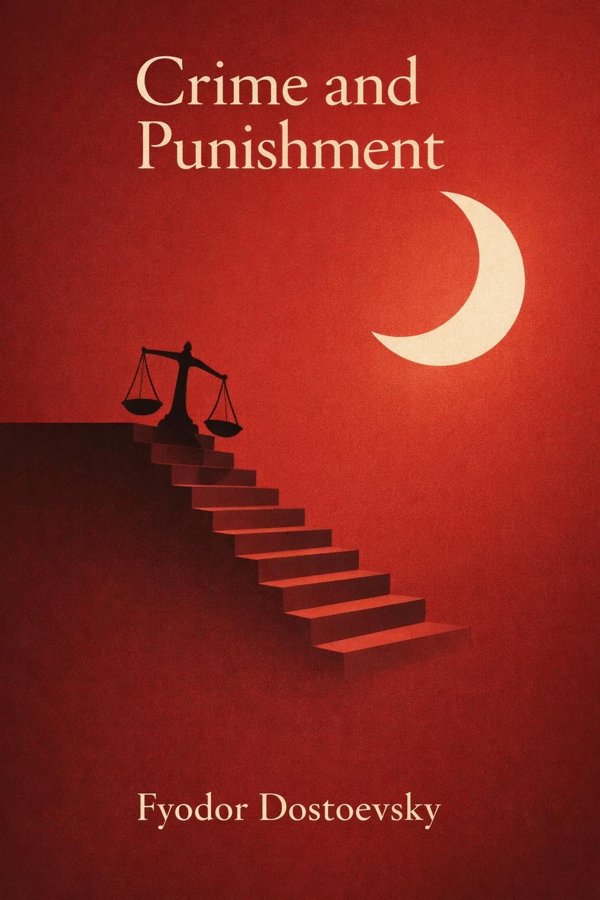
Crime and Punishment: Summary & Key Insights
 10 min9 chaptersAudio available
Key Takeaways from Crime and Punishment
A destructive act often begins long before the act itself, in the quiet acceptance of a dangerous idea.
The most relentless punishment is often internal rather than legal.
Pride does not always look like confidence; sometimes it looks like withdrawal, contempt, and a refusal to need anyone.
Pain does not automatically make people wiser, but it can become the ground of transformation when it is faced honestly.
When people are reduced to symbols, categories, or obstacles, cruelty becomes easier; compassion restores their full reality.
What Is Crime and Punishment About?
Crime and Punishment by Fyodor Dostoevsky is a general book. Crime and Punishment is one of the most penetrating novels ever written about guilt, morality, and the hidden motives that drive human behavior. Set in the oppressive heat and poverty of St. Petersburg, the story follows Rodion Raskolnikov, a former student who convinces himself that extraordinary people may step beyond ordinary moral laws. Acting on this idea, he commits a brutal crime and then discovers that intellectual justification offers no protection against conscience, fear, and spiritual collapse. What begins as a murder story becomes a profound psychological investigation into suffering, pride, alienation, and the possibility of redemption. Fyodor Dostoevsky matters because few writers have understood the contradictions of the human soul so deeply. Drawing on his own experiences with poverty, imprisonment, political persecution, and religious struggle, he created a novel that still feels startlingly modern. Crime and Punishment remains essential not only as a literary classic, but as a timeless study of how people rationalize wrongdoing, how guilt reshapes identity, and how truth can become the first step toward renewal.
This FizzRead summary covers all 9 key chapters of Crime and Punishment in approximately 10 minutes, distilling the most important ideas, arguments, and takeaways from Fyodor Dostoevsky's work. Also available as an audio summary and Key Quotes Podcast.
Crime and Punishment
Crime and Punishment is one of the most penetrating novels ever written about guilt, morality, and the hidden motives that drive human behavior. Set in the oppressive heat and poverty of St. Petersburg, the story follows Rodion Raskolnikov, a former student who convinces himself that extraordinary people may step beyond ordinary moral laws. Acting on this idea, he commits a brutal crime and then discovers that intellectual justification offers no protection against conscience, fear, and spiritual collapse. What begins as a murder story becomes a profound psychological investigation into suffering, pride, alienation, and the possibility of redemption. Fyodor Dostoevsky matters because few writers have understood the contradictions of the human soul so deeply. Drawing on his own experiences with poverty, imprisonment, political persecution, and religious struggle, he created a novel that still feels startlingly modern. Crime and Punishment remains essential not only as a literary classic, but as a timeless study of how people rationalize wrongdoing, how guilt reshapes identity, and how truth can become the first step toward renewal.
Who Should Read Crime and Punishment?
This book is perfect for anyone interested in general and looking to gain actionable insights in a short read. Whether you're a student, professional, or lifelong learner, the key ideas from Crime and Punishment by Fyodor Dostoevsky will help you think differently.
- ✓Readers who enjoy general and want practical takeaways
- ✓Professionals looking to apply new ideas to their work and life
- ✓Anyone who wants the core insights of Crime and Punishment in just 10 minutes
Want the full summary?
Get instant access to this book summary and 100K+ more with Fizz Moment.
Get Free SummaryAvailable on App Store • Free to download
Key Chapters
A destructive act often begins long before the act itself, in the quiet acceptance of a dangerous idea. In Crime and Punishment, Raskolnikov does not commit murder in a sudden burst of passion alone; he prepares for it intellectually. He develops a theory that humanity is divided into ordinary people, who must obey moral law, and extraordinary people, who may violate it if doing so serves a higher purpose. This belief allows him to imagine that murder might be justified, even admirable, if it removes a harmful person and benefits others.
Dostoevsky shows how abstract theories can detach a person from human reality. Raskolnikov reduces the pawnbroker to a function rather than seeing her as a living person. Once morality becomes a calculation, cruelty can appear logical. The novel is not merely attacking philosophy; it is exposing what happens when ideas are used to silence empathy. Raskolnikov wants to prove his own greatness, but he disguises that personal ambition as moral reasoning.
This dynamic remains familiar. People still justify harmful choices with language about efficiency, necessity, or the greater good. In workplaces, leaders may excuse exploitation by calling it strategy. In personal life, someone may rationalize betrayal because they think the outcome will be beneficial. The pattern is the same: a theory is used to numb conscience.
Dostoevsky’s warning is practical. Before defending a harsh decision, ask whether the reasoning respects human dignity or merely protects pride. The actionable takeaway: when an idea makes compassion feel irrelevant, stop and examine the idea before it turns into action.
The most relentless punishment is often internal rather than legal. After the murder, Raskolnikov does not become triumphant, liberated, or powerful. Instead, he descends into confusion, fever, paranoia, and isolation. His real sentence begins immediately, not in a prison camp but in his own mind. Dostoevsky makes guilt feel almost physical: disorientation, sudden panic, fragmented speech, and the constant fear of exposure. The crime cannot stay in the past because conscience keeps dragging it into the present.
This is one of the novel’s most enduring insights. People often imagine wrongdoing in practical terms: Can I get away with it? Will anyone find out? Crime and Punishment insists that these questions are too narrow. Even if external consequences are delayed, the self may begin to fracture. Raskolnikov’s intellect had told him he could rise above morality, but his psyche refuses to cooperate. He remains human, and that humanity becomes his torment.
Dostoevsky also suggests that guilt can be revealing. It exposes values we tried to deny. Raskolnikov’s suffering proves that he is not the cold superior being he hoped to become. His pain is terrible, but it also points toward truth.
In ordinary life, this lesson extends far beyond criminal acts. Dishonesty in relationships, deception at work, or betrayal of one’s principles may not bring immediate public consequences, but they often create anxiety, defensiveness, and self-contempt. The actionable takeaway: do not measure your actions only by whether others will condemn them; measure them by whether you can live honestly with yourself afterward.
Pride does not always look like confidence; sometimes it looks like withdrawal, contempt, and a refusal to need anyone. Raskolnikov isolates himself from friends, family, and society not simply because he is poor or distressed, but because his pride depends on separation. He wants to stand above others, to judge them, and to prove his exceptional nature. That desire cuts him off from the very relationships that might have steadied him. The more he protects his superiority, the more lonely and unstable he becomes.
Dostoevsky treats pride as a moral and psychological sickness. It narrows perception, making other people seem small, irritating, or irrelevant. Raskolnikov’s interactions often swing between tenderness and cruelty because he is torn between his buried need for connection and his determination not to admit that need. His suffering grows in part because he cannot accept humility. To confess would be to surrender his fantasy of being above ordinary moral life.
This idea still matters. Many people hide vulnerability behind intellectual superiority, sarcasm, or emotional distance. A person may refuse help because accepting it feels weak. A manager may stop listening because they believe they already know better. A student may reject correction because identity has become tied to being exceptional. In each case, pride damages judgment and relationships.
The novel proposes that genuine strength begins where pride ends. Human beings are not diminished by dependence, empathy, or accountability; they are stabilized by them. The actionable takeaway: notice where the need to appear superior is preventing honest connection, and practice one act of humility by asking for help, admitting fault, or truly listening.
Pain does not automatically make people wiser, but it can become the ground of transformation when it is faced honestly. Crime and Punishment is full of suffering: poverty, humiliation, exploitation, illness, and moral anguish. Dostoevsky does not romanticize this pain. He shows its ugliness and its waste. Yet he also explores how suffering, when accepted rather than denied, can break through self-deception. Raskolnikov suffers because he resists truth. Others, especially Sonya, suffer under social injustice yet retain compassion and moral clarity.
The contrast matters. Raskolnikov initially treats suffering as something to escape through grand theory and domination. Sonya endures suffering with humility and love, not because her life is easy, but because she remains connected to others and to moral reality. Through her, Dostoevsky suggests that the meaning of suffering depends partly on one’s response to it. It can harden the soul into bitterness, or it can open the way to repentance, empathy, and renewal.
Modern readers may apply this insight carefully. Hardship in itself is not noble, and no one should glorify trauma. But when pain arrives, denial and resentment are rarely enough. People often begin to heal when they stop pretending they are untouched and instead seek meaning, support, and honesty. Grief counseling, honest conversation, spiritual practice, and accountability can turn suffering into a site of growth.
Dostoevsky’s point is demanding but hopeful: pain becomes transformative when it leads us out of illusion. The actionable takeaway: when facing hardship, ask not only how to escape it, but what truth it is forcing you to confront and what response would move you toward integrity.
When people are reduced to symbols, categories, or obstacles, cruelty becomes easier; compassion restores their full reality. Throughout Crime and Punishment, St. Petersburg is crowded with the desperate poor, the humiliated, and the morally compromised. Yet Dostoevsky refuses to treat them as scenery. Characters such as Sonya, Marmeladov, Dunya, and Razumikhin reveal a world in which every person carries suffering, dignity, and contradiction. This matters because Raskolnikov’s crime depends on abstraction. He can kill only by turning a person into an idea.
Compassion is the novel’s corrective force. Sonya, in particular, represents a kind of radical moral presence. She sees Raskolnikov clearly, including his horror, but does not withdraw her recognition of his humanity. Her compassion is not approval; it is steadfast acknowledgment. That makes confession possible. Dostoevsky suggests that people are more likely to face truth when they encounter mercy without denial.
In practical life, compassion does not mean abandoning judgment or standards. It means refusing to let judgment erase personhood. A teacher can discipline a student while still seeing fear beneath the behavior. A leader can address failure without humiliating an employee. A family member can confront wrongdoing while preserving the possibility of repair. Compassion is powerful because it interrupts the logic of dehumanization.
The novel argues that moral recovery depends not only on law or logic, but on relationship. People often change when they are seen fully rather than dismissed entirely. The actionable takeaway: in your next conflict, deliberately describe the other person as a human being with pressures, fears, and dignity before deciding how to respond.
Secrets promise control, but they usually deepen bondage. For much of the novel, Raskolnikov tries to preserve himself through concealment. He avoids direct admission, speaks in fragments, and clings to the belief that if he can outthink suspicion, he can survive intact. Yet concealment only intensifies his suffering. The hidden crime colonizes every conversation and every silence. He is never fully present because he is always protecting the lie.
Dostoevsky presents confession not as humiliation alone, but as a necessary act of liberation. To confess is to align speech with reality. That alignment is painful because it destroys false self-images. Raskolnikov must surrender his fantasy of being extraordinary, self-sufficient, and beyond moral law. But in losing that illusion, he begins to recover the possibility of a real life. The punishment of truth is severe, yet it is less destructive than the endless burden of concealment.
This idea applies well beyond dramatic crimes. People hide addiction, financial problems, betrayal, resentment, or failure because exposure feels unbearable. Often the secret seems safer than the consequences of honesty. But the cost of secrecy includes anxiety, fragmentation, and emotional distance. Confession to the right person, in the right setting, can be the first practical step toward repair, treatment, forgiveness, or accountability.
Dostoevsky does not say confession solves everything immediately. It begins a process. But without it, transformation remains blocked. The actionable takeaway: identify one truth you are managing through avoidance and take a concrete step toward honest disclosure, whether through a conversation, a written admission, or professional help.
Brilliance can analyze a moral crisis without resolving it. Raskolnikov is intelligent, observant, and capable of intricate reasoning, yet his intelligence does not save him. In fact, it often worsens his condition by giving him more tools for rationalization. He can explain, argue, and reinterpret, but he cannot think his way out of a shattered moral reality. Dostoevsky is challenging the belief that intellect alone is enough to govern a human life.
The novel repeatedly contrasts cleverness with wisdom. Raskolnikov’s mind is agile, but his heart is divided. He understands arguments, not himself. By comparison, characters with less theoretical sophistication often possess greater moral clarity. Sonya’s wisdom comes from humility, suffering, and faithfulness rather than from abstract systems. Razumikhin’s decency appears simple, yet it is sturdier than Raskolnikov’s grand ideas.
This is deeply relevant in a culture that often prizes being right over being good. A person can win every debate and still avoid responsibility. Professionals may use expertise to excuse unethical practices. Individuals may hide emotional immaturity behind articulate language. Intelligence is valuable, but when separated from humility, conscience, and compassion, it can become a servant of self-deception.
Dostoevsky’s insight is not anti-intellectual. It is an argument for integrated human development. Knowledge should deepen responsibility, not replace it. The actionable takeaway: when evaluating a decision, ask not only whether it is logically defensible, but whether it reflects honesty, humility, and care for others.
Personal choices never occur in a vacuum; they are shaped by the social world in which people struggle to survive. Crime and Punishment is intensely psychological, but it is also deeply social. St. Petersburg appears as a city of cramped rooms, hunger, debt, drunkenness, exploitation, and humiliation. Raskolnikov’s crime cannot be reduced to poverty, yet poverty forms the atmosphere in which desperation, resentment, and distorted thinking grow. Dostoevsky insists on individual responsibility while refusing to ignore social misery.
This balance is one of the novel’s strengths. It does not excuse wrongdoing by blaming society, nor does it pretend that moral life is untouched by material conditions. The vulnerable characters around Raskolnikov show how economic precarity can pressure people into impossible choices. Sonya is driven into prostitution to support her family. Marmeladov destroys himself in drink. Dunya faces predatory power dressed up as opportunity. The city itself becomes a moral pressure cooker.
Readers can apply this insight by resisting simplistic judgments. When people fail, it is worth asking both what they chose and what pressures shaped those choices. In public life, this means caring about housing, wages, addiction treatment, education, and mental health. In personal life, it means recognizing how stress, insecurity, and humiliation can distort behavior without erasing accountability.
Dostoevsky asks us to think morally and socially at once. Justice becomes wiser when it considers circumstances without surrendering standards. The actionable takeaway: when judging a harmful act, examine both the person’s responsibility and the conditions that may have narrowed their sense of possibility.
The novel’s deepest claim is that a broken life is not beyond renewal. Crime and Punishment is dark, tense, and often suffocating, but it does not end in pure despair. After confession and punishment, Raskolnikov enters the possibility of moral rebirth. This change is not sentimental or immediate. Dostoevsky avoids the false comfort of instant healing. Instead, he suggests that renewal begins slowly, through humility, suffering accepted, and the awakening of love.
What changes in Raskolnikov is not merely his legal status but his relation to reality. He begins to move away from abstraction, self-worship, and emotional deadness. Sonya’s faithful presence helps make this possible, but the change must become his own. Rebirth in Dostoevsky is not self-improvement in a modern productivity sense. It is a profound reorientation of the soul: from pride to humility, from isolation to connection, and from rationalization to truth.
This theme explains why the novel still resonates. Many readers recognize the feeling of having betrayed their values, damaged relationships, or built a false self. The book offers neither easy absolution nor fatalism. It proposes that transformation is possible, but only through honesty and surrender.
In practical terms, moral rebirth may look like repair after addiction, rebuilding trust after deception, or choosing a more truthful life after years of self-protection. Change is often slow, embodied, and relational. The actionable takeaway: if you are facing the consequences of your own failures, do not ask only whether life can return to normal; ask what new, more truthful self those consequences might help you begin to become.
All Chapters in Crime and Punishment
About the Author
Fyodor Dostoevsky was a Russian novelist born in 1821 and is widely considered one of the greatest psychological writers in literary history. His life was marked by hardship and upheaval: he was arrested for political activities, sentenced to death, reprieved at the last moment, and sent to Siberian imprisonment and exile. He also struggled with poverty, epilepsy, and personal loss. These experiences profoundly shaped his fiction, which explores guilt, freedom, suffering, faith, and the complexities of the human soul. Dostoevsky’s major works include Crime and Punishment, The Idiot, Demons, Notes from Underground, and The Brothers Karamazov. His influence extends far beyond literature, shaping modern psychology, philosophy, theology, and existential thought.
Get This Summary in Your Preferred Format
Read or listen to the Crime and Punishment summary by Fyodor Dostoevsky anytime, anywhere. FizzRead offers multiple formats so you can learn on your terms — all free.
Available formats: App · Audio · PDF · EPUB — All included free with FizzRead
Download Crime and Punishment PDF and EPUB Summary
Key Quotes from Crime and Punishment
“A destructive act often begins long before the act itself, in the quiet acceptance of a dangerous idea.”
“The most relentless punishment is often internal rather than legal.”
“Pride does not always look like confidence; sometimes it looks like withdrawal, contempt, and a refusal to need anyone.”
“Pain does not automatically make people wiser, but it can become the ground of transformation when it is faced honestly.”
“When people are reduced to symbols, categories, or obstacles, cruelty becomes easier; compassion restores their full reality.”
Frequently Asked Questions about Crime and Punishment
Crime and Punishment by Fyodor Dostoevsky is a general book that explores key ideas across 9 chapters. Crime and Punishment is one of the most penetrating novels ever written about guilt, morality, and the hidden motives that drive human behavior. Set in the oppressive heat and poverty of St. Petersburg, the story follows Rodion Raskolnikov, a former student who convinces himself that extraordinary people may step beyond ordinary moral laws. Acting on this idea, he commits a brutal crime and then discovers that intellectual justification offers no protection against conscience, fear, and spiritual collapse. What begins as a murder story becomes a profound psychological investigation into suffering, pride, alienation, and the possibility of redemption. Fyodor Dostoevsky matters because few writers have understood the contradictions of the human soul so deeply. Drawing on his own experiences with poverty, imprisonment, political persecution, and religious struggle, he created a novel that still feels startlingly modern. Crime and Punishment remains essential not only as a literary classic, but as a timeless study of how people rationalize wrongdoing, how guilt reshapes identity, and how truth can become the first step toward renewal.
Compare Crime and Punishment
More by Fyodor Dostoevsky

You Might Also Like
Duct Tape Marketing: The World's Most Practical Small Business Marketing Guide
John Jantsch
10 minDusk, Night, Dawn: On Revival and Courage
Anne Lamott
10 minFinish Big: How Great Entrepreneurs Exit Their Companies on Top
Bo Burlingham
10 minFirst As Tragedy, Then As Farce
Slavoj Zizek
10 minFirst Principles: What America's Founders Learned from the Greeks and Romans and How That Shaped Our Country
Thomas E. Ricks
10 minGood Habits, Bad Habits: The Science of Making Positive Changes That Stick
Wendy Wood
10 minFeatured In
Jordan Peterson's Book Picks
Jordan Peterson's Essential Reading for Finding Meaning
Robert Greene's Book Picks
Robert Greene's Essential Reading List
Stephen King's Book Picks
Stephen King's Must-Read Books
Curated's Book Picks
Best Classic Novels Everyone Should Read
Curated's Book Picks
Must-Read Books Before You Die — The Essential List
Browse by Category
Ready to read Crime and Punishment?
Get the full summary and 100K+ more books with Fizz Moment.