
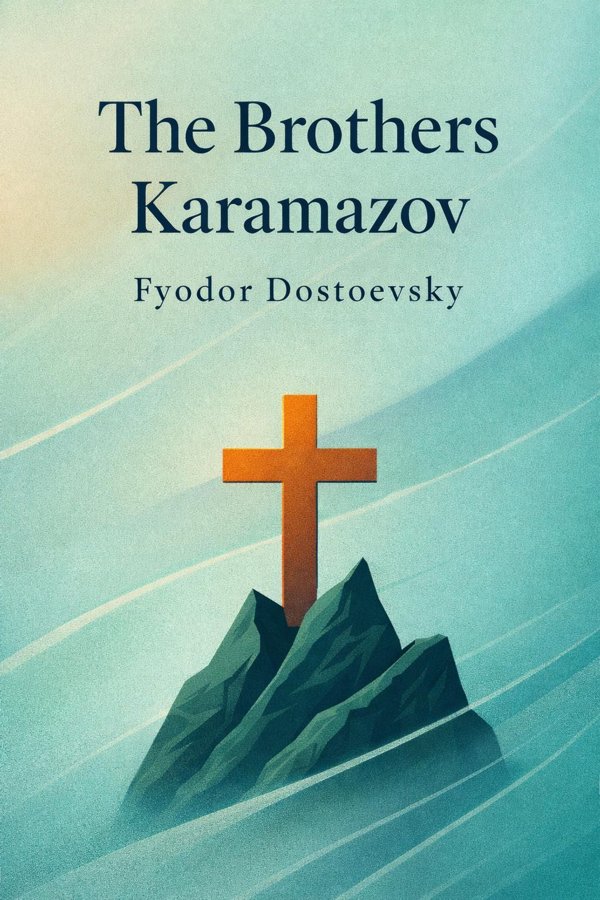
The Brothers Karamazov: Summary & Key Insights
 10 min9 chaptersAudio available
Key Takeaways from The Brothers Karamazov
Sometimes a family reveals more about human nature than any philosophy textbook.
Human beings often demand freedom, but Dostoevsky asks a harder question: freedom for what?
It is easy to discuss morality in the abstract; it is much harder to defend meaning in the face of innocent suffering.
One of Dostoevsky’s most radical ideas is that each person is responsible not only for personal sins but, in some mysterious way, for everyone else.
Intelligence can expose illusions, but it cannot by itself teach a person how to live.
What Is The Brothers Karamazov About?
The Brothers Karamazov by Fyodor Dostoevsky is a general book. Few novels ask larger questions than The Brothers Karamazov. On its surface, Fyodor Dostoevsky’s final masterpiece is a family drama: a violent, greedy father is hated by his sons, rivalries intensify, and a murder shatters what little order remains. But beneath that gripping plot lies one of literature’s deepest explorations of faith, doubt, justice, guilt, freedom, morality, and the possibility of redemption. Through the contrasting personalities of Dmitri, Ivan, and Alyosha Karamazov, Dostoevsky turns one broken family into a portrait of the human soul itself. First published in 1880, the novel remains astonishingly modern because it confronts questions that still unsettle us: If God is absent, what guides our choices? Can reason alone sustain morality? Why do innocent people suffer? Are we responsible only for our own actions, or also for the pain we ignore in others? Dostoevsky writes with unusual authority because his own life was marked by political persecution, exile, poverty, illness, and profound spiritual struggle. The result is not merely a great Russian novel, but a timeless investigation into what it means to be human when love, desire, intellect, and conscience pull in different directions.
This FizzRead summary covers all 9 key chapters of The Brothers Karamazov in approximately 10 minutes, distilling the most important ideas, arguments, and takeaways from Fyodor Dostoevsky's work. Also available as an audio summary and Key Quotes Podcast.
The Brothers Karamazov
Few novels ask larger questions than The Brothers Karamazov. On its surface, Fyodor Dostoevsky’s final masterpiece is a family drama: a violent, greedy father is hated by his sons, rivalries intensify, and a murder shatters what little order remains. But beneath that gripping plot lies one of literature’s deepest explorations of faith, doubt, justice, guilt, freedom, morality, and the possibility of redemption. Through the contrasting personalities of Dmitri, Ivan, and Alyosha Karamazov, Dostoevsky turns one broken family into a portrait of the human soul itself.
First published in 1880, the novel remains astonishingly modern because it confronts questions that still unsettle us: If God is absent, what guides our choices? Can reason alone sustain morality? Why do innocent people suffer? Are we responsible only for our own actions, or also for the pain we ignore in others? Dostoevsky writes with unusual authority because his own life was marked by political persecution, exile, poverty, illness, and profound spiritual struggle. The result is not merely a great Russian novel, but a timeless investigation into what it means to be human when love, desire, intellect, and conscience pull in different directions.
Who Should Read The Brothers Karamazov?
This book is perfect for anyone interested in general and looking to gain actionable insights in a short read. Whether you're a student, professional, or lifelong learner, the key ideas from The Brothers Karamazov by Fyodor Dostoevsky will help you think differently.
- ✓Readers who enjoy general and want practical takeaways
- ✓Professionals looking to apply new ideas to their work and life
- ✓Anyone who wants the core insights of The Brothers Karamazov in just 10 minutes
Want the full summary?
Get instant access to this book summary and 100K+ more with Fizz Moment.
Get Free SummaryAvailable on App Store • Free to download
Key Chapters
Sometimes a family reveals more about human nature than any philosophy textbook. In The Brothers Karamazov, Dostoevsky builds the novel around one corrupt household: the vulgar, selfish father Fyodor Pavlovich and his sons Dmitri, Ivan, Alyosha, and the shadowy Smerdyakov. Their conflicts are personal, but they also represent clashing moral and spiritual forces. The family becomes a laboratory for examining desire, resentment, faith, pride, longing, and guilt.
Dmitri is impulsive and passionate, constantly torn between sensual appetite and noble feeling. Ivan is intellectual, skeptical, and morally serious, yet trapped in his own arguments. Alyosha is compassionate, spiritually grounded, and committed to love in action. Smerdyakov embodies bitterness, humiliation, and dangerous nihilism. Together they are not just individuals; they are fragments of the human condition. Dostoevsky suggests that every person contains some mixture of appetite, intellect, tenderness, and resentment.
This is why the novel feels so psychologically rich. The murder mystery matters, but the deeper story is how character and belief shape action long before the crime occurs. Families often serve as places where buried values are exposed under pressure. Old grievances, favoritism, inheritance disputes, and emotional neglect can reveal what people truly worship: money, power, recognition, pleasure, certainty, or love.
In practical terms, the novel invites readers to look at their own relationships not only as emotional histories but as moral environments. In a workplace, a marriage, or a parent-child bond, repeated contempt and selfishness do not stay private; they spread. Likewise, patience, honesty, and mercy influence others in unseen ways.
Actionable takeaway: Examine one strained relationship in your life and ask what deeper values are actually colliding beneath the surface. Address the value conflict, not just the latest argument.
Human beings often demand freedom, but Dostoevsky asks a harder question: freedom for what? One of the central tensions in The Brothers Karamazov is whether people can live freely without any higher moral responsibility. Ivan’s intellectual rebellion against religious belief opens a space where traditional moral limits lose their authority. In that vacuum, freedom risks turning from dignity into destruction.
The novel does not argue against freedom itself. Rather, it warns that freedom detached from conscience, humility, and accountability can justify almost anything. If no transcendent meaning exists, and if human desire becomes the only law, then cruelty can be rationalized, betrayal can be explained away, and even murder can begin to look like a logical outcome rather than a moral horror. Smerdyakov becomes a chilling example of this danger: he takes abstract ideas about moral permission and converts them into action.
Dostoevsky is especially sharp in showing how people hide behind theories to avoid responsibility. This is not limited to religion or atheism. In everyday life, people can excuse harmful behavior with phrases like “I’m just being honest,” “Everyone does it,” or “I need to do what’s best for me.” Freedom becomes a slogan that masks selfishness. Real freedom, the novel suggests, includes the ability to restrain oneself, care for others, and choose the good even when no one is forcing it.
This idea remains deeply relevant in modern life. Digital culture celebrates self-expression, individual choice, and personal autonomy, yet many people feel more fragmented and less grounded than ever. Choice alone does not create meaning. Values, commitments, and obligations do.
Actionable takeaway: The next time you defend a decision as “my choice,” add a second question: does this choice also serve truth, responsibility, and the well-being of others?
It is easy to discuss morality in the abstract; it is much harder to defend meaning in the face of innocent suffering. One of the most powerful elements of The Brothers Karamazov is Ivan’s protest against a world in which children suffer. His rebellion is not shallow disbelief but a serious ethical challenge. He cannot accept a cosmic harmony purchased at the price of innocent pain. In raising this objection, Dostoevsky gives one of literature’s strongest expressions of moral outrage.
The novel does not dismiss Ivan. In fact, it respects the force of his argument. This is part of what makes Dostoevsky so compelling: he does not create weak objections to faith, only to refute them easily. He stages the deepest possible conflict between reason and belief, justice and mercy, outrage and hope. Alyosha, shaped by the teachings of Elder Zosima, does not defeat Ivan with logic. Instead, he responds through compassion, presence, and a vision of love that bears suffering rather than explaining it away.
This tension matters because many readers wrestle with similar questions. Why do good people suffer? Why do children endure cruelty? Why does injustice seem so arbitrary? The novel suggests that intellectual answers alone may never satisfy the heart. At the same time, emotional anguish cannot simply erase the search for meaning. Human beings live in the painful space between protest and trust.
In everyday life, this appears when someone faces illness, grief, or betrayal. Platitudes usually fail. What helps more is moral presence: listening, mourning with others, refusing indifference, and acting where one can. Dostoevsky implies that while suffering may resist explanation, it still demands response.
Actionable takeaway: When confronted by someone’s pain, resist the urge to explain it quickly. Offer attention, concrete help, and honest compassion before offering interpretations.
Intelligence can expose illusions, but it cannot by itself teach a person how to live. Ivan Karamazov is among Dostoevsky’s greatest portraits of the brilliant mind in spiritual crisis. He sees hypocrisy clearly, rejects easy consolations, and refuses sentimental faith. Yet his intellect, for all its power, leaves him isolated and inwardly tormented. He can deconstruct belief, but he cannot construct peace.
Dostoevsky does not attack reason itself. The novel is full of argument, analysis, and serious philosophical inquiry. What he challenges is the assumption that human beings are satisfied by logic alone. People also need love, trust, belonging, moral purpose, and a way to endure guilt and suffering. Without these, intelligence can become corrosive, turning endlessly against itself.
This is especially visible in the contrast between Ivan and Alyosha. Alyosha is not anti-intellectual; he simply understands that truth must be lived, not only argued. The most important realities in the novel, such as forgiveness, compassion, and spiritual renewal, are grasped through relationship and action as much as through theory.
The insight remains relevant in highly analytical environments. A person may excel academically, professionally, or intellectually while privately feeling empty. Information is abundant, but wisdom is scarce. Many modern people can explain their worldview in detail yet still struggle to answer basic existential questions: What is worth loving? What obligations do I accept? How should I live when no answer feels certain?
Dostoevsky’s answer is not to abandon thought but to join thought with moral practice. Understanding deepens when it is embodied.
Actionable takeaway: Pair one intellectual belief you hold strongly with a concrete habit that expresses it. If you value human dignity, practice it today through patience, generosity, or attentive listening.
Many people admire humanity in general but struggle to love the person directly in front of them. The Brothers Karamazov repeatedly exposes this gap between idealized love and lived love. Through Elder Zosima’s teachings and Alyosha’s example, Dostoevsky distinguishes abstract love for mankind from active love for actual people, who are inconvenient, flawed, needy, repetitive, and sometimes deeply irritating.
Abstract love is emotionally satisfying because it asks little. A person can speak warmly about justice, compassion, or human brotherhood while remaining impatient, proud, or cold in daily interactions. Active love is harder because it requires sacrifice, humility, and endurance. It means forgiving someone who disappoints you, caring for someone whose suffering disrupts your plans, or treating a difficult person with dignity rather than contempt.
Dostoevsky suggests that spiritual life is tested here, not in grand declarations. Alyosha’s goodness matters because it is embodied in attention, gentleness, and presence. He does not merely hold noble ideas; he steps into conflict, grief, and confusion with a willingness to serve. The novel thus shifts the moral focus from emotion to practice.
This applies powerfully today. It is easy to post public compassion and still fail at private kindness. Someone may support worthy causes yet neglect family, coworkers, or neighbors. Real moral growth often begins not in dramatic heroism but in consistent everyday conduct.
To practice active love, think smaller and more concretely. Return a difficult message with patience. Visit someone lonely. Apologize without defending yourself. Speak respectfully when irritation would be easier. These actions may seem minor, but Dostoevsky treats them as spiritually serious.
Actionable takeaway: Choose one person who is hard for you to love and perform one concrete act of patient care this week, without expecting gratitude or recognition.
People often fear punishment, but Dostoevsky shows that unacknowledged guilt can be even more unbearable. In The Brothers Karamazov, guilt moves through the novel in obvious and hidden forms. Some characters are legally accused, others are morally compromised, and still others suffer because they know they have contributed to evil indirectly. The story reveals that guilt is not just a courtroom matter; it is a spiritual and psychological force.
Dmitri’s situation is especially striking. Though he may not be guilty in the legal sense of the central crime, he recognizes that his life has been full of reckless passions, violence, and dark wishes. He feels condemned not only by events but by his own character. Ivan also faces a different kind of guilt: the torment of ideas and omissions, the sense that one can participate in evil without physically committing it. Dostoevsky’s point is that conscience is broader than law.
At the same time, the novel does not present guilt as purely destructive. Guilt can become the beginning of truth. A person who admits wrongdoing becomes capable of repentance, change, and deeper humility. The refusal of guilt, by contrast, hardens the soul. Self-justification may feel protective, but it blocks transformation.
In ordinary life, this matters in relationships, leadership, parenting, and public life. Many conflicts persist because people want innocence more than truth. They minimize harm, shift blame, or hide behind technicalities. Yet healing usually begins when someone says, without excuse, “I was wrong.”
Dostoevsky does not romanticize pain, but he suggests that honest remorse can cleanse what denial only festers.
Actionable takeaway: Name one wrongdoing you have rationalized. Write a clear sentence admitting it without qualifications, then decide what repair, apology, or change would honor that truth.
Courts seek facts, but novels often reveal how messy truth really is. In The Brothers Karamazov, the legal proceedings surrounding Fyodor Pavlovich’s murder show how justice systems can be dramatic, persuasive, and deeply flawed at the same time. Evidence, rhetoric, prejudice, personality, and public emotion all shape the outcome. Dostoevsky is fascinated by the gap between formal judgment and moral reality.
The trial is not merely a plot device. It becomes a broader critique of society’s hunger for neat narratives. People prefer coherent stories to complicated truths. Dmitri is passionate, reckless, and publicly explosive, so he appears guilty in a way that fits expectations. Once a person seems to match the role of criminal, every gesture reinforces the accusation. Meanwhile, deeper motives and less visible actors are harder to recognize.
This dynamic remains familiar. In workplaces, online controversies, politics, and personal disputes, people often decide first and interpret evidence second. Charisma can influence credibility. Bias can shape perception. Surface behavior can overshadow substance. Dostoevsky warns that justice requires humility because appearances are powerful and often misleading.
Yet the novel does not descend into total cynicism. It still affirms the necessity of judgment, law, and moral seriousness. The point is not that truth is unknowable, but that human institutions are limited. Therefore they must be approached with caution, scrutiny, and awareness of their blind spots.
Practically, this insight encourages slower judgment. Before concluding that someone is entirely innocent or entirely guilty, ask what assumptions are guiding your interpretation. Seek more than the most emotionally satisfying explanation.
Actionable takeaway: In the next conflict you evaluate, identify one fact, one assumption, and one missing perspective before deciding what is true.
In a novel crowded with violence, doubt, and despair, Dostoevsky still leaves room for hope. That hope does not arrive as simplistic optimism or guaranteed happy endings. Instead, it emerges through memory, shared suffering, moral growth, and the possibility of spiritual renewal. Alyosha’s interactions with children, especially near the novel’s end, reveal Dostoevsky’s belief that goodness survives when people remember moments of love and carry them into communal life.
This is a subtle but important conclusion. The world of The Brothers Karamazov is not magically repaired. Injustice remains. People suffer. Questions remain unresolved. Yet Dostoevsky insists that small acts of fidelity matter. A remembered kindness, a sincere word spoken at the right moment, or a community formed around grief and care can shape a person’s future more than abstract systems can.
Memory, in the novel, is not nostalgia. It is moral formation. To remember a moment of genuine love is to preserve proof that life contains meaning beyond cruelty. Community matters for the same reason. Isolated people are more vulnerable to despair, pride, and delusion. Shared life, even if fragile, helps anchor moral hope.
This insight has practical force today in an age of loneliness and fragmentation. People often look for transformation through major breakthroughs, but Dostoevsky points toward something steadier: keep company with the good, honor meaningful memories, and create circles of trust where truth and care can survive.
Hope is not denial of darkness. It is the refusal to let darkness define everything.
Actionable takeaway: Strengthen hope by preserving one meaningful memory in writing and sharing one sincere, encouraging conversation with someone who may need connection.
All Chapters in The Brothers Karamazov
About the Author
Fyodor Dostoevsky was a Russian novelist, journalist, and philosopher born in Moscow in 1821. He is celebrated for transforming the psychological and moral possibilities of fiction. Early in life he was arrested for involvement in a political discussion group, sentenced to death, and then reprieved at the last moment before being sent to Siberian prison camps and military exile. Those experiences profoundly shaped his understanding of suffering, freedom, guilt, and faith. Despite chronic illness, debt, and personal tragedy, he produced some of literature’s most influential works, including Notes from Underground, Crime and Punishment, The Idiot, Demons, and The Brothers Karamazov. His novels continue to influence writers, philosophers, theologians, and psychologists because of their unmatched insight into inner conflict and the search for redemption.
Get This Summary in Your Preferred Format
Read or listen to the The Brothers Karamazov summary by Fyodor Dostoevsky anytime, anywhere. FizzRead offers multiple formats so you can learn on your terms — all free.
Available formats: App · Audio · PDF · EPUB — All included free with FizzRead
Download The Brothers Karamazov PDF and EPUB Summary
Key Quotes from The Brothers Karamazov
“Sometimes a family reveals more about human nature than any philosophy textbook.”
“Human beings often demand freedom, but Dostoevsky asks a harder question: freedom for what?”
“It is easy to discuss morality in the abstract; it is much harder to defend meaning in the face of innocent suffering.”
“One of Dostoevsky’s most radical ideas is that each person is responsible not only for personal sins but, in some mysterious way, for everyone else.”
“Intelligence can expose illusions, but it cannot by itself teach a person how to live.”
Frequently Asked Questions about The Brothers Karamazov
The Brothers Karamazov by Fyodor Dostoevsky is a general book that explores key ideas across 9 chapters. Few novels ask larger questions than The Brothers Karamazov. On its surface, Fyodor Dostoevsky’s final masterpiece is a family drama: a violent, greedy father is hated by his sons, rivalries intensify, and a murder shatters what little order remains. But beneath that gripping plot lies one of literature’s deepest explorations of faith, doubt, justice, guilt, freedom, morality, and the possibility of redemption. Through the contrasting personalities of Dmitri, Ivan, and Alyosha Karamazov, Dostoevsky turns one broken family into a portrait of the human soul itself. First published in 1880, the novel remains astonishingly modern because it confronts questions that still unsettle us: If God is absent, what guides our choices? Can reason alone sustain morality? Why do innocent people suffer? Are we responsible only for our own actions, or also for the pain we ignore in others? Dostoevsky writes with unusual authority because his own life was marked by political persecution, exile, poverty, illness, and profound spiritual struggle. The result is not merely a great Russian novel, but a timeless investigation into what it means to be human when love, desire, intellect, and conscience pull in different directions.
Compare The Brothers Karamazov
More by Fyodor Dostoevsky

You Might Also Like
Duct Tape Marketing: The World's Most Practical Small Business Marketing Guide
John Jantsch
10 minDusk, Night, Dawn: On Revival and Courage
Anne Lamott
10 minFinish Big: How Great Entrepreneurs Exit Their Companies on Top
Bo Burlingham
10 minFirst As Tragedy, Then As Farce
Slavoj Zizek
10 minFirst Principles: What America's Founders Learned from the Greeks and Romans and How That Shaped Our Country
Thomas E. Ricks
10 minGood Habits, Bad Habits: The Science of Making Positive Changes That Stick
Wendy Wood
10 minFeatured In
Browse by Category
Ready to read The Brothers Karamazov?
Get the full summary and 100K+ more books with Fizz Moment.