
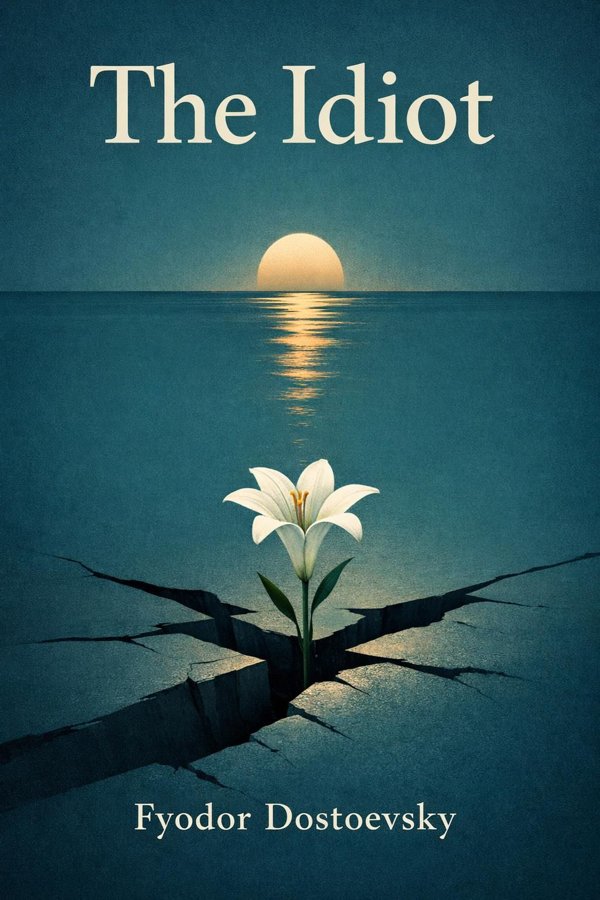
The Idiot: Summary & Key Insights
 10 min8 chaptersAudio available
Key Takeaways from The Idiot
Sometimes the clearest way to expose a corrupt world is not through rebellion, but through sincerity.
Good intentions are not always enough; without judgment and limits, compassion can deepen suffering instead of healing it.
People are often driven less by reason than by the memory of being shamed.
Beauty is never simple in Dostoevsky.
What people call love is often tangled with control, fantasy, fear, and wounded pride.
What Is The Idiot About?
The Idiot by Fyodor Dostoevsky is a general book. What happens when a genuinely good person enters a world organized around vanity, money, wounded pride, and desire? Fyodor Dostoevsky’s The Idiot answers that question through Prince Lev Myshkin, a gentle, epileptic young nobleman who returns to Russian society after years of medical treatment abroad. Often dismissed as naive because of his honesty and compassion, Myshkin becomes the moral center of a story filled with obsession, rivalry, humiliation, and spiritual longing. As he moves among the wealthy Yepanchin family, the tormented Nastasya Filippovna, and the passionate Parfyon Rogozhin, his presence exposes the hidden fears and contradictions of everyone around him. First published in 1868–1869, the novel remains one of Dostoevsky’s boldest experiments: a portrait of what Christ-like innocence might look like in modern society, and what such innocence would suffer there. Dostoevsky, one of world literature’s greatest psychological novelists, draws on deep insight into guilt, faith, love, and human contradiction. The Idiot matters because it asks whether purity can survive reality—or whether reality inevitably destroys it.
This FizzRead summary covers all 8 key chapters of The Idiot in approximately 10 minutes, distilling the most important ideas, arguments, and takeaways from Fyodor Dostoevsky's work. Also available as an audio summary and Key Quotes Podcast.
The Idiot
What happens when a genuinely good person enters a world organized around vanity, money, wounded pride, and desire? Fyodor Dostoevsky’s The Idiot answers that question through Prince Lev Myshkin, a gentle, epileptic young nobleman who returns to Russian society after years of medical treatment abroad. Often dismissed as naive because of his honesty and compassion, Myshkin becomes the moral center of a story filled with obsession, rivalry, humiliation, and spiritual longing. As he moves among the wealthy Yepanchin family, the tormented Nastasya Filippovna, and the passionate Parfyon Rogozhin, his presence exposes the hidden fears and contradictions of everyone around him. First published in 1868–1869, the novel remains one of Dostoevsky’s boldest experiments: a portrait of what Christ-like innocence might look like in modern society, and what such innocence would suffer there. Dostoevsky, one of world literature’s greatest psychological novelists, draws on deep insight into guilt, faith, love, and human contradiction. The Idiot matters because it asks whether purity can survive reality—or whether reality inevitably destroys it.
Who Should Read The Idiot?
This book is perfect for anyone interested in general and looking to gain actionable insights in a short read. Whether you're a student, professional, or lifelong learner, the key ideas from The Idiot by Fyodor Dostoevsky will help you think differently.
- ✓Readers who enjoy general and want practical takeaways
- ✓Professionals looking to apply new ideas to their work and life
- ✓Anyone who wants the core insights of The Idiot in just 10 minutes
Want the full summary?
Get instant access to this book summary and 100K+ more with Fizz Moment.
Get Free SummaryAvailable on App Store • Free to download
Key Chapters
Sometimes the clearest way to expose a corrupt world is not through rebellion, but through sincerity. In The Idiot, Prince Myshkin does not arrive in society with a program, an ideology, or a desire to dominate others. He simply speaks honestly, feels deeply, and responds to suffering with compassion. Yet this very openness unsettles nearly everyone he meets. People project weakness onto him because they cannot imagine goodness without hidden motives. Dostoevsky uses Myshkin to show that society often mistrusts purity more than vice.
Myshkin’s reputation as an “idiot” says less about his intelligence than about the values of the people judging him. He listens when others posture. He forgives when others calculate. He refuses to reduce people to status or scandal. In return, he is mocked, misunderstood, and drawn into emotional chaos. This dynamic reveals one of the novel’s central insights: a damaged society frequently labels moral clarity as foolishness because it threatens accepted forms of self-interest.
This idea remains practical today. In workplaces, friendships, or public life, straightforward kindness is often treated as naivety. A person who refuses gossip, competition, or manipulation can seem unrealistic. But Dostoevsky suggests that such people expose a deeper problem: many systems depend on distrust and performance. The truly disarming person is not the most aggressive one, but the one who cannot be easily absorbed into those games.
To apply this insight, notice when cynicism is being mistaken for wisdom. Ask whether a “realistic” attitude is actually just moral compromise. The actionable takeaway: treat sincerity as a form of strength, and do not let a cynical environment define compassion as stupidity.
Good intentions are not always enough; without judgment and limits, compassion can deepen suffering instead of healing it. Prince Myshkin is moved by the pain of nearly everyone around him, especially Nastasya Filippovna, whose life has been shaped by exploitation, shame, and self-destructive defiance. He wants to save her, comfort her, and affirm her dignity. At the same time, he is also drawn toward Aglaya Yepanchina, whose intelligence and pride offer the possibility of a different kind of life. Myshkin’s inability to choose clearly leaves both women, and himself, trapped in emotional uncertainty.
Dostoevsky does not mock compassion. On the contrary, he treats it as one of the highest human capacities. But he also shows that pity can blur into rescue fantasies, passivity, or indecision. Myshkin often responds to emotional crisis with tenderness, yet he struggles to establish stable boundaries or make decisive commitments. His kindness becomes entangled with others’ needs, obsessions, and projections. What begins as mercy turns into paralysis.
This insight has obvious modern relevance. Many people confuse being caring with being endlessly available. They stay in unhealthy relationships because they feel responsible for another person’s pain. They avoid difficult choices in order not to hurt anyone, only to create greater confusion. Compassion needs structure: honesty, boundaries, and the willingness to accept that you cannot save everyone.
In practical terms, helping someone may require saying no, stepping back, or refusing to participate in destructive cycles. Emotional generosity should not mean surrendering judgment. The actionable takeaway: pair empathy with clarity, and remember that real care often requires limits, not just feeling.
People are often driven less by reason than by the memory of being shamed. Throughout The Idiot, Dostoevsky shows how humiliation influences speech, desire, pride, and even violence. Characters do not merely want love, money, or status; they want relief from insult, exposure, and inner disgrace. Nastasya Filippovna, in particular, lives inside the wounds of public and private degradation. Her dramatic behavior, alternating between self-assertion and self-destruction, reflects a person who both rejects and reenacts the shame forced upon her.
Dostoevsky understood that humiliation is socially contagious. Once people feel diminished, they often seek to reverse the feeling through domination, theatrical gestures, cruelty, or self-sabotage. Rogozhin’s obsession carries the intensity of possessive pride. Social gatherings in the novel frequently become scenes of emotional brinkmanship, where beneath conversation lies fear of ridicule or rejection. Even apparently minor interactions are charged with the need to preserve dignity.
This insight helps explain many modern conflicts. A colleague lashes out not because of the issue at hand, but because they felt overlooked. A family dispute escalates because an old insult is reawakened. Social media magnifies this tendency, turning embarrassment into spectacle and defensiveness into performance. If we miss the role of humiliation, we misunderstand the emotional logic behind many destructive actions.
A practical response is to listen for injured dignity beneath aggression. This does not excuse harmful behavior, but it can reveal what is really happening. In your own life, ask whether a strong emotional reaction is tied to present reality or to an older wound. The actionable takeaway: treat humiliation as a powerful force in human behavior, and address dignity directly before conflict turns toxic.
Beauty is never simple in Dostoevsky. In The Idiot, it appears as something spiritually elevating, morally ambiguous, and dangerously powerful at the same time. Myshkin is drawn to beauty not merely as physical attractiveness, but as a sign of depth, suffering, and transcendence. Yet the novel repeatedly demonstrates that beauty, especially when mixed with desire and social competition, can trigger obsession, resentment, and ruin. No character embodies this more fully than Nastasya Filippovna, whose beauty gives her power but also turns her into an object of projection and possession.
Dostoevsky asks whether beauty can redeem the world or whether human beings inevitably corrupt what they admire. In principle, beauty can awaken reverence, compassion, and spiritual longing. In practice, people often respond to it by trying to own it, display it, or destroy it. This contradiction gives the novel much of its tension. Characters are not simply attracted to beauty; they are destabilized by it. It magnifies what is already inside them.
This idea matters beyond literature. Today, beauty is constantly packaged into image culture, branding, and status. People chase surfaces while neglecting character. At the same time, encounters with genuine beauty—art, nature, kindness, truthfulness—can interrupt routine and restore perspective. The question is what kind of response beauty calls forth in us: gratitude or possession, wonder or envy.
To apply this insight, pay attention to how you relate to what you find beautiful. Do you let it deepen your humanity, or turn it into comparison and craving? The actionable takeaway: seek forms of beauty that enlarge the soul, and resist the impulse to possess what should first be appreciated.
What people call love is often tangled with control, fantasy, fear, and wounded pride. The Idiot is filled with declarations of devotion, yet very little of what its characters experience is calm, mutual, or liberating. Rogozhin’s passion for Nastasya Filippovna is intense, consuming, and destructive. Myshkin’s love is tender but uncertain, mixed with pity and spiritual concern. Aglaya seeks an idealized form of love shaped by imagination and pride. Dostoevsky uses these competing attachments to ask a difficult question: how often is love really about seeing another person clearly?
One of the novel’s strongest insights is that people frequently love not the person before them, but a role that person plays in their inner drama. Someone becomes a savior, a victim, a conquest, a symbol of purity, or proof of self-worth. The beloved is then burdened with expectations no human being can meet. This is why relationships in the novel so often move toward crisis. They are structured by projection rather than understanding.
This dynamic is easy to recognize today. People enter relationships wanting healing, validation, or rescue. They confuse intensity with depth. They become attached to an idea of someone instead of the reality of that person’s complexity and freedom. Healthy love requires room for ambiguity, honesty, and the other person’s independence.
A useful practice is to ask what exactly you are seeking from love: companionship, rescue, admiration, security, transformation? The answer matters. Relationships become more stable when we are aware of our hidden motives. The actionable takeaway: examine whether your love is grounded in genuine recognition of another person, or in the need to possess, fix, or idealize them.
A polished appearance often counts for more than moral substance, and Dostoevsky saw this clearly. In The Idiot, social life is full of etiquette, reputation management, flirtation, strategic speech, and public scenes. Characters perform versions of themselves for one another, carefully managing impressions while concealing insecurity, greed, or desperation. Into this theatrical world steps Myshkin, whose refusal to perform makes him both magnetic and vulnerable. He speaks with startling directness, but directness does not grant him power. In fact, it often places him at a disadvantage.
The novel suggests that social settings frequently reward those who understand the rules of display. Wit, status, confidence, and emotional control shape how people are judged. Genuine truthfulness can look awkward because it interrupts the script. Myshkin’s honesty exposes others, but it does not protect him. He becomes a participant in dramas he barely wants, because the surrounding culture is better at spectacle than sincerity.
This observation feels contemporary in an era of branding, curated identities, and endless public self-presentation. Online and offline, people often learn to optimize how they are seen rather than who they are. Institutions may praise authenticity while actually rewarding strategic image management. Dostoevsky does not offer an easy escape from this condition, but he makes its cost visible: relationships become unstable, and inner life is subordinated to social theater.
In practical terms, this means cultivating environments where truth can be spoken without immediate punishment or ridicule. It also means noticing when you are editing yourself to fit expectations. The actionable takeaway: value substance over performance, and practice small acts of honest speech even in settings that prefer appearances.
Some of the novel’s most powerful moments suggest that suffering, while never desirable in itself, can strip away illusion and reveal what matters most. Dostoevsky does not romanticize pain in a simplistic way; his characters are wounded, confused, and often crushed by what they endure. Yet he repeatedly links extreme experiences—illness, shame, fear, approaching death—to moments of unusual clarity. Myshkin’s epilepsy, in particular, is associated with states of heightened perception, as though crisis can briefly illuminate truths ordinary life conceals.
This idea reflects Dostoevsky’s broader spiritual vision. Human beings often live distracted by vanity, ambition, and habit. Suffering interrupts these routines. It can reveal dependence, vulnerability, and the need for grace. In the novel, those closest to suffering are not automatically noble, but they are often closer to existential honesty. They cannot fully believe in society’s polite illusions, because pain has already exposed how fragile those illusions are.
Modern readers need not embrace suffering to learn from this insight. The practical lesson is that hardship often clarifies values. Serious illness, heartbreak, loss, or failure can force questions we would otherwise avoid: What do I actually believe? Whom do I love? What kind of life am I living? Such experiences can either harden us or deepen us.
A constructive approach is to reflect consciously during difficult periods instead of only trying to escape them. Journaling, conversation, prayer, or therapy can help turn pain into understanding. The actionable takeaway: when suffering arrives, ask not only how to endure it, but what it may be revealing about your life, priorities, and soul.
Moral beauty is moving, but innocence by itself may not be enough to withstand a disordered world. This is one of the most tragic and important lessons of The Idiot. Myshkin is arguably the most ethically admirable person in the novel: gentle, forgiving, nonjudgmental, and deeply responsive to suffering. Yet he cannot transform the social and emotional systems around him. His goodness affects people, sometimes profoundly, but it does not stop jealousy, obsession, manipulation, or catastrophe. Dostoevsky refuses the comforting fantasy that virtue automatically prevails.
This does not mean goodness is useless. On the contrary, Myshkin’s presence reveals truth and creates moments of grace that would otherwise not exist. But the novel insists that evil, confusion, and psychological damage are not dissolved simply by contact with innocence. Real life includes forces that compassion alone cannot neutralize: entrenched habits, trauma, pride, desire, and social pressure. The result is a deeply realistic spiritual tragedy.
For modern readers, this is an important corrective to simplistic optimism. Being kind, ethical, or emotionally intelligent does not guarantee good outcomes. Some situations require not only moral intention but also discernment, boundaries, timing, and institutional support. A healthy worldview combines compassion with realism about the complexity of people and systems.
This insight can help in leadership, caregiving, teaching, and relationships. Do good, but do not assume good intentions are self-executing. Learn the structures of the situation you are in. The actionable takeaway: keep your ideals, but strengthen them with judgment, boundaries, and practical wisdom if you want goodness to have lasting effect.
All Chapters in The Idiot
About the Author
Fyodor Dostoevsky was a Russian novelist, journalist, and thinker born in Moscow in 1821. He is considered one of the greatest psychological writers in literary history. His life was marked by dramatic hardship: he was arrested for political activity, sentenced to death, reprieved at the last moment, and sent to Siberian exile. He also struggled with epilepsy, grief, debt, and gambling addiction. These experiences shaped his intense interest in suffering, faith, freedom, guilt, and redemption. Dostoevsky’s major works include Crime and Punishment, The Brothers Karamazov, Demons, Notes from Underground, and The Idiot. His fiction combines philosophical depth with emotional and psychological realism, and his influence extends far beyond literature into philosophy, theology, and modern psychology.
Get This Summary in Your Preferred Format
Read or listen to the The Idiot summary by Fyodor Dostoevsky anytime, anywhere. FizzRead offers multiple formats so you can learn on your terms — all free.
Available formats: App · Audio · PDF · EPUB — All included free with FizzRead
Download The Idiot PDF and EPUB Summary
Key Quotes from The Idiot
“Sometimes the clearest way to expose a corrupt world is not through rebellion, but through sincerity.”
“Good intentions are not always enough; without judgment and limits, compassion can deepen suffering instead of healing it.”
“People are often driven less by reason than by the memory of being shamed.”
“In The Idiot, it appears as something spiritually elevating, morally ambiguous, and dangerously powerful at the same time.”
“What people call love is often tangled with control, fantasy, fear, and wounded pride.”
Frequently Asked Questions about The Idiot
The Idiot by Fyodor Dostoevsky is a general book that explores key ideas across 8 chapters. What happens when a genuinely good person enters a world organized around vanity, money, wounded pride, and desire? Fyodor Dostoevsky’s The Idiot answers that question through Prince Lev Myshkin, a gentle, epileptic young nobleman who returns to Russian society after years of medical treatment abroad. Often dismissed as naive because of his honesty and compassion, Myshkin becomes the moral center of a story filled with obsession, rivalry, humiliation, and spiritual longing. As he moves among the wealthy Yepanchin family, the tormented Nastasya Filippovna, and the passionate Parfyon Rogozhin, his presence exposes the hidden fears and contradictions of everyone around him. First published in 1868–1869, the novel remains one of Dostoevsky’s boldest experiments: a portrait of what Christ-like innocence might look like in modern society, and what such innocence would suffer there. Dostoevsky, one of world literature’s greatest psychological novelists, draws on deep insight into guilt, faith, love, and human contradiction. The Idiot matters because it asks whether purity can survive reality—or whether reality inevitably destroys it.
More by Fyodor Dostoevsky



You Might Also Like
Duct Tape Marketing: The World's Most Practical Small Business Marketing Guide
John Jantsch
10 minDusk, Night, Dawn: On Revival and Courage
Anne Lamott
10 minFinish Big: How Great Entrepreneurs Exit Their Companies on Top
Bo Burlingham
10 minFirst As Tragedy, Then As Farce
Slavoj Zizek
10 minFirst Principles: What America's Founders Learned from the Greeks and Romans and How That Shaped Our Country
Thomas E. Ricks
10 minGood Habits, Bad Habits: The Science of Making Positive Changes That Stick
Wendy Wood
10 minBrowse by Category
Ready to read The Idiot?
Get the full summary and 100K+ more books with Fizz Moment.