
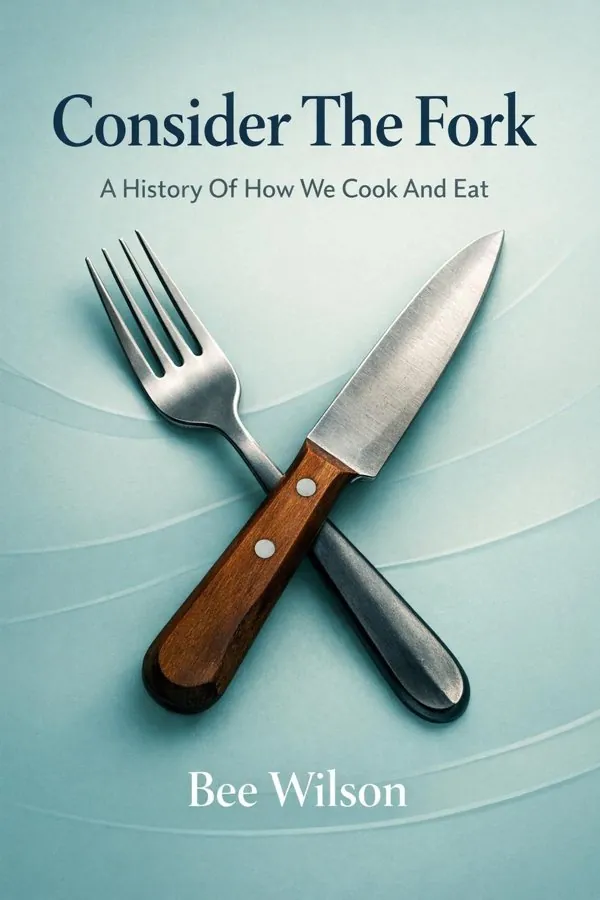
Consider The Fork: A History Of How We Cook And Eat: Summary & Key Insights
by Bee Wilson
 10 min10 chaptersAudio available
What Is Consider The Fork: A History Of How We Cook And Eat About?
Consider The Fork: A History Of How We Cook And Eat by Bee Wilson is a civilization book spanning 10 pages. A fascinating exploration of the history of cooking tools and kitchen technology, tracing how innovations from the knife to the microwave have shaped the way humans prepare and consume food. Bee Wilson combines culinary history, anthropology, and cultural insight to reveal how our kitchens reflect broader social and technological changes.
This FizzRead summary covers all 10 key chapters of Consider The Fork: A History Of How We Cook And Eat in approximately 10 minutes, distilling the most important ideas, arguments, and takeaways from Bee Wilson's work. Also available as an audio summary and Key Quotes Podcast.
Consider The Fork: A History Of How We Cook And Eat
A fascinating exploration of the history of cooking tools and kitchen technology, tracing how innovations from the knife to the microwave have shaped the way humans prepare and consume food. Bee Wilson combines culinary history, anthropology, and cultural insight to reveal how our kitchens reflect broader social and technological changes.
Who Should Read Consider The Fork: A History Of How We Cook And Eat?
This book is perfect for anyone interested in civilization and looking to gain actionable insights in a short read. Whether you're a student, professional, or lifelong learner, the key ideas from Consider The Fork: A History Of How We Cook And Eat by Bee Wilson will help you think differently.
- ✓Readers who enjoy civilization and want practical takeaways
- ✓Professionals looking to apply new ideas to their work and life
- ✓Anyone who wants the core insights of Consider The Fork: A History Of How We Cook And Eat in just 10 minutes
Want the full summary?
Get instant access to this book summary and 100K+ more with Fizz Moment.
Get Free SummaryAvailable on App Store • Free to download
Key Chapters
The knife stands at the beginning of human civilization. In many ways, it is the first true kitchen tool: a bridge between hunting and cooking, between survival and art. From the flint blades of the Stone Age to the carbon steel chef’s knives that gleam in modern kitchens, the knife reveals how ingenuity and necessity intertwined in our relationship with food.
For prehistoric humans, a sharp edge could mean life or death. Early knives were multipurpose—used for hunting, skinning, carving, and defending. It was only as humans began to domesticate both animals and fire that knives became culinary instruments. With agriculture came the need to chop vegetables finely, to butcher meat more efficiently, to shape food presentation as well as preparation. Every advancement in metallurgy—bronze, iron, steel—translated into a refinement of technique in the kitchen.
The knife also tells a moral story. In some cultures, such as China, sharp blades remained in the kitchen, never at the dining table, symbolizing the host’s hospitality and refusal to show aggression. In others, like medieval Europe, personal eating knives marked rank and status; to bring one’s own blade to the feast was a sign of self-sufficiency. The transition to blunter table knives in the seventeenth century paralleled the European domestication of manners. As sharpness moved from the table to the kitchen, civility entered the home by way of cutlery.
For me, the knife is a perfect emblem of human control: the skillful assertion of mastery over raw nature. Yet every slice and chop also testifies to fragility. A dull knife is dangerous; a sharp knife requires trust and respect. Cooking begins, quite literally, with the edge of civilization.
Fire made us human, but cooking shaped what kind of humans we became. The control of heat transformed not only our diets but also our social structures, our brains, and our sense of community. When our ancestors first leaned over open flames to roast hunks of meat, they were engaging in the first true act of cultural technology—using an external tool to change what the body could consume.
Cooking softens food, releases energy more efficiently, and allowed our ancestors to develop smaller jaws and larger brains. Anthropologist Richard Wrangham’s studies inspired me to think of cooking not just as a domestic art but as a scientific adaptation. The evolution from open fire to controlled heat—from hearths to stoves and ovens—maps humanity’s gradual conquest of unpredictability.
In the classical home, fire was sacred as much as practical. The Roman focus on the hearth goddess Vesta, or the Chinese reverence for kitchen gods, shows how heat became both spiritual and social. As technology evolved, so too did our relationship to the flame. The closed stove, with its iron top and adjustable dampers, was a revolution of safety and efficiency that altered the architecture of homes and the labor of women. In the twentieth century, gas and later electric ranges replaced the ritual of tending a flame with the convenience of control knobs—but something of the old awe remains. The heating element still glows, reminding us that within every comforting meal lies fire, tamed but never extinguished.
+ 8 more chapters — available in the FizzRead app
All Chapters in Consider The Fork: A History Of How We Cook And Eat
About the Author
Bee Wilson is a British food writer, historian, and journalist known for her insightful works on food culture and history. She has written for publications such as The Guardian and The Sunday Times and is the author of several acclaimed books on the evolution of cooking and eating habits.
Get This Summary in Your Preferred Format
Read or listen to the Consider The Fork: A History Of How We Cook And Eat summary by Bee Wilson anytime, anywhere. FizzRead offers multiple formats so you can learn on your terms — all free.
Available formats: App · Audio · PDF · EPUB — All included free with FizzRead
Download Consider The Fork: A History Of How We Cook And Eat PDF and EPUB Summary
Key Quotes from Consider The Fork: A History Of How We Cook And Eat
“The knife stands at the beginning of human civilization.”
“Fire made us human, but cooking shaped what kind of humans we became.”
Frequently Asked Questions about Consider The Fork: A History Of How We Cook And Eat
Consider The Fork: A History Of How We Cook And Eat by Bee Wilson is a civilization book that explores key ideas across 10 chapters. A fascinating exploration of the history of cooking tools and kitchen technology, tracing how innovations from the knife to the microwave have shaped the way humans prepare and consume food. Bee Wilson combines culinary history, anthropology, and cultural insight to reveal how our kitchens reflect broader social and technological changes.
More by Bee Wilson

You Might Also Like

The Structure of Scientific Revolutions
Thomas S. Kuhn
10 min
Genius
Harold Bloom
10 min
A Cultural History of the Medieval Age
Various Editors
10 min
A History of God: The 4,000-Year Quest of Judaism, Christianity and Islam
Karen Armstrong
10 min
A History of the World in 10½ Chapters
Julian Barnes
10 min
A Short History of Progress
Ronald Wright
10 minBrowse by Category
Ready to read Consider The Fork: A History Of How We Cook And Eat?
Get the full summary and 100K+ more books with Fizz Moment.