
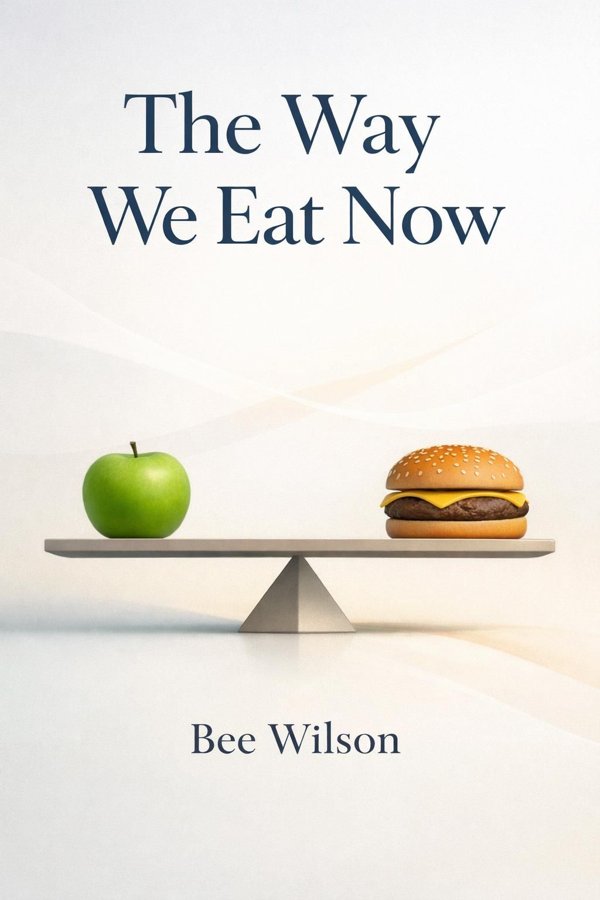
The Way We Eat Now: How the Food Revolution Has Transformed Our Lives, Our Bodies, and Our World: Summary & Key Insights
by Bee Wilson
 10 min9 chaptersAudio available
Key Takeaways from The Way We Eat Now: How the Food Revolution Has Transformed Our Lives, Our Bodies, and Our World
For most of human history, the core food problem was not temptation but insufficiency.
Modern food culture often presents convenience as freedom, but Wilson asks what kind of freedom it really offers.
One of the most striking features of the modern food revolution is convergence.
This is the nutrition transition.
We often speak of food as if everyone were equally free to choose what they eat, but Wilson shows how misleading that idea can be.
What Is The Way We Eat Now: How the Food Revolution Has Transformed Our Lives, Our Bodies, and Our World About?
The Way We Eat Now: How the Food Revolution Has Transformed Our Lives, Our Bodies, and Our World by Bee Wilson is a sociology book spanning 11 pages. Bee Wilson’s The Way We Eat Now is a sharp, wide-ranging investigation into one of the most intimate and universal parts of modern life: eating. Yet this is not simply a book about food preferences or culinary trends. It is about how industrialization, global trade, advertising, technology, urbanization, and inequality have transformed the very structure of human diets in just a few generations. Wilson shows that the modern food revolution has brought astonishing abundance and convenience, while also producing obesity, malnutrition, environmental strain, and deep confusion about what “healthy eating” even means. What makes the book especially compelling is Wilson’s ability to connect the personal and the political. She moves from family meals and snack habits to supply chains, processed food systems, and global nutrition patterns, revealing how private choices are shaped by powerful social forces. As a respected food writer, historian, and journalist, Wilson brings both research and storytelling to the subject. Her authority lies not only in her command of history and public health, but in her capacity to make food feel like a mirror of modern society itself. This book matters because understanding how we eat now is inseparable from understanding how we live now.
This FizzRead summary covers all 9 key chapters of The Way We Eat Now: How the Food Revolution Has Transformed Our Lives, Our Bodies, and Our World in approximately 10 minutes, distilling the most important ideas, arguments, and takeaways from Bee Wilson's work. Also available as an audio summary and Key Quotes Podcast.
The Way We Eat Now: How the Food Revolution Has Transformed Our Lives, Our Bodies, and Our World
Bee Wilson’s The Way We Eat Now is a sharp, wide-ranging investigation into one of the most intimate and universal parts of modern life: eating. Yet this is not simply a book about food preferences or culinary trends. It is about how industrialization, global trade, advertising, technology, urbanization, and inequality have transformed the very structure of human diets in just a few generations. Wilson shows that the modern food revolution has brought astonishing abundance and convenience, while also producing obesity, malnutrition, environmental strain, and deep confusion about what “healthy eating” even means.
What makes the book especially compelling is Wilson’s ability to connect the personal and the political. She moves from family meals and snack habits to supply chains, processed food systems, and global nutrition patterns, revealing how private choices are shaped by powerful social forces. As a respected food writer, historian, and journalist, Wilson brings both research and storytelling to the subject. Her authority lies not only in her command of history and public health, but in her capacity to make food feel like a mirror of modern society itself. This book matters because understanding how we eat now is inseparable from understanding how we live now.
Who Should Read The Way We Eat Now: How the Food Revolution Has Transformed Our Lives, Our Bodies, and Our World?
This book is perfect for anyone interested in sociology and looking to gain actionable insights in a short read. Whether you're a student, professional, or lifelong learner, the key ideas from The Way We Eat Now: How the Food Revolution Has Transformed Our Lives, Our Bodies, and Our World by Bee Wilson will help you think differently.
- ✓Readers who enjoy sociology and want practical takeaways
- ✓Professionals looking to apply new ideas to their work and life
- ✓Anyone who wants the core insights of The Way We Eat Now: How the Food Revolution Has Transformed Our Lives, Our Bodies, and Our World in just 10 minutes
Want the full summary?
Get instant access to this book summary and 100K+ more with Fizz Moment.
Get Free SummaryAvailable on App Store • Free to download
Key Chapters
For most of human history, the core food problem was not temptation but insufficiency. People worried about famine, crop failure, seasonal shortages, and the sheer labor required to feed a household. Bee Wilson shows that modern societies have undergone a dramatic reversal: in many parts of the world, food is no longer scarce in quantity, but overwhelming in availability. Supermarkets offer thousands of products, refrigeration extends shelf life, global trade makes strawberries available in winter, and industrial farming produces calories at unprecedented scale.
This transformation is one of humanity’s great achievements, but it has created new problems. When food is abundant, cheap, and constantly visible, the challenge shifts from finding enough to deciding what to eat and how much. Surplus changes habits. It encourages snacking, weakens the old rhythms of meals, and makes restraint harder. At the same time, abundance is unevenly distributed. Some communities still lack access to fresh, nutritious food even while surrounded by inexpensive ultra-processed options.
Wilson’s point is that food abundance is not automatically nutritional abundance. A shelf packed with products does not guarantee health, pleasure, or fairness. For example, a convenience store may offer hundreds of edible items but very little real nourishment. Similarly, a household may consume plenty of calories while remaining deficient in fiber, vitamins, or protein quality.
The practical lesson is to stop confusing quantity with well-being. In a world of surplus, eating well requires conscious selection rather than passive consumption. The actionable takeaway: treat abundance as something to manage carefully—build meals around foods with clear nutritional value, and remember that more available food does not necessarily mean better food.
Modern food culture often presents convenience as freedom, but Wilson asks what kind of freedom it really offers. Processed foods, ready meals, fast-food chains, and snack products have reduced the time and effort needed to eat. For busy workers, parents, and urban households, this can feel liberating. Convenience matters, especially in societies where long work hours and commuting leave little energy for cooking. But the rise of convenience food has also shifted control away from home kitchens and toward corporations that design products for shelf life, consistency, and repeat purchase.
Wilson does not argue that all processing is bad. Frozen vegetables, canned beans, yogurt, and bread are all processed in some way. The real issue is when industrial design prioritizes hyper-palatability over nourishment. Many convenience foods are engineered to be soft, salty, sweet, portable, and hard to stop eating. They fit seamlessly into distracted lifestyles, encouraging people to eat while driving, scrolling, or working.
This shift has social consequences too. Cooking used to transmit culture, family memory, and practical skill. As fewer people cook from scratch, they may lose both culinary confidence and control over ingredients. A child who grows up on packaged snacks and takeout may never learn the taste of simple staple foods prepared at home.
Still, Wilson avoids nostalgia. The old kitchen system was often exhausting, especially for women. The goal is not to reject convenience but to redefine it. Batch cooking, simple recipes, meal planning, and smart use of minimally processed staples can offer convenience without surrendering health. The actionable takeaway: audit which conveniences genuinely support your life and which quietly erode your control, then replace a few highly processed defaults with easier whole-food alternatives.
One of the most striking features of the modern food revolution is convergence. Across continents, people who once ate highly distinct local diets are increasingly consuming similar globalized products: soft drinks, packaged bread, instant noodles, fried chicken, burgers, sweetened cereals, and branded snacks. Wilson shows that while cuisines still matter, the commercial food environment has become more standardized. Whether in London, Mexico City, Nairobi, or Shanghai, the same logos, flavors, and retail formats now appear with remarkable consistency.
This convergence is driven by multinational corporations, global supply chains, urban living, refrigeration, aggressive marketing, and the aspirational appeal of Western-style packaged foods. In some places, these products symbolize status, modernity, or participation in global culture. Traditional meals can begin to look slow, old-fashioned, or labor-intensive by comparison.
The loss is not just culinary diversity but dietary resilience. Traditional food cultures often evolved around local crops, climates, and social customs. When those systems weaken, communities can become dependent on imported foods that are cheaper, heavily marketed, and often less nutritious. A rice-and-vegetable meal may be replaced by fried snacks and sugary drinks not because it tastes better in a deep sense, but because it is more visible, convenient, and profitable.
At the same time, convergence does not erase identity completely. People adapt global foods to local tastes, creating hybrids. Yet Wilson warns that the commercial logic behind this shift tends to favor the same profitable formulas everywhere: refined starch, sugar, salt, and fat.
The actionable takeaway: protect dietary diversity intentionally. Keep local dishes, ingredients, and meal traditions in circulation at home. Eating globally can be enriching, but not if it crowds out the food knowledge that gives culture and health their depth.
It is easy to think of malnutrition as a problem of hunger alone, but Wilson makes a crucial distinction: modern malnutrition often comes from excess calories and inadequate nourishment at the same time. This is the nutrition transition. As societies urbanize and incomes rise, many populations move away from traditional diets toward more refined grains, added sugars, edible oils, processed meats, and sugary beverages. The result is a double burden: undernutrition may persist while obesity, diabetes, and heart disease rise rapidly.
A person can be overfed and undernourished simultaneously. Children may consume enough calories yet lack iron, zinc, or other essential nutrients. Adults may gain weight while eating diets low in fiber and micronutrients. This helps explain why public health debates about food are so confusing. Weight alone does not tell the full story, and calorie counts do not capture food quality.
Wilson also points out that bodies are shaped by food environments, not simply by individual willpower. If the cheapest available lunch is fried, oversized, and heavily marketed, then unhealthy outcomes become predictable rather than accidental. In many countries, rates of chronic disease have surged not because people suddenly became morally weaker, but because food systems changed faster than biological instincts could adapt.
Practical applications include focusing less on narrow dieting trends and more on dietary patterns: vegetables, legumes, whole grains, fruit, nuts, and modest portions of satisfying foods. Public policy matters too—school meals, labeling, and pricing influence what people can realistically choose.
The actionable takeaway: redefine malnutrition in your own thinking. Don’t ask only whether a meal is filling; ask whether it is nourishing. Make food quality, not just quantity, your basic standard.
We often speak of food as if everyone were equally free to choose what they eat, but Wilson shows how misleading that idea can be. Choice is always structured by income, geography, time, education, transport, work schedules, and social stress. For affluent shoppers, healthy eating may look like a matter of discipline or values. For someone juggling multiple jobs, unreliable transport, and a neighborhood with few fresh options, the same advice may be unrealistic.
Wilson explores how food inequality appears in many forms. There are food deserts, where fresh produce is physically scarce, but also food swamps, where unhealthy options are everywhere. There is price inequality, where calorie-dense products are often cheaper per unit of fullness than fresh ingredients. There is time inequality, where cooking from scratch requires planning and energy that many households simply do not have. And there is emotional inequality: stress itself can drive people toward cheap comfort foods.
This perspective changes the moral language around eating. Instead of dividing people into virtuous and irresponsible eaters, Wilson asks us to examine the systems around them. A mother buying packaged snacks may be responding rationally to constraints of cost, child preference, and exhaustion. Blaming individuals without addressing those pressures misses the point.
For readers, this idea offers both compassion and strategy. If you want to improve your own eating, do not rely on motivation alone. Reshape your environment—shop with a list, keep visible healthy defaults, prep ingredients in advance, and reduce reliance on emergency food decisions made under stress.
The actionable takeaway: treat food choices as environmental outcomes. Whether in your home, workplace, or community, improve the conditions of choice instead of expecting willpower to do all the work.
Food is never just fuel. Wilson emphasizes that what we eat expresses who we are, where we come from, and what we value. Meals carry memory, class signals, religious meaning, family loyalty, and political identity. People defend foods not only because they taste good but because they symbolize belonging. That is why debates over meat, sugar, breastfeeding, school lunches, or traditional cuisine can become surprisingly emotional—they touch identity as much as nutrition.
Modern food culture intensifies this symbolic role. In a world of endless options, diet becomes a performance of the self. One person communicates discipline through clean eating, another ethics through veganism, another sophistication through artisanal products, another comfort through nostalgic dishes. Social media magnifies this effect by turning meals into public statements.
Wilson’s insight is that food arguments often hide deeper concerns. When a family resists dietary change, the resistance may not be about ingredients but about tradition, affection, or fear of losing cultural continuity. When someone clings to certain processed brands, they may be attached to convenience, childhood familiarity, or class aspiration, not mere taste.
This understanding has practical value. If you want to change eating habits—your own or others’—facts alone are rarely enough. New foods must feel emotionally and culturally acceptable. For example, introducing healthier versions of familiar dishes often works better than demanding a complete break with established tastes.
The actionable takeaway: approach eating habits with cultural sensitivity. Rather than framing food change as self-denial, connect it to meanings people already care about—family, pleasure, heritage, hospitality, and long-term well-being.
The modern meal is shaped by technologies most eaters barely notice. Wilson examines how refrigeration, industrial agriculture, food science, additives, logistics, delivery apps, and digital marketing have reorganized what food is, where it comes from, and how it reaches us. Technology has made food safer in many ways, reduced spoilage, expanded access, and enabled year-round variety. Yet it has also increased distance between eater and source, making food systems more opaque and more dependent on corporate infrastructure.
Food technology does not just preserve food; it redesigns it. Products can now be made sweeter, softer, crunchier, more stable, and more craveable than traditional foods. Algorithms and targeted ads nudge consumers toward certain purchases. Delivery platforms remove friction from impulse eating. The phone in your pocket has become part of the food environment, collapsing the time between craving and consumption.
Wilson is especially strong on the subtlety of these shifts. People often assume they are making spontaneous personal choices when those choices have been anticipated, simplified, and monetized by design. A streaming night with snacks delivered in twenty minutes feels casual, but it depends on a technological system built to convert appetite into revenue.
None of this means technology is the enemy. It can support healthier eating too, through grocery delivery to underserved areas, digital meal planning, nutrition tracking, or improved crop efficiency. The issue is governance and intention: who benefits, and what behaviors are being rewarded?
The actionable takeaway: make hidden technologies visible. Notice which apps, platforms, and product designs influence your eating. Use technology deliberately—such as planning meals or ordering staples—rather than letting convenience tools steer you into automatic overconsumption.
One of Wilson’s most powerful arguments is that modern food often appears inexpensive only because many of its real costs are hidden. Industrial abundance depends on fossil fuels, monocultures, intensive livestock systems, packaging waste, long-distance transport, and labor practices that can be exploitative or precarious. Consumers see a low supermarket price, but they do not directly see soil depletion, water use, greenhouse gas emissions, biodiversity loss, or public health costs tied to poor diet.
This creates a dangerous illusion. Food that is cheap at the checkout can be extremely costly to societies over time. A sugary drink may be affordable in the moment, but the broader system around it contributes to medical spending and lost health. Cheap meat may depend on methods that externalize environmental damage. Convenience packaging saves a few minutes but accumulates as waste.
Wilson’s contribution here is not moral panic but systems thinking. She shows that the food revolution cannot be judged only by what it delivers to the individual consumer today. It must also be evaluated by what it does to landscapes, climate, labor, and future generations. This broader view challenges the assumption that the best food system is simply the one that maximizes short-term affordability and constant supply.
For everyday readers, perfection is impossible, but awareness matters. Buying some seasonal foods, reducing waste, moderating meat consumption, supporting better producers when possible, and resisting disposable food culture all have cumulative value.
The actionable takeaway: when choosing food, think in layers. Ask not only “Can I afford this?” but also “What system am I supporting?” Small shifts toward less wasteful, less resource-intensive eating can align personal habits with planetary reality.
If food decisions were purely rational, modern eating would be much simpler. Wilson explains that appetite is shaped by emotion, memory, stress, habit, reward, and context as much as by hunger. People eat to soothe themselves, to celebrate, to procrastinate, to bond, and to cope. Food companies understand this deeply and build products and advertising around emotional triggers rather than nutritional logic.
This matters because many public conversations about diet assume that better information automatically leads to better behavior. Wilson shows why that fails. Most people already know, in broad terms, that vegetables are good and sugary snacks should be limited. The problem is not ignorance alone. It is that modern food environments are expertly designed to exploit vulnerable moments: fatigue at the end of the day, loneliness, work stress, boredom, or the desire for reward.
Habits become especially powerful when repeated in stable contexts. A biscuit with afternoon coffee, fast food during commutes, late-night delivery after stressful meetings—these routines feel natural because they are linked to cues. Changing them requires more than determination; it requires redesigning the pattern.
Practical applications include identifying emotional eating triggers, adding friction to impulsive foods, keeping satisfying alternatives available, and building rituals around regular meals rather than constant grazing. Self-compassion also matters. Shame tends to reinforce cycles of comfort eating, while curiosity can interrupt them.
The actionable takeaway: before changing what you eat, examine why and when you eat. Track the situations, moods, and routines that shape your choices, then adjust the environment around those moments instead of blaming yourself after the fact.
All Chapters in The Way We Eat Now: How the Food Revolution Has Transformed Our Lives, Our Bodies, and Our World
About the Author
Bee Wilson is a British food writer, historian, and journalist whose work explores the cultural, political, and emotional dimensions of eating. She is known for bringing together history, social analysis, and everyday observation in a way that makes food a lens for understanding modern life. Wilson has written for major publications such as The Guardian and the London Review of Books, and she is the author of several acclaimed books on food habits, domestic life, and culinary history. Her writing stands out for its clarity, empathy, and depth, particularly in showing how personal eating choices are shaped by larger systems. In The Way We Eat Now, Wilson draws on this broad expertise to examine how global food revolutions have changed our diets, bodies, and societies.
Get This Summary in Your Preferred Format
Read or listen to the The Way We Eat Now: How the Food Revolution Has Transformed Our Lives, Our Bodies, and Our World summary by Bee Wilson anytime, anywhere. FizzRead offers multiple formats so you can learn on your terms — all free.
Available formats: App · Audio · PDF · EPUB — All included free with FizzRead
Download The Way We Eat Now: How the Food Revolution Has Transformed Our Lives, Our Bodies, and Our World PDF and EPUB Summary
Key Quotes from The Way We Eat Now: How the Food Revolution Has Transformed Our Lives, Our Bodies, and Our World
“For most of human history, the core food problem was not temptation but insufficiency.”
“Modern food culture often presents convenience as freedom, but Wilson asks what kind of freedom it really offers.”
“One of the most striking features of the modern food revolution is convergence.”
“We often speak of food as if everyone were equally free to choose what they eat, but Wilson shows how misleading that idea can be.”
“Wilson emphasizes that what we eat expresses who we are, where we come from, and what we value.”
Frequently Asked Questions about The Way We Eat Now: How the Food Revolution Has Transformed Our Lives, Our Bodies, and Our World
The Way We Eat Now: How the Food Revolution Has Transformed Our Lives, Our Bodies, and Our World by Bee Wilson is a sociology book that explores key ideas across 9 chapters. Bee Wilson’s The Way We Eat Now is a sharp, wide-ranging investigation into one of the most intimate and universal parts of modern life: eating. Yet this is not simply a book about food preferences or culinary trends. It is about how industrialization, global trade, advertising, technology, urbanization, and inequality have transformed the very structure of human diets in just a few generations. Wilson shows that the modern food revolution has brought astonishing abundance and convenience, while also producing obesity, malnutrition, environmental strain, and deep confusion about what “healthy eating” even means. What makes the book especially compelling is Wilson’s ability to connect the personal and the political. She moves from family meals and snack habits to supply chains, processed food systems, and global nutrition patterns, revealing how private choices are shaped by powerful social forces. As a respected food writer, historian, and journalist, Wilson brings both research and storytelling to the subject. Her authority lies not only in her command of history and public health, but in her capacity to make food feel like a mirror of modern society itself. This book matters because understanding how we eat now is inseparable from understanding how we live now.
More by Bee Wilson
You Might Also Like

Between the World and Me
Ta-Nehisi Coates
10 min
Half the Sky
Nicholas D. Kristof, Sheryl WuDunn
10 min
Men Explain Things To Me
Rebecca Solnit
10 min
Rational Ritual
Michael Suk-Young Chwe
10 min
The New Jim Crow
Michelle Alexander
10 min
Beyond Culture
Edward T. Hall
10 minBrowse by Category
Ready to read The Way We Eat Now: How the Food Revolution Has Transformed Our Lives, Our Bodies, and Our World?
Get the full summary and 100K+ more books with Fizz Moment.