
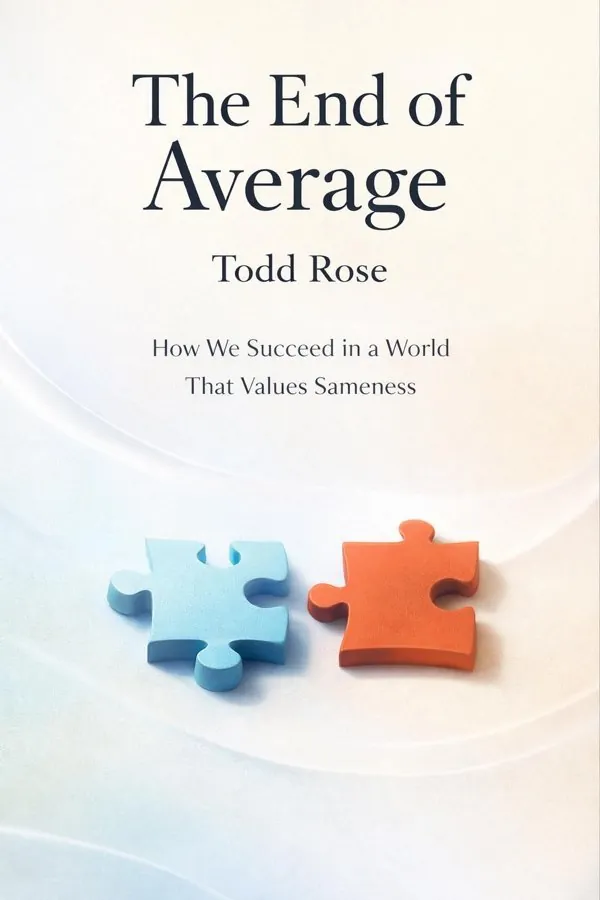
The End of Average: How We Succeed in a World That Values Sameness: Summary & Key Insights
by Todd Rose
 10 min7 chaptersAudio available
What Is The End of Average: How We Succeed in a World That Values Sameness About?
The End of Average: How We Succeed in a World That Values Sameness by Todd Rose is a psychology book spanning 7 pages. In this groundbreaking work, Todd Rose explores how the concept of 'average' has shaped modern society, education, and workplaces. He argues that the idea of designing systems around the 'average person' is fundamentally flawed because individuality is the true source of human potential. Drawing on research from psychology, neuroscience, and education, Rose presents the 'science of the individual'—a framework for understanding and fostering personal success by embracing uniqueness rather than conformity.
This FizzRead summary covers all 7 key chapters of The End of Average: How We Succeed in a World That Values Sameness in approximately 10 minutes, distilling the most important ideas, arguments, and takeaways from Todd Rose's work. Also available as an audio summary and Key Quotes Podcast.
The End of Average: How We Succeed in a World That Values Sameness
In this groundbreaking work, Todd Rose explores how the concept of 'average' has shaped modern society, education, and workplaces. He argues that the idea of designing systems around the 'average person' is fundamentally flawed because individuality is the true source of human potential. Drawing on research from psychology, neuroscience, and education, Rose presents the 'science of the individual'—a framework for understanding and fostering personal success by embracing uniqueness rather than conformity.
Who Should Read The End of Average: How We Succeed in a World That Values Sameness?
This book is perfect for anyone interested in psychology and looking to gain actionable insights in a short read. Whether you're a student, professional, or lifelong learner, the key ideas from The End of Average: How We Succeed in a World That Values Sameness by Todd Rose will help you think differently.
- ✓Readers who enjoy psychology and want practical takeaways
- ✓Professionals looking to apply new ideas to their work and life
- ✓Anyone who wants the core insights of The End of Average: How We Succeed in a World That Values Sameness in just 10 minutes
Want the full summary?
Get instant access to this book summary and 100K+ more with Fizz Moment.
Get Free SummaryAvailable on App Store • Free to download
Key Chapters
To understand how the concept of 'average' became so powerful, we must travel back to the 19th century. The mathematician Adolphe Quetelet, seeking to apply statistical methods to human behavior, introduced the idea of the 'average man'—a composite representation of a population’s traits. He believed that by finding the mean of various characteristics, such as height or weight, we could uncover the ideal human form and, by extension, the foundation of social order.
This idea quickly merged with industrial thinking. As factories sought efficiency and schools aimed to prepare students for predictable roles, the 'average' became the design blueprint. Education systems established grade levels based on the 'typical' child’s rate of learning. Businesses created standardized job descriptions based on the 'typical' worker. In both cases, individual variation was treated as error—noise in an otherwise clean signal.
The most startling consequence of this came in the early 20th century, when Edward Thorndike and others infused the idea of average into psychology and intelligence testing. People were ranked, sorted, and labeled according to numerical norms. From college admissions to job evaluations, an illusion of fairness masked a system that excluded anyone who did not conform to the statistical mean. And yet, Quetelet’s 'average man' was never a real person. He existed only as an abstraction, an arithmetic phantom.
What matters to me, and what I hope will matter to you, is realizing how deep this illusion runs. When we describe someone as above or below average, we are referencing a fiction that erases individuality. By understanding how this fiction took hold, we can begin to dismantle its grip on our modern institutions and our self-concept.
The obvious flaw in designing for averages is that no one is average. This became dramatically clear to me when I studied how the U.S. Air Force designed cockpits in the 1950s. Engineers had measured thousands of pilots to find the 'average' body dimensions and built cockpits accordingly. But when researchers later measured ten critical dimensions—including arm length, chest size, and torso height—they discovered that not a single pilot fit the average profile in all categories. Zero. The Air Force realized that designing for the average meant designing for nobody. So they switched to adjustable cockpits—a move that transformed aviation safety.
This principle holds everywhere. When we build education systems for the 'average student' or design training programs for the 'average employee,' we systematically disadvantage individuals whose strengths and weaknesses vary across dimensions. Average-based systems simplify complexity to make management easier, but in doing so, they strip away what makes us human.
The truth is, human potential is anything but uniform. Each of us possesses a unique constellation of strengths and weaknesses. Designing around average tries to flatten that constellation into a single point. The result is inefficiency, disengagement, and wasted potential. My own story mirrors this: as a high school dropout labeled a failure, I discovered later in life that it wasn’t intelligence I lacked—it was a system that could see and value the way I learn and think.
Once we understand that no person fits the mold, the only logical conclusion is revolutionary: the mold must go.
+ 5 more chapters — available in the FizzRead app
All Chapters in The End of Average: How We Succeed in a World That Values Sameness
About the Author
Todd Rose is an American author, researcher, and professor at Harvard University, known for his work on individuality and human potential. He co-founded Populace, a think tank focused on advancing a society that values individual achievement and purpose. His research challenges traditional metrics of success and advocates for personalized approaches in education and work.
Get This Summary in Your Preferred Format
Read or listen to the The End of Average: How We Succeed in a World That Values Sameness summary by Todd Rose anytime, anywhere. FizzRead offers multiple formats so you can learn on your terms — all free.
Available formats: App · Audio · PDF · EPUB — All included free with FizzRead
Download The End of Average: How We Succeed in a World That Values Sameness PDF and EPUB Summary
Key Quotes from The End of Average: How We Succeed in a World That Values Sameness
“To understand how the concept of 'average' became so powerful, we must travel back to the 19th century.”
“The obvious flaw in designing for averages is that no one is average.”
Frequently Asked Questions about The End of Average: How We Succeed in a World That Values Sameness
The End of Average: How We Succeed in a World That Values Sameness by Todd Rose is a psychology book that explores key ideas across 7 chapters. In this groundbreaking work, Todd Rose explores how the concept of 'average' has shaped modern society, education, and workplaces. He argues that the idea of designing systems around the 'average person' is fundamentally flawed because individuality is the true source of human potential. Drawing on research from psychology, neuroscience, and education, Rose presents the 'science of the individual'—a framework for understanding and fostering personal success by embracing uniqueness rather than conformity.
More by Todd Rose

You Might Also Like

The Body Keeps the Score
Bessel van der Kolk
10 min
Surrounded by Idiots
Thomas Erikson
10 min
Emotional Intelligence
Daniel Goleman
10 min
Attached
Amir Levine
10 min
Why Does He Do That
Lundy Bancroft
10 min
Women Who Run with the Wolves
Clarissa Pinkola Estés
10 minBrowse by Category
Ready to read The End of Average: How We Succeed in a World That Values Sameness?
Get the full summary and 100K+ more books with Fizz Moment.