
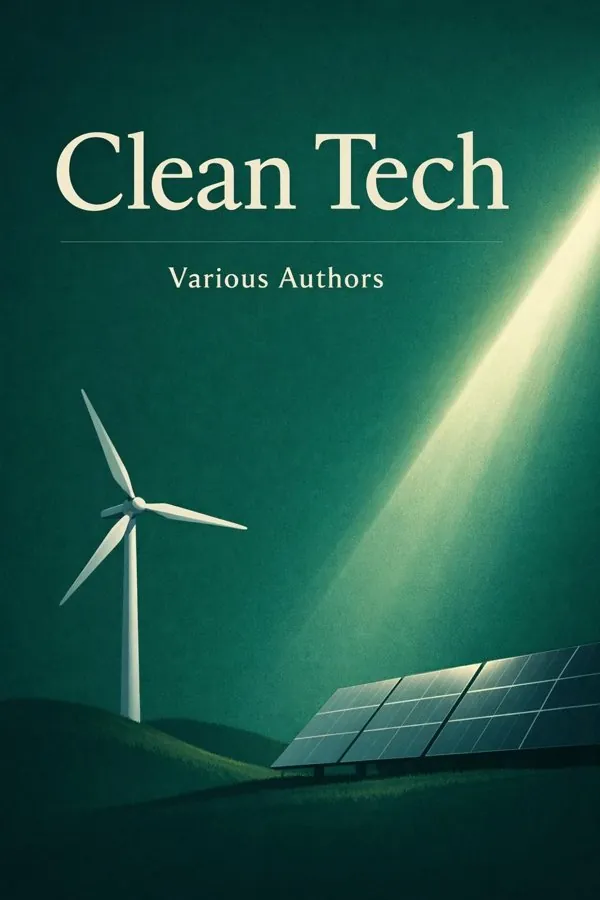
Clean Tech: Summary & Key Insights
 10 min9 chaptersAudio available
Key Takeaways from Clean Tech
A striking shift has occurred in the last two decades: renewable energy is no longer a futuristic side project but an increasingly central pillar of modern economic infrastructure.
If energy powers the modern world, materials give it physical form, and many of those materials carry a hidden environmental cost.
One of the book’s most practical insights is that the cleanest unit of energy is often the one never used.
Technologies do not scale in a vacuum; they grow inside systems shaped by policy, finance, and institutions.
A powerful but often overlooked truth runs through Clean Tech: no technology is truly successful if society refuses, resists, or cannot access it.
What Is Clean Tech About?
Clean Tech by Various Authors is a environment book spanning 5 pages. Clean Tech brings together a range of voices to examine one of the defining challenges of our time: how to build prosperity without deepening environmental damage. Across essays and case studies, the book explores the technologies, business models, and policy frameworks driving the transition to a low-carbon economy. It looks at renewable energy, sustainable materials, energy-efficient cities, cleaner manufacturing, and the social choices that determine whether innovation scales fairly and effectively. What makes the book valuable is its multidisciplinary lens. Rather than treating climate solutions as purely technical, the contributors show that real progress depends on economics, regulation, infrastructure, consumer behavior, and global cooperation. That broader view helps readers understand why some promising ideas transform industries while others stall. The authors write with the authority of researchers, engineers, and sustainability experts who have studied these systems from different angles, giving the collection both analytical depth and practical relevance. For anyone trying to make sense of the clean technology landscape, Clean Tech offers a grounded, accessible guide to the opportunities, trade-offs, and urgency of environmental innovation.
This FizzRead summary covers all 9 key chapters of Clean Tech in approximately 10 minutes, distilling the most important ideas, arguments, and takeaways from Various Authors's work. Also available as an audio summary and Key Quotes Podcast.
Clean Tech
Clean Tech brings together a range of voices to examine one of the defining challenges of our time: how to build prosperity without deepening environmental damage. Across essays and case studies, the book explores the technologies, business models, and policy frameworks driving the transition to a low-carbon economy. It looks at renewable energy, sustainable materials, energy-efficient cities, cleaner manufacturing, and the social choices that determine whether innovation scales fairly and effectively. What makes the book valuable is its multidisciplinary lens. Rather than treating climate solutions as purely technical, the contributors show that real progress depends on economics, regulation, infrastructure, consumer behavior, and global cooperation. That broader view helps readers understand why some promising ideas transform industries while others stall. The authors write with the authority of researchers, engineers, and sustainability experts who have studied these systems from different angles, giving the collection both analytical depth and practical relevance. For anyone trying to make sense of the clean technology landscape, Clean Tech offers a grounded, accessible guide to the opportunities, trade-offs, and urgency of environmental innovation.
Who Should Read Clean Tech?
This book is perfect for anyone interested in environment and looking to gain actionable insights in a short read. Whether you're a student, professional, or lifelong learner, the key ideas from Clean Tech by Various Authors will help you think differently.
- ✓Readers who enjoy environment and want practical takeaways
- ✓Professionals looking to apply new ideas to their work and life
- ✓Anyone who wants the core insights of Clean Tech in just 10 minutes
Want the full summary?
Get instant access to this book summary and 100K+ more with Fizz Moment.
Get Free SummaryAvailable on App Store • Free to download
Key Chapters
A striking shift has occurred in the last two decades: renewable energy is no longer a futuristic side project but an increasingly central pillar of modern economic infrastructure. Clean Tech emphasizes that solar, wind, hydro, geothermal, and other low-carbon sources have moved from niche experiments to scalable systems capable of powering homes, factories, and entire regions. This matters because the energy sector sits at the heart of climate change, and transforming how electricity is generated has outsized effects across transportation, manufacturing, heating, and digital services.
The book explains that technological advancement has driven this transition. Solar panels have become cheaper and more efficient, wind turbines have grown larger and more productive, and smart-grid tools have improved the management of variable energy supply. Hydropower remains important in many regions, while emerging storage solutions help smooth the intermittent nature of sun and wind. Together, these developments make renewable systems more reliable and commercially attractive than they once seemed.
Practical examples include utility-scale solar farms supplying national grids, offshore wind projects supporting dense urban regions, and microgrids bringing electricity to rural communities where centralized infrastructure is weak. Businesses also increasingly sign power purchase agreements to lock in renewable electricity and reduce long-term operating costs. Households contribute through rooftop solar, heat pumps, and home batteries.
The deeper lesson is that clean energy adoption is not just a climate strategy; it is an industrial, geopolitical, and economic strategy. Countries that invest early can improve energy security, reduce fuel-price volatility, and create new supply chains.
Actionable takeaway: assess where your home, organization, or community can switch to renewable power now, even partially, rather than waiting for a perfect system to emerge.
If energy powers the modern world, materials give it physical form, and many of those materials carry a hidden environmental cost. Clean Tech argues that true sustainability requires rethinking not only how products are powered but also what they are made from and how they are manufactured. Traditional industrial processes often rely on virgin resources, toxic inputs, energy-intensive extraction, and waste-heavy design. Clean technology challenges this model by introducing cleaner feedstocks, circular design principles, and greener production methods.
The book explores alternatives such as recycled metals, bio-based plastics, low-carbon cement, sustainably sourced timber, and advanced composites designed for durability and disassembly. It also highlights cleaner manufacturing approaches, including water-efficient processing, non-toxic chemistry, additive manufacturing, and systems that recover heat, scrap, and wastewater instead of discarding them. These changes reduce emissions while often improving resilience against resource scarcity and supply disruptions.
Case studies show how manufacturers redesign packaging to use fewer raw materials, how construction firms adopt lower-carbon building inputs, and how electronics companies experiment with modular products that are easier to repair and recycle. The point is not simply substitution, but redesign. A sustainable product is created by examining the full life cycle: extraction, production, transport, use, and end-of-life recovery.
Clean Tech makes clear that green manufacturing is increasingly tied to competitiveness. Regulators, investors, and customers now pay closer attention to embodied carbon, waste streams, and material traceability. Firms that ignore these issues may face rising costs or reputational risk.
Actionable takeaway: when evaluating any product or process, look beyond upfront price and ask what materials are used, whether they can be reused or recycled, and how much waste the system creates.
One of the book’s most practical insights is that the cleanest unit of energy is often the one never used. Clean Tech stresses that while breakthrough technologies attract attention, energy efficiency remains one of the fastest, cheapest, and most scalable ways to cut emissions. It reduces demand before supply must be expanded, making renewable transitions easier and less expensive.
The contributors show how efficiency works across multiple levels. In buildings, insulation, high-performance windows, smart thermostats, LED lighting, and efficient heating and cooling systems can dramatically lower energy use. In industry, better motors, heat recovery, automation, and process optimization reduce waste while boosting productivity. In transportation, lighter materials, efficient drivetrains, route optimization, and shared mobility decrease fuel consumption. In digital infrastructure, better cooling and server management can cut the electricity intensity of data centers.
The urban dimension is especially important. Cities concentrate population, economic activity, and emissions, so improvements in public transit, district energy systems, building codes, and compact land-use planning have outsized impact. A city that encourages walking, cycling, electrified public transport, and efficient housing can reduce both household costs and environmental footprints.
Clean Tech also notes a common obstacle: efficiency is often undervalued because the benefits are dispersed and incremental. A glamorous new power plant is easier to publicize than thousands of retrofitted buildings. Yet aggregate savings from such measures can be enormous.
The broader message is that innovation is not always about inventing something radically new. Sometimes it is about using existing systems more intelligently.
Actionable takeaway: identify the biggest energy losses in your daily environment—lighting, heating, appliances, transportation, or workflow—and improve the least efficient area first.
Technologies do not scale in a vacuum; they grow inside systems shaped by policy, finance, and institutions. Clean Tech argues that clean innovation succeeds when governments and markets reinforce rather than undermine each other. Private enterprise can develop products, drive competition, and accelerate deployment, but public policy often sets the rules, incentives, and infrastructure that make large-scale change possible.
The book discusses several policy tools: carbon pricing, emissions standards, renewable portfolio mandates, public procurement, tax credits, research funding, and grid modernization investments. These mechanisms reduce uncertainty and help emerging technologies cross the difficult gap between invention and mass adoption. Without this support, cleaner options may struggle to compete against entrenched industries that benefit from legacy infrastructure and historical subsidies.
Economics also matters at the consumer and investor level. Falling technology costs can encourage adoption, but financing models often determine who can participate. Leasing arrangements for solar panels, green bonds for infrastructure, concessional finance for developing economies, and blended public-private partnerships all help move clean projects from concept to implementation.
The global dimension adds complexity. Climate change is transnational, supply chains are international, and policy misalignment can slow progress. Cooperation on standards, trade, and research can speed diffusion, while fragmented regulations can create unnecessary friction.
A key lesson in the book is that the clean transition is not simply a contest of better gadgets. It is a process of market design. Rules influence which technologies flourish, how quickly they scale, and who benefits from them.
Actionable takeaway: when assessing any climate solution, ask not only whether the technology works, but whether policy, financing, and regulation support its widespread adoption.
Generating clean power is only half the battle; delivering it reliably when and where it is needed is what turns energy innovation into a functioning system. Clean Tech highlights storage technologies and smarter grids as the essential connective tissue of the renewable transition. Without them, even abundant solar and wind resources can fall short of their potential because supply fluctuates while demand remains constant or peaks at inconvenient times.
The book explains how batteries, pumped hydro, thermal storage, and other emerging options help absorb excess renewable generation and release it later. Utility-scale batteries can stabilize power networks, while home batteries allow households to store rooftop solar energy for evening use. In parallel, digital grid management tools improve forecasting, demand response, and load balancing. Smart meters, distributed energy platforms, and flexible pricing encourage consumers and businesses to shift electricity use away from peak periods.
Examples include industrial facilities adjusting operations to match low-cost renewable supply, electric vehicles serving as distributed storage assets, and regional transmission lines linking areas with different weather patterns so that renewable output can be shared more efficiently. These solutions reduce curtailment, improve resilience, and lower dependence on fossil-fuel backup.
Clean Tech makes an important systems-level point: energy transitions fail when planners think in isolated components. A solar panel is not enough. It must be connected to infrastructure, regulation, market signals, and user behavior. Reliability is therefore not a reason to reject clean energy, but a design challenge that can be solved with coordinated innovation.
Actionable takeaway: when evaluating renewable energy adoption, include storage, grid flexibility, and demand management in the plan rather than treating generation alone as the solution.
Transportation is often discussed in terms of vehicles, but Clean Tech shows that cleaner mobility is really about redesigning the systems that move people and goods. Electrification is a major part of that story, especially as electricity grids become cleaner. Electric cars, buses, trains, delivery fleets, and two-wheel transport can sharply reduce direct emissions, local air pollution, and fuel dependence. Yet the book insists that focusing only on car replacement misses the bigger opportunity.
A truly sustainable transport transition combines cleaner vehicles with better urban planning, public transit, logistics efficiency, and modal shifts. Dense, transit-oriented development reduces the need for long commutes. Electrified buses improve air quality in cities. Rail can displace some high-emission freight and short-haul travel. Cycling infrastructure and pedestrian-friendly neighborhoods create low-cost, low-carbon mobility options. Fleet electrification, route optimization, and charging management help businesses cut operating costs while meeting sustainability targets.
The contributors also discuss infrastructure hurdles. Charging networks must be expanded, grid capacity must adapt, and battery supply chains must become more sustainable. Policymakers play a role through fuel economy standards, transit investment, procurement rules, and incentives that lower adoption barriers.
An important insight is that transportation technology influences social outcomes. Cleaner mobility can improve public health, reduce noise, and expand access to jobs and services if designed inclusively. If designed poorly, it can reinforce congestion, sprawl, and inequality.
Actionable takeaway: think of sustainable transportation not merely as buying an electric vehicle, but as choosing the cleanest and most efficient way to reduce travel emissions across commuting, freight, and urban design.
Waste is often treated as an unavoidable byproduct of prosperity, but Clean Tech challenges that assumption by framing waste as evidence of poor system design. A circular economy seeks to keep materials in use for as long as possible through repair, reuse, remanufacturing, and recycling. This approach reduces the need for virgin resource extraction, lowers emissions, and creates new economic opportunities from what was once discarded.
The book links circular thinking to clean technology in several ways. Product design can make devices easier to disassemble and repair. Digital tracking tools can improve material traceability. Advanced sorting and recycling technologies can recover valuable metals, plastics, and fibers. Industrial symbiosis allows one company’s byproducts to become another company’s inputs. Organic waste can be transformed into compost, bioenergy, or biomaterials. These strategies reduce landfill use while extracting more value from existing resources.
Examples include refurbished electronics markets, construction projects using reclaimed materials, and manufacturers offering product-as-a-service models in which companies retain ownership of equipment and are therefore incentivized to design for longevity and recovery. The circular model is especially relevant in sectors with high material intensity, such as electronics, packaging, textiles, and construction.
Clean Tech does not present circularity as simple. Collection systems, consumer habits, quality standards, and economics all matter. Recycling alone is not enough if products are designed to fail quickly or remain difficult to process. The hierarchy matters: reducing and reusing often produce greater environmental gains than recycling.
Actionable takeaway: before discarding or replacing a product, ask whether it can be repaired, reused, upgraded, or sourced in a circular form that extends material life.
What cannot be measured is difficult to improve, and Clean Tech repeatedly underscores the importance of data, standards, and accountability in environmental innovation. Many organizations claim sustainability progress, but meaningful clean transformation requires credible metrics that track emissions, resource use, waste, water consumption, and life-cycle impact. Without this, green initiatives can become marketing exercises rather than real change.
The contributors emphasize that measurement helps decision-makers compare options and prioritize investments. A company deciding between new packaging materials, a building owner planning retrofits, or a city evaluating transit upgrades all need reliable data to understand which intervention produces the greatest environmental benefit. Life-cycle assessment is especially important because a solution that appears green at the point of use may carry hidden upstream impacts in extraction, manufacturing, or disposal.
The book also addresses the rise of ESG reporting, carbon disclosure, and sustainability certification. These tools can improve transparency, but only if standards are robust and consistently applied. Poor-quality reporting can obscure trade-offs, exaggerate performance, or ignore supply-chain emissions. Accountability therefore requires independent verification, clear methodologies, and a willingness to confront inconvenient findings.
Practical applications include energy dashboards in buildings, emissions accounting in manufacturing, satellite monitoring of environmental change, and digital product passports that record material origin and recyclability. These systems help organizations move from vague commitments to operational discipline.
The larger insight is simple: clean technology is not defined by intention alone. It must demonstrate environmental value in measurable terms.
Actionable takeaway: when considering any sustainability claim, look for concrete metrics, transparent assumptions, and evidence that impacts are tracked across the full life cycle.
All Chapters in Clean Tech
About the Author
Various Authors represents a collaborative group of specialists in environmental science, engineering, energy systems, sustainable design, and green business strategy. Their combined expertise gives Clean Tech a multidisciplinary perspective that reflects the complexity of real-world environmental challenges. Rather than approaching sustainability from a single angle, the contributors examine how technology, policy, economics, infrastructure, and social behavior interact in the transition to a low-carbon future. Many of the authors draw on research, case studies, and industry experience to explain how clean solutions move from theory to implementation. This collective authorship is especially fitting for a subject like clean technology, where progress depends on cross-sector thinking and cooperation. Together, the contributors offer readers a broad yet practical understanding of the innovations shaping a more sustainable economy.
Get This Summary in Your Preferred Format
Read or listen to the Clean Tech summary by Various Authors anytime, anywhere. FizzRead offers multiple formats so you can learn on your terms — all free.
Available formats: App · Audio · PDF · EPUB — All included free with FizzRead
Download Clean Tech PDF and EPUB Summary
Key Quotes from Clean Tech
“A striking shift has occurred in the last two decades: renewable energy is no longer a futuristic side project but an increasingly central pillar of modern economic infrastructure.”
“If energy powers the modern world, materials give it physical form, and many of those materials carry a hidden environmental cost.”
“One of the book’s most practical insights is that the cleanest unit of energy is often the one never used.”
“Technologies do not scale in a vacuum; they grow inside systems shaped by policy, finance, and institutions.”
“A powerful but often overlooked truth runs through Clean Tech: no technology is truly successful if society refuses, resists, or cannot access it.”
Frequently Asked Questions about Clean Tech
Clean Tech by Various Authors is a environment book that explores key ideas across 9 chapters. Clean Tech brings together a range of voices to examine one of the defining challenges of our time: how to build prosperity without deepening environmental damage. Across essays and case studies, the book explores the technologies, business models, and policy frameworks driving the transition to a low-carbon economy. It looks at renewable energy, sustainable materials, energy-efficient cities, cleaner manufacturing, and the social choices that determine whether innovation scales fairly and effectively. What makes the book valuable is its multidisciplinary lens. Rather than treating climate solutions as purely technical, the contributors show that real progress depends on economics, regulation, infrastructure, consumer behavior, and global cooperation. That broader view helps readers understand why some promising ideas transform industries while others stall. The authors write with the authority of researchers, engineers, and sustainability experts who have studied these systems from different angles, giving the collection both analytical depth and practical relevance. For anyone trying to make sense of the clean technology landscape, Clean Tech offers a grounded, accessible guide to the opportunities, trade-offs, and urgency of environmental innovation.
More by Various Authors




You Might Also Like

A Life on Our Planet: My Witness Statement and a Vision for the Future
David Attenborough
10 min
A Sky Full Of Birds
Matt Merritt
10 min
Carbon Zero: Imagining Cities That Can Save the Planet
Alex Steffen
10 min
Eaarth: Making a Life on a Tough New Planet
Bill McKibben
10 min
The Social Contract and Environmental Governance
Various Editors
10 min
The Wild Places
Robert Macfarlane
10 minBrowse by Category
Ready to read Clean Tech?
Get the full summary and 100K+ more books with Fizz Moment.