
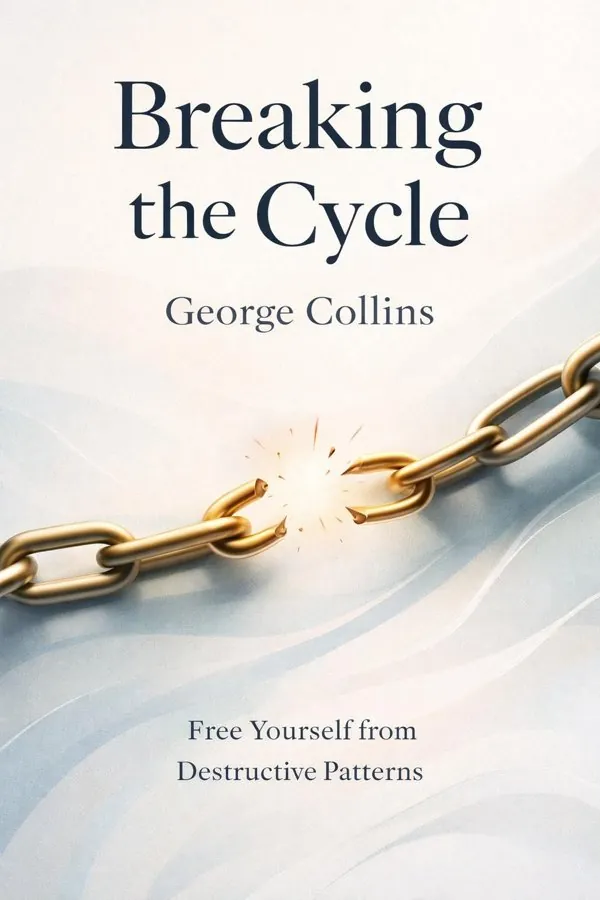
Breaking the Cycle: Free Yourself from Destructive Patterns: Summary & Key Insights
 10 min9 chaptersAudio available
Key Takeaways from Breaking the Cycle: Free Yourself from Destructive Patterns
One of the most dangerous myths about destructive behavior is that it is simply a matter of weak character.
Destructive patterns feel chaotic from the inside, but Collins argues that they usually follow a recognizable sequence.
People rarely act out because of the trigger alone.
Many people want change, but far fewer are willing to observe themselves honestly enough to create it.
A cycle continues because it becomes automatic.
What Is Breaking the Cycle: Free Yourself from Destructive Patterns About?
Breaking the Cycle: Free Yourself from Destructive Patterns by George Collins is a mental_health book spanning 9 pages. Breaking the Cycle: Free Yourself from Destructive Patterns is a practical and compassionate guide to understanding why people repeat behaviors that harm their health, relationships, and sense of self. Drawing especially on the dynamics of compulsive sexual behavior, therapist George Collins shows that addiction is rarely just about pleasure or lack of willpower. More often, it is an attempt to regulate pain, escape loneliness, soothe anxiety, or avoid unresolved emotional wounds. The book helps readers identify the triggers, beliefs, and routines that keep destructive habits alive, then offers concrete ways to interrupt them. What makes this book valuable is its blend of personal honesty and clinical insight. Collins writes not only as a licensed therapist, but as someone who understands the shame, secrecy, and confusion that often surround compulsive behavior. His approach is neither moralizing nor abstract. Instead, he emphasizes awareness, accountability, emotional maturity, and support. For anyone who feels trapped in recurring patterns—whether related to sex, pornography, relationships, or other self-defeating habits—this book offers a hopeful message: real change begins when we understand the cycle clearly enough to break it deliberately.
This FizzRead summary covers all 9 key chapters of Breaking the Cycle: Free Yourself from Destructive Patterns in approximately 10 minutes, distilling the most important ideas, arguments, and takeaways from George Collins's work. Also available as an audio summary and Key Quotes Podcast.
Breaking the Cycle: Free Yourself from Destructive Patterns
Breaking the Cycle: Free Yourself from Destructive Patterns is a practical and compassionate guide to understanding why people repeat behaviors that harm their health, relationships, and sense of self. Drawing especially on the dynamics of compulsive sexual behavior, therapist George Collins shows that addiction is rarely just about pleasure or lack of willpower. More often, it is an attempt to regulate pain, escape loneliness, soothe anxiety, or avoid unresolved emotional wounds. The book helps readers identify the triggers, beliefs, and routines that keep destructive habits alive, then offers concrete ways to interrupt them.
What makes this book valuable is its blend of personal honesty and clinical insight. Collins writes not only as a licensed therapist, but as someone who understands the shame, secrecy, and confusion that often surround compulsive behavior. His approach is neither moralizing nor abstract. Instead, he emphasizes awareness, accountability, emotional maturity, and support. For anyone who feels trapped in recurring patterns—whether related to sex, pornography, relationships, or other self-defeating habits—this book offers a hopeful message: real change begins when we understand the cycle clearly enough to break it deliberately.
Who Should Read Breaking the Cycle: Free Yourself from Destructive Patterns?
This book is perfect for anyone interested in mental_health and looking to gain actionable insights in a short read. Whether you're a student, professional, or lifelong learner, the key ideas from Breaking the Cycle: Free Yourself from Destructive Patterns by George Collins will help you think differently.
- ✓Readers who enjoy mental_health and want practical takeaways
- ✓Professionals looking to apply new ideas to their work and life
- ✓Anyone who wants the core insights of Breaking the Cycle: Free Yourself from Destructive Patterns in just 10 minutes
Want the full summary?
Get instant access to this book summary and 100K+ more with Fizz Moment.
Get Free SummaryAvailable on App Store • Free to download
Key Chapters
One of the most dangerous myths about destructive behavior is that it is simply a matter of weak character. Collins challenges this idea by showing that compulsion is not the same as healthy desire, and not even the same as ordinary bad habits. Healthy sexuality, for example, is rooted in connection, mutuality, and presence. Compulsive behavior, by contrast, is driven by urgency, secrecy, and an emotional need that the behavior can never truly satisfy. The person is not moving toward intimacy but away from discomfort.
This distinction matters because many people minimize their problem by saying, “Everyone does this,” or “It’s just stress relief.” But compulsion reveals itself through loss of control, repeated acting out despite consequences, obsession, and the use of behavior to numb painful feelings. In that sense, the behavior becomes less about enjoyment and more about escape. A person may promise themselves they will stop, only to find that certain moods, situations, or memories override their intention.
Collins helps readers see compulsion as a pattern with emotional, cognitive, and behavioral components. This reduces shame without removing responsibility. It says: you are not broken beyond repair, but you do need to understand what is happening. For instance, someone who repeatedly turns to pornography after conflict at home may believe they are chasing pleasure, when in fact they are avoiding feelings of rejection or inadequacy.
Actionable takeaway: Write down one behavior you keep repeating and ask three questions: What feeling comes before it? What temporary relief does it provide? What real need is it failing to meet?
Destructive patterns feel chaotic from the inside, but Collins argues that they usually follow a recognizable sequence. That is good news, because what has a pattern can be interrupted. The cycle often begins with a trigger: stress, loneliness, boredom, anger, shame, or even success that feels emotionally destabilizing. That trigger activates craving and fantasy. The person then moves into ritualization, the preparatory behaviors that make acting out more likely—isolating, browsing online, revisiting certain thoughts, driving to familiar places, or creating opportunities for secrecy. Finally comes the acting out itself, followed by relief, regret, shame, and renewed promises to stop.
The crucial insight is that acting out does not begin at the moment of the behavior. It begins much earlier, often at the level of mood and attention. By the time someone is at the final stage, willpower is already weakened. This is why many people feel as if they “suddenly” lost control, when in reality they missed several earlier warning signs.
Collins encourages readers to map their own cycle in detail. A person might notice that after feeling criticized at work, they become restless, start scrolling late at night, rationalize that they deserve comfort, and then act out. Another might see that travel, alcohol, or emotional disconnection in a marriage are recurring precursors.
Actionable takeaway: Draw your personal cycle from trigger to aftermath. Identify the earliest point where you still have meaningful control, and create one alternative action for that stage, such as calling a friend, leaving the room, or going for a walk.
People rarely act out because of the trigger alone. They act out because the trigger touches something deeper. Collins emphasizes that underneath compulsive behavior are often core beliefs formed through painful experiences: “I am unlovable,” “My needs do not matter,” “I will always be abandoned,” or “I can only soothe myself alone.” These beliefs shape emotional reactions long before the destructive behavior appears.
This is why two people can experience the same event and respond very differently. One person feels disappointed after a tense conversation and moves on. Another spirals into shame and immediately seeks escape. The difference often lies in the meaning assigned to the event. A forgotten text message may not just feel inconvenient; it may awaken an old wound of neglect. A partner’s criticism may not just sting; it may confirm a lifelong fear of inadequacy.
Collins invites readers to look beyond surface explanations and ask what the trigger symbolizes. If pornography follows feelings of rejection, perhaps the deeper issue is not lust but a desperate attempt to regain control or feel wanted. If affairs follow periods of emotional emptiness, perhaps the underlying belief is that genuine intimacy is unsafe and fantasy is easier than vulnerability.
Understanding core beliefs helps recovery move from symptom management to real transformation. Without this deeper work, people may stop one behavior only to replace it with another form of escape.
Actionable takeaway: The next time you feel triggered, complete this sentence in writing: “This situation makes me feel as if…” Then ask, “What old belief does that point to?” Naming the belief is the first step to challenging it.
Many people want change, but far fewer are willing to observe themselves honestly enough to create it. Collins argues that recovery begins with awareness and acknowledgment, not with dramatic promises. As long as a person minimizes, rationalizes, or hides the truth of their behavior, they remain trapped in the cycle. Denial protects the habit by keeping it vague. Clarity weakens its power.
Awareness means more than admitting, “I have a problem.” It means learning to notice the thoughts, bodily sensations, moods, fantasies, situations, and lies that surround the behavior. It also means acknowledging the consequences without distortion. How has the pattern affected trust, time, finances, self-respect, concentration, or emotional availability? Where have you been pretending there is no cost?
This kind of self-observation is uncomfortable because it threatens the coping strategy the person has relied on. Yet Collins presents awareness as an act of courage rather than self-condemnation. A person who tracks their behavior honestly is not failing; they are building the foundation for freedom. For example, journaling after urges may reveal that acting out happens most often when one feels powerless, tired, or disconnected.
The key is to replace vague self-judgment with specific self-knowledge. “I’m a mess” is not useful. “I am vulnerable when I feel criticized and alone after 10 p.m.” is useful. Recovery becomes possible when behavior is described precisely.
Actionable takeaway: Keep a daily awareness log for two weeks. Record mood, triggers, urges, actions, and consequences. Do not aim to impress yourself. Aim to see yourself clearly.
A cycle continues because it becomes automatic. Collins explains that breaking destructive behavior requires more than insight; it requires active interruption. People often assume they must eliminate every urge before they can change. In reality, recovery often begins when they learn to interrupt the sequence between urge and action. That small space is where freedom grows.
Interruption can take many forms: leaving an isolating environment, blocking access to high-risk material, contacting a support person, delaying action for twenty minutes, engaging the body through exercise, or using grounding techniques to regulate panic or shame. The purpose is not merely distraction. It is to prevent the emotional brain from taking over while giving the reflective mind time to return.
Collins stresses that the plan must be specific. General intentions like “I’ll do better” collapse under pressure. Specificity creates structure: “If I feel the urge when alone at night, I will put my phone in another room, text my accountability partner, and read my trigger notes.” Practical barriers matter because compulsion thrives on immediacy and secrecy.
He also encourages replacing destructive routines with restorative ones. Since behavior serves a function, something healthier must eventually meet that need—calm, comfort, stimulation, or connection. A person who used acting out to escape anxiety may need breathing exercises, exercise, or honest conversation instead.
Actionable takeaway: Build a written interruption plan with three parts: your top triggers, your first three emergency actions, and one healthier behavior that addresses the feeling underneath the urge.
At the heart of Collins’s approach is a demanding but liberating idea: long-term recovery depends on emotional maturity. Compulsive behavior often reflects an underdeveloped ability to tolerate discomfort, express needs, manage disappointment, and remain present with difficult feelings. In that sense, stopping the behavior is only the beginning. The deeper task is becoming a person who no longer needs it in the same way.
Emotional maturity includes learning to name feelings accurately instead of collapsing into a vague sense of distress. It includes taking responsibility without self-hatred, setting boundaries without aggression, and asking for connection without manipulation. Many people who struggle with compulsion were never taught these skills, or learned early that vulnerability was dangerous. As adults, they seek relief through secrecy rather than resilience through expression.
Collins encourages readers to practice emotional regulation deliberately. That may mean pausing before reacting, identifying whether one is angry, ashamed, lonely, or afraid, and choosing a response aligned with long-term values rather than short-term relief. It also means tolerating frustration. Not every need can be met immediately, and not every feeling needs to be escaped.
Consider someone who feels rejected after their partner is emotionally unavailable. An immature response may be withdrawal, resentment, or acting out. A more mature response might be to acknowledge the hurt, calm the nervous system, and later initiate a direct conversation.
Actionable takeaway: Several times a day, stop and label your emotional state with specific words. Then ask, “What would a grounded adult response look like right now?” Practice that response before the next crisis arrives.
Compulsive behavior does not occur in isolation. It affects trust, emotional presence, honesty, and the capacity for real intimacy. Collins shows that many people confuse intensity with connection. Acting out can create excitement, fantasy, or temporary reassurance, but it often erodes the openness required for genuine relationship. Real intimacy asks for truthfulness, empathy, patience, and the willingness to be known.
Recovery therefore is not only about stopping a private habit; it is about rebuilding relational integrity. This includes disclosing the truth appropriately, repairing broken trust over time, respecting the pain of a partner, and learning to engage emotionally instead of escaping into fantasy. For couples, this can be a painful process. The person who acted out may want quick forgiveness, while the injured partner may need consistency and transparency before safety returns.
Collins also notes that many compulsive patterns grow out of intimacy avoidance. If closeness feels risky, fantasy becomes attractive because it offers control without vulnerability. Healing requires reversing that pattern. A person must learn to stay present during emotional discomfort, listen without defensiveness, and communicate needs honestly.
Healthy intimacy is not simply sexual availability; it is emotional attunement. A recovering person who becomes more reliable, more self-aware, and more open may begin to experience a deeper form of connection than compulsion ever provided.
Actionable takeaway: Choose one relationship where secrecy or distance has grown. Begin rebuilding intimacy with one consistent practice this week: honest check-ins, device transparency, active listening, or a direct conversation about emotional needs.
Shame thrives in isolation, and isolation strengthens compulsion. Collins argues that one of the most powerful steps in recovery is accepting support. Many people resist this because they want to solve the problem privately or fear being judged. Yet destructive patterns often survive precisely because they remain hidden. The presence of wise, structured support interrupts secrecy and adds accountability, perspective, and hope.
Therapy can help uncover the emotional wounds, relationship dynamics, and belief systems driving the behavior. A skilled therapist does more than discuss symptoms; they help the person understand function, triggers, trauma history, attachment patterns, and relapse risks. Group support adds something different but equally important: the realization that one is not uniquely broken. Hearing others describe similar struggles can reduce shame and increase honesty.
Support systems also make practical recovery more likely. Accountability partners, support groups, couples counseling, and structured check-ins provide external reinforcement when internal motivation is unstable. A person who reaches out during an urge often breaks the spell of secrecy. Someone who reports weekly to a therapist may become more honest about patterns they would otherwise minimize.
Collins does not present support as dependence. Instead, he frames it as a training ground for healthier interdependence. Recovery often requires borrowing strength from structure until stronger self-regulation develops.
Actionable takeaway: Identify one form of support you have been avoiding—therapy, a group, a trusted friend, or couples counseling—and take one concrete step toward it within the next seven days.
Many people imagine recovery as a finish line: once the behavior stops, the problem is solved. Collins warns that this mindset is dangerous. Sustaining recovery requires an ongoing way of living, not a single victory. Because the roots of compulsion involve stress, beliefs, emotions, and habits, maintenance must address daily life, not just moments of crisis.
This means developing routines that support stability: adequate sleep, reduced isolation, honest communication, spiritual or reflective practices, exercise, meaningful work, and regular self-check-ins. It also means recognizing that complacency can be as risky as distress. A person who starts to believe they are “beyond temptation” may stop using the very practices that helped them recover.
Collins encourages readers to watch for subtle relapse signs long before acting out returns. These may include increased irritability, secrecy, resentment, fantasy, overconfidence, neglect of support systems, or emotional withdrawal. Recovery is strengthened not by perfection but by fast correction. The sooner a person notices drift, the easier it is to reorient.
He also frames setbacks in a constructive way. A lapse does not erase progress, but it should be taken seriously as information. What changed? What warning signs were missed? What support needs to be reactivated? Shame says, “You failed, so give up.” Recovery says, “Study the breach and rebuild the structure.”
Actionable takeaway: Create a maintenance checklist with five non-negotiable habits that protect your recovery, and review them weekly. When one slips, respond immediately instead of waiting for a crisis.
All Chapters in Breaking the Cycle: Free Yourself from Destructive Patterns
About the Author
George Collins is a licensed therapist and the founder of Compulsion Solutions, a counseling practice focused on helping individuals and couples recover from compulsive sexual behavior, pornography addiction, and intimacy-related struggles. His work centers on the emotional and relational roots of destructive patterns, including shame, secrecy, attachment wounds, and poor coping strategies. Collins is known for combining clinical insight with practical recovery tools that readers can apply in everyday life. He also brings personal understanding to the subject, which gives his writing a compassionate and credible tone. Rather than framing addiction as a moral failure, he emphasizes awareness, accountability, emotional growth, and support. Through his counseling and writing, Collins has helped many people move from self-defeating cycles toward healthier relationships and more stable inner lives.
Get This Summary in Your Preferred Format
Read or listen to the Breaking the Cycle: Free Yourself from Destructive Patterns summary by George Collins anytime, anywhere. FizzRead offers multiple formats so you can learn on your terms — all free.
Available formats: App · Audio · PDF · EPUB — All included free with FizzRead
Download Breaking the Cycle: Free Yourself from Destructive Patterns PDF and EPUB Summary
Key Quotes from Breaking the Cycle: Free Yourself from Destructive Patterns
“One of the most dangerous myths about destructive behavior is that it is simply a matter of weak character.”
“Destructive patterns feel chaotic from the inside, but Collins argues that they usually follow a recognizable sequence.”
“People rarely act out because of the trigger alone.”
“Many people want change, but far fewer are willing to observe themselves honestly enough to create it.”
“A cycle continues because it becomes automatic.”
Frequently Asked Questions about Breaking the Cycle: Free Yourself from Destructive Patterns
Breaking the Cycle: Free Yourself from Destructive Patterns by George Collins is a mental_health book that explores key ideas across 9 chapters. Breaking the Cycle: Free Yourself from Destructive Patterns is a practical and compassionate guide to understanding why people repeat behaviors that harm their health, relationships, and sense of self. Drawing especially on the dynamics of compulsive sexual behavior, therapist George Collins shows that addiction is rarely just about pleasure or lack of willpower. More often, it is an attempt to regulate pain, escape loneliness, soothe anxiety, or avoid unresolved emotional wounds. The book helps readers identify the triggers, beliefs, and routines that keep destructive habits alive, then offers concrete ways to interrupt them. What makes this book valuable is its blend of personal honesty and clinical insight. Collins writes not only as a licensed therapist, but as someone who understands the shame, secrecy, and confusion that often surround compulsive behavior. His approach is neither moralizing nor abstract. Instead, he emphasizes awareness, accountability, emotional maturity, and support. For anyone who feels trapped in recurring patterns—whether related to sex, pornography, relationships, or other self-defeating habits—this book offers a hopeful message: real change begins when we understand the cycle clearly enough to break it deliberately.
More by George Collins
You Might Also Like
Big Feelings: How to Be Okay When Things Are Not Okay
Liz Fosslien, Mollie West Duffy
10 min
Creative Arts Therapies Handbook: Art, Music and Dance Therapy Practices for Wellbeing
Susan I. Buchalter
10 min
Emotional First Aid: Healing Rejection, Guilt, Failure, and Other Everyday Hurts
Guy Winch
10 min
Lost Connections: Why You're Depressed and How to Find Hope
Johann Hari
10 min
No Time to Panic: How to Stop Worrying and Embrace Life
Matt Gutman
10 min
Overcoming Mobbing: A Recovery Guide for Workplace Aggression and Bullying
Maureen Duffy, Len Sperry
10 minFeatured In
Browse by Category
Ready to read Breaking the Cycle: Free Yourself from Destructive Patterns?
Get the full summary and 100K+ more books with Fizz Moment.