
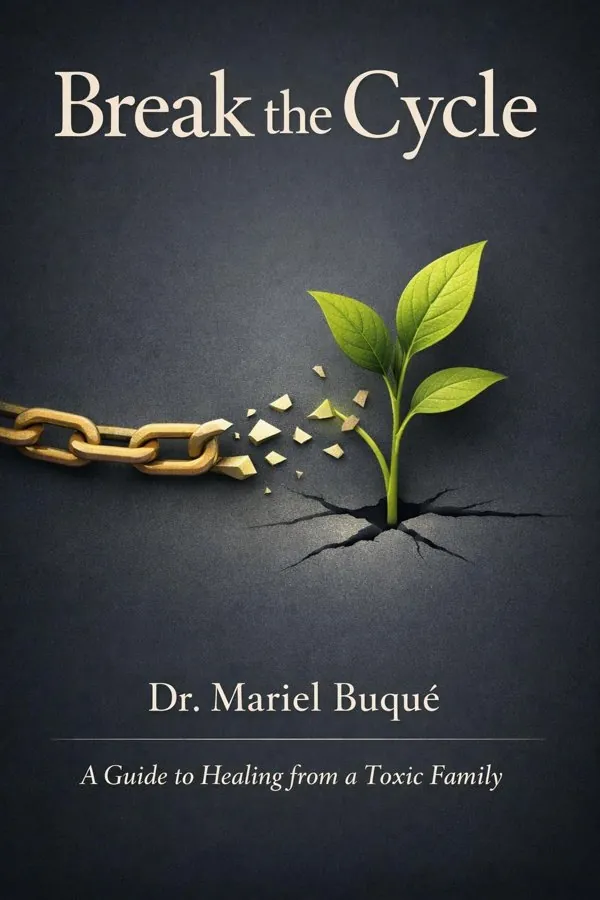
Break the Cycle: A Guide to Healing from a Toxic Family: Summary & Key Insights
 10 min9 chaptersAudio available
Key Takeaways from Break the Cycle: A Guide to Healing from a Toxic Family
Many people assume their emotional patterns belong only to them, but some wounds arrive long before we have words for them.
What feels like a private struggle is often part of a larger family design.
Healing does not happen through insight alone, because trauma is not stored only as a story.
In many toxic families, what damages people most is not only what happened, but what could never be spoken.
Family pain does not exist in a vacuum.
What Is Break the Cycle: A Guide to Healing from a Toxic Family About?
Break the Cycle: A Guide to Healing from a Toxic Family by Dr. Mariel Buqué is a mental_health book spanning 6 pages. Some of the pain we carry did not begin with us. In Break the Cycle, Dr. Mariel Buqué argues that many of our deepest emotional struggles—chronic shame, relationship instability, people-pleasing, emotional numbness, and constant hypervigilance—are shaped not only by personal experience, but by trauma passed down through families and reinforced by culture. This book shows that healing is not just about understanding what happened in your childhood. It is about recognizing inherited patterns, calming the body that has learned to live in survival mode, and choosing new ways of relating to yourself and others. Buqué writes with the authority of a clinical psychologist who specializes in intergenerational trauma, while also bringing a warm, culturally sensitive, holistic perspective to mental health. Drawing from psychology, neuroscience, attachment theory, and ancestral wisdom, she offers both explanation and practical guidance. The result is a compassionate roadmap for anyone trying to make sense of a painful family history without being defined by it. Break the Cycle matters because it names a truth many people feel but cannot yet articulate: healing yourself can also become an act of healing generations.
This FizzRead summary covers all 9 key chapters of Break the Cycle: A Guide to Healing from a Toxic Family in approximately 10 minutes, distilling the most important ideas, arguments, and takeaways from Dr. Mariel Buqué's work. Also available as an audio summary and Key Quotes Podcast.
Break the Cycle: A Guide to Healing from a Toxic Family
Some of the pain we carry did not begin with us. In Break the Cycle, Dr. Mariel Buqué argues that many of our deepest emotional struggles—chronic shame, relationship instability, people-pleasing, emotional numbness, and constant hypervigilance—are shaped not only by personal experience, but by trauma passed down through families and reinforced by culture. This book shows that healing is not just about understanding what happened in your childhood. It is about recognizing inherited patterns, calming the body that has learned to live in survival mode, and choosing new ways of relating to yourself and others.
Buqué writes with the authority of a clinical psychologist who specializes in intergenerational trauma, while also bringing a warm, culturally sensitive, holistic perspective to mental health. Drawing from psychology, neuroscience, attachment theory, and ancestral wisdom, she offers both explanation and practical guidance. The result is a compassionate roadmap for anyone trying to make sense of a painful family history without being defined by it. Break the Cycle matters because it names a truth many people feel but cannot yet articulate: healing yourself can also become an act of healing generations.
Who Should Read Break the Cycle: A Guide to Healing from a Toxic Family?
This book is perfect for anyone interested in mental_health and looking to gain actionable insights in a short read. Whether you're a student, professional, or lifelong learner, the key ideas from Break the Cycle: A Guide to Healing from a Toxic Family by Dr. Mariel Buqué will help you think differently.
- ✓Readers who enjoy mental_health and want practical takeaways
- ✓Professionals looking to apply new ideas to their work and life
- ✓Anyone who wants the core insights of Break the Cycle: A Guide to Healing from a Toxic Family in just 10 minutes
Want the full summary?
Get instant access to this book summary and 100K+ more with Fizz Moment.
Get Free SummaryAvailable on App Store • Free to download
Key Chapters
Many people assume their emotional patterns belong only to them, but some wounds arrive long before we have words for them. Buqué explains intergenerational trauma as the transmission of unresolved pain, fear, coping strategies, and relational habits from one generation to the next. This can happen through behavior, family beliefs, attachment styles, silence around painful events, and even the body’s stress responses. A grandparent’s unprocessed grief, a parent’s emotional neglect, or a family history of migration, racism, addiction, or violence can shape the emotional climate a child grows up in.
The book helps readers understand that inherited trauma is not an excuse for harmful behavior, but it is an important context for it. A parent who is emotionally unavailable may not be cruel by intention; they may be repeating what they learned was normal. A child raised in that environment may grow into an adult who struggles to trust love, express anger safely, or feel worthy of care. Once this chain is visible, shame begins to loosen. Instead of asking, “What is wrong with me?” readers can ask, “What happened in my family that taught me to survive this way?”
Buqué encourages curiosity over self-blame. Practical ways to begin include reflecting on recurring family phrases, noting what emotions were welcomed or punished, and observing which relationship patterns keep repeating. This shift from personal defect to inherited adaptation is foundational. The actionable takeaway: replace self-judgment with investigation by identifying one emotional pattern in your life and tracing where it may have first been modeled in your family system.
What feels like a private struggle is often part of a larger family design. Buqué uses a family systems lens to show that no behavior exists in isolation. Roles emerge in response to stress: the caretaker, the scapegoat, the achiever, the lost child, the peacekeeper. These roles may help a family maintain stability on the surface, but they usually come at a deep emotional cost. The high-achieving child may learn to earn love through performance. The funny one may hide pain to keep others comfortable. The scapegoated family member may carry everyone else’s disowned anger.
By mapping the family system, readers can see how survival patterns were distributed and reinforced. This process is powerful because it moves healing beyond blaming one “bad” person. It reveals the ecosystem that shaped everyone, including those who caused harm. Buqué invites readers to look at the rules that governed their family: Do not talk about hard things. Stay loyal no matter what. Be strong. Keep the peace. Never embarrass the family. These rules often survive long after they stop being useful.
A practical application is creating a simple family map that notes major events, emotional roles, addictions, estrangements, illnesses, migrations, and repeated themes. This can clarify why certain triggers feel so intense. For example, someone who panics when disappointing others may realize they were assigned the role of emotional stabilizer early in life. The actionable takeaway: write down the role you most often played in your family and ask how that role still shapes your choices, relationships, and sense of self today.
Healing does not happen through insight alone, because trauma is not stored only as a story. Buqué emphasizes that the body carries the memory of chronic stress through the nervous system. Even when someone intellectually understands their family history, they may still react with panic, shutdown, numbness, or rage because their body has learned that closeness, conflict, or uncertainty are dangerous. This is why readers often feel stuck: they know better, yet their body keeps responding as if the threat is still present.
Drawing on neuroscience, Buqué explains how survival responses such as fight, flight, freeze, and fawn become ingrained. A person from a volatile household may become hyper-alert to tone of voice. Someone raised with emotional neglect may disconnect from bodily sensations altogether. Others may overfunction, soothe everyone else, or abandon their own needs to stay safe. These are not character flaws; they are nervous system adaptations.
The book encourages somatic healing practices that help the body experience safety again. Examples include grounding through the feet, lengthening the exhale, orienting to the room with the eyes, shaking out stress, practicing gentle movement, and noticing bodily cues before they escalate. Readers can also learn to name sensations without immediately judging them: “My chest is tight,” “My jaw is clenched,” “My stomach dropped.” This builds regulation and choice.
The actionable takeaway: begin a daily two-minute body check-in. Ask yourself what sensations are present, what emotion may be underneath them, and what small act of care—breathing, stretching, resting, stepping outside—would help your nervous system feel safer.
In many toxic families, what damages people most is not only what happened, but what could never be spoken. Buqué shows how secrecy, denial, minimization, and taboo topics keep trauma alive across generations. Families may hide abuse, addiction, infidelity, mental illness, financial instability, or experiences of discrimination behind phrases like “that’s in the past,” “don’t air dirty laundry,” or “we don’t talk about those things.” Silence then becomes a survival strategy—but also a prison.
When truth is repeatedly denied, children learn to doubt their own perceptions. They may sense tension, fear, or sadness but be told everything is fine. Over time, this creates confusion, self-gaslighting, and difficulty trusting intuition. In adulthood, that can show up as staying in unhealthy relationships, minimizing harm, or feeling guilty for naming what is real. Buqué encourages readers to understand that silence is not neutrality. It often protects dysfunctional systems at the expense of the vulnerable.
Breaking secrecy does not require public confrontation or dramatic disclosure. It can begin privately by naming the truth to yourself in clear language. Journaling, therapy, trauma-informed support groups, or conversations with safe people can help readers reclaim their own reality. Even saying, “What happened to me mattered,” can be revolutionary for someone raised to normalize pain.
A practical application is listing the topics your family avoided and how that avoidance shaped you. Did it make you fear conflict, distrust memory, or hide your needs? The actionable takeaway: choose one family silence you are ready to name honestly—at least in writing—and replace minimization with a truthful sentence about its impact on your life.
Family pain does not exist in a vacuum. One of Buqué’s most valuable contributions is her insistence that healing must include cultural and social context. Trauma is not only personal and familial; it is also shaped by racism, migration, colonization, poverty, gender norms, religious pressure, and community expectations. A family’s harshness, emotional suppression, or fear may reflect not just dysfunction, but adaptation to collective survival conditions. This does not excuse harm, but it helps explain why some patterns become deeply entrenched.
For example, a parent who values silence and obedience above emotional openness may have been raised under conditions where speaking out was dangerous. A family that dismisses therapy may come from communities taught to distrust institutions for good reason. A child of immigrants may feel crushing pressure to succeed because failure is experienced as betrayal of sacrifice. Buqué urges readers to heal with nuance: not by rejecting culture, but by separating what nourishes from what wounds.
This broader perspective helps reduce both shame and simplistic blame. It allows readers to honor resilience in their lineage while still refusing harmful patterns. Practical applications include reflecting on cultural messages about emotion, strength, gender roles, mental health, and loyalty; exploring ancestral stories of survival; and building communities that support both identity and healing.
The actionable takeaway: identify one cultural or social message your family carried—such as “be strong,” “don’t trust outsiders,” or “family comes first”—and ask whether it protects your well-being today or keeps you trapped in old survival patterns.
One of the hardest lessons for people from toxic families is that love without boundaries often becomes self-abandonment. Buqué reframes boundaries not as punishment, selfishness, or rejection, but as acts of emotional clarity. In unhealthy family systems, boundaries are often mocked, ignored, or treated as betrayal because access, control, and enmeshment have been normalized. As a result, many adults feel intense guilt when they say no, take space, or protect their peace.
The book emphasizes that boundaries are especially important when family members continue harmful behavior or deny accountability. Readers may need limits around phone calls, visits, topics of conversation, financial requests, criticism, or emotional dumping. In some cases, a boundary may involve reduced contact or estrangement. Buqué does not romanticize these decisions; she acknowledges their grief. But she also shows that healing cannot thrive where harm remains constant and unquestioned.
Practical boundary work begins with self-awareness. What interactions leave you depleted, ashamed, reactive, or physically tense? What do you keep tolerating to avoid disapproval? A useful formula is: what behavior is not okay, what you will do if it continues, and how you will care for yourself afterward. For example: “If you begin insulting me, I will end the conversation.” The focus stays on your action, not controlling another person.
The actionable takeaway: identify one recurring family interaction that violates your well-being and write a simple, specific boundary you can communicate or enforce this week, even if the first step is just shortening your exposure to that pattern.
Few ideas confuse survivors more than forgiveness. Buqué offers a humane and liberating distinction: healing does not require excusing harm, denying anger, or reconciling with unsafe people. In many families, forgiveness is weaponized to restore comfort without accountability. Victims are asked to move on quickly, keep the family together, or stop being “dramatic,” while the original injury remains unaddressed. Buqué resists this pressure and centers the reader’s safety, truth, and emotional reality.
She presents forgiveness as a personal choice, not a moral obligation. For some, it may eventually mean releasing the grip of resentment so the past no longer dominates the present. For others, especially where abuse or chronic violation occurred, healing may happen without any felt forgiveness at all. What matters is moving from survival into self-possession: grieving what was lost, validating pain, and building a life not organized around the wound.
This perspective allows readers to stop forcing premature peace. Instead of asking, “How do I forgive them?” they can ask better questions: “What do I need to feel safe?” “What grief have I not allowed myself to feel?” “What story about myself was created by this harm?” Practical tools include grief rituals, unsent letters, therapy, anger processing, and compassionate self-talk.
The actionable takeaway: release the pressure to forgive on demand and focus instead on one healing task that restores your agency—such as naming your anger, grieving a loss, or choosing distance from someone who continues to violate your boundaries.
Trauma shapes identity by teaching us stories about who we are and what we should expect from others. Buqué shows that people from toxic families often internalize narratives such as “I am too much,” “My needs are a burden,” “Love must be earned,” “Conflict means abandonment,” or “I have to fix everyone.” These beliefs quietly influence friendships, romance, parenting, and work. We may choose familiar dynamics over healthy ones simply because they match the old script.
Healing requires rewriting these internal narratives with honesty and compassion. This is not shallow positive thinking; it is the deliberate correction of trauma-based conclusions. For example, a person who learned that vulnerability leads to ridicule may practice sharing small truths with safe people and discovering that connection can be mutual rather than punishing. Someone who overfunctions in relationships can experiment with letting others contribute instead of automatically rescuing.
Buqué encourages readers to notice where the old story shows up in real time. Do you apologize for having needs? Do you confuse intensity with intimacy? Do you equate unpredictability with passion? By bringing these habits into awareness, new relational experiences become possible. Rewriting the narrative also means choosing language that reflects agency: “I learned this pattern” instead of “This is just how I am.”
The actionable takeaway: identify one painful belief inherited from your family and write a healthier replacement belief grounded in truth. Then practice one small behavior that supports it, such as asking for help, telling the truth about a feeling, or refusing to overexplain a boundary.
Transformation is rarely a single breakthrough; it is built through repeated acts of care, awareness, and courage. Buqué closes the loop by showing that healing from family trauma must be integrated into daily life. Insight without practice fades, especially when old environments and triggers remain active. Readers need rituals and habits that help them return to themselves consistently, not just in moments of crisis.
These practices can be simple but meaningful: journaling after triggering interactions, tracking bodily cues, setting a weekly boundary intention, choosing rest over overwork, practicing self-soothing before reacting, and surrounding yourself with relationships that honor reciprocity. Therapy can be an important container, but so can meditation, breathwork, community support, spiritual practice, movement, creative expression, or time in nature. The goal is not perfection. It is building a life where safety, truth, and compassion become more familiar than chaos.
Buqué also highlights the importance of repair. Even healed people get activated. The difference is that they recover with greater self-awareness and less shame. They apologize when needed, regroup after setbacks, and return to their values. This makes healing sustainable rather than idealized.
A practical application is creating a personal healing menu with options for different states: what helps when you are overwhelmed, numb, angry, lonely, or triggered by family contact. This prevents you from relying only on willpower in difficult moments. The actionable takeaway: choose three repeatable practices—one for the body, one for emotional reflection, and one for connection—and commit to using them regularly for the next two weeks.
All Chapters in Break the Cycle: A Guide to Healing from a Toxic Family
About the Author
Dr. Mariel Buqué is a Dominican-American psychologist, educator, and leading voice on intergenerational trauma and culturally informed healing. Her work focuses on helping individuals understand how emotional pain, survival patterns, and unresolved trauma are passed through families and communities. Known for blending clinical psychology with holistic and body-based approaches, she brings together science, compassion, and cultural awareness in a way that feels both rigorous and accessible. Buqué has built a wide audience through her writing, speaking, and public education on trauma, relationships, and emotional wellness. Her insights have been featured in prominent publications including The New York Times and Vogue. In Break the Cycle, she brings her expertise to readers seeking not just to understand toxic family patterns, but to heal them in lasting, transformative ways.
Get This Summary in Your Preferred Format
Read or listen to the Break the Cycle: A Guide to Healing from a Toxic Family summary by Dr. Mariel Buqué anytime, anywhere. FizzRead offers multiple formats so you can learn on your terms — all free.
Available formats: App · Audio · PDF · EPUB — All included free with FizzRead
Download Break the Cycle: A Guide to Healing from a Toxic Family PDF and EPUB Summary
Key Quotes from Break the Cycle: A Guide to Healing from a Toxic Family
“Many people assume their emotional patterns belong only to them, but some wounds arrive long before we have words for them.”
“What feels like a private struggle is often part of a larger family design.”
“Healing does not happen through insight alone, because trauma is not stored only as a story.”
“In many toxic families, what damages people most is not only what happened, but what could never be spoken.”
“One of Buqué’s most valuable contributions is her insistence that healing must include cultural and social context.”
Frequently Asked Questions about Break the Cycle: A Guide to Healing from a Toxic Family
Break the Cycle: A Guide to Healing from a Toxic Family by Dr. Mariel Buqué is a mental_health book that explores key ideas across 9 chapters. Some of the pain we carry did not begin with us. In Break the Cycle, Dr. Mariel Buqué argues that many of our deepest emotional struggles—chronic shame, relationship instability, people-pleasing, emotional numbness, and constant hypervigilance—are shaped not only by personal experience, but by trauma passed down through families and reinforced by culture. This book shows that healing is not just about understanding what happened in your childhood. It is about recognizing inherited patterns, calming the body that has learned to live in survival mode, and choosing new ways of relating to yourself and others. Buqué writes with the authority of a clinical psychologist who specializes in intergenerational trauma, while also bringing a warm, culturally sensitive, holistic perspective to mental health. Drawing from psychology, neuroscience, attachment theory, and ancestral wisdom, she offers both explanation and practical guidance. The result is a compassionate roadmap for anyone trying to make sense of a painful family history without being defined by it. Break the Cycle matters because it names a truth many people feel but cannot yet articulate: healing yourself can also become an act of healing generations.
You Might Also Like
Big Feelings: How to Be Okay When Things Are Not Okay
Liz Fosslien, Mollie West Duffy
10 min
Creative Arts Therapies Handbook: Art, Music and Dance Therapy Practices for Wellbeing
Susan I. Buchalter
10 min
Emotional First Aid: Healing Rejection, Guilt, Failure, and Other Everyday Hurts
Guy Winch
10 min
Lost Connections: Why You're Depressed and How to Find Hope
Johann Hari
10 min
No Time to Panic: How to Stop Worrying and Embrace Life
Matt Gutman
10 min
Overcoming Mobbing: A Recovery Guide for Workplace Aggression and Bullying
Maureen Duffy, Len Sperry
10 minFeatured In
Browse by Category
Ready to read Break the Cycle: A Guide to Healing from a Toxic Family?
Get the full summary and 100K+ more books with Fizz Moment.