
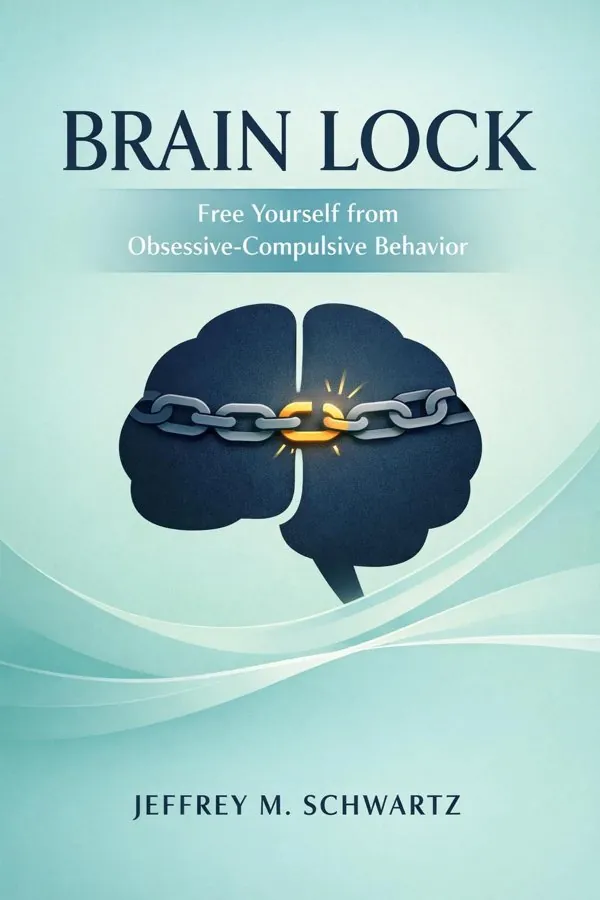
Brain Lock: Free Yourself from Obsessive-Compulsive Behavior: Summary & Key Insights
 10 min3 chaptersAudio available
What Is Brain Lock: Free Yourself from Obsessive-Compulsive Behavior About?
Brain Lock: Free Yourself from Obsessive-Compulsive Behavior by Jeffrey M. Schwartz is a mental_health book spanning 3 pages. Brain Lock is a groundbreaking self-help book that presents a four-step method for overcoming obsessive-compulsive disorder (OCD) without medication. Drawing on clinical research and patient case studies, Dr. Jeffrey M. Schwartz explains how individuals can use mindfulness and cognitive techniques to rewire their brain’s response to obsessive thoughts and compulsive behaviors. The book empowers readers to recognize OCD as a brain malfunction rather than a personal failing, offering practical tools to regain control and live more freely.
This FizzRead summary covers all 3 key chapters of Brain Lock: Free Yourself from Obsessive-Compulsive Behavior in approximately 10 minutes, distilling the most important ideas, arguments, and takeaways from Jeffrey M. Schwartz's work. Also available as an audio summary and Key Quotes Podcast.
Brain Lock: Free Yourself from Obsessive-Compulsive Behavior
Brain Lock is a groundbreaking self-help book that presents a four-step method for overcoming obsessive-compulsive disorder (OCD) without medication. Drawing on clinical research and patient case studies, Dr. Jeffrey M. Schwartz explains how individuals can use mindfulness and cognitive techniques to rewire their brain’s response to obsessive thoughts and compulsive behaviors. The book empowers readers to recognize OCD as a brain malfunction rather than a personal failing, offering practical tools to regain control and live more freely.
Who Should Read Brain Lock: Free Yourself from Obsessive-Compulsive Behavior?
This book is perfect for anyone interested in mental_health and looking to gain actionable insights in a short read. Whether you're a student, professional, or lifelong learner, the key ideas from Brain Lock: Free Yourself from Obsessive-Compulsive Behavior by Jeffrey M. Schwartz will help you think differently.
- ✓Readers who enjoy mental_health and want practical takeaways
- ✓Professionals looking to apply new ideas to their work and life
- ✓Anyone who wants the core insights of Brain Lock: Free Yourself from Obsessive-Compulsive Behavior in just 10 minutes
Want the full summary?
Get instant access to this book summary and 100K+ more with Fizz Moment.
Get Free SummaryAvailable on App Store • Free to download
Key Chapters
When I describe OCD, I emphasize that it isn't simply about cleanliness or checking behaviors — it's about being trapped in an unwanted cycle of thoughts and actions that the brain keeps reinforcing. Early research showed that people with OCD experience overactivity in specific brain circuits linking the orbitofrontal cortex, the caudate nucleus, and the anterior cingulate gyrus. These regions regulate decision-making and error detection. In OCD, however, the brain’s error signal doesn’t turn off even when everything is fine. The mind remains in constant alarm, sending messages like 'something isn’t right' or 'you have to fix this,' even when reason says otherwise.
Through brain imaging at UCLA, my colleagues and I saw what I termed 'brain lock.' The neural pathways responsible for sending and resolving these danger signals were stuck in overdrive. The caudate nucleus, which normally filters signals and lets the brain move from one thought to another smoothly, failed to close the loop. That malfunction explains why people feel they *must* check the stove one more time or wash their hands again, even after being sure it’s unnecessary.
This understanding was profoundly liberating for patients. It meant their compulsions weren’t proof of weakness; they were the effects of a physiological glitch, something measurable and correctable. When you frame OCD as a brain disorder, not a personal failing, you stop battling yourself and start treating the problem scientifically. The power of self-directed therapy lies in recognizing that although your brain may misfire, your mind — your awareness — can learn to override it.
The essence of overcoming OCD lies in learning new mental habits that change the neural circuitry responsible for obsessive-compulsive behavior. Through years of clinical practice, I developed the Four-Step Method. It reflects both scientific principles and patient experience, a mindful way of retraining your brain.
The first step, *Relabel*, is about naming the enemy. When intrusive thoughts appear — such as 'I might get sick if I don’t wash again' — you must clearly say to yourself, 'That’s not me. That’s my OCD.' This act of labeling separates your true self from the faulty signal the brain sends. Language matters because it shifts the brain’s focus from automatic reaction to conscious observation, activating rational circuits that calm the emotional centers.
In the second step, *Reattribute,* you remind yourself that these thoughts arise from a biochemical imbalance, not personal failure. When patients truly understand that their symptoms stem from misfiring neurons, shame dissolves and a scientific attitude replaces panic. This change is crucial for creating distance from the compulsive urge.
Next comes *Refocus.* This is where real neuroplastic change happens. When you feel the compulsion, rather than giving in, redirect your attention to something constructive for at least fifteen minutes — walking, reading, listening to music, anything meaningful. This deliberate redirection teaches the brain new pathways, weakening the old ones. I call this 'workout for the mind,' because like muscles, circuits strengthen through repeated use.
Finally, *Revalue* restores perspective. You learn to see those obsessive thoughts as worthless, false messages from the brain — not something deserving attention. The more you practice devaluing these signals, the less power they hold. This step cements freedom because it rewrites the emotional meaning of intrusive thoughts.
Over time, repeated use of these steps changes brain activity. Imaging studies confirmed decreased activity in the hyperactive circuits of patients who practiced this method consistently. What was once locked became unlocked through mental discipline and awareness. The message is clear: your mind can heal the brain.
+ 1 more chapters — available in the FizzRead app
All Chapters in Brain Lock: Free Yourself from Obsessive-Compulsive Behavior
About the Author
Jeffrey M. Schwartz, M.D., is a research psychiatrist at the University of California, Los Angeles (UCLA) School of Medicine. He is internationally recognized for his work in neuroplasticity and the treatment of obsessive-compulsive disorder. His research has contributed significantly to understanding how mindfulness and cognitive-behavioral therapy can alter brain function. Dr. Schwartz is also the author of several books on the intersection of neuroscience and human behavior.
Get This Summary in Your Preferred Format
Read or listen to the Brain Lock: Free Yourself from Obsessive-Compulsive Behavior summary by Jeffrey M. Schwartz anytime, anywhere. FizzRead offers multiple formats so you can learn on your terms — all free.
Available formats: App · Audio · PDF · EPUB — All included free with FizzRead
Download Brain Lock: Free Yourself from Obsessive-Compulsive Behavior PDF and EPUB Summary
Key Quotes from Brain Lock: Free Yourself from Obsessive-Compulsive Behavior
“When I describe OCD, I emphasize that it isn't simply about cleanliness or checking behaviors — it's about being trapped in an unwanted cycle of thoughts and actions that the brain keeps reinforcing.”
“The essence of overcoming OCD lies in learning new mental habits that change the neural circuitry responsible for obsessive-compulsive behavior.”
Frequently Asked Questions about Brain Lock: Free Yourself from Obsessive-Compulsive Behavior
Brain Lock: Free Yourself from Obsessive-Compulsive Behavior by Jeffrey M. Schwartz is a mental_health book that explores key ideas across 3 chapters. Brain Lock is a groundbreaking self-help book that presents a four-step method for overcoming obsessive-compulsive disorder (OCD) without medication. Drawing on clinical research and patient case studies, Dr. Jeffrey M. Schwartz explains how individuals can use mindfulness and cognitive techniques to rewire their brain’s response to obsessive thoughts and compulsive behaviors. The book empowers readers to recognize OCD as a brain malfunction rather than a personal failing, offering practical tools to regain control and live more freely.
More by Jeffrey M. Schwartz
You Might Also Like

Big Feelings: How to Be Okay When Things Are Not Okay
Liz Fosslien, Mollie West Duffy
10 min
Creative Arts Therapies Handbook: Art, Music and Dance Therapy Practices for Wellbeing
Susan I. Buchalter
10 min
Emotional First Aid: Healing Rejection, Guilt, Failure, and Other Everyday Hurts
Guy Winch
10 min
Lost Connections: Why You're Depressed and How to Find Hope
Johann Hari
10 min
No Time to Panic: How to Stop Worrying and Embrace Life
Matt Gutman
10 min
Overcoming Mobbing: A Recovery Guide for Workplace Aggression and Bullying
Maureen Duffy, Len Sperry
10 minFeatured In
Browse by Category
Ready to read Brain Lock: Free Yourself from Obsessive-Compulsive Behavior?
Get the full summary and 100K+ more books with Fizz Moment.