
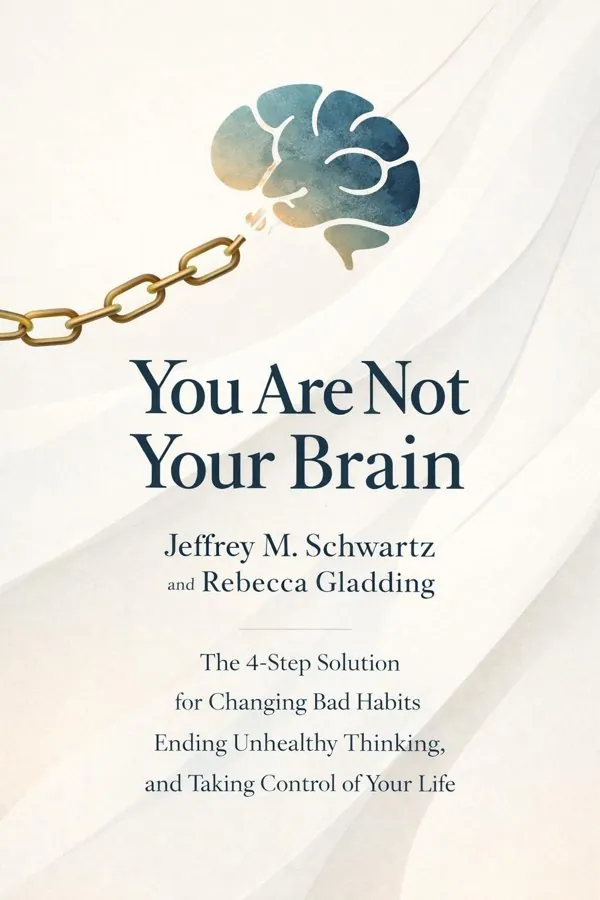
You Are Not Your Brain: The 4-Step Solution for Changing Bad Habits, Ending Unhealthy Thinking, and Taking Control of Your Life: Summary & Key Insights
by Jeffrey M. Schwartz, Rebecca Gladding
 10 min5 chaptersAudio available
What Is You Are Not Your Brain: The 4-Step Solution for Changing Bad Habits, Ending Unhealthy Thinking, and Taking Control of Your Life About?
You Are Not Your Brain: The 4-Step Solution for Changing Bad Habits, Ending Unhealthy Thinking, and Taking Control of Your Life by Jeffrey M. Schwartz, Rebecca Gladding is a neuroscience book spanning 5 pages. This book presents a neuroscience-based approach to overcoming destructive thoughts and behaviors. Dr. Jeffrey Schwartz and Dr. Rebecca Gladding explain how to use mindful awareness to rewire the brain, helping readers break free from obsessive thinking patterns and regain control over their actions and emotions.
This FizzRead summary covers all 5 key chapters of You Are Not Your Brain: The 4-Step Solution for Changing Bad Habits, Ending Unhealthy Thinking, and Taking Control of Your Life in approximately 10 minutes, distilling the most important ideas, arguments, and takeaways from Jeffrey M. Schwartz, Rebecca Gladding's work. Also available as an audio summary and Key Quotes Podcast.
You Are Not Your Brain: The 4-Step Solution for Changing Bad Habits, Ending Unhealthy Thinking, and Taking Control of Your Life
This book presents a neuroscience-based approach to overcoming destructive thoughts and behaviors. Dr. Jeffrey Schwartz and Dr. Rebecca Gladding explain how to use mindful awareness to rewire the brain, helping readers break free from obsessive thinking patterns and regain control over their actions and emotions.
Who Should Read You Are Not Your Brain: The 4-Step Solution for Changing Bad Habits, Ending Unhealthy Thinking, and Taking Control of Your Life?
This book is perfect for anyone interested in neuroscience and looking to gain actionable insights in a short read. Whether you're a student, professional, or lifelong learner, the key ideas from You Are Not Your Brain: The 4-Step Solution for Changing Bad Habits, Ending Unhealthy Thinking, and Taking Control of Your Life by Jeffrey M. Schwartz, Rebecca Gladding will help you think differently.
- ✓Readers who enjoy neuroscience and want practical takeaways
- ✓Professionals looking to apply new ideas to their work and life
- ✓Anyone who wants the core insights of You Are Not Your Brain: The 4-Step Solution for Changing Bad Habits, Ending Unhealthy Thinking, and Taking Control of Your Life in just 10 minutes
Want the full summary?
Get instant access to this book summary and 100K+ more with Fizz Moment.
Get Free SummaryAvailable on App Store • Free to download
Key Chapters
Let me begin by explaining the concept that underpins this entire approach: deceptive brain messages. These are automatic impulses, thoughts, or feelings generated by your brain that trick you into believing something that isn’t true — such as that you’re not good enough, that you must perform a ritual to decrease anxiety, or that a fleeting craving defines your needs. They originate in deeply ingrained neural patterns whose evolutionary function once helped us avoid harm and seek reward, but which now operate independently of your conscious values and judgment.
Through brain studies, we’ve seen how these signals activate the error-detection system, particularly in the anterior cingulate cortex and the orbitofrontal cortex. When these circuits misfire, they produce sensations like anxiety or doubt, repeatedly urging you to act or worry to ‘fix’ something that isn’t actually wrong. This is what drives compulsions, addictions, and intrusive thought loops. The brain, in these cases, is reacting; it isn’t reasoning.
But here’s where hope emerges: the human brain is plastic. Neuroplasticity refers to its ability to change structure and function through experience and focused mental activity. When you direct your attention with awareness and intention, you literally reshape synaptic connections and strengthen new pathways. This truth means that you are not doomed to live according to old habits or fears. You can train your brain to follow your mind.
My colleague Rebecca Gladding and I discovered that mindful awareness — the nonjudgmental observation of thoughts and sensations — is the vehicle for this change. When you observe your mind without getting entangled, the intensity of deceptive messages decreases, and new circuits start to develop in the prefrontal cortex, the area responsible for insight and conscious control. Over time, these circuits assume dominance, and you regain freedom of choice.
Think of this as a training process: by intentionally practicing awareness, naming deceptive messages, and acting according to your values, you repeatedly reinforce healthier neural networks. Each moment of awareness becomes a moment of change at the physical, cellular level of your brain.
To effectively apply the Four-Step Method, you must understand the difference between who you truly are and what your brain happens to signal. The real self is not a construct of fleeting emotions or desires; it is the conscious awareness that chooses and directs meaning. It holds your deepest sense of integrity, compassion, and intentionality. In contrast, the deceptive brain messages are noises from instinctual circuits — they mimic urgency but lack wisdom.
For example, when you feel guilt for relaxing instead of working, or panic over a minor uncertainty, those sensations may not reflect any objective reality; they are simply patterns produced by anxiety circuits seeking control. Recognizing the gap between those impulses and your core values is crucial. In my clinical practice, I’ve seen people who believed their anxious thoughts defined them. When they learned that those thoughts were mere neural events, their entire perspective changed. It was as if a fog lifted — allowing them to act from their authentic self, not from reflex.
Neuroscience supports this distinction. The prefrontal cortex, the seat of conscious awareness, can inhibit or redirect activity in lower-level emotional centers. When you recognize deceptive thoughts as product of malfunctioning brain signals, you stop identifying with them. This is the moment of psychological liberation. You realize, I am not my fears. I am not my brain. I am my awareness interpreting those signals.
Maintaining this awareness requires daily practice. Each time you pause and observe instead of reacting, you strengthen your real self’s leadership and diminish the grip of those automatic circuits. The brain learns through repetition — and the more you choose from your conscious self, the less power those deceptive messages hold.
+ 3 more chapters — available in the FizzRead app
All Chapters in You Are Not Your Brain: The 4-Step Solution for Changing Bad Habits, Ending Unhealthy Thinking, and Taking Control of Your Life
About the Authors
Jeffrey M. Schwartz, M.D., is a research psychiatrist at UCLA School of Medicine known for his work on neuroplasticity and obsessive-compulsive disorder. Rebecca Gladding, M.D., is a psychiatrist and clinical instructor at UCLA, specializing in mindfulness and cognitive-behavioral therapy.
Get This Summary in Your Preferred Format
Read or listen to the You Are Not Your Brain: The 4-Step Solution for Changing Bad Habits, Ending Unhealthy Thinking, and Taking Control of Your Life summary by Jeffrey M. Schwartz, Rebecca Gladding anytime, anywhere. FizzRead offers multiple formats so you can learn on your terms — all free.
Available formats: App · Audio · PDF · EPUB — All included free with FizzRead
Download You Are Not Your Brain: The 4-Step Solution for Changing Bad Habits, Ending Unhealthy Thinking, and Taking Control of Your Life PDF and EPUB Summary
Key Quotes from You Are Not Your Brain: The 4-Step Solution for Changing Bad Habits, Ending Unhealthy Thinking, and Taking Control of Your Life
“Let me begin by explaining the concept that underpins this entire approach: deceptive brain messages.”
“To effectively apply the Four-Step Method, you must understand the difference between who you truly are and what your brain happens to signal.”
Frequently Asked Questions about You Are Not Your Brain: The 4-Step Solution for Changing Bad Habits, Ending Unhealthy Thinking, and Taking Control of Your Life
You Are Not Your Brain: The 4-Step Solution for Changing Bad Habits, Ending Unhealthy Thinking, and Taking Control of Your Life by Jeffrey M. Schwartz, Rebecca Gladding is a neuroscience book that explores key ideas across 5 chapters. This book presents a neuroscience-based approach to overcoming destructive thoughts and behaviors. Dr. Jeffrey Schwartz and Dr. Rebecca Gladding explain how to use mindful awareness to rewire the brain, helping readers break free from obsessive thinking patterns and regain control over their actions and emotions.
You Might Also Like
Anxious
Joseph LeDoux
10 min
Hallucinations
Oliver Sacks
10 min
The Biological Mind: How Brain, Body, and Environment Collaborate to Make Us Who We Are
Alan Jasanoff
10 min
The Feeling of Life Itself: Why Consciousness Is Widespread but Can't Be Computed
Christof Koch
10 min
The No-Nonsense Meditation Book
Steven Laureys
10 min
A General Theory of Love
Thomas Lewis, Fari Amini, Richard Lannon
10 minBrowse by Category
Ready to read You Are Not Your Brain: The 4-Step Solution for Changing Bad Habits, Ending Unhealthy Thinking, and Taking Control of Your Life?
Get the full summary and 100K+ more books with Fizz Moment.