
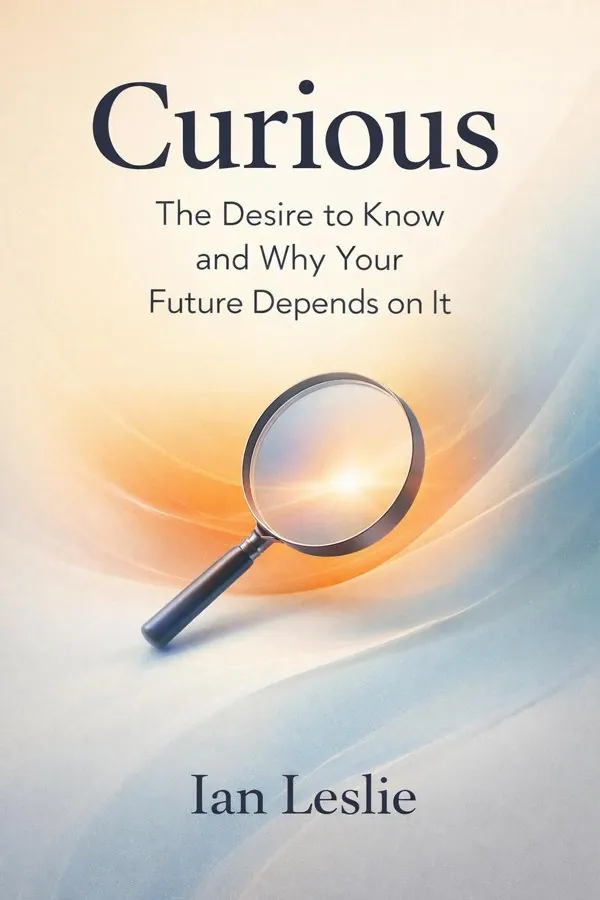
Curious: The Desire to Know and Why Your Future Depends on It: Summary & Key Insights
by Ian Leslie
 10 min8 chaptersAudio available
What Is Curious: The Desire to Know and Why Your Future Depends on It About?
Curious: The Desire to Know and Why Your Future Depends on It by Ian Leslie is a cognition book spanning 8 pages. Curious explores the science and psychology of curiosity, arguing that it is one of the most important traits for success and fulfillment in the modern world. Ian Leslie examines how curiosity works, why it is essential for creativity and learning, and how it can be cultivated in an age of instant information. Through engaging stories and research, the book reveals how curiosity drives innovation and personal growth.
This FizzRead summary covers all 8 key chapters of Curious: The Desire to Know and Why Your Future Depends on It in approximately 10 minutes, distilling the most important ideas, arguments, and takeaways from Ian Leslie's work. Also available as an audio summary and Key Quotes Podcast.
Curious: The Desire to Know and Why Your Future Depends on It
Curious explores the science and psychology of curiosity, arguing that it is one of the most important traits for success and fulfillment in the modern world. Ian Leslie examines how curiosity works, why it is essential for creativity and learning, and how it can be cultivated in an age of instant information. Through engaging stories and research, the book reveals how curiosity drives innovation and personal growth.
Who Should Read Curious: The Desire to Know and Why Your Future Depends on It?
This book is perfect for anyone interested in cognition and looking to gain actionable insights in a short read. Whether you're a student, professional, or lifelong learner, the key ideas from Curious: The Desire to Know and Why Your Future Depends on It by Ian Leslie will help you think differently.
- ✓Readers who enjoy cognition and want practical takeaways
- ✓Professionals looking to apply new ideas to their work and life
- ✓Anyone who wants the core insights of Curious: The Desire to Know and Why Your Future Depends on It in just 10 minutes
Want the full summary?
Get instant access to this book summary and 100K+ more with Fizz Moment.
Get Free SummaryAvailable on App Store • Free to download
Key Chapters
Imagine a world before language, before books, before Google. Our ancestors relied on curiosity as a survival tool. In evolutionary terms, curiosity wasn’t a luxury—it was adaptive behavior that helped our species learn about its environment, discover new resources, and avoid danger. I explore how curiosity gave humans the edge over other species, linking it to our capacity for exploration and problem-solving.
In other animals, curiosity tends to be situational—it serves immediate needs, like locating food or escaping threats. But human curiosity transcended that. It allowed us to think abstractly, to wonder about what lies beyond the horizon or beneath the surface of things. That’s how we became the kind of species that invents and innovates. Anthropologists and psychologists have found that curiosity is the evolutionary spark behind tool-making, language, and storytelling—all behaviors that help us make sense of an uncertain world.
And here’s the paradox: the same curiosity that drives exploration also demands self-restraint. Evolution didn’t just give us the impulse to seek—it gave us the cognitive control to manage that seeking, to learn slowly and deliberately. Our intelligence evolved not from raw curiosity alone but from the ability to turn curiosity into sustained attention. That tension—between impulsive novelty-seeking and disciplined inquiry—defines our species and remains the tension we must navigate in our digital era.
Curiosity is not mystical; it is measurable. In this section, I dive into the psychology and neuroscience that explain how it works. Research from psychologists like Daniel Berlyne shows that curiosity arises from cognitive gaps—the realization that we don’t know something we want to know. These gaps create an itch, a mental discomfort that fuels exploration until it’s resolved.
Neuroscientists have found that curiosity activates the same dopamine circuits that govern reward. This means that when you learn something new, the brain responds much like it does to pleasure or novelty. Curiosity, quite literally, feels good. But it’s not just about reward; curiosity also engages memory. Studies show that when curiosity is aroused, the brain retains information more deeply and durably.
From this science emerges a profound insight: curiosity is both a motivational and cognitive force. It bridges emotion and intellect. When we teach, learn, or communicate, stimulating curiosity is far more effective than simply dispensing information. The deeper the emotional engagement—the more the learner feels that itch of the unknown—the more enduring the learning. The book’s message is clear: if you want to build knowledge that lasts, you must begin with questions that truly matter to you.
+ 6 more chapters — available in the FizzRead app
All Chapters in Curious: The Desire to Know and Why Your Future Depends on It
About the Author
Ian Leslie is a British author and journalist known for his works on psychology, behavior, and culture. He has written for publications such as The Economist, The Guardian, and The New Statesman. His books often explore how human thinking and motivation shape society and personal success.
Get This Summary in Your Preferred Format
Read or listen to the Curious: The Desire to Know and Why Your Future Depends on It summary by Ian Leslie anytime, anywhere. FizzRead offers multiple formats so you can learn on your terms — all free.
Available formats: App · Audio · PDF · EPUB — All included free with FizzRead
Download Curious: The Desire to Know and Why Your Future Depends on It PDF and EPUB Summary
Key Quotes from Curious: The Desire to Know and Why Your Future Depends on It
“Imagine a world before language, before books, before Google.”
“Curiosity is not mystical; it is measurable.”
Frequently Asked Questions about Curious: The Desire to Know and Why Your Future Depends on It
Curious: The Desire to Know and Why Your Future Depends on It by Ian Leslie is a cognition book that explores key ideas across 8 chapters. Curious explores the science and psychology of curiosity, arguing that it is one of the most important traits for success and fulfillment in the modern world. Ian Leslie examines how curiosity works, why it is essential for creativity and learning, and how it can be cultivated in an age of instant information. Through engaging stories and research, the book reveals how curiosity drives innovation and personal growth.
More by Ian Leslie
You Might Also Like
A Field Guide to Lies: Critical Thinking in the Information Age
Daniel J. Levitin
10 min
A Theory of Cognitive Dissonance
Leon Festinger
10 min
Black-And-White Thinking: The Burden of a Binary Brain in a Complex World
Kevin Dutton
10 min
Born Liars: Why We Can’t Live Without Deceit
Ian Leslie
10 min
Collective Illusions: Conformity, Complicity, and the Science of Why We Make Bad Decisions
Todd Rose
10 min
Concrete Mathematics: A Foundation for Computer Science
Ronald L. Graham, Donald E. Knuth, Oren Patashnik
10 minBrowse by Category
Ready to read Curious: The Desire to Know and Why Your Future Depends on It?
Get the full summary and 100K+ more books with Fizz Moment.