
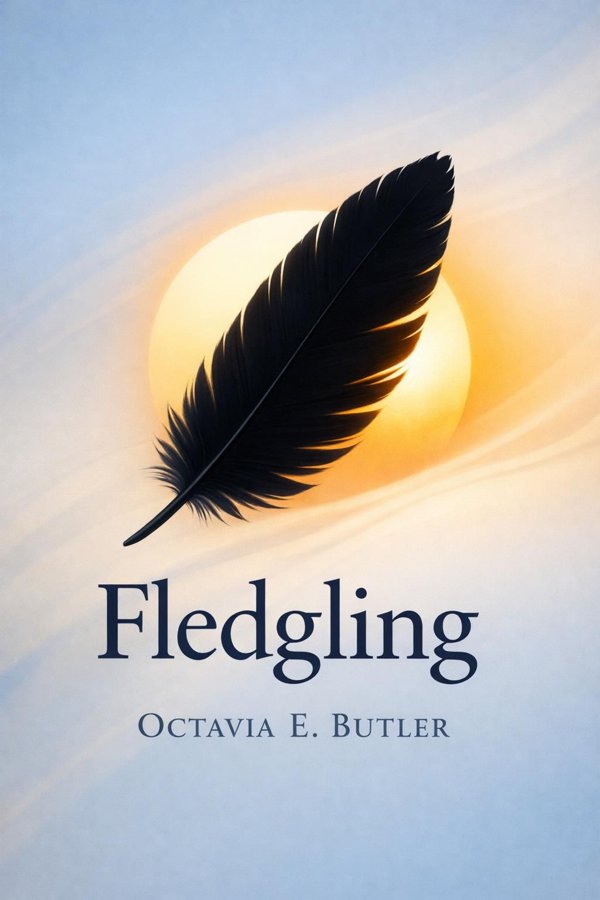
Fledgling: Summary & Key Insights
 10 min9 chaptersAudio available
Key Takeaways from Fledgling
Identity often feels permanent until it is suddenly stripped away.
Connection can begin in fear and still become genuine.
Sometimes recovering the truth hurts more than not knowing it.
What makes someone dangerous to a society is often not weakness, but difference that cannot be controlled.
The most dangerous prejudice is the kind that presents itself as tradition.
What Is Fledgling About?
Fledgling by Octavia E. Butler is a scifi_fantasy book spanning 6 pages. Fledgling is Octavia E. Butler’s bold reinvention of the vampire story: intimate, unsettling, and deeply intelligent. The novel begins with Shori, a young-looking girl who wakes in a cave, badly burned, hunted, and stripped of her memory. As she slowly reconstructs her identity, she learns that she is not human but Ina, a long-lived species that survives by feeding on humans while forming emotionally and biologically intertwined bonds with them. Shori is also something unprecedented: a genetically altered Ina with human DNA, able to tolerate sunlight and potentially reshape her people’s future. From this gripping premise, Butler builds a story that is part survival thriller, part mystery, and part social critique. Fledgling matters because it uses speculative fiction to examine race, consent, community, trauma, prejudice, and power with remarkable clarity. Few writers were better equipped for that task than Butler, one of the most influential voices in modern science fiction, whose work consistently fused imaginative worldbuilding with moral complexity. In Fledgling, she turns the vampire myth into a provocative study of what it means to belong, to need others, and to fight for one’s right to exist.
This FizzRead summary covers all 9 key chapters of Fledgling in approximately 10 minutes, distilling the most important ideas, arguments, and takeaways from Octavia E. Butler's work. Also available as an audio summary and Key Quotes Podcast.
Fledgling
Fledgling is Octavia E. Butler’s bold reinvention of the vampire story: intimate, unsettling, and deeply intelligent. The novel begins with Shori, a young-looking girl who wakes in a cave, badly burned, hunted, and stripped of her memory. As she slowly reconstructs her identity, she learns that she is not human but Ina, a long-lived species that survives by feeding on humans while forming emotionally and biologically intertwined bonds with them. Shori is also something unprecedented: a genetically altered Ina with human DNA, able to tolerate sunlight and potentially reshape her people’s future. From this gripping premise, Butler builds a story that is part survival thriller, part mystery, and part social critique. Fledgling matters because it uses speculative fiction to examine race, consent, community, trauma, prejudice, and power with remarkable clarity. Few writers were better equipped for that task than Butler, one of the most influential voices in modern science fiction, whose work consistently fused imaginative worldbuilding with moral complexity. In Fledgling, she turns the vampire myth into a provocative study of what it means to belong, to need others, and to fight for one’s right to exist.
Who Should Read Fledgling?
This book is perfect for anyone interested in scifi_fantasy and looking to gain actionable insights in a short read. Whether you're a student, professional, or lifelong learner, the key ideas from Fledgling by Octavia E. Butler will help you think differently.
- ✓Readers who enjoy scifi_fantasy and want practical takeaways
- ✓Professionals looking to apply new ideas to their work and life
- ✓Anyone who wants the core insights of Fledgling in just 10 minutes
Want the full summary?
Get instant access to this book summary and 100K+ more with Fizz Moment.
Get Free SummaryAvailable on App Store • Free to download
Key Chapters
Identity often feels permanent until it is suddenly stripped away. Fledgling opens in exactly that condition: Shori wakes alone, injured, and without any memory of who she is, where she comes from, or why someone tried to kill her. Butler uses this disorientation not only to generate suspense but to ask a deeper question: if memory disappears, what remains of the self? Shori’s first responses are physical and instinctive. She is hungry, alert, cautious, and startlingly capable. Even before she understands her origins, she reveals her intelligence, resilience, and moral curiosity.
This opening matters because it reframes identity as something actively rebuilt rather than passively inherited. Shori cannot rely on family history, status, or social expectations. She must interpret the world through evidence, behavior, and trust. That gives the novel unusual emotional power. We do not meet Shori as a fully formed supernatural being; we meet her as someone who must earn knowledge the hard way. Her survival depends on observation, adaptability, and the willingness to ask dangerous questions.
In practical terms, this makes Fledgling a story about rebuilding after trauma. Many people experience moments when old certainties collapse: after illness, loss, betrayal, migration, or dramatic change. Like Shori, they must reconstruct identity from fragments. The novel suggests that the process is frightening, but also liberating. Without inherited narratives, Shori can judge the world more clearly.
Actionable takeaway: when life disrupts your sense of self, begin with what remains reliable—your instincts, your values, and the evidence in front of you—and rebuild from there, one truthful observation at a time.
Connection can begin in fear and still become genuine. When Shori meets Wright Hamlin, their encounter initially carries danger, confusion, and imbalance. She is an injured stranger with unusual needs; he is an ordinary human pulled into a reality he cannot yet understand. Yet their relationship quickly becomes one of the novel’s central emotional anchors. Through Wright, Butler shows that dependence is never simple. It can involve care, desire, vulnerability, power, and negotiation all at once.
Shori’s bond with Wright introduces the symbiotic structure of Ina life. Ina feed on humans, but they also provide their symbionts with pleasure, health benefits, protection, and longevity. Butler refuses to present this arrangement as either purely exploitative or purely romantic. Instead, she invites readers to sit with its complexity. Wright is drawn to Shori, comforts her, and chooses to stay with her, but his bond is also shaped by venom, biology, and altered desire. The relationship becomes a lens for examining consent, influence, and emotional attachment under unequal conditions.
What makes this idea compelling is its relevance beyond the supernatural premise. Real relationships also contain mixtures of need and agency. People affect one another chemically, emotionally, socially, and economically. The healthiest bonds are not those without influence, but those where influence is recognized, discussed, and handled responsibly. Shori and Wright’s relationship forces readers to ask what ethical dependence looks like.
Actionable takeaway: in any close relationship, do not assume care automatically makes a bond ethical. Ask where power lies, what each person is choosing freely, and how honesty can make attachment more mutual and humane.
Sometimes recovering the truth hurts more than not knowing it. As Shori moves beyond immediate survival, fragments of memory return and external clues reveal the scale of what she has lost. Her family has been murdered, her community shattered, and her own existence targeted. Butler turns memory into a double-edged gift: it restores identity, but it also reopens grief. Knowledge is necessary, yet it comes at an emotional cost.
This stage of the novel deepens Shori’s character. She is not merely solving a mystery; she is learning that the life waiting for her is full of violence, betrayal, and inherited conflict. The return of memory does not produce simple healing. Instead, it forces her to integrate trauma into a new sense of self. Butler understands that restoration is never a return to innocence. Once we know what happened, we must decide what to do with that knowledge.
The idea resonates with anyone who has had to revisit painful history, whether personal or collective. Families uncover buried abuse. Communities confront injustice. Nations face violent pasts. In all these cases, remembering is disruptive, but forgetting leaves underlying harm untouched. Fledgling suggests that grief and clarity often arrive together. Shori’s strength lies not in avoiding pain but in refusing to let pain define the limits of her future.
Butler also emphasizes that memory is social. Others help Shori reconstruct what happened, but they also shape the meaning of that history. This reminds us to be careful about whose stories we trust and whose absences we notice.
Actionable takeaway: when difficult truths surface, resist the urge to retreat into denial. Let memory inform you, mourn what was lost, and then use that knowledge to choose a more deliberate future.
What makes someone dangerous to a society is often not weakness, but difference that cannot be controlled. Shori is unique among the Ina because she carries human genetic material engineered into her body. This gives her abilities other Ina lack, most notably greater resistance to sunlight. Her hybrid nature is a scientific breakthrough, a survival advantage, and a social provocation. She embodies a future that some Ina welcome and others fear.
Butler uses Shori’s body to examine how societies react to those who cross established categories. She is both insider and outsider: unquestionably Ina, yet visibly transformed by human ancestry. That dual status exposes the fragility of supposedly natural boundaries. The prejudice directed toward her is not based on incapacity but on the anxiety that she may redefine what Ina can become. In that sense, Fledgling is not just about race; it is about any form of identity that unsettles rigid hierarchies.
This idea has powerful real-world applications. Mixed-race individuals, immigrants, queer people, multilingual speakers, and anyone living across cultural lines often encounter pressure to prove authenticity to multiple communities at once. They may be told they are too much of one thing and not enough of another. Butler rejects that logic. Shori’s hybrid nature is not a flaw to be hidden but a possibility to be understood.
The novel also suggests that innovation frequently arrives through hybridity. New perspectives, new communities, and new solutions often emerge where boundaries blur rather than harden.
Actionable takeaway: when you encounter difference in yourself or others, do not ask whether it fits old categories. Ask what new capacities, insights, or futures that difference might make possible.
A relationship can feel loving and still demand ethical scrutiny. One of Fledgling’s most provocative concerns is consent. Ina venom creates pleasure, attachment, and dependency in human symbionts. That means Shori’s relationships are affectionate and sustaining, but they are never free from questions about influence. Butler does not resolve this tension neatly. Instead, she insists that readers remain uncomfortable enough to think seriously about what consent means when biology, need, and emotional bonding complicate free choice.
This complexity is what gives the novel its depth. Shori cares for her symbionts and often protects them better than humans protect one another. They receive real benefits from the bond: improved health, longer life, belonging, and love. Yet the bond also changes their desires. Their willingness cannot be understood apart from the physiological effects of Ina feeding. Butler uses this setup to challenge simplistic moral categories. Consent is not merely a yes or no uttered in one moment; it is shaped by context, information, power, and the ability to leave.
The novel remains strikingly relevant because many real-world dynamics work similarly, if less dramatically. Employers, charismatic leaders, romantic partners, and institutions can create environments where affection and coercion mix. People may sincerely want what also limits their freedom. Ethical responsibility, then, falls especially on the more powerful party.
Shori is at her best when she seeks clarity, explains herself, and values the well-being of those connected to her. Butler suggests that love does not erase power; it demands more accountability from those who hold it.
Actionable takeaway: whenever desire and dependency coexist, ask not only whether someone agreed, but whether they were informed, free to refuse, and protected from manipulation over time.
Private suffering becomes political the moment a community must decide what counts as justice. The council hearing near the end of Fledgling shifts the story from personal recovery to collective judgment. By this point, Shori has gathered evidence, allies, and enough memory to understand the attack against her family. But truth alone is not enough. She must present her case before Ina leadership in a formal setting where prejudice, power, and social reputation all influence the outcome.
This hearing is more than a plot climax. It dramatizes how institutions process violence. Ideally, councils and courts exist to establish facts and hold wrongdoers accountable. In reality, they also reflect the biases of the societies that create them. Butler captures both possibilities. The hearing offers a space where testimony matters, where wrongdoing can be named publicly, and where community standards are tested. At the same time, it reveals how easily justice can be delayed or distorted when the accused are influential and the victim is controversial.
For readers, this section illuminates the difference between being right and being recognized as right. Many people know the truth of what happened to them but still must navigate systems designed by others. The hearing also underscores the importance of witnesses, documentation, and coalition-building. Shori does not prevail through outrage alone. She succeeds by combining moral clarity with preparation.
This has practical value in everyday life. Whether confronting workplace misconduct, community harm, or legal disputes, the most effective pursuit of justice often requires evidence, allies, and strategic patience alongside courage.
Actionable takeaway: when seeking accountability, pair your convictions with proof, build support before the decisive moment, and remember that fair outcomes usually depend on both truth and collective pressure.
No one survives alone, and Fledgling takes that fact seriously. Butler’s vision of community is built on symbiosis: Ina need humans, humans need one another, and even powerful beings require trust, care, and social belonging. As Shori rebuilds her life, she forms a network that is not simply inherited but chosen. Her human symbionts, remaining allies, and eventual supporters create a family structure rooted in mutual dependence rather than conventional norms.
This is one of the novel’s most humane ideas. Dependency is often portrayed as weakness, especially in cultures that prize autonomy. Butler argues the opposite. Need is fundamental. The question is not whether we depend on others, but whether our dependencies are exploitative, denied, or responsibly structured. In Shori’s world, the healthiest bonds are those in which people understand what they give, what they receive, and what obligations come with intimacy.
The concept of chosen family resonates widely. Many readers know what it means to build belonging outside biological kinship: through friendship, queer community, migration networks, caregiving circles, or collaborative work. Butler validates these forms of connection without idealizing them. Chosen family still requires honesty, boundaries, and reciprocity.
Shori’s story suggests that sustainable communities are not built on purity or sameness. They are built on negotiated care among different beings with different needs. This is perhaps the novel’s quiet answer to the violence of exclusion. Against the politics of purity, Butler offers interdependence.
Actionable takeaway: invest in relationships where care flows in more than one direction, name your needs clearly, and treat chosen community as something to be actively maintained rather than passively expected.
The true test of survival is not escaping destruction but deciding what should be built afterward. In the final movement of Fledgling, Butler turns from exposure and judgment toward reconstruction. Shori has endured violence, reclaimed enough of herself to act, and confronted a society divided over her legitimacy. What remains is the harder challenge: imagining a future that does not simply restore the old order. Because Shori is unique, any life she builds will alter Ina society.
This ending is significant because Butler refuses to treat victory as closure. Justice may punish some offenders, but it does not automatically repair loss. Families remain dead, trust remains fractured, and long-standing prejudice does not vanish in a single ruling. Yet the novel does not end in despair. Shori represents a future shaped by adaptation rather than nostalgia. Her genetic difference, once treated as contamination, becomes a path toward resilience. She may help the Ina survive in changing conditions, but only if they are willing to accept transformation.
That idea applies broadly. After conflict, organizations and communities often try to return to “normal.” Butler warns that normal may be the very condition that produced the crisis. Real renewal requires structural change, not just emotional recovery. It asks what old assumptions must be relinquished so that something more just and durable can emerge.
For readers, Shori’s reconstruction is a call to think beyond personal healing toward social redesign. Survival is the beginning of responsibility, not the end.
Actionable takeaway: after any rupture, resist the urge to rebuild the familiar by default. Ask what failed, what deserves to continue, and what new form of life could emerge if you embraced change instead of merely recovering from it.
All Chapters in Fledgling
About the Author
Octavia E. Butler (1947–2006) was a groundbreaking American science fiction writer whose work transformed the genre. Known for novels such as Kindred, Parable of the Sower, Wild Seed, and Dawn, she brought rare psychological depth and political intelligence to speculative fiction. Butler frequently explored race, gender, power, survival, hierarchy, and human interdependence, using futuristic and fantastical settings to illuminate real social tensions. In 1995, she became the first science fiction writer to receive a MacArthur Fellowship, recognizing her exceptional originality and influence. Her fiction remains widely taught and deeply admired for its moral complexity and prophetic insight. In Fledgling, Butler once again demonstrates her ability to reinvent genre conventions while asking urgent questions about identity, prejudice, consent, and what it means to build a more inclusive future.
Get This Summary in Your Preferred Format
Read or listen to the Fledgling summary by Octavia E. Butler anytime, anywhere. FizzRead offers multiple formats so you can learn on your terms — all free.
Available formats: App · Audio · PDF · EPUB — All included free with FizzRead
Download Fledgling PDF and EPUB Summary
Key Quotes from Fledgling
“Identity often feels permanent until it is suddenly stripped away.”
“Connection can begin in fear and still become genuine.”
“Sometimes recovering the truth hurts more than not knowing it.”
“What makes someone dangerous to a society is often not weakness, but difference that cannot be controlled.”
“The most dangerous prejudice is the kind that presents itself as tradition.”
Frequently Asked Questions about Fledgling
Fledgling by Octavia E. Butler is a scifi_fantasy book that explores key ideas across 9 chapters. Fledgling is Octavia E. Butler’s bold reinvention of the vampire story: intimate, unsettling, and deeply intelligent. The novel begins with Shori, a young-looking girl who wakes in a cave, badly burned, hunted, and stripped of her memory. As she slowly reconstructs her identity, she learns that she is not human but Ina, a long-lived species that survives by feeding on humans while forming emotionally and biologically intertwined bonds with them. Shori is also something unprecedented: a genetically altered Ina with human DNA, able to tolerate sunlight and potentially reshape her people’s future. From this gripping premise, Butler builds a story that is part survival thriller, part mystery, and part social critique. Fledgling matters because it uses speculative fiction to examine race, consent, community, trauma, prejudice, and power with remarkable clarity. Few writers were better equipped for that task than Butler, one of the most influential voices in modern science fiction, whose work consistently fused imaginative worldbuilding with moral complexity. In Fledgling, she turns the vampire myth into a provocative study of what it means to belong, to need others, and to fight for one’s right to exist.
More by Octavia E. Butler
You Might Also Like
Red Rising
Pierce Brown
10 min
Stranger in a Strange Land
Robert A. Heinlein
10 min
AI Valley
Chen Qiufan
10 min
Bloodchild
Octavia E. Butler
10 min
Do Androids Dream of Electric Sheep?
Philip K. Dick
10 min
Jujutsu Kaisen, Vol. 24
Gege Akutami
10 minBrowse by Category
Ready to read Fledgling?
Get the full summary and 100K+ more books with Fizz Moment.