
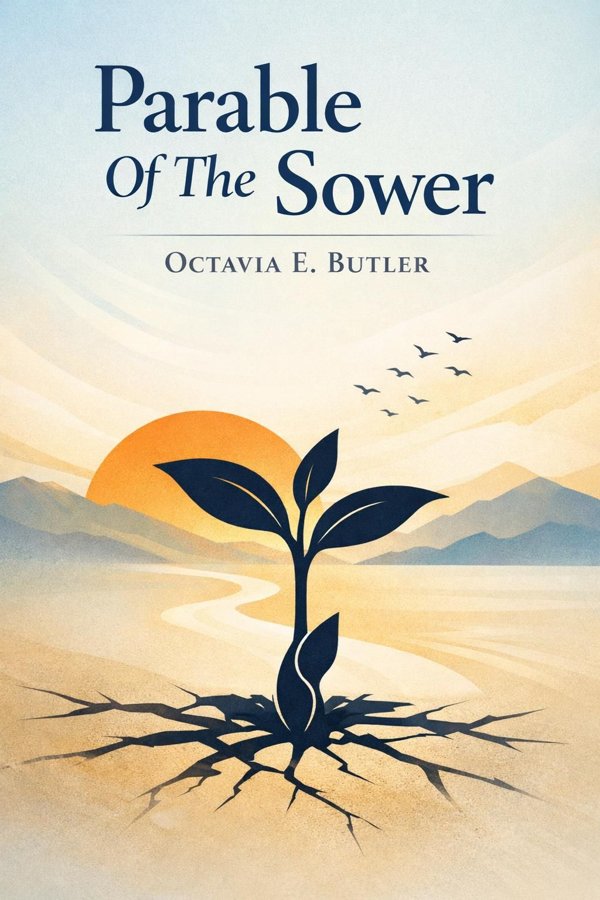
Parable Of The Sower: Summary & Key Insights
 10 min8 chaptersAudio available
Key Takeaways from Parable Of The Sower
Safety often looks strongest right before it fails.
What if feeling other people’s pain made survival harder, but humanity deeper?
Civilization rarely disappears all at once; more often, it erodes until the unbearable becomes normal.
Transformation often begins when the life you planned is no longer possible.
The most dangerous illusion is believing the world should stay still.
What Is Parable Of The Sower About?
Parable Of The Sower by Octavia E. Butler is a scifi_fantasy book spanning 4 pages. Parable Of The Sower is a landmark work of speculative fiction that feels less like a distant fantasy and more like a warning delivered ahead of schedule. Set in a near-future United States shattered by climate change, economic collapse, privatization, addiction, and everyday violence, the novel follows Lauren Olamina, a sharp, determined teenager living inside a walled neighborhood in Southern California. When that fragile refuge is destroyed, she begins a dangerous journey north, carrying with her not just survival skills, but a radical new belief system she calls Earthseed. What makes this novel so powerful is the way Octavia E. Butler combines intimate character storytelling with a sweeping social vision. Butler was one of the most important voices in modern science fiction, celebrated for exploring race, gender, power, hierarchy, and human adaptability with unusual depth and clarity. In Parable Of The Sower, she asks what people become when institutions fail, and what kind of future can still be built from ruin. The result is a gripping survival story, a philosophical novel, and a profound meditation on change, community, and hope under pressure.
This FizzRead summary covers all 8 key chapters of Parable Of The Sower in approximately 10 minutes, distilling the most important ideas, arguments, and takeaways from Octavia E. Butler's work. Also available as an audio summary and Key Quotes Podcast.
Parable Of The Sower
Parable Of The Sower is a landmark work of speculative fiction that feels less like a distant fantasy and more like a warning delivered ahead of schedule. Set in a near-future United States shattered by climate change, economic collapse, privatization, addiction, and everyday violence, the novel follows Lauren Olamina, a sharp, determined teenager living inside a walled neighborhood in Southern California. When that fragile refuge is destroyed, she begins a dangerous journey north, carrying with her not just survival skills, but a radical new belief system she calls Earthseed.
What makes this novel so powerful is the way Octavia E. Butler combines intimate character storytelling with a sweeping social vision. Butler was one of the most important voices in modern science fiction, celebrated for exploring race, gender, power, hierarchy, and human adaptability with unusual depth and clarity. In Parable Of The Sower, she asks what people become when institutions fail, and what kind of future can still be built from ruin. The result is a gripping survival story, a philosophical novel, and a profound meditation on change, community, and hope under pressure.
Who Should Read Parable Of The Sower?
This book is perfect for anyone interested in scifi_fantasy and looking to gain actionable insights in a short read. Whether you're a student, professional, or lifelong learner, the key ideas from Parable Of The Sower by Octavia E. Butler will help you think differently.
- ✓Readers who enjoy scifi_fantasy and want practical takeaways
- ✓Professionals looking to apply new ideas to their work and life
- ✓Anyone who wants the core insights of Parable Of The Sower in just 10 minutes
Want the full summary?
Get instant access to this book summary and 100K+ more with Fizz Moment.
Get Free SummaryAvailable on App Store • Free to download
Key Chapters
Safety often looks strongest right before it fails. At the beginning of Parable Of The Sower, Lauren Olamina lives in Robledo, a walled neighborhood in Southern California where families try to preserve ordinary life in an extraordinary collapse. They grow food, share chores, train with weapons, and watch one another’s homes. From the inside, the community appears organized and resilient. From the outside, the country is unraveling through inflation, joblessness, arson, theft, and desperation. Butler uses Robledo to show a central paradox: security built on isolation is never fully secure.
Lauren understands this better than many adults around her. She sees that the walls are not a solution, only a delay. Her neighbors want normalcy, but she studies emergency supplies, escape routes, and social patterns beyond the gate. She notices that when institutions vanish, small communities become both lifelines and targets. Robledo survives only through vigilance, cooperation, and luck, and luck is running out.
This idea has practical force beyond fiction. People often cling to familiar routines even when conditions have clearly changed: businesses ignore market shifts, families avoid hard conversations, societies deny mounting environmental risks. Butler suggests that real preparedness means facing reality before reality forces the issue.
The lesson is not to reject community, but to build stronger, more adaptive forms of it. Create mutual support systems, learn practical skills, and do not confuse temporary stability with lasting safety. Actionable takeaway: identify one “wall” in your own life that gives a false sense of security, and replace passive comfort with a concrete preparedness plan.
What if feeling other people’s pain made survival harder, but humanity deeper? Lauren lives with hyperempathy syndrome, a condition that causes her to physically feel the pain and pleasure she witnesses in others. In the brutal world Butler imagines, this trait seems like a dangerous weakness. If someone is beaten, Lauren suffers. If someone is injured, her own body reacts. In violent situations, that can incapacitate her and put her at enormous risk.
But Butler does not present hyperempathy as mere vulnerability. It becomes one of the novel’s most important moral lenses. Lauren cannot detach easily from the suffering around her, and that inability shapes the kind of leader she becomes. While others harden themselves into indifference, she is pushed toward compassion, caution, and interdependence. Her condition forces her to recognize a truth many people prefer to avoid: harm spreads. What is done to one person affects others, even when society pretends otherwise.
In everyday life, most readers do not share Lauren’s literal condition, but the metaphor is powerful. Organizations fail when leaders stop feeling the consequences of their decisions. Communities fracture when people treat others’ pain as irrelevant. On a personal level, empathy can be exhausting, but it is also what allows trust, cooperation, and ethical responsibility.
Butler also warns that empathy without boundaries is not enough. Lauren survives because she pairs feeling with discipline. She learns to prepare, observe, defend herself, and choose carefully whom to trust.
Actionable takeaway: strengthen empathy, but combine it with boundaries and practical action. When you encounter someone’s struggle, ask not only “How do I feel this?” but also “What effective help can I offer without becoming helpless myself?”
Civilization rarely disappears all at once; more often, it erodes until the unbearable becomes normal. Butler’s vision of America is terrifying precisely because it is so incremental. Wages have collapsed, public institutions barely function, water is expensive, schools are unreliable, and roads are dangerous. Entire regions are shaped by displacement and fear. People still buy and sell, travel, worship, and dream, but every activity is distorted by scarcity and insecurity.
This matters because Butler refuses the fantasy that disaster always arrives as a dramatic singular event. Instead, she shows how systems fail unevenly. Some people still have homes while others sleep outside. Some neighborhoods remain intact while others are overrun. Some companies offer employment, but under exploitative conditions that resemble debt bondage. In other words, collapse is not pure chaos. It is often a new and cruel order.
The practical relevance is striking. Economic instability, environmental stress, political polarization, housing inequality, and privatized essentials can accumulate until people adapt to conditions they once would have considered unacceptable. Butler invites readers to notice this process in real time: the slow lowering of expectations, the normalization of fear, the acceptance of institutional abandonment.
Lauren’s insight is that denial is deadly. She observes patterns honestly and prepares accordingly. She does not assume that rescue is coming or that old systems will automatically restore themselves.
Actionable takeaway: practice realistic awareness. Pick one major system you rely on—food, energy, income, housing, healthcare—and ask how resilient it really is under stress. Then take one practical step to reduce your dependence on fragile assumptions.
Transformation often begins when the life you planned is no longer possible. The decisive turning point in Parable Of The Sower comes when Robledo is attacked and burned, shattering the last illusion that Lauren can build her future inside the old structure. Forced onto the road, she begins traveling north through a landscape of danger, smoke, hunger, and shattered social trust. The journey is physically brutal, but it is also the novel’s crucible for leadership.
On the road, Lauren cannot survive through insight alone. She must turn observation into action. She disguises herself for safety, rationing what she carries, assessing threats constantly, and deciding whom to approach or avoid. Along the way, she gathers companions, including people from different backgrounds who share one urgent need: a chance to live with dignity. Their movement northward is not just escape. It is the beginning of a new social experiment formed under pressure.
Butler uses the journey structure to explore a practical truth about crisis: mobility changes identity. When people are displaced, they lose status markers, possessions, and inherited routines. What remains are character, adaptability, and the capacity to cooperate. Lauren grows into a leader because she can read reality, articulate purpose, and make difficult decisions without surrendering to cynicism.
Readers can apply this insight to any major disruption: job loss, migration, illness, family upheaval, or social instability. In periods of forced transition, progress often depends less on certainty than on disciplined movement.
Actionable takeaway: if your current “Robledo” were suddenly gone, what would you carry forward? Write down three portable strengths—skills, values, relationships—that would help you rebuild under radically changed conditions.
The most dangerous illusion is believing the world should stay still. Out of fear, observation, and hard-earned insight, Lauren develops Earthseed, a new belief system built around one central idea: God is Change. This is not a comforting religion in the traditional sense. It does not promise safety, justice, or divine rescue. Instead, it begins from the premise that change is the fundamental reality shaping every life, every society, and every future.
Earthseed matters because it turns adaptation into a spiritual discipline. For Lauren, people are not merely victims of change; they can shape it, if they understand it clearly enough. That makes Earthseed both philosophical and practical. It is a framework for surviving upheaval without becoming passive. Its long-term destiny—humanity taking root among the stars—extends hope beyond immediate catastrophe, giving purpose to endurance and collective effort.
In practical terms, Earthseed resembles a mindset useful far beyond the novel. Careers shift, technologies transform industries, relationships evolve, and environments destabilize. People suffer when they treat change as an interruption rather than a constant. Lauren’s answer is not resignation but intentional adaptation: study conditions, accept flux, and direct energy toward shaping outcomes.
The power of Earthseed is also rhetorical. It gives frightened people language for meaning, and meaning is essential in crisis. Groups endure hardship better when they believe their struggle points toward something larger.
Actionable takeaway: adopt a “shape change” habit. When facing uncertainty, stop asking only how to preserve the old form of your life. Ask instead: what is changing, what can I influence, and what future am I actively helping create?
In broken worlds, trust becomes both the rarest resource and the most necessary one. As Lauren travels north, she slowly forms a small group of companions. This emerging community includes people who would likely never have built a life together under more stable conditions. They differ in race, age, history, and temperament, yet survival pushes them toward interdependence. Butler shows that community is not a sentimental given; it is something built through repeated acts of usefulness, honesty, and restraint.
Lauren’s leadership is especially compelling because it is not based on dominance. She leads by preparing, observing, teaching, and articulating a future others can imagine joining. She earns authority through competence and purpose. At the same time, Butler never idealizes group life. Trust is risky. Some people carry trauma, secrets, or conflicting values. The question is not whether community will be imperfect, but whether imperfect people can cooperate better than they can survive alone.
This has clear real-world applications. Strong teams, neighborhoods, and families are rarely formed by shared slogans alone. They need routines of mutual aid, clear expectations, conflict management, and a sense of mission. Crisis often reveals whether a group is truly collaborative or merely adjacent.
Butler’s deeper point is that chosen community can be more resilient than inherited structure. When old institutions fail, people must decide whom they will protect, listen to, and build with.
Actionable takeaway: invest in one relationship or group that increases mutual resilience. Share skills, define expectations, and practice trust through small cooperative acts before a larger crisis tests whether your community is real.
Hope becomes credible only when it takes material form. By the later movement of Lauren’s journey, survival alone is no longer enough. She and her companions begin to imagine settlement, continuity, and shared purpose. This leads toward Acorn, the community that embodies Earthseed not merely as belief, but as practice. Acorn represents a crucial shift in the novel: from reacting to destruction to deliberately building an alternative.
What makes Acorn important is that it is modest. Butler does not present a utopia descending fully formed from Lauren’s ideas. Instead, the future begins with land, labor, teaching, cooperation, and the fragile willingness to commit to one another. Acorn is a seed in both literal and symbolic terms. It suggests that durable change starts small, with habits and institutions that can survive pressure.
This is one of the book’s most practical insights. People often imagine that meaningful transformation must begin with sweeping victory. Butler argues the opposite. In unstable times, the first task is to create viable pockets of order, meaning, and growth. A school, a neighborhood garden, a worker cooperative, a mutual-aid network, a family culture of preparedness—these are all forms of planting.
Acorn also reinforces the long horizon of Earthseed. Even while focused on immediate needs, Lauren insists on a destiny larger than mere survival. Communities endure better when their daily labor is connected to a future worth inheriting.
Actionable takeaway: build one “Acorn” in your own life—a small but real structure that reflects the future you want, whether that means a shared project, a learning circle, a resilience plan, or a local community initiative.
All Chapters in Parable Of The Sower
About the Author
Octavia E. Butler (1947–2006) was one of the most important American science fiction writers of the twentieth century. Her work transformed the genre by bringing sustained attention to race, gender, power, hierarchy, survival, and human change. Born in Pasadena, California, Butler began writing at a young age and went on to produce a body of work that combined speculative imagination with psychological insight and social critique. She won multiple Hugo and Nebula Awards and, in 1995, became the first science fiction writer to receive a MacArthur Fellowship. Butler is best known for novels such as Kindred, the Xenogenesis trilogy, and the Parable series. Her writing remains widely read because it is both visionary and grounded, asking difficult questions about what human beings become under pressure.
Get This Summary in Your Preferred Format
Read or listen to the Parable Of The Sower summary by Octavia E. Butler anytime, anywhere. FizzRead offers multiple formats so you can learn on your terms — all free.
Available formats: App · Audio · PDF · EPUB — All included free with FizzRead
Download Parable Of The Sower PDF and EPUB Summary
Key Quotes from Parable Of The Sower
“Safety often looks strongest right before it fails.”
“What if feeling other people’s pain made survival harder, but humanity deeper?”
“Civilization rarely disappears all at once; more often, it erodes until the unbearable becomes normal.”
“Transformation often begins when the life you planned is no longer possible.”
“The most dangerous illusion is believing the world should stay still.”
Frequently Asked Questions about Parable Of The Sower
Parable Of The Sower by Octavia E. Butler is a scifi_fantasy book that explores key ideas across 8 chapters. Parable Of The Sower is a landmark work of speculative fiction that feels less like a distant fantasy and more like a warning delivered ahead of schedule. Set in a near-future United States shattered by climate change, economic collapse, privatization, addiction, and everyday violence, the novel follows Lauren Olamina, a sharp, determined teenager living inside a walled neighborhood in Southern California. When that fragile refuge is destroyed, she begins a dangerous journey north, carrying with her not just survival skills, but a radical new belief system she calls Earthseed. What makes this novel so powerful is the way Octavia E. Butler combines intimate character storytelling with a sweeping social vision. Butler was one of the most important voices in modern science fiction, celebrated for exploring race, gender, power, hierarchy, and human adaptability with unusual depth and clarity. In Parable Of The Sower, she asks what people become when institutions fail, and what kind of future can still be built from ruin. The result is a gripping survival story, a philosophical novel, and a profound meditation on change, community, and hope under pressure.
More by Octavia E. Butler
You Might Also Like
Red Rising
Pierce Brown
10 min
Stranger in a Strange Land
Robert A. Heinlein
10 min
AI Valley
Chen Qiufan
10 min
Bloodchild
Octavia E. Butler
10 min
Do Androids Dream of Electric Sheep?
Philip K. Dick
10 min
Jujutsu Kaisen, Vol. 24
Gege Akutami
10 minBrowse by Category
Ready to read Parable Of The Sower?
Get the full summary and 100K+ more books with Fizz Moment.