
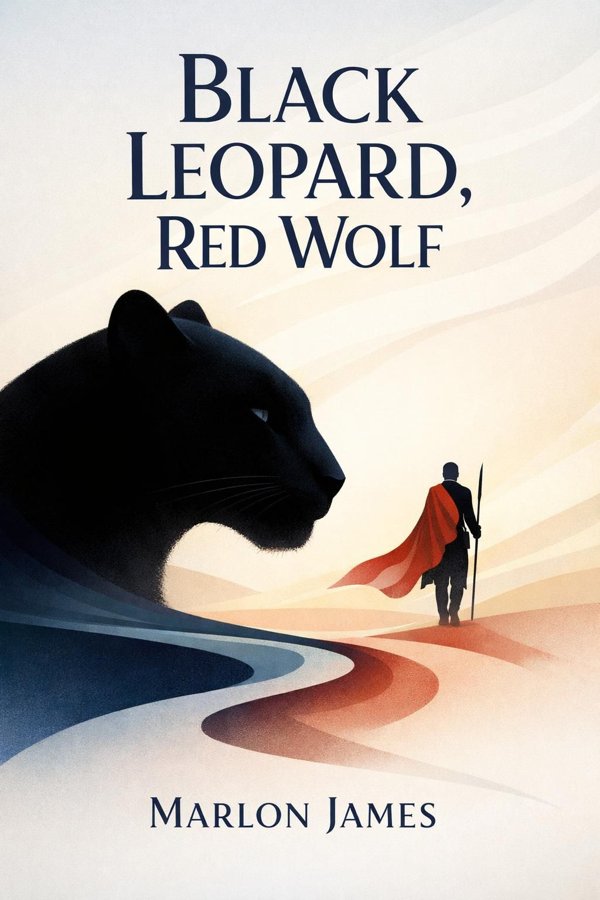
Black Leopard, Red Wolf: Summary & Key Insights
by Marlon James
 10 min9 chaptersAudio available
Key Takeaways from Black Leopard, Red Wolf
A hunter does not merely follow footprints; he follows desire, fear, and deception.
Some quests begin with a clear objective, but the most dangerous ones begin with a question no one answers the same way.
Companionship in dark times is rarely pure; often it is a bargain among the broken.
The most haunting landscapes are not on maps; they live in memory, rumor, and inherited fear.
Violence in this novel is not spectacle for its own sake; it is a language of history, domination, and survival.
What Is Black Leopard, Red Wolf About?
Black Leopard, Red Wolf by Marlon James is a scifi_fantasy book spanning 6 pages. What if the greatest fantasy quest were not about finding truth, but surviving the many lies told about it? Marlon James’s Black Leopard, Red Wolf drops readers into a vast, brutal, dazzling world inspired by African myth, oral storytelling, and deep historical memory. At its center is Tracker, a hunter with an uncanny sense of smell, hired to find a mysterious missing boy. What begins like a familiar search soon fractures into something stranger: a maze of monsters, shapeshifters, kingdoms, betrayals, old wounds, and competing versions of reality. The farther Tracker travels, the less certain he becomes about the boy, his companions, and even himself. This novel matters because it expands the possibilities of epic fantasy. Rather than echoing the usual medieval European template, James builds a mythic landscape rooted in African cosmologies, language rhythms, and storytelling traditions. The result is both challenging and exhilarating: a tale about power, memory, identity, violence, and the instability of truth. James, a Booker Prize–winning Jamaican novelist celebrated for his daring style and layered narratives, brings unusual authority and ambition to this work, creating a fantasy epic that feels ancient, radical, and unforgettable at once.
This FizzRead summary covers all 9 key chapters of Black Leopard, Red Wolf in approximately 10 minutes, distilling the most important ideas, arguments, and takeaways from Marlon James's work. Also available as an audio summary and Key Quotes Podcast.
Black Leopard, Red Wolf
What if the greatest fantasy quest were not about finding truth, but surviving the many lies told about it? Marlon James’s Black Leopard, Red Wolf drops readers into a vast, brutal, dazzling world inspired by African myth, oral storytelling, and deep historical memory. At its center is Tracker, a hunter with an uncanny sense of smell, hired to find a mysterious missing boy. What begins like a familiar search soon fractures into something stranger: a maze of monsters, shapeshifters, kingdoms, betrayals, old wounds, and competing versions of reality. The farther Tracker travels, the less certain he becomes about the boy, his companions, and even himself.
This novel matters because it expands the possibilities of epic fantasy. Rather than echoing the usual medieval European template, James builds a mythic landscape rooted in African cosmologies, language rhythms, and storytelling traditions. The result is both challenging and exhilarating: a tale about power, memory, identity, violence, and the instability of truth. James, a Booker Prize–winning Jamaican novelist celebrated for his daring style and layered narratives, brings unusual authority and ambition to this work, creating a fantasy epic that feels ancient, radical, and unforgettable at once.
Who Should Read Black Leopard, Red Wolf?
This book is perfect for anyone interested in scifi_fantasy and looking to gain actionable insights in a short read. Whether you're a student, professional, or lifelong learner, the key ideas from Black Leopard, Red Wolf by Marlon James will help you think differently.
- ✓Readers who enjoy scifi_fantasy and want practical takeaways
- ✓Professionals looking to apply new ideas to their work and life
- ✓Anyone who wants the core insights of Black Leopard, Red Wolf in just 10 minutes
Want the full summary?
Get instant access to this book summary and 100K+ more with Fizz Moment.
Get Free SummaryAvailable on App Store • Free to download
Key Chapters
A hunter does not merely follow footprints; he follows desire, fear, and deception. That idea defines Tracker, the novel’s unforgettable narrator, whose near-supernatural sense of smell makes him both powerful and vulnerable. He can locate people across extraordinary distances, distinguish lies from traces left on skin and air, and detect what others miss. But in Black Leopard, Red Wolf, skill is never simple. Tracker’s talent gives him access to truths, yet it does not protect him from misreading motives, trusting the wrong people, or telling a self-serving version of events.
Tracker introduces himself as hard, independent, and emotionally detached. He wants to be seen as a man who needs no one and fears little. But as the story unfolds, that self-image cracks. His hunts are not only physical pursuits across forests, ruined cities, and haunted territories; they are also inward journeys through trauma, longing, shame, and memory. His bond with others, especially Leopard, reveals how much of his identity depends on resisting intimacy even while craving it.
This makes Tracker more than a fantasy hero. He becomes a study in how people turn gifts into armor. In practical terms, the novel invites readers to consider their own “tracking” habits. We all use certain abilities—analysis, charm, discipline, humor—to navigate the world. Yet those strengths can also become masks that keep others at a distance.
As you read, pay attention to the gap between what Tracker says about himself and what his actions reveal. The key takeaway: your greatest strength may also be the hiding place of your deepest wound, so examine both with equal honesty.
Some quests begin with a clear objective, but the most dangerous ones begin with a question no one answers the same way. The central mystery of Black Leopard, Red Wolf is the disappearance of a boy, yet the novel quickly shows that the boy matters for reasons far beyond a simple rescue. Different people insist he is a royal heir, a magical being, a threat to kingdoms, or a symbol of future power. Every claim comes loaded with politics, prophecy, and personal ambition.
Tracker is hired to find him, but the assignment never stays stable. Each clue opens new uncertainty: who wants the boy found, who wants him hidden, and who benefits from his death? The child becomes less a person than a contested story. He is what rulers, mercenaries, witches, and rebels project onto him. In that sense, James is not just writing about a missing child; he is writing about how power forms around narratives. Whoever controls the boy’s meaning may control the future.
This idea has a practical resonance beyond fantasy. In public life, organizations, families, and nations often rally around symbols rather than facts. A person or event becomes a vessel for fear, hope, ideology, or control. Think of how political figures, missing evidence, or historical myths are interpreted differently depending on who is speaking and what they want.
James forces readers to resist easy conclusions. The boy is not simply an innocent treasure at the center of an adventure. He is the pivot around which competing realities turn. The actionable takeaway: when a story seems too urgent, ask not only what happened, but who needs it to mean a particular thing.
Companionship in dark times is rarely pure; often it is a bargain among the broken. One of the novel’s richest pleasures is its strange, unstable group of allies: Tracker, Leopard, the giant Sadogo, the moon witch Sogolon, and other figures who are monstrous, gifted, wounded, and untrustworthy in different measures. At first glance, this resembles the classic fantasy fellowship. But James subverts that model by stripping away the usual sentimentality. These companions do not unite because they share simple values. They come together because their needs overlap, their enemies intersect, and survival requires uneasy cooperation.
Leopard, in particular, embodies the book’s refusal to separate beauty from danger. Seductive, elusive, and shape-shifting, he is both partner and mystery to Tracker. Their connection is erotic, emotional, and adversarial all at once. The group as a whole becomes a study in how alliances form under pressure: not through purity, but through negotiation, friction, and constantly shifting trust.
This idea applies far beyond fiction. In real life, effective collaboration often happens among people who do not like one another, do not agree on everything, and do not share the same methods. A workplace team, activist coalition, or family crisis may require cooperation without full harmony. What matters is understanding strengths, limits, and the cost of betrayal.
James also complicates the very category of “monster.” The supposed beasts in this fellowship often show more honesty than kings, nobles, and institutions. By blurring the line between human and inhuman, the novel challenges simplistic moral judgments. The takeaway: do not ask whether your allies are flawless; ask whether you understand what they want, what they fear, and what they will do when tested.
The most haunting landscapes are not on maps; they live in memory, rumor, and inherited fear. Black Leopard, Red Wolf is packed with travel across forests, deserts, ancient cities, riverlands, and supernatural territories, yet these journeys are never mere world-building decoration. Every place carries a story, and every story reshapes the place. James creates a setting where mythology is not background texture but an active force that alters what characters can know, survive, and become.
As Tracker moves through this world, he encounters creatures and phenomena drawn from a broad range of African-inspired mythic traditions: spirits, witches, giants, vampires, shape-shifters, and beings that trouble the line between divine and animal. But the real complexity lies in how these encounters interact with memory. The past is never settled. Trauma resurfaces through landscape. Old violence echoes in bodies and in territories. To travel is to remember, often against one’s will.
This makes the novel feel dreamlike and disorienting in a purposeful way. Readers are not meant to stand outside the story as detached observers. They are meant to experience uncertainty, to feel how oral storytelling folds time, how recollection distorts sequence, and how myth can preserve truth more effectively than literal reporting.
Practically, this can change how we read difficult narratives. Instead of demanding strict linear clarity, we can ask what emotional or symbolic truth a fragmented story conveys. The novel teaches readers to become more flexible interpreters. The actionable takeaway: when a story seems confusing, look for patterns of memory, repetition, and symbol rather than insisting on a tidy map.
Violence in this novel is not spectacle for its own sake; it is a language of history, domination, and survival. Black Leopard, Red Wolf is famously intense, filled with brutality, torture, war, sexual violence, and bodily transformation. That intensity can be unsettling, but James uses it to expose what fantasy often hides behind clean heroism. In this world, power is maintained through flesh. Kingdoms, masculinities, and myths are written onto bodies.
Tracker moves through cycles of attack and betrayal that force him into self-reckoning. He is injured physically, but more importantly he is repeatedly confronted with the limits of his own certainty. He judges others harshly, then discovers his complicity. He seeks control, then faces his own vulnerability. Betrayal comes not only from enemies but from companions, lovers, and internal contradictions. The result is a narrative in which survival demands more than strength; it demands the willingness to see oneself clearly.
For readers, this can be understood as an exaggerated version of ordinary moral life. Betrayal does not always arrive as dramatic treachery. It can appear in smaller acts: withholding truth, choosing convenience over courage, allowing fear to govern loyalty. Likewise, self-reckoning rarely happens when life is easy. It comes when our preferred self-image collapses.
James refuses to romanticize suffering, but he does suggest that confrontation with pain can destroy illusions. The point is not that hardship is good, but that it reveals what comfort lets us ignore. The takeaway: when trust breaks or conflict erupts, resist the urge to focus only on who hurt you; also ask what the crisis exposes about your own habits, fears, and blind spots.
The most radical move a storyteller can make is to refuse final certainty. Black Leopard, Red Wolf ends not with neat closure, but with deeper ambiguity about what really happened, who the boy is, and whether Tracker’s account can be trusted. This is not a flaw to be solved; it is one of the novel’s central achievements. James turns the fantasy quest into an argument about narration itself: every story is shaped by perspective, injury, ego, omission, and desire.
Tracker tells his tale while being questioned, which means the entire novel unfolds under pressure. He is not casually reminiscing; he is defending himself, performing, editing, and sometimes evading. That frame matters because it reminds readers that testimony is never neutral. Even sincerity can mislead. We may believe Tracker because of his intensity and detail, but those qualities do not guarantee accuracy. In fact, they may deepen the illusion of truth.
This has practical importance in a world saturated with competing narratives. Whether reading news, hearing family history, or evaluating social media claims, we are constantly asked to choose among partial accounts. James trains readers to hold multiple possibilities at once. He encourages intellectual humility: the recognition that truth may exist, but our access to it is always mediated.
The ending therefore feels less like a puzzle answer than an opening into broader questions. Who gets believed? What happens when power determines credibility? Can contradictory stories both contain truth? The actionable takeaway: when confronted with a confident narrator, admire the story but also examine the conditions under which it is being told.
Behind every magical quest lies a political struggle over who gets to rule and who must disappear. While Black Leopard, Red Wolf is filled with monsters and marvels, its conflicts are deeply political. Kings, nobles, mercenaries, and secret factions all circle the missing boy because succession, legitimacy, and prophecy are never abstract matters. They shape wars, alliances, and mass violence. James shows that power rarely rests on strength alone; it depends on stories people are made to believe.
In the novel, rulers are often less interested in truth than in usefulness. A rumor can justify a killing. A prophecy can legitimize a coup. A child can become a pretext for conquest. By embedding these dynamics in fantasy, James mirrors real political systems in which authority is staged, narrated, and defended through myth. Courts and kingdoms may seem distant from modern life, but the mechanisms are familiar: spin, scapegoating, image control, and strategic secrecy.
This gives the book unusual depth. It is not just a wild adventure through invented terrain. It is also a study of how institutions manipulate uncertainty. When information is fragmented, the powerful thrive. People become easier to control when they fear what they do not understand.
Readers can apply this insight by becoming more attentive to the relationship between information and power. In workplaces, media, and civic life, ask who benefits from confusion and who has the authority to define events. James suggests that politics is often a contest over narrative before it becomes a contest over weapons. The takeaway: whenever a crisis emerges, look beyond the official explanation and trace who gains from the story being told.
Identity becomes clearest where desire makes it impossible to keep performing. One of the novel’s most compelling dimensions is its treatment of sexuality, masculinity, and intimacy, especially through Tracker’s relationships with men and with Leopard in particular. In many fantasy traditions, queer desire is erased, softened, or treated as secondary. James does the opposite. He places longing, attraction, shame, and vulnerability near the center of the narrative.
Tracker presents himself as hard and self-contained, but desire repeatedly unsettles that posture. His encounters expose how masculinity can function as defense: a way of avoiding tenderness by turning everything into dominance, anger, or flight. Leopard, elusive and transformative, intensifies this tension. Their bond cannot be reduced to romance, friendship, or rivalry. It is all of these at once, which makes it feel emotionally true. Desire here is not cleanly liberating; it is also risky, destabilizing, and entangled with power.
The novel therefore offers a broader insight into identity. We do not discover who we are through isolated introspection alone. We discover it in relation, especially in those connections that threaten the stories we tell about ourselves. For many readers, this will resonate beyond sexuality. Any taboo desire, hidden vulnerability, or disowned need can produce the same conflict between authenticity and self-protection.
James does not provide easy healing, but he does insist that denied desire shapes behavior whether acknowledged or not. The actionable takeaway: notice where strong reactions—attraction, jealousy, defensiveness, shame—reveal truths about yourself that your public identity tries to suppress.
Genres become stale when they repeat the same map, the same heroes, and the same myths. One of Black Leopard, Red Wolf’s greatest contributions is its reinvention of epic fantasy through African-rooted imagination. James does not simply swap the setting while preserving conventional formulas. He rethinks the structure, language, moral logic, and mythic sources of the genre itself. The result is a work that feels at once ancient and startlingly new.
Instead of castles, taverns, and familiar medieval tropes, readers encounter oral cadence, non-Western cosmologies, shape-shifting ontologies, fluid time, and densely layered mythologies. Even the prose resists passive consumption. It can be sensual, violent, lyrical, abrupt, and deliberately disorienting. James wants readers to enter a different storytelling tradition, not just a different scenery. That challenge is part of the point.
This matters because representation in literature is not only about visible diversity. It is also about whose narrative forms are treated as central, whose myths are allowed to generate universes, and whose imaginative histories are considered foundational rather than supplemental. James expands fantasy by refusing to make African influence decorative. He makes it structural.
For readers and writers alike, the novel offers a practical lesson in creative renewal. If you want fresher stories, do not merely search for new characters; examine the assumptions built into your genre. What narrative habits are you taking for granted? What traditions have been ignored? The takeaway: innovation often comes not from inventing from nothing, but from taking seriously the storytelling worlds that dominant traditions overlooked.
All Chapters in Black Leopard, Red Wolf
About the Author
Marlon James is a Jamaican novelist and one of the most distinctive voices in contemporary literature. Born in Kingston, he is known for fiction that combines historical depth, daring structure, and unforgettable language. His international breakthrough came with A Brief History of Seven Killings, which won the 2015 Man Booker Prize and established him as a writer capable of blending political history with narrative experimentation. James later turned to epic fantasy with Black Leopard, Red Wolf, launching the Dark Star Trilogy and reimagining the genre through African-inspired myth, oral storytelling, and radical shifts in perspective. Across his work, he explores violence, identity, sexuality, memory, and power with unusual intensity. His writing is celebrated for being bold, immersive, and resistant to easy categorization.
Get This Summary in Your Preferred Format
Read or listen to the Black Leopard, Red Wolf summary by Marlon James anytime, anywhere. FizzRead offers multiple formats so you can learn on your terms — all free.
Available formats: App · Audio · PDF · EPUB — All included free with FizzRead
Download Black Leopard, Red Wolf PDF and EPUB Summary
Key Quotes from Black Leopard, Red Wolf
“A hunter does not merely follow footprints; he follows desire, fear, and deception.”
“Some quests begin with a clear objective, but the most dangerous ones begin with a question no one answers the same way.”
“Companionship in dark times is rarely pure; often it is a bargain among the broken.”
“The most haunting landscapes are not on maps; they live in memory, rumor, and inherited fear.”
“Violence in this novel is not spectacle for its own sake; it is a language of history, domination, and survival.”
Frequently Asked Questions about Black Leopard, Red Wolf
Black Leopard, Red Wolf by Marlon James is a scifi_fantasy book that explores key ideas across 9 chapters. What if the greatest fantasy quest were not about finding truth, but surviving the many lies told about it? Marlon James’s Black Leopard, Red Wolf drops readers into a vast, brutal, dazzling world inspired by African myth, oral storytelling, and deep historical memory. At its center is Tracker, a hunter with an uncanny sense of smell, hired to find a mysterious missing boy. What begins like a familiar search soon fractures into something stranger: a maze of monsters, shapeshifters, kingdoms, betrayals, old wounds, and competing versions of reality. The farther Tracker travels, the less certain he becomes about the boy, his companions, and even himself. This novel matters because it expands the possibilities of epic fantasy. Rather than echoing the usual medieval European template, James builds a mythic landscape rooted in African cosmologies, language rhythms, and storytelling traditions. The result is both challenging and exhilarating: a tale about power, memory, identity, violence, and the instability of truth. James, a Booker Prize–winning Jamaican novelist celebrated for his daring style and layered narratives, brings unusual authority and ambition to this work, creating a fantasy epic that feels ancient, radical, and unforgettable at once.
More by Marlon James


You Might Also Like
Red Rising
Pierce Brown
10 min
Stranger in a Strange Land
Robert A. Heinlein
10 min
AI Valley
Chen Qiufan
10 min
Bloodchild
Octavia E. Butler
10 min
Do Androids Dream of Electric Sheep?
Philip K. Dick
10 min
Jujutsu Kaisen, Vol. 24
Gege Akutami
10 minBrowse by Category
Ready to read Black Leopard, Red Wolf?
Get the full summary and 100K+ more books with Fizz Moment.