
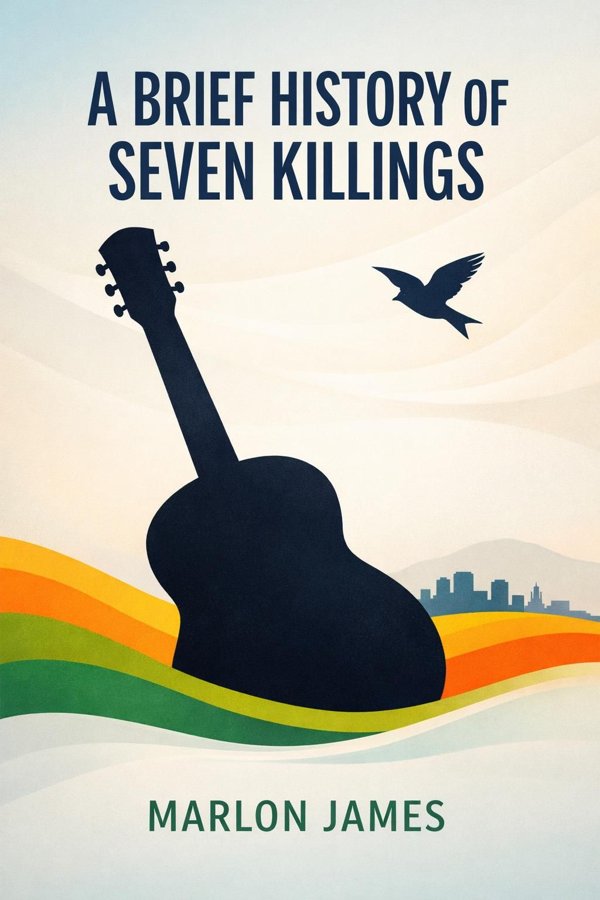
A Brief History of Seven Killings: Summary & Key Insights
by Marlon James
 10 min9 chaptersAudio available
Key Takeaways from A Brief History of Seven Killings
Violence in this novel is never random; it grows from a political system that turns neighborhoods into war zones.
A song can inspire a people, but in a fractured country even music becomes political.
Cruel men are not born fully formed; they are assembled by fear, ambition, and the rewards of power.
A single night can split history into before and after.
Migration does not automatically free people from history; often it transports history into new territory.
What Is A Brief History of Seven Killings About?
A Brief History of Seven Killings by Marlon James is a bestsellers book spanning 5 pages. Some novels tell a story; A Brief History of Seven Killings reconstructs an era. Marlon James’s landmark novel begins with the attempted assassination of a world-famous reggae icon clearly modeled on Bob Marley in December 1976, then expands outward into a vast, multi-voiced portrait of Jamaica and its diaspora over the next two decades. Through gang leaders, gunmen, mothers, ghosts, journalists, CIA-linked operatives, and survivors, James shows how political tribalism, Cold War interference, poverty, masculinity, and celebrity collide to shape ordinary and extraordinary lives. What makes the book matter is not only its historical scope, but its moral ambition. James refuses easy heroes and villains. Instead, he reveals how systems of violence recruit, corrupt, and traumatize everyone they touch. The novel is challenging, polyphonic, and often brutal, yet it rewards readers with a deeper understanding of how history is lived from the street up, not just written from the top down. Marlon James, a Jamaican novelist and 2015 Booker Prize winner, brings authority through intimate cultural knowledge, literary daring, and a rare ability to transform fractured voices into a powerful account of power, memory, and survival.
This FizzRead summary covers all 9 key chapters of A Brief History of Seven Killings in approximately 10 minutes, distilling the most important ideas, arguments, and takeaways from Marlon James's work. Also available as an audio summary and Key Quotes Podcast.
A Brief History of Seven Killings
Some novels tell a story; A Brief History of Seven Killings reconstructs an era. Marlon James’s landmark novel begins with the attempted assassination of a world-famous reggae icon clearly modeled on Bob Marley in December 1976, then expands outward into a vast, multi-voiced portrait of Jamaica and its diaspora over the next two decades. Through gang leaders, gunmen, mothers, ghosts, journalists, CIA-linked operatives, and survivors, James shows how political tribalism, Cold War interference, poverty, masculinity, and celebrity collide to shape ordinary and extraordinary lives.
What makes the book matter is not only its historical scope, but its moral ambition. James refuses easy heroes and villains. Instead, he reveals how systems of violence recruit, corrupt, and traumatize everyone they touch. The novel is challenging, polyphonic, and often brutal, yet it rewards readers with a deeper understanding of how history is lived from the street up, not just written from the top down. Marlon James, a Jamaican novelist and 2015 Booker Prize winner, brings authority through intimate cultural knowledge, literary daring, and a rare ability to transform fractured voices into a powerful account of power, memory, and survival.
Who Should Read A Brief History of Seven Killings?
This book is perfect for anyone interested in bestsellers and looking to gain actionable insights in a short read. Whether you're a student, professional, or lifelong learner, the key ideas from A Brief History of Seven Killings by Marlon James will help you think differently.
- ✓Readers who enjoy bestsellers and want practical takeaways
- ✓Professionals looking to apply new ideas to their work and life
- ✓Anyone who wants the core insights of A Brief History of Seven Killings in just 10 minutes
Want the full summary?
Get instant access to this book summary and 100K+ more with Fizz Moment.
Get Free SummaryAvailable on App Store • Free to download
Key Chapters
Violence in this novel is never random; it grows from a political system that turns neighborhoods into war zones. One of the book’s central insights is that 1970s Jamaica cannot be understood apart from the fierce rivalry between the People’s National Party and the Jamaica Labour Party. In Kingston, party loyalty is not just ideological. It determines where you can live, whom you can trust, and whether you survive the night. Entire communities become “garrisons,” politically controlled spaces where local dons enforce loyalty through fear, patronage, and murder.
James makes this reality concrete by showing how young men are absorbed into armed networks long before they can imagine alternatives. Guns, favors, and political protection create a brutal local order. A housing project is not simply a place to live; it becomes an armed camp. Elections are not civic rituals; they are flashpoints for bloodshed. The result is a society in which private life and political violence are inseparable.
This matters beyond Jamaica. The novel offers a powerful lens for understanding any society where political identity hardens into tribal belonging. When communities are abandoned by institutions, informal powers rush in. We see similar patterns in gang-controlled districts, partisan militias, and neighborhoods where state authority exists mainly as force.
As you read, notice how James links structural forces to intimate choices. A gunman’s cruelty is personal, but it is also conditioned by the world that made him useful. The practical takeaway is simple: when politics rewards division and neglects dignity, violence becomes a form of governance. To better understand conflict in any setting, look beyond headlines and ask who benefits when fear becomes the local language.
A song can inspire a people, but in a fractured country even music becomes political. At the center of the novel is the attempted assassination of the Singer, an unmistakable stand-in for Bob Marley, just before the Smile Jamaica concert in 1976. James treats this event not as celebrity gossip or isolated tragedy, but as a moment where culture, politics, and myth collide. The Singer is not merely a performer. He is a symbolic figure onto whom competing forces project their fears, hopes, and agendas.
His public call for peace threatens those who profit from instability. Because he carries enormous moral and cultural authority, his body becomes a political target. The attack reveals a disturbing truth: fame does not shield a person from violence; it can intensify danger by turning one human being into a national battleground.
James also explores how public figures are trapped by symbolism. The Singer means liberation to some, betrayal to others, and opportunity to those who wish to manipulate perception. This is a useful way to think about modern celebrity. Whether in music, sports, or activism, famous people often become screens onto which societies project collective conflict.
A practical example is the way public endorsements or appearances can be misread as partisan allegiance, even when the intention is unity. The novel shows how impossible neutrality becomes in polarized environments. Every gesture gets interpreted, weaponized, and retold.
The actionable takeaway: be careful when reducing artists or public figures to symbols. James reminds us that once a person becomes an emblem, their humanity is often erased. To read history well, ask not only what happened to a famous figure, but why so many powerful interests needed that figure to stand for something larger than himself.
Cruel men are not born fully formed; they are assembled by fear, ambition, and the rewards of power. The rise of Josey Wales is one of the novel’s most chilling threads because James presents him not simply as a monster, but as the product and master of a violent ecosystem. Josey is charismatic, strategic, and terrifyingly adaptive. He understands that in a world ruled by instability, power belongs to the man who appears least vulnerable.
The novel uses Josey to examine masculinity as performance. To survive, men must project hardness, suppress tenderness, and retaliate instantly. Reputation becomes currency. Mercy looks like weakness. Over time, this performance hardens into identity. Josey’s authority depends not just on guns, but on the stories others tell about him. Myth amplifies violence.
This has broad relevance. In many contexts, from street hierarchies to corporate and political cultures, systems reward aggression dressed up as strength. The book asks what happens when dominance becomes the main measure of manhood. The answer is devastating: emotional life shrinks, women suffer, and violence reproduces itself through imitation.
James also exposes the cost paid by the so-called strong men themselves. Paranoia, isolation, and constant threat stalk every victory. Josey may command fear, but he cannot create peace. He can only manage instability while being consumed by it.
The practical application is to recognize how institutions train people into destructive roles. If communities celebrate intimidation and punish vulnerability, they should not be surprised when brutality spreads. The actionable takeaway: question any culture that equates manhood with control, silence, and violence. Real strength, the novel suggests, begins where performance ends and accountability starts.
A single night can split history into before and after. The attempted assassination of the Singer on December 3, 1976 is the novel’s catalytic event, but James refuses to treat it as a neat mystery with a single explanation. Instead, he shows how major acts of violence generate overlapping stories, conflicting motives, and enduring consequences. Some characters plan, others assist, some witness, some survive, and many spend years haunted by what they think they know.
This narrative choice matters because it mirrors real history. Public trauma is rarely experienced in one coherent version. Rumor competes with testimony. Conspiracy fills the gaps left by fear and secrecy. By presenting the attack through multiple voices, James captures how truth fragments under pressure. The event is both specific and symbolic: an attack on a man, a cultural icon, and the possibility of unity.
The ripple effects extend far beyond the immediate victims. Careers, loyalties, migrations, and revenge cycles all stem from that night. This is one of the book’s deepest insights: violence does not end when bullets stop. It alters memory, reshapes ambition, and creates new forms of dependency and fear.
A practical modern application is the way societies respond to political assassinations, mass shootings, or major public scandals. The first version of events is almost never the full one, yet that first version often shapes institutions and lives for years. James teaches readers to be patient with complexity.
The actionable takeaway: when a major event dominates public attention, resist the urge to seek one simple cause. Ask instead how many people, systems, and silences converged to make that event possible. The wider the lens, the closer we get to the truth.
Migration does not automatically free people from history; often it transports history into new territory. As the novel moves beyond Jamaica into the United States, especially New York and Miami, James traces how criminal networks, political residues, and psychic wounds cross borders with the diaspora. Characters do not leave one world neatly behind and enter another. They carry loyalties, debts, enemies, habits, and trauma into unfamiliar cities.
This is one of the novel’s most sophisticated achievements. It rejects the comforting fantasy that relocation alone produces reinvention. For some characters, America offers money and anonymity. For others, it intensifies danger. Drug economies replace local political warfare, but the underlying logic remains familiar: power concentrates around those who can organize fear, exploit instability, and manipulate identity.
James also captures the emotional complexity of diaspora life. Exile can mean opportunity, but also fragmentation. People become divided between versions of themselves: who they were, who they pretend to be, and who the new country allows them to become. This tension is especially visible in characters who seek legitimacy while remaining entangled in criminal worlds.
The practical relevance extends far beyond this novel. Immigrant communities often navigate the double burden of adaptation and inherited conflict. Family pressure, neighborhood reputation, and survival strategies can persist across generations and geographies.
The actionable takeaway is to think of migration as transformation, not erasure. When trying to understand any diaspora community, ask what histories traveled with it. James shows that borders can interrupt movement, but they do not automatically dissolve violence, memory, or power. To build healthier futures, individuals and societies must confront what has been carried forward, not just celebrate starting over.
In a novel crowded with gunmen, dons, and political operators, one of the most important truths is that women often bear the cost of systems they did not design. James gives us mothers, lovers, workers, witnesses, and survivors whose lives are constrained by male violence, yet he never reduces them to background figures. Through them, the novel reveals how power operates in homes, bedrooms, and daily routines, not just in shootouts and elections.
Women in the book navigate danger differently. They read moods, anticipate eruptions, protect children, endure abandonment, and negotiate with men whose insecurity can quickly become lethal. Their survival often depends on emotional intelligence rather than brute force. That does not make their experience less political. It makes it more revealing. They expose the hidden labor required to live inside violent systems.
James also shows how misogyny is tied to the larger culture of domination. Men who control neighborhoods often seek to control women’s bodies, movement, and speech. Sexual exploitation, intimidation, and silencing become extensions of broader political violence. Yet women also preserve memory and create forms of resilience that male power cannot fully erase.
This has practical importance for readers thinking about conflict in any setting. Statistics on war, crime, or political violence often center male actors while overlooking the domestic, sexual, and psychological harm women experience. The novel pushes us to widen our definition of what violence is.
The actionable takeaway: when evaluating any political or criminal system, ask how women are expected to absorb its consequences. James teaches that survival itself can be a form of resistance, but true justice requires more than admiring resilience. It requires naming the structures that make such resilience necessary in the first place.
History becomes dangerous when one voice claims to explain everything. One of the most striking features of A Brief History of Seven Killings is its chorus of narrators. James moves among gang members, ghosts, journalists, intelligence figures, women, exiles, and minor witnesses, each with a distinct rhythm and worldview. The result is not confusion for its own sake. It is a literary argument: truth in violent societies is fragmented, contested, and inseparable from perspective.
This structure forces readers to work. We are not handed a neutral authority who settles every contradiction. Instead, we must compare testimony, detect bias, and sit with uncertainty. A liar may reveal something true. A victim may misunderstand the forces acting upon them. A powerful man may narrate with confidence while exposing his own delusion. The novel makes reading an ethical act of listening.
This idea has real-world relevance in an age of propaganda, social media, and polarized news. Public events are constantly narrated by competing factions, each claiming total clarity. James reminds us that complexity is not weakness. It is often the closest available form of honesty.
A practical example is how we approach contemporary political crises. Rather than relying on one source, we can examine multiple accounts, ask who is speaking, and notice what each perspective makes visible or hides. The novel trains exactly that habit.
The actionable takeaway is to read and listen comparatively. When facing contested events, do not ask only which story sounds strongest. Ask what each voice is unable to admit. James shows that truth often emerges not from certainty, but from the pressure created when many partial stories collide.
People do not remember violence like archivists; they remember it like survivors. Another key idea in the novel is that memory is unstable, emotionally charged, and constantly revised by fear, guilt, pride, and rumor. James is less interested in producing an official account than in showing how stories become the means by which people endure what they cannot fully explain. Over time, memory hardens into myth, and myth can become more socially powerful than fact.
This is especially visible in how characters reinterpret the assassination attempt, old loyalties, and personal betrayals. Some exaggerate their role. Some erase their shame. Some cannot distinguish what they witnessed from what they later heard repeated. The dead, too, haunt the novel, suggesting that unresolved history continues to speak whether societies are ready or not.
Far from being a flaw, this instability is the point. James portrays storytelling as both distortion and necessity. Human beings need narratives to organize chaos. But those narratives can conceal responsibility as easily as they preserve truth. That tension gives the novel much of its emotional force.
The practical application is immediate. Families, communities, and nations all construct usable memories. They celebrate some events, suppress others, and simplify painful ambiguities. To read history seriously, we must ask not only what is remembered, but what has become easier to tell than the fuller truth.
The actionable takeaway: treat memory with respect, but not naïveté. Listen closely to stories of trauma and survival while recognizing that every act of remembering also selects, edits, and protects. James’s novel invites us to search for truth not beyond storytelling, but through a more critical, compassionate understanding of how storytelling works.
All Chapters in A Brief History of Seven Killings
About the Author
Marlon James is a Jamaican novelist and literary voice of international acclaim. Born in Kingston, Jamaica, in 1970, he studied language and literature at the University of the West Indies before later pursuing graduate study in the United States. His fiction is known for its musicality, formal ambition, and unflinching treatment of history, race, violence, sexuality, and Caribbean identity. James often blends historical realism with oral storytelling, folklore, and multiple narrative voices, creating novels that feel both rooted and expansive. He won the 2015 Man Booker Prize for A Brief History of Seven Killings, becoming the first Jamaican author to receive the award. His other major works include John Crow’s Devil, The Book of Night Women, Black Leopard, Red Wolf, and Moon Witch, Spider King.
Get This Summary in Your Preferred Format
Read or listen to the A Brief History of Seven Killings summary by Marlon James anytime, anywhere. FizzRead offers multiple formats so you can learn on your terms — all free.
Available formats: App · Audio · PDF · EPUB — All included free with FizzRead
Download A Brief History of Seven Killings PDF and EPUB Summary
Key Quotes from A Brief History of Seven Killings
“Violence in this novel is never random; it grows from a political system that turns neighborhoods into war zones.”
“A song can inspire a people, but in a fractured country even music becomes political.”
“Cruel men are not born fully formed; they are assembled by fear, ambition, and the rewards of power.”
“A single night can split history into before and after.”
“Migration does not automatically free people from history; often it transports history into new territory.”
Frequently Asked Questions about A Brief History of Seven Killings
A Brief History of Seven Killings by Marlon James is a bestsellers book that explores key ideas across 9 chapters. Some novels tell a story; A Brief History of Seven Killings reconstructs an era. Marlon James’s landmark novel begins with the attempted assassination of a world-famous reggae icon clearly modeled on Bob Marley in December 1976, then expands outward into a vast, multi-voiced portrait of Jamaica and its diaspora over the next two decades. Through gang leaders, gunmen, mothers, ghosts, journalists, CIA-linked operatives, and survivors, James shows how political tribalism, Cold War interference, poverty, masculinity, and celebrity collide to shape ordinary and extraordinary lives. What makes the book matter is not only its historical scope, but its moral ambition. James refuses easy heroes and villains. Instead, he reveals how systems of violence recruit, corrupt, and traumatize everyone they touch. The novel is challenging, polyphonic, and often brutal, yet it rewards readers with a deeper understanding of how history is lived from the street up, not just written from the top down. Marlon James, a Jamaican novelist and 2015 Booker Prize winner, brings authority through intimate cultural knowledge, literary daring, and a rare ability to transform fractured voices into a powerful account of power, memory, and survival.
More by Marlon James

You Might Also Like
The Godfather
Mario Puzo
10 min
The Handmaid's Tale
Margaret Atwood
10 min
The Hunger Games
Suzanne Collins
10 min
The Nightingale
Kristin Hannah
10 min
The Seven Husbands of Evelyn Hugo
Taylor Jenkins Reid
10 min
Backwater Justice
Fern Michaels
10 minBrowse by Category
Ready to read A Brief History of Seven Killings?
Get the full summary and 100K+ more books with Fizz Moment.