
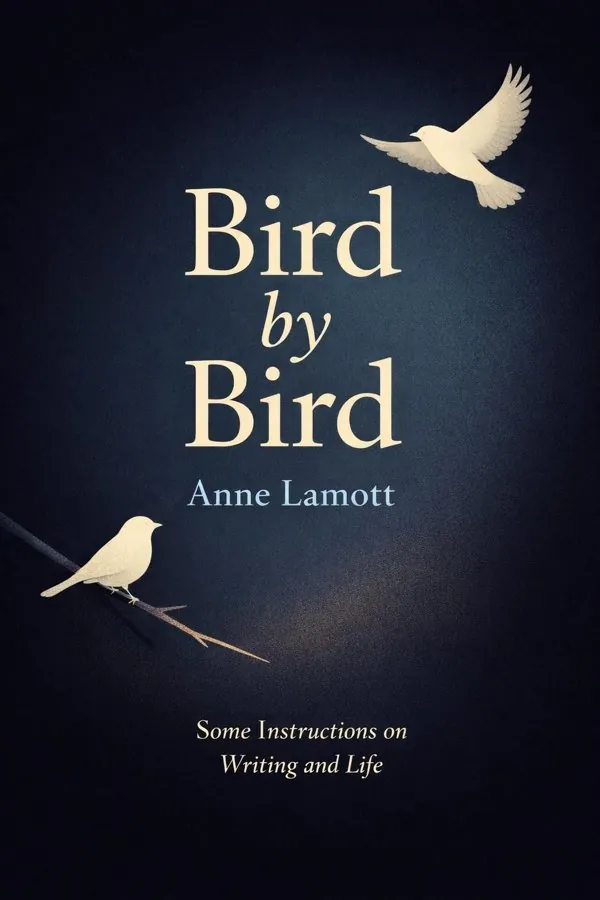
Bird by Bird: Some Instructions on Writing and Life: Summary & Key Insights
by Anne Lamott
 10 min9 chaptersAudio available
Key Takeaways from Bird by Bird: Some Instructions on Writing and Life
Most worthwhile work begins in uncertainty, not confidence.
The first draft is not where you prove your talent; it is where you discover what you have to say.
Perfectionism often presents itself as high standards, but Lamott exposes it as a form of fear that keeps people stalled.
General writing is easy to ignore; specific writing makes readers feel.
Strong writing rarely comes from forcing characters through a predetermined machine.
What Is Bird by Bird: Some Instructions on Writing and Life About?
Bird by Bird: Some Instructions on Writing and Life by Anne Lamott is a writing book spanning 13 pages. Anne Lamott’s Bird by Bird: Some Instructions on Writing and Life is one of the most beloved books ever written about the craft of writing because it understands a truth many manuals miss: writing is never just about technique. It is also about fear, ego, hope, memory, discipline, disappointment, and the stubborn decision to keep going anyway. With warmth, wit, and startling honesty, Lamott blends practical advice on drafting, revision, character, plot, and publication with deeply human reflections on perfectionism, self-doubt, and the emotional realities of a creative life. The famous phrase “bird by bird,” borrowed from a childhood story about being overwhelmed, becomes her central lesson: large, intimidating tasks are completed one small step at a time. What makes this book endure is Lamott’s authority without pretension. As a novelist, teacher, and essayist, she writes from experience rather than theory, offering guidance that feels lived-in, compassionate, and usable. For writers, artists, students, and anyone facing a daunting project, Bird by Bird is both a craft guide and a survival manual for making something meaningful in an imperfect world.
This FizzRead summary covers all 9 key chapters of Bird by Bird: Some Instructions on Writing and Life in approximately 10 minutes, distilling the most important ideas, arguments, and takeaways from Anne Lamott's work. Also available as an audio summary and Key Quotes Podcast.
Bird by Bird: Some Instructions on Writing and Life
Anne Lamott’s Bird by Bird: Some Instructions on Writing and Life is one of the most beloved books ever written about the craft of writing because it understands a truth many manuals miss: writing is never just about technique. It is also about fear, ego, hope, memory, discipline, disappointment, and the stubborn decision to keep going anyway. With warmth, wit, and startling honesty, Lamott blends practical advice on drafting, revision, character, plot, and publication with deeply human reflections on perfectionism, self-doubt, and the emotional realities of a creative life. The famous phrase “bird by bird,” borrowed from a childhood story about being overwhelmed, becomes her central lesson: large, intimidating tasks are completed one small step at a time. What makes this book endure is Lamott’s authority without pretension. As a novelist, teacher, and essayist, she writes from experience rather than theory, offering guidance that feels lived-in, compassionate, and usable. For writers, artists, students, and anyone facing a daunting project, Bird by Bird is both a craft guide and a survival manual for making something meaningful in an imperfect world.
Who Should Read Bird by Bird: Some Instructions on Writing and Life?
This book is perfect for anyone interested in writing and looking to gain actionable insights in a short read. Whether you're a student, professional, or lifelong learner, the key ideas from Bird by Bird: Some Instructions on Writing and Life by Anne Lamott will help you think differently.
- ✓Readers who enjoy writing and want practical takeaways
- ✓Professionals looking to apply new ideas to their work and life
- ✓Anyone who wants the core insights of Bird by Bird: Some Instructions on Writing and Life in just 10 minutes
Want the full summary?
Get instant access to this book summary and 100K+ more with Fizz Moment.
Get Free SummaryAvailable on App Store • Free to download
Key Chapters
Most worthwhile work begins in uncertainty, not confidence. One of Anne Lamott’s most liberating insights is that waiting to feel fully prepared is often just a polished form of avoidance. Writers commonly imagine that real authors begin with clarity, conviction, and elegant sentences. In reality, they begin with confusion, resistance, and a blank page that feels faintly accusatory. Lamott argues that starting anyway is an act of faith. You do not need total assurance; you need willingness.
This matters because perfectionism convinces people that beginning should feel noble and clean. But creative work is usually messy from the first moment. A student may want to write a memoir but keep postponing it until they “understand their life.” A manager may want to write a thought-leadership article but delay until every point is polished in advance. In both cases, the dream remains abstract because they are demanding certainty before action. Lamott reminds us that clarity often comes after motion, not before it.
Her approach is practical: shrink the task. Instead of “write a book,” write one paragraph about a specific memory. Instead of “figure out my voice,” describe one scene exactly as you remember it. Momentum grows from small acts of engagement. Beginning badly is still beginning, and beginning is what separates would-be writers from working writers.
Actionable takeaway: when a project feels overwhelming, lower the threshold for starting. Give yourself one modest assignment you can finish today, and let progress replace intimidation.
The first draft is not where you prove your talent; it is where you discover what you have to say. Lamott’s famous defense of “shitty first drafts” is powerful because it removes one of the biggest obstacles to writing: the false belief that quality must appear immediately. She insists that nearly all good writing begins as clumsy, overlong, awkward, and incomplete. This is not a flaw in the process. It is the process.
Many people freeze because they treat the first draft as a performance. They edit every sentence as they go, worry about how intelligent they sound, and lose contact with the original impulse behind the piece. Lamott encourages the opposite. On a first pass, write with freedom, speed, and permission to be wrong. Capture fragments, associations, dialogue, sensory details, and emotional truth. You can organize later. You can cut later. You can improve later. But you cannot revise a page that does not exist.
This principle applies beyond literature. If you are preparing a presentation, brainstorm ugly slides before refining them. If you are outlining a report, dump every relevant thought onto the page before shaping the argument. The rough draft is a container for raw material, not a verdict on your ability.
Lamott’s point is deeply compassionate: the inner critic is loudest at the start, so you must temporarily outrun it. Let the draft be uneven, repetitive, sentimental, or dull. Its purpose is to exist, not to impress.
Actionable takeaway: set a timer for 20 to 30 minutes and write a deliberately imperfect first version without editing. Treat completion, not elegance, as the day’s success.
Perfectionism often presents itself as high standards, but Lamott exposes it as a form of fear that keeps people stalled. It promises protection from embarrassment, criticism, and failure, yet its real effect is paralysis. If every sentence must be brilliant, every chapter original, and every insight profound, then almost nothing gets written. The standard becomes so absolute that it prevents the work from existing at all.
Lamott is especially sharp on the emotional cost of this mindset. Perfectionism does not make people produce better work; it makes them anxious, ashamed, and excessively self-conscious. Writers begin listening more to imaginary judges than to the material in front of them. They compare themselves to polished books instead of messy drafts. They confuse being imperfect with being unworthy. In that state, writing becomes a test of identity rather than a practice of attention.
A healthier standard is honesty and persistence. A scene can be revised. An argument can be clarified. A weak chapter can be cut. But none of that can happen if perfectionism stops you from drafting. Consider the writer who abandons a story because the opening is not “good enough,” or the student who rewrites the first page ten times and never reaches page two. What they need is not more pressure but more permission.
Lamott encourages writers to expect imperfection and proceed anyway. This attitude creates room for experimentation, risk, and growth. Creative confidence is not the absence of flaws; it is the willingness to work through them.
Actionable takeaway: when you hear yourself aiming for perfection, replace the goal with a better one: make it true, make it clear, and make it revisable.
General writing is easy to ignore; specific writing makes readers feel. Lamott emphasizes that compelling work comes from concrete detail, lived observation, and close attention to what is actually there. This applies to character, setting, emotion, and memory. Vague language such as “she was sad” or “it was a beautiful day” gives the reader a label. Specificity gives them an experience.
The difference is dramatic. Instead of saying a father was strict, show him folding the newspaper into a hard line before speaking. Instead of calling a room cozy, mention the chipped yellow mug on the windowsill, the smell of dust warming on a radiator, and the crocheted blanket slipping from the sofa arm. Details do not decorate writing; they reveal meaning. They make a character believable, a place inhabited, and an emotion embodied.
Lamott also connects specificity to voice. When writers stop trying to sound literary and start noticing what is actually odd, funny, painful, or beautiful, their work gains authenticity. A memoirist recalling childhood should not aim for “important memories” but for the exact texture of a lunchbox, the sound of a parent’s laugh, the fear in a school hallway. These particulars let universal feeling emerge through the concrete.
This principle is useful in nonfiction too. In business writing, a vivid customer example often communicates more than abstract claims. In teaching, a real classroom moment can illuminate a theory better than definitions alone.
Actionable takeaway: in your next piece, replace three abstract statements with sensory details, gestures, or images that let the reader infer the meaning for themselves.
Strong writing rarely comes from forcing characters through a predetermined machine. Lamott suggests that character and plot are discovered through patient observation rather than rigid control. Writers often worry that they must invent everything in advance: a flawless outline, complete psychological backstories, perfect turning points. But living stories tend to emerge when the writer pays close attention to what a person would actually do, fear, hide, or desire.
This means character development is not just a list of traits. It is revealed through choices, contradictions, habits, speech patterns, and pressure. A generous person may become petty when jealous. A confident person may become evasive when confronted with grief. Plot then grows from those tensions. If a character longs for approval, they will make different decisions than someone who values freedom. Events become meaningful when they arise from who the characters are.
Lamott’s advice frees writers from overengineering. Instead of asking, “What shocking thing should happen next?” ask, “Given this person’s history and longing, what would they do now?” A novelist drafting a family scene might discover conflict simply by letting each character want something different. A nonfiction writer profiling someone might find structure by tracing the gap between public image and private struggle.
This approach also supports revision. Once characters become clearer, plot can be tightened around the most revealing moments. You cut events that merely fill space and keep the scenes that expose desire, conflict, and change.
Actionable takeaway: write a short scene in which your main character wants one concrete thing, another person blocks it, and the resulting behavior reveals who they truly are.
Readers trust writing that sounds alive. Lamott treats voice and dialogue as matters of listening more than performance. Voice is not a decorative style you paste onto sentences; it is the natural rhythm of a mind telling the truth in its own way. Dialogue is not an opportunity for cleverness alone; it is a tool for revealing relationships, tension, class, mood, and hidden motives.
Many weak scenes fail because everyone sounds the same or because characters speak in pure exposition. Real speech is more indirect. People avoid, deflect, joke, interrupt, repeat themselves, and say one thing while implying another. A mother asking, “Are you eating enough?” may really be asking, “Are you okay?” A friend saying, “Interesting choice,” may be expressing judgment. Dialogue becomes believable when it carries subtext.
Voice works similarly. Writers often try to sound impressive and end up sounding generic. Lamott encourages them to sound like themselves: observant, quirky, precise, irreverent, tender, whatever is actually true. A strong voice can hold complexity because it is not trying to impress everyone. It is trying to say something real.
Practical listening helps. Eavesdrop respectfully in cafés. Notice how people interrupt, hesitate, and circle around emotion. Read your work aloud to hear stiffness. If a sentence feels unnatural in your mouth, it may feel unnatural on the page. In essays and memoir, voice often sharpens when you remove inflated phrasing and keep the language that carries genuine energy.
Actionable takeaway: read one page of your work aloud and mark every sentence or line of dialogue that sounds staged. Revise until the language feels spoken, specific, and true.
Writing may begin in freedom, but it becomes good through revision. Lamott treats revision not as punishment for getting it wrong, but as the real craft of shaping meaning. The first draft generates material; revision discovers structure, sharpens language, deepens scenes, and removes what was merely self-indulgent or unclear. This stage requires a different energy from drafting: less emotional urgency, more discernment.
One challenge is attachment. Writers become fond of lines, scenes, or digressions that do not serve the whole. Lamott reminds us that affection is not the same as usefulness. A beautiful sentence that slows the piece may need cutting. A funny anecdote that distracts from the central movement may need to go. Revision is partly the willingness to disappoint your ego in service of the work.
Distance helps. Set the piece aside, then return as a reader instead of a creator. Ask practical questions: Where does the energy begin? Where does it sag? What is the piece really about? What can be clarified, tightened, or rearranged? Feedback can also help, but only from trusted readers who understand what you are trying to do. Not all criticism is wise. Good feedback makes the work more itself, not more generic.
This applies in every writing context. An email can be revised for tone. An article can be revised for structure. A memoir chapter can be revised for emotional honesty. Revision is where intention meets execution.
Actionable takeaway: after finishing a draft, let it rest, then revise with three questions in mind: what can I cut, what can I clarify, and what deserves more development?
Waiting for inspiration is seductive because it turns writing into a romantic event. Lamott offers a more durable view: writing gets done through routine, modest goals, and returning to the page even when you feel flat. Inspiration exists, but it is unreliable. Discipline creates the conditions in which inspiration is more likely to appear.
This is especially important because writer’s block is often less mysterious than it seems. Sometimes it is exhaustion, fear, distraction, or unrealistic expectations. A writer may claim to be blocked when they are really afraid of writing poorly, overwhelmed by the scale of the project, or resentful that the work feels harder than imagined. Lamott’s answer is not harshness but structure. Sit down. Focus on the small assignment in front of you. Use a routine to reduce drama.
For example, a writer might commit to 300 words each morning before checking messages. A student might reserve two evenings a week for drafting. A busy parent might keep a notebook and write in short bursts during lunch or after bedtime. These habits matter because they make writing part of life rather than something postponed until ideal conditions arrive.
Lamott also underscores the importance of community and support. Writing is solitary, but it should not be isolating. Encouraging peers, classes, or trusted friends can help writers persist when self-doubt rises. The work remains yours, but companionship helps sustain it.
Actionable takeaway: choose a realistic writing rhythm for the next seven days, however small, and protect it like an appointment. Consistency matters more than intensity.
Bird by Bird endures because it is not only about producing publishable pages. Lamott presents writing as a way of paying attention, telling the truth, surviving pain, and making meaning from ordinary life. In that sense, her lessons extend beyond literature. To write well, you must notice. To notice, you must slow down enough to observe your mind, your relationships, your surroundings, and your own evasions.
Lamott is honest about ambition and publication. Recognition can be gratifying, but it does not solve the deeper human problems writers often imagine it will fix. Being published will not remove insecurity, heal loneliness, or make you permanently confident. If your entire motivation rests on external validation, the practice becomes brittle. A healthier foundation is curiosity, service, and the desire to understand experience more clearly.
This is why she often frames writing in spiritual terms, even for secular readers. The act asks for humility, patience, compassion, and surrender to a process larger than control. It invites you to face reality and render it faithfully. Journaling through grief, writing an essay about failure, or capturing a fleeting moment of joy can all become forms of emotional and moral attention.
People who never plan to publish can still benefit from Lamott’s philosophy. Writing helps clarify thought, process feeling, preserve memory, and build empathy. It teaches you to look closer and judge less quickly.
Actionable takeaway: keep a small daily practice of noticing. Write down one scene, feeling, or observation each day, not for achievement but to strengthen your attention to life.
All Chapters in Bird by Bird: Some Instructions on Writing and Life
About the Author
Anne Lamott is an American novelist, memoirist, and nonfiction writer celebrated for her sharp wit, emotional honesty, and compassionate insight into writing, faith, family, and personal struggle. Born in 1954, she developed a distinctive voice that blends humor with vulnerability, making difficult subjects feel intimate and accessible. Over the course of her career, she has written acclaimed novels as well as bestselling works of nonfiction and memoir. Bird by Bird remains her most influential craft book, beloved by writers for its candid portrayal of the creative process and its enduring advice on imperfection, discipline, and revision. Lamott’s work often explores addiction, motherhood, grief, spirituality, and the search for meaning, and she is widely admired for writing about life’s messiness without sentimentality or pretense.
Get This Summary in Your Preferred Format
Read or listen to the Bird by Bird: Some Instructions on Writing and Life summary by Anne Lamott anytime, anywhere. FizzRead offers multiple formats so you can learn on your terms — all free.
Available formats: App · Audio · PDF · EPUB — All included free with FizzRead
Download Bird by Bird: Some Instructions on Writing and Life PDF and EPUB Summary
Key Quotes from Bird by Bird: Some Instructions on Writing and Life
“Most worthwhile work begins in uncertainty, not confidence.”
“The first draft is not where you prove your talent; it is where you discover what you have to say.”
“Perfectionism often presents itself as high standards, but Lamott exposes it as a form of fear that keeps people stalled.”
“General writing is easy to ignore; specific writing makes readers feel.”
“Strong writing rarely comes from forcing characters through a predetermined machine.”
Frequently Asked Questions about Bird by Bird: Some Instructions on Writing and Life
Bird by Bird: Some Instructions on Writing and Life by Anne Lamott is a writing book that explores key ideas across 9 chapters. Anne Lamott’s Bird by Bird: Some Instructions on Writing and Life is one of the most beloved books ever written about the craft of writing because it understands a truth many manuals miss: writing is never just about technique. It is also about fear, ego, hope, memory, discipline, disappointment, and the stubborn decision to keep going anyway. With warmth, wit, and startling honesty, Lamott blends practical advice on drafting, revision, character, plot, and publication with deeply human reflections on perfectionism, self-doubt, and the emotional realities of a creative life. The famous phrase “bird by bird,” borrowed from a childhood story about being overwhelmed, becomes her central lesson: large, intimidating tasks are completed one small step at a time. What makes this book endure is Lamott’s authority without pretension. As a novelist, teacher, and essayist, she writes from experience rather than theory, offering guidance that feels lived-in, compassionate, and usable. For writers, artists, students, and anyone facing a daunting project, Bird by Bird is both a craft guide and a survival manual for making something meaningful in an imperfect world.
More by Anne Lamott
You Might Also Like
The Art of Perspective
Christopher Castellani
10 min
Making a Point: The Persnickety Story of English Punctuation
David Crystal
10 min
The Elements Of Eloquence: How To Turn The Perfect English Phrase
Mark Forsyth
10 min
The Pocket Muse: Ideas and Inspirations for Writing
Monica Wood
10 min
A Little Book on Form: An Exploration into the Formal Imagination of Poetry
Robert Hass
10 min
Adventures In The Screen Trade: A Personal View Of Hollywood And Screenwriting
William Goldman
10 minBrowse by Category
Ready to read Bird by Bird: Some Instructions on Writing and Life?
Get the full summary and 100K+ more books with Fizz Moment.