
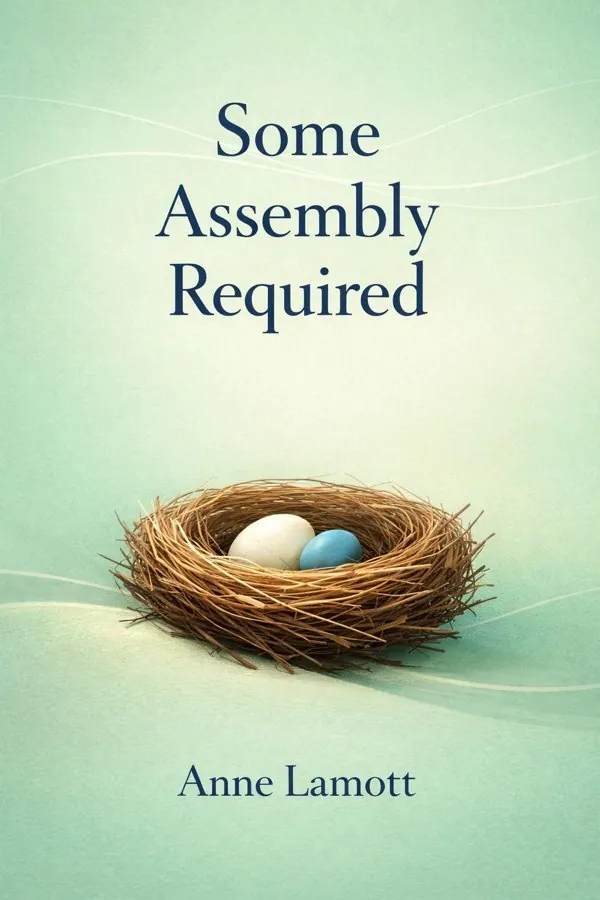
Some Assembly Required: A Journal of My Son's First Son: Summary & Key Insights
by Anne Lamott
 10 min10 chaptersAudio available
Key Takeaways from Some Assembly Required: A Journal of My Son's First Son
Life rarely announces its turning points politely.
People often think preparation is about buying the right gear, but the harder work is internal.
A baby’s birth does not simply introduce a child into the world; it reshapes everyone around him.
Nothing reveals the limits of patience, energy, and illusion quite like caring for an infant.
One of the most challenging forms of love is supportive love that does not dominate.
What Is Some Assembly Required: A Journal of My Son's First Son About?
Some Assembly Required: A Journal of My Son's First Son by Anne Lamott is a biographies book spanning 11 pages. Some Assembly Required is Anne Lamott’s intimate, funny, and deeply human memoir about becoming a grandmother under less-than-ideal circumstances: her nineteen-year-old son, Sam, is about to become a father. What follows is not a neat family success story but a journal of emotional whiplash, practical chaos, fierce love, and spiritual searching. Lamott writes about pregnancy, birth, sleeplessness, conflict, forgiveness, and the strange miracle of watching a new generation arrive before the previous one feels fully grown. The book matters because it speaks to a universal truth: families are rarely orderly, but they can still be places of tenderness, resilience, and redemption. Lamott is uniquely qualified to tell this story. Long celebrated for her candid memoirs and essays, she brings her signature mix of wit, vulnerability, and spiritual honesty to the upheaval of grandparenthood. Her authority does not come from perfection or distance, but from lived experience. She writes as someone who knows addiction, recovery, faith, motherhood, and the daily work of loving flawed people well. In this book, she shows how grace often arrives in messy packaging.
This FizzRead summary covers all 10 key chapters of Some Assembly Required: A Journal of My Son's First Son in approximately 10 minutes, distilling the most important ideas, arguments, and takeaways from Anne Lamott's work. Also available as an audio summary and Key Quotes Podcast.
Some Assembly Required: A Journal of My Son's First Son
Some Assembly Required is Anne Lamott’s intimate, funny, and deeply human memoir about becoming a grandmother under less-than-ideal circumstances: her nineteen-year-old son, Sam, is about to become a father. What follows is not a neat family success story but a journal of emotional whiplash, practical chaos, fierce love, and spiritual searching. Lamott writes about pregnancy, birth, sleeplessness, conflict, forgiveness, and the strange miracle of watching a new generation arrive before the previous one feels fully grown. The book matters because it speaks to a universal truth: families are rarely orderly, but they can still be places of tenderness, resilience, and redemption. Lamott is uniquely qualified to tell this story. Long celebrated for her candid memoirs and essays, she brings her signature mix of wit, vulnerability, and spiritual honesty to the upheaval of grandparenthood. Her authority does not come from perfection or distance, but from lived experience. She writes as someone who knows addiction, recovery, faith, motherhood, and the daily work of loving flawed people well. In this book, she shows how grace often arrives in messy packaging.
Who Should Read Some Assembly Required: A Journal of My Son's First Son?
This book is perfect for anyone interested in biographies and looking to gain actionable insights in a short read. Whether you're a student, professional, or lifelong learner, the key ideas from Some Assembly Required: A Journal of My Son's First Son by Anne Lamott will help you think differently.
- ✓Readers who enjoy biographies and want practical takeaways
- ✓Professionals looking to apply new ideas to their work and life
- ✓Anyone who wants the core insights of Some Assembly Required: A Journal of My Son's First Son in just 10 minutes
Want the full summary?
Get instant access to this book summary and 100K+ more with Fizz Moment.
Get Free SummaryAvailable on App Store • Free to download
Key Chapters
Life rarely announces its turning points politely. When Anne Lamott learns that her nineteen-year-old son, Sam, is about to become a father, the news lands with equal parts shock, fear, tenderness, and disbelief. The moment is about more than a pregnancy announcement; it marks the end of one family story and the abrupt beginning of another. Lamott must reckon with the fact that the child she still sees as vulnerable is now crossing into parenthood himself. That emotional contradiction drives much of the book.
What makes this episode powerful is Lamott’s refusal to simplify it. She does not pretend that unexpected family news is instantly meaningful or inspiring. Instead, she documents the emotional clutter: the urge to protect, the fear of failure, the quiet hope that love might be enough, and the grief that things are not unfolding according to plan. In doing so, she captures a truth many families know well: major transitions often feel messy before they feel sacred.
This idea applies far beyond teen parenthood. A diagnosis, divorce, job loss, or relocation can similarly force families into roles they did not choose. Lamott’s example suggests that the first task is not solving everything immediately, but staying present long enough to let reality sink in. Naming conflicting emotions can be more helpful than trying to suppress them.
Actionable takeaway: When life delivers destabilizing family news, resist the urge to force instant optimism. Write down what you feel, tell the truth to someone safe, and let honesty become the first step toward resilience.
People often think preparation is about buying the right gear, but the harder work is internal. As Amy’s pregnancy progresses, Lamott and her family gather diapers, baby clothes, and supplies, yet what they are really trying to collect is courage. The coming baby, Jax, requires more than a crib and blankets; he demands emotional readiness from people who are still scrambling to understand their new roles.
Lamott shows that practical preparation and emotional preparation unfold side by side. There are doctor visits, logistics, and conversations about what will happen after the birth. But beneath these visible tasks lies a deeper challenge: managing anxiety without letting it poison joy. Lamott must learn how to support Sam without controlling him, how to welcome Amy without pretending tension does not exist, and how to make room for uncertainty. This is one of the memoir’s most relatable insights. Family crises often disguise themselves as scheduling problems, when in truth they are exercises in emotional adaptation.
A useful modern parallel is any caregiving transition: welcoming a newborn, taking in an aging parent, or supporting a struggling sibling. The calendar fills quickly, but if people ignore fear, resentment, or exhaustion, practical planning begins to crack. Emotional preparation may include asking for help, discussing expectations, or admitting limitations before they become conflicts.
Actionable takeaway: For any major family transition, make two lists: one for practical needs and one for emotional needs. Address both with equal seriousness, because households function best when logistics and feelings are given room to breathe.
A baby’s birth does not simply introduce a child into the world; it reshapes everyone around him. When Jax is born, Lamott witnesses not only a new life beginning but also the rebirth of identities. Sam becomes a father. Anne becomes a grandmother. Amy becomes a mother. The family system itself is reorganized. Birth, in Lamott’s telling, is never just biological. It is relational, psychological, and spiritual.
This insight helps explain why periods after birth can feel disorienting even when they are joyful. The arrival of a child exposes unhealed fears, immature habits, and old family dynamics. Sam’s youth does not disappear because he has become a parent. Lamott’s protectiveness does not vanish because she now has a grandchild. Instead, each person must learn how to inhabit a role that is both new and unfinished. Lamott finds beauty in this incompleteness. No one is fully ready, yet love begins anyway.
The broader lesson is that major life transitions often involve simultaneous loss and gain. A promotion changes your sense of self. Marriage alters friendships and independence. Caring for a newborn can bring wonder while also ending a former version of daily life. If people expect transformation to feel clean, they may misread normal confusion as failure.
Lamott’s account also reminds readers that tenderness can coexist with exhaustion. New roles become real not in ideal moments but through repetition: holding the baby, showing up, staying through uncertainty, trying again after mistakes.
Actionable takeaway: When entering a new life stage, ask not only “What is happening?” but “Who am I becoming?” Give yourself permission to grow into a role gradually rather than expecting instant competence.
Nothing reveals the limits of patience, energy, and illusion quite like caring for an infant. In the early months of Jax’s life, Lamott chronicles the sleeplessness, strain, awkward adjustments, and interpersonal friction that define new parenthood. This period is not sentimentalized. Love is real, but so are fatigue, confusion, and the unsettling realization that babies do not respect anyone’s emotional timetable.
Lamott’s portrayal matters because it challenges the false cultural script that says new family life should feel naturally harmonious. Instead, she shows that growing pains are part of attachment. Sam is learning fatherhood while still being emotionally young. Amy is navigating motherhood under pressure. Anne herself is trying to help without overstepping. Their love for Jax does not erase tension; if anything, it heightens the stakes. That honesty makes the memoir unusually compassionate. People are not failing because the early months are hard. The difficulty is built into the process.
This idea extends to many caregiving relationships. The first months with a child, the first year after a loved one’s illness, or the first stage of blending families can make people feel incompetent. Yet fragility is not the opposite of strength. Often, strength is what appears when people keep showing up in the middle of inadequacy.
A practical application is to normalize support systems during demanding transitions. Meals, childcare breaks, honest check-ins, and reduced expectations can preserve relationships better than heroic self-reliance.
Actionable takeaway: When family life feels raw and difficult, stop using ease as your measure of success. Instead, ask whether people are being fed, rested when possible, and treated with kindness. Stability grows from small mercies, not perfect performance.
One of the most challenging forms of love is supportive love that does not dominate. As Lamott becomes a grandmother, she enters a role with deep emotional investment but limited authority. She adores Jax and worries about Sam, yet she cannot parent her son through his own parenthood. This tension sits at the heart of the memoir. Grandparenthood, in Lamott’s experience, is a call to love fiercely while surrendering the fantasy of control.
That surrender is harder than it sounds. Parents often believe that if they care enough, advise clearly enough, or remain vigilant enough, they can steer their adult children away from mistakes. Lamott knows better, but knowing does not make letting go easy. She must repeatedly distinguish between helping and managing, between wisdom and interference. Her emotional task is to become available without becoming invasive.
This dynamic will feel familiar to anyone with adult children, younger siblings, or loved ones making consequential decisions. Mature care means respecting another person’s agency, even when their choices unsettle you. That does not mean silence in the face of danger, but it does mean recognizing that other people grow through responsibility, not endless rescue.
Lamott also reveals that grandparenthood can be redemptive. It offers a second chance to witness childhood, this time with more humility and gratitude. The grandparent sees both the fragility of the baby and the unfinishedness of the parents, and learns to hold both with gentleness.
Actionable takeaway: Before giving family advice, ask yourself, “Am I trying to support growth or reduce my own anxiety?” Let that answer guide whether you speak, listen, or simply remain lovingly present.
Certainty is often unavailable precisely when people want it most. In Some Assembly Required, faith does not function as a tidy explanation for suffering or confusion. Instead, it serves as a compass when no one can see the full map. Lamott turns to prayer, surrender, and spiritual community not because they remove chaos, but because they help her stay soft-hearted inside it.
This is a particularly important feature of Lamott’s writing. Her spirituality is not polished or performative. She does not claim that faith makes fear disappear. Rather, faith gives her a language for endurance, humility, and grace. It reminds her that people do not have to manufacture redemption alone. In the context of Sam’s sudden fatherhood and the family’s uncertainty, this perspective matters. Faith becomes less about outcomes and more about posture: can we remain open, loving, and truthful even when events are not under our control?
Readers do not need to share Lamott’s theology to benefit from this insight. In secular terms, faith can look like trust in process, loyalty to values, or commitment to compassion when circumstances feel unstable. During medical crises, career upheavals, or family conflict, people often survive not through answers but through practices that keep them grounded: prayer, meditation, journaling, community service, or quiet reflection.
Lamott’s example suggests that spiritual life is most credible when it makes people more merciful, not more certain. A faith worth keeping should increase patience, honesty, and tenderness.
Actionable takeaway: In a season of uncertainty, choose one grounding practice you can return to daily. Let it steady your spirit rather than solve your problems, and measure its value by whether it helps you act with more grace.
Every family carries inherited habits, wounds, and stories, whether acknowledged or not. As Lamott watches Sam enter parenthood, she sees echoes across generations: immaturity and love, fear and devotion, mistakes and resilience. The memoir quietly asks a profound question: how much of our family life is chosen, and how much is reenacted? For Lamott, becoming a grandmother sharpens her awareness that generations mirror one another in surprising and uncomfortable ways.
This recognition is not meant to inspire blame. Instead, it invites consciousness. Sam’s journey as a young father inevitably stirs Lamott’s own memories of raising him, her hopes and regrets, and the patterns she may have unconsciously passed on. Family systems often repeat themselves not because people are malicious, but because what is familiar feels natural. Emotional reactivity, avoidance, control, or self-sacrifice can travel across decades unless someone pauses long enough to examine them.
In practical life, this insight matters whenever a family reaches a milestone. Weddings, births, illnesses, and funerals often reactivate old roles: the fixer, the rebel, the peacemaker, the invisible one. Awareness can interrupt automatic behavior. A person who notices, “I am starting to control because I am scared,” has more freedom than one who simply acts it out.
Lamott’s honesty shows that seeing patterns is itself a form of grace. It creates the possibility of doing at least one thing differently: apologizing sooner, listening longer, withdrawing less, asking for help, or choosing gentleness over criticism.
Actionable takeaway: Identify one recurring family pattern that surfaces under stress. Name it clearly, trace where it comes from, and decide on one different response you can practice the next time tension rises.
Love alone does not keep families intact; forgiveness does. In Lamott’s account, the arrival of Jax does not magically erase friction between the adults around him. There are disagreements, disappointments, misunderstandings, and moments when everyone’s limits become visible. Yet the memoir insists that family life can continue, and even deepen, not because people become flawless but because they keep returning to one another with mercy.
Forgiveness here is not passive tolerance or denial. Lamott does not ask readers to ignore harm or avoid difficult truths. Instead, she portrays forgiveness as the discipline of refusing to let resentment become the final authority in a relationship. This is especially important in close families, where expectations are high and hurts are often repetitive. New parenthood amplifies everything: fatigue shortens tempers, fear hardens opinions, and love can turn quickly into judgment. Without forgiveness, ordinary strain can calcify into long-term division.
This lesson has broad application. Shared caregiving, financial stress, and generational differences all test relationships. In those moments, forgiveness may mean resetting after a harsh conversation, acknowledging someone’s effort even when it falls short, or making room for people to mature beyond who they were last year. It also includes self-forgiveness. Lamott repeatedly suggests that people cannot love others well if they remain trapped in shame over their own imperfection.
Forgiveness does not remove accountability; it makes accountability survivable. It creates conditions where honesty can coexist with continued belonging.
Actionable takeaway: The next time a family conflict lingers, initiate one small repair. Offer a specific apology, ask one sincere question, or name one thing you still value about the other person. Repair begins with movement, not perfection.
No family, however loving, is fully self-sufficient. One of Lamott’s most compelling themes is that community helps hold the weight that private households cannot bear by themselves. Friends, church members, neighbors, and chosen family become part of the scaffolding around Sam, Amy, Jax, and Anne. Their presence is practical, emotional, and spiritual. They offer meals, conversation, perspective, and the reminder that crises are easier to endure when witnessed.
Lamott understands something modern life often obscures: isolation makes ordinary struggle feel like personal failure. When families believe they must manage every challenge alone, shame grows quickly. Community interrupts that shame. It normalizes need. It also broadens the sources of wisdom available to a young parent or anxious grandparent. Sometimes support comes not through dramatic intervention but through regular contact, humor, and the simple reassurance that no one is uniquely broken.
This idea is especially relevant in a culture that prizes independence. New parents, caregivers, and people navigating loss often hesitate to ask for help because they fear burdening others. Lamott’s memoir argues the opposite: interdependence is part of healthy life. Shared effort is not evidence of weakness but of realism.
Readers can apply this by intentionally building support before emergencies happen. That might mean joining a faith community, cultivating neighborly relationships, participating in a parenting group, or simply becoming more honest with trusted friends. Community becomes stronger through mutual exchange, not one-sided rescue.
Actionable takeaway: Make a short list of three people or groups you could both ask for help from and offer help to. Reach out before the next crisis. Strong support networks are built through steady connection, not last-minute desperation.
The deepest transformation in Lamott’s memoir is not that life becomes orderly, but that she learns to love it as it is. Over time, the shock of Sam’s sudden fatherhood gives way to a more spacious acceptance. The family is still imperfect. The relationships are still evolving. The future is still uncertain. But Lamott begins to see that acceptance is not resignation; it is the doorway to gratitude.
This matters because many people postpone peace until conditions improve. They imagine they will be grateful once everyone matures, once conflict disappears, once the family finally resembles the original plan. Lamott challenges that logic. She discovers that joy can emerge in unfinished circumstances. Jax’s presence becomes a source of wonder not because the adults around him have mastered life, but because love is already alive among them. Gratitude grows not from control, but from attention.
The broader lesson is that personal transformation often begins when people stop arguing with reality. Acceptance allows energy to move away from obsession and toward response. Instead of asking, “Why is this happening to me?” one starts asking, “How can I meet this moment faithfully?” That shift does not deny pain. It simply refuses to let disappointment define the whole story.
Lamott’s final posture is one of humbled amazement. Families do not assemble neatly. They are improvised, repaired, and reimagined over time. Yet there is beauty in that unfinishedness.
Actionable takeaway: Practice end-of-day gratitude during unstable seasons. Write down three specific moments of goodness, however small. This habit trains your attention to notice grace before life becomes perfect.
All Chapters in Some Assembly Required: A Journal of My Son's First Son
About the Author
Anne Lamott is an American novelist, memoirist, and essayist celebrated for her frank, funny, and spiritually searching voice. Born in California, she built a devoted readership through books that explore writing, faith, addiction, recovery, motherhood, grief, and everyday imperfection. Her nonfiction works include Bird by Bird, one of the most beloved books on writing, and Traveling Mercies, which introduced many readers to her distinctive blend of vulnerability and grace. Lamott’s style is marked by self-awareness, compassion, and a willingness to tell difficult truths without losing humor. In Some Assembly Required, she draws on her lived experience as a mother, grandmother, and person of faith to examine how families endure surprise, disappointment, and love. Her authority comes not from presenting a flawless life, but from reflecting honestly on a deeply human one.
Get This Summary in Your Preferred Format
Read or listen to the Some Assembly Required: A Journal of My Son's First Son summary by Anne Lamott anytime, anywhere. FizzRead offers multiple formats so you can learn on your terms — all free.
Available formats: App · Audio · PDF · EPUB — All included free with FizzRead
Download Some Assembly Required: A Journal of My Son's First Son PDF and EPUB Summary
Key Quotes from Some Assembly Required: A Journal of My Son's First Son
“Life rarely announces its turning points politely.”
“People often think preparation is about buying the right gear, but the harder work is internal.”
“A baby’s birth does not simply introduce a child into the world; it reshapes everyone around him.”
“Nothing reveals the limits of patience, energy, and illusion quite like caring for an infant.”
“One of the most challenging forms of love is supportive love that does not dominate.”
Frequently Asked Questions about Some Assembly Required: A Journal of My Son's First Son
Some Assembly Required: A Journal of My Son's First Son by Anne Lamott is a biographies book that explores key ideas across 10 chapters. Some Assembly Required is Anne Lamott’s intimate, funny, and deeply human memoir about becoming a grandmother under less-than-ideal circumstances: her nineteen-year-old son, Sam, is about to become a father. What follows is not a neat family success story but a journal of emotional whiplash, practical chaos, fierce love, and spiritual searching. Lamott writes about pregnancy, birth, sleeplessness, conflict, forgiveness, and the strange miracle of watching a new generation arrive before the previous one feels fully grown. The book matters because it speaks to a universal truth: families are rarely orderly, but they can still be places of tenderness, resilience, and redemption. Lamott is uniquely qualified to tell this story. Long celebrated for her candid memoirs and essays, she brings her signature mix of wit, vulnerability, and spiritual honesty to the upheaval of grandparenthood. Her authority does not come from perfection or distance, but from lived experience. She writes as someone who knows addiction, recovery, faith, motherhood, and the daily work of loving flawed people well. In this book, she shows how grace often arrives in messy packaging.
More by Anne Lamott



You Might Also Like

An American Marriage
Tayari Jones
10 min
Benjamin Franklin: An American Life
Walter Isaacson
10 min
I Know Why The Caged Bird Sings
Maya Angelou
10 min
Long Walk to Freedom
Nelson Mandela
10 min
Persepolis
Marjane Satrapi
10 min
Surely You're Joking, Mr. Feynman!
Richard P. Feynman
10 minBrowse by Category
Ready to read Some Assembly Required: A Journal of My Son's First Son?
Get the full summary and 100K+ more books with Fizz Moment.