
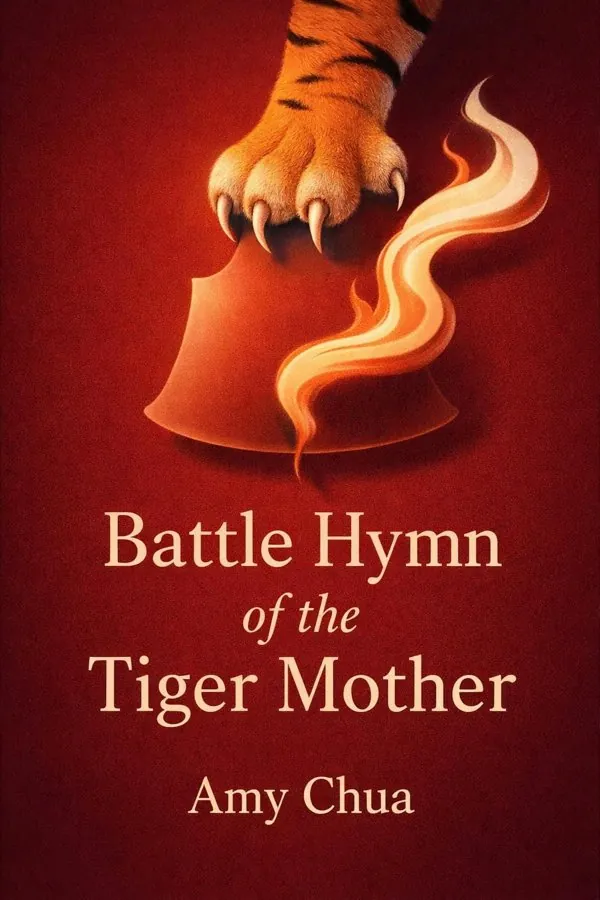
Battle Hymn of the Tiger Mother: Summary & Key Insights
by Amy Chua
 10 min6 chaptersAudio available
What Is Battle Hymn of the Tiger Mother About?
Battle Hymn of the Tiger Mother by Amy Chua is a parenting book spanning 6 pages. Battle Hymn of the Tiger Mother is a memoir by Amy Chua that explores her experiences raising her daughters using strict Chinese parenting methods. The book contrasts Eastern and Western parenting philosophies, sparking global debate about discipline, success, and cultural identity.
This FizzRead summary covers all 6 key chapters of Battle Hymn of the Tiger Mother in approximately 10 minutes, distilling the most important ideas, arguments, and takeaways from Amy Chua's work. Also available as an audio summary and Key Quotes Podcast.
Battle Hymn of the Tiger Mother
Battle Hymn of the Tiger Mother is a memoir by Amy Chua that explores her experiences raising her daughters using strict Chinese parenting methods. The book contrasts Eastern and Western parenting philosophies, sparking global debate about discipline, success, and cultural identity.
Who Should Read Battle Hymn of the Tiger Mother?
This book is perfect for anyone interested in parenting and looking to gain actionable insights in a short read. Whether you're a student, professional, or lifelong learner, the key ideas from Battle Hymn of the Tiger Mother by Amy Chua will help you think differently.
- ✓Readers who enjoy parenting and want practical takeaways
- ✓Professionals looking to apply new ideas to their work and life
- ✓Anyone who wants the core insights of Battle Hymn of the Tiger Mother in just 10 minutes
Want the full summary?
Get instant access to this book summary and 100K+ more with Fizz Moment.
Get Free SummaryAvailable on App Store • Free to download
Key Chapters
When Sophia and Lulu were small, I set out with a clear mission. In my mind, Western parents were simply too permissive, while Chinese parents demanded excellence as an act of love. So I created rules—rules that would make most Westerners cringe. No sleepovers. No playdates. No school plays. And above all, no grade lower than an A. From the start, I imagined their childhood as a disciplined path toward mastery.
Sophia, my elder daughter, responded perfectly to this structure. She thrived on challenge. When she learned piano, she attacked difficult pieces with fierce determination. I saw in her the reflection of my own disciplined upbringing, and it reaffirmed my faith in structure. Lulu, on the other hand, had fire—a wild determination that refused to bend as easily. When she began playing the violin, I demanded precision, practice, and focus; she met me with energy, talent, and eventually, resistance.
But in those early years, I was unwavering. If they cried during practice, I told myself it was the cry of effort, not misery. Every obstacle, I thought, could be overcome through persistence. I practiced with them for hours. I pushed, I commanded, and I insisted that they live up to standards they could not yet understand. I was determined to show them that discipline forms the foundation of freedom. What I didn’t yet see was that love also needs room to breathe.
My entire parenting approach rested on an ancient conviction: that children owe their parents obedience and that excellence is a moral duty. This wasn’t about ego or status—it was about respect. In a Chinese family, to “do well” is to honor the sacrifices of generations. I truly believed that by enforcing rigorous discipline, I was giving my daughters the best gift imaginable: resilience.
When I watched Western parents negotiate with their children—offering rewards for minimal effort, praising mediocrity, celebrating ‘self-esteem’—I was convinced they were setting their children up for disappointment. Love, to me, wasn’t about approval but empowerment through struggle. I saw struggle as formative, essential. I knew that true confidence doesn’t come from unearned praise; it comes from mastery and achievement.
But over time, I began to realize how cultural philosophies about parenting are often driven by emotion rather than logic. My belief in control was intertwined with my fear of failure—both theirs and mine. By aiming to sculpt their future, I was also clinging to the legacy of my immigrant parents, to the dreams they carried from one continent to another. In that way, my philosophy wasn’t simply about success; it was about survival and belonging. That tension—between love and fear, freedom and duty—runs through every page of this story.
+ 4 more chapters — available in the FizzRead app
All Chapters in Battle Hymn of the Tiger Mother
About the Author
Get This Summary in Your Preferred Format
Read or listen to the Battle Hymn of the Tiger Mother summary by Amy Chua anytime, anywhere. FizzRead offers multiple formats so you can learn on your terms — all free.
Available formats: App · Audio · PDF · EPUB — All included free with FizzRead
Download Battle Hymn of the Tiger Mother PDF and EPUB Summary
Key Quotes from Battle Hymn of the Tiger Mother
“When Sophia and Lulu were small, I set out with a clear mission.”
“My entire parenting approach rested on an ancient conviction: that children owe their parents obedience and that excellence is a moral duty.”
Frequently Asked Questions about Battle Hymn of the Tiger Mother
Battle Hymn of the Tiger Mother by Amy Chua is a parenting book that explores key ideas across 6 chapters. Battle Hymn of the Tiger Mother is a memoir by Amy Chua that explores her experiences raising her daughters using strict Chinese parenting methods. The book contrasts Eastern and Western parenting philosophies, sparking global debate about discipline, success, and cultural identity.
More by Amy Chua


You Might Also Like
Never Enough
Jennifer Breheny Wallace
10 min
Bluey: Sleepytime
Joe Brumm
10 min
In My Heart: A Book of Feelings
Jo Witek
10 min
Love From The Crayons
Drew Daywalt, Oliver Jeffers
10 min
Pete The Cat: Big Easter Adventure
James Dean, Kimberly Dean
10 min
Smart Money Smart Kids: Raising the Next Generation to Win with Money
Dave Ramsey, Rachel Cruze
10 minFeatured In
Browse by Category
Ready to read Battle Hymn of the Tiger Mother?
Get the full summary and 100K+ more books with Fizz Moment.