
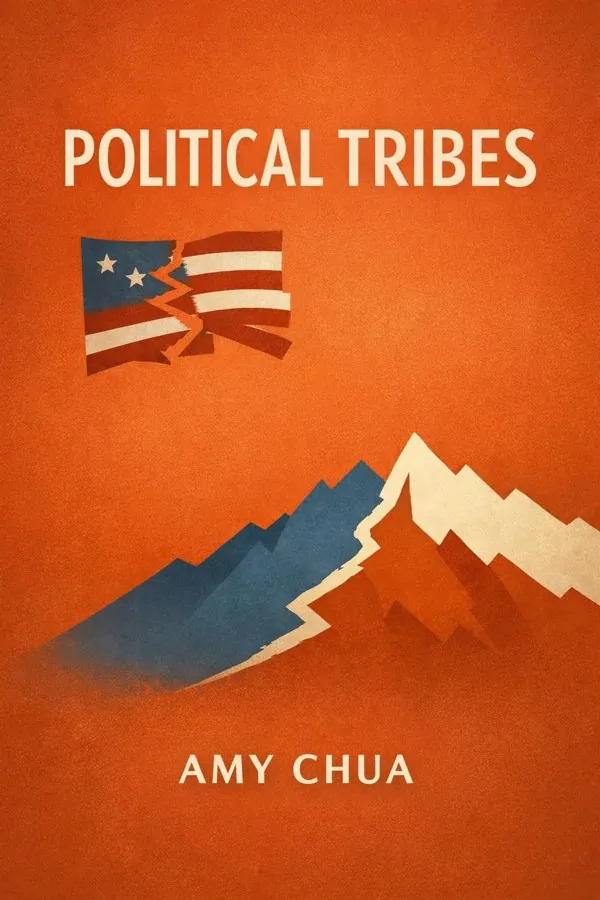
Political Tribes: Group Instinct and the Fate of Nations: Summary & Key Insights
by Amy Chua
 10 min13 chaptersAudio available
What Is Political Tribes: Group Instinct and the Fate of Nations About?
Political Tribes: Group Instinct and the Fate of Nations by Amy Chua is a politics book spanning 13 pages. In this book, Amy Chua explores how humans’ deep-seated tribal instincts shape political and social dynamics, both within the United States and across the world. She argues that ignoring the power of group identity has led to policy failures abroad and increasing polarization at home. Through case studies ranging from Vietnam and Iraq to contemporary American politics, Chua examines how tribalism influences national identity, democracy, and conflict.
This FizzRead summary covers all 13 key chapters of Political Tribes: Group Instinct and the Fate of Nations in approximately 10 minutes, distilling the most important ideas, arguments, and takeaways from Amy Chua's work. Also available as an audio summary and Key Quotes Podcast.
Political Tribes: Group Instinct and the Fate of Nations
In this book, Amy Chua explores how humans’ deep-seated tribal instincts shape political and social dynamics, both within the United States and across the world. She argues that ignoring the power of group identity has led to policy failures abroad and increasing polarization at home. Through case studies ranging from Vietnam and Iraq to contemporary American politics, Chua examines how tribalism influences national identity, democracy, and conflict.
Who Should Read Political Tribes: Group Instinct and the Fate of Nations?
This book is perfect for anyone interested in politics and looking to gain actionable insights in a short read. Whether you're a student, professional, or lifelong learner, the key ideas from Political Tribes: Group Instinct and the Fate of Nations by Amy Chua will help you think differently.
- ✓Readers who enjoy politics and want practical takeaways
- ✓Professionals looking to apply new ideas to their work and life
- ✓Anyone who wants the core insights of Political Tribes: Group Instinct and the Fate of Nations in just 10 minutes
Want the full summary?
Get instant access to this book summary and 100K+ more with Fizz Moment.
Get Free SummaryAvailable on App Store • Free to download
Key Chapters
Throughout history, humans have survived not as lone individuals but as members of tightly knit groups. Our sense of safety, respect, and identity has always been conditional on belonging. Neuroscience and anthropology alike confirm that group recognition triggers powerful emotional responses—it governs whom we trust, whom we fear, and for whom we fight. In modern nations, this instinct does not disappear; it merely takes on new forms. We join political parties, cultural communities, sports fandoms, online movements—all modern tribes that satisfy our longing for meaning.
When I refer to tribalism, I don’t mean something archaic or primitive. I mean the fundamental social orientation to 'us' and 'them.' It operates simultaneously at two levels: the micro level of family, ethnicity, and religion, and the macro level of nationalism or ideology. The micro tribes bind us through intimacy and inheritance, while macro tribes provide narratives of destiny and justice. When these levels align—when national identity includes and dignifies local affiliations—societies tend toward cohesion. But when they conflict, when national projects ignore or erase tribal realities, the result is alienation and violence.
The United States has often underestimated this instinct in its foreign policy. We assume that democracy and free markets will appeal universally, but these ideals cannot simply replace group loyalties. In many societies, political legitimacy still flows through kinship, sect, and ethnicity. To impose institutions based on abstract individualism without acknowledging tribal structure is to misunderstand the fabric of human community. Recognizing tribalism does not mean surrendering to it—it means starting where people really are.
The Vietnam War offers one of the clearest examples of how ignoring tribal dynamics leads to catastrophe. American policymakers viewed Vietnam through the Cold War lens: a battle between democracy and communism. Yet, the real division on the ground was ethnic and social, between the Sino-Vietnamese minority—descendants of Chinese traders who dominated commerce—and the rural ethnic Vietnamese majority, who struggled under immense inequality.
We allied ourselves with the wrong tribe without knowing it. By backing a government whose power rested in part on the market-dominant Chinese-Vietnamese, we appeared to support an ethnic elite against the native population. The Viet Cong exploited this resentment brilliantly, positioning themselves as the champions of the majority. Our blindness to these realities meant that every act of 'liberation' seemed, at the local level, like occupation. The tragedy of Vietnam was not just military miscalculation—it was anthropological ignorance. We fought ideas, but people fought for their tribe.
+ 11 more chapters — available in the FizzRead app
All Chapters in Political Tribes: Group Instinct and the Fate of Nations
About the Author
Amy Chua is an American law professor at Yale Law School, known for her work on globalization, ethnic conflict, and cultural identity. She gained international recognition for her books on parenting and political culture, and her scholarship often explores the intersection of culture, economics, and power.
Get This Summary in Your Preferred Format
Read or listen to the Political Tribes: Group Instinct and the Fate of Nations summary by Amy Chua anytime, anywhere. FizzRead offers multiple formats so you can learn on your terms — all free.
Available formats: App · Audio · PDF · EPUB — All included free with FizzRead
Download Political Tribes: Group Instinct and the Fate of Nations PDF and EPUB Summary
Key Quotes from Political Tribes: Group Instinct and the Fate of Nations
“Throughout history, humans have survived not as lone individuals but as members of tightly knit groups.”
“The Vietnam War offers one of the clearest examples of how ignoring tribal dynamics leads to catastrophe.”
Frequently Asked Questions about Political Tribes: Group Instinct and the Fate of Nations
Political Tribes: Group Instinct and the Fate of Nations by Amy Chua is a politics book that explores key ideas across 13 chapters. In this book, Amy Chua explores how humans’ deep-seated tribal instincts shape political and social dynamics, both within the United States and across the world. She argues that ignoring the power of group identity has led to policy failures abroad and increasing polarization at home. Through case studies ranging from Vietnam and Iraq to contemporary American politics, Chua examines how tribalism influences national identity, democracy, and conflict.
More by Amy Chua


You Might Also Like
Antifa: The Anti-Fascist Handbook
Mark Bray
10 min
Attack from Within: How Disinformation Is Sabotaging America
Barbara McQuade
10 min
Coercion, Capital, and European States, AD 990–1992
Charles Tilly
10 min
Digital Democracy: Concepts, Methodologies, Tools, and Applications
Various Authors
10 min
Fascism
Stanley G. Payne
10 min
Fire And Fury: Inside The Trump White House
Michael Wolff
10 minBrowse by Category
Ready to read Political Tribes: Group Instinct and the Fate of Nations?
Get the full summary and 100K+ more books with Fizz Moment.