
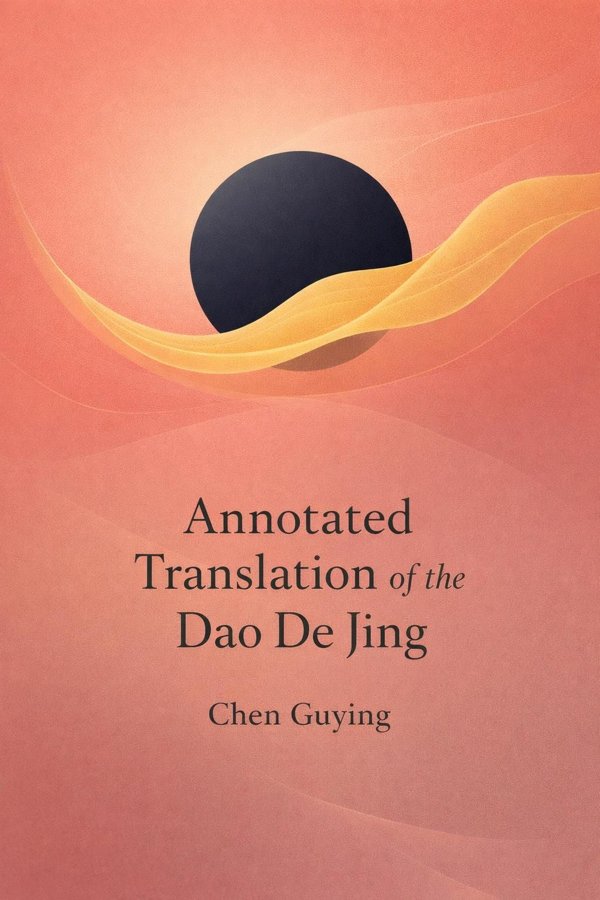
Annotated Translation of the Dao De Jing: Summary & Key Insights
by Chen Guying
 10 min10 chaptersAudio available
What Is Annotated Translation of the Dao De Jing About?
Annotated Translation of the Dao De Jing by Chen Guying is a eastern_wisdom book spanning 10 pages. Annotated Translation of the Dao De Jing is a modern annotated edition of Laozi’s Dao De Jing by the renowned philosopher Chen Guying. Based on the original text, the book integrates research from philosophy, history, and linguistics to provide an in-depth interpretation of the Dao De Jing’s conceptual system, linguistic structure, and its place in the history of Chinese philosophy. Chen’s rigorous scholarship and accessible language help readers better understand Laozi’s core ideas of Dao, De, Wu Wei, and Ziran.
This FizzRead summary covers all 10 key chapters of Annotated Translation of the Dao De Jing in approximately 10 minutes, distilling the most important ideas, arguments, and takeaways from Chen Guying's work. Also available as an audio summary and Key Quotes Podcast.
Annotated Translation of the Dao De Jing
Annotated Translation of the Dao De Jing is a modern annotated edition of Laozi’s Dao De Jing by the renowned philosopher Chen Guying. Based on the original text, the book integrates research from philosophy, history, and linguistics to provide an in-depth interpretation of the Dao De Jing’s conceptual system, linguistic structure, and its place in the history of Chinese philosophy. Chen’s rigorous scholarship and accessible language help readers better understand Laozi’s core ideas of Dao, De, Wu Wei, and Ziran.
Who Should Read Annotated Translation of the Dao De Jing?
This book is perfect for anyone interested in eastern_wisdom and looking to gain actionable insights in a short read. Whether you're a student, professional, or lifelong learner, the key ideas from Annotated Translation of the Dao De Jing by Chen Guying will help you think differently.
- ✓Readers who enjoy eastern_wisdom and want practical takeaways
- ✓Professionals looking to apply new ideas to their work and life
- ✓Anyone who wants the core insights of Annotated Translation of the Dao De Jing in just 10 minutes
Want the full summary?
Get instant access to this book summary and 100K+ more with Fizz Moment.
Get Free SummaryAvailable on App Store • Free to download
Key Chapters
Understanding the Dao De Jing requires first knowing its elusive history. The text’s transmission across centuries was far from linear; it evolved through layers of commentary and translation that shaped how Laozi’s thought was received and reimagined. In my own scholarship, I trace these stages from the Han to the Tang dynasties, comparing archaeological discoveries — such as the Mawangdui manuscripts — with traditional versions preserved in canonical commentaries.
By the Han dynasty, the Dao De Jing was not merely a philosophical treatise but a text revered for governing principles and self-cultivation. Commentators like Heshang Gong emphasized its political dimension, reading Laozi as a sage who taught rulers the art of minimal interference. Later, Wang Bi reinterpreted the work through the lens of metaphysics, proposing that the Dao was not merely guidance for rulers but the ontological ground of all being. The Tang era brought further expansion, weaving together religious Daoism and cosmology, transforming Dao into a living principle encompassing both heaven and humanity.
My engagement with these textual lineages seeks to clarify how Laozi’s language — succinct, paradoxical, and profoundly relational — has remained alive through shifting philosophical climates. By identifying manuscript variations, we uncover both semantic nuance and philosophical evolution. For instance, certain passages expressing the return to simplicity show different word choices that subtly shift meaning from moral restoration to metaphysical return. Recognizing these differences helps modern readers grasp the flexible genius of Laozi’s composition.
Thus, historical context is not mere background; it’s the living framework through which interpretation breathes. Each generation re-sees Laozi’s vision according to its existential needs. My annotated translation joins this tradition — not as an authority to fix the Dao’s meaning but as a bridge continuing the flow of inquiry, connecting ancient insight with contemporary reflection.
When I speak of the Dao, I do not refer to a concept that can be captured by definition. Laozi’s genius lies in presenting Dao as both origin and process — the mysterious source from which all phenomena arise and to which they return. Dao is not something beyond reality; it is reality itself before it differentiates into form. In philosophical terms, Dao serves as the metaphysical ground of being, yet it transcends any schema of duality.
As I explored Laozi’s formulations, I felt compelled to show readers that Dao is both utterly simple and infinitely profound. It is “nameless” because names belong to things, and Dao precedes all things. It gives birth yet does not possess. It acts without intention, flowing through the cosmos as the spontaneous order we call nature. In my commentary, I align this insight with both Chinese and Western metaphysical discourse. Where Aristotle speaks of the ‘unmoved mover,’ Laozi speaks of the movement that arises from stillness itself. The Dao is not a creator in a personal sense; it is generative emptiness, ceaselessly unfolding.
This understanding leads naturally into ethical reflection: to live according to the Dao means to align one’s actions with the pattern that moves without coercion. It is a philosophy of balance — seeing the world not as opposing forces but as interdependent manifestations. When water flows downward, it is not following an external order; it simply expresses the Dao’s nature of non-resistance. Likewise, when a person lives by humility, compassion, and moderation, they embody the Dao through their conduct.
Dao is not external to us. To perceive it is to return from abstraction to direct experience, to recognize in every breath and moment the harmony of becoming. The philosophical core of my translation aims to help readers see Dao not as mystical escape but as grounding presence — the silent rhythm beneath all motion, the stillness that births all transformation.
+ 8 more chapters — available in the FizzRead app
All Chapters in Annotated Translation of the Dao De Jing
About the Author
Chen Guying (born 1935 in Fujian) is a prominent philosopher and historian of ideas, and a professor in the Department of Philosophy at Peking University. His main research areas include the history of Chinese philosophy, Daoist thought, and comparative philosophy. His representative works include Laozi: Annotated Translation and Commentary, Zhuangzi: Modern Annotation and Translation, and Studies on Nietzsche’s Philosophy. He is recognized for his influential contributions to comparative studies between Chinese and Western philosophy.
Get This Summary in Your Preferred Format
Read or listen to the Annotated Translation of the Dao De Jing summary by Chen Guying anytime, anywhere. FizzRead offers multiple formats so you can learn on your terms — all free.
Available formats: App · Audio · PDF · EPUB — All included free with FizzRead
Download Annotated Translation of the Dao De Jing PDF and EPUB Summary
Key Quotes from Annotated Translation of the Dao De Jing
“Understanding the Dao De Jing requires first knowing its elusive history.”
“When I speak of the Dao, I do not refer to a concept that can be captured by definition.”
Frequently Asked Questions about Annotated Translation of the Dao De Jing
Annotated Translation of the Dao De Jing by Chen Guying is a eastern_wisdom book that explores key ideas across 10 chapters. Annotated Translation of the Dao De Jing is a modern annotated edition of Laozi’s Dao De Jing by the renowned philosopher Chen Guying. Based on the original text, the book integrates research from philosophy, history, and linguistics to provide an in-depth interpretation of the Dao De Jing’s conceptual system, linguistic structure, and its place in the history of Chinese philosophy. Chen’s rigorous scholarship and accessible language help readers better understand Laozi’s core ideas of Dao, De, Wu Wei, and Ziran.
More by Chen Guying
You Might Also Like
A New Earth
Eckhart Tolle
10 min
The Daily Stoic
Ryan Holiday, Stephen Hanselman
10 min
Buddhism: Plain and Simple
Steve Hagen
10 min
Enchiridion
Epictetus
10 min
The Book of Tea
Kakuzō Okakura
10 min
The Light We Give: How Sikh Wisdom Can Transform Your Life
Simran Jeet Singh
10 minFeatured In
Browse by Category
Ready to read Annotated Translation of the Dao De Jing?
Get the full summary and 100K+ more books with Fizz Moment.