
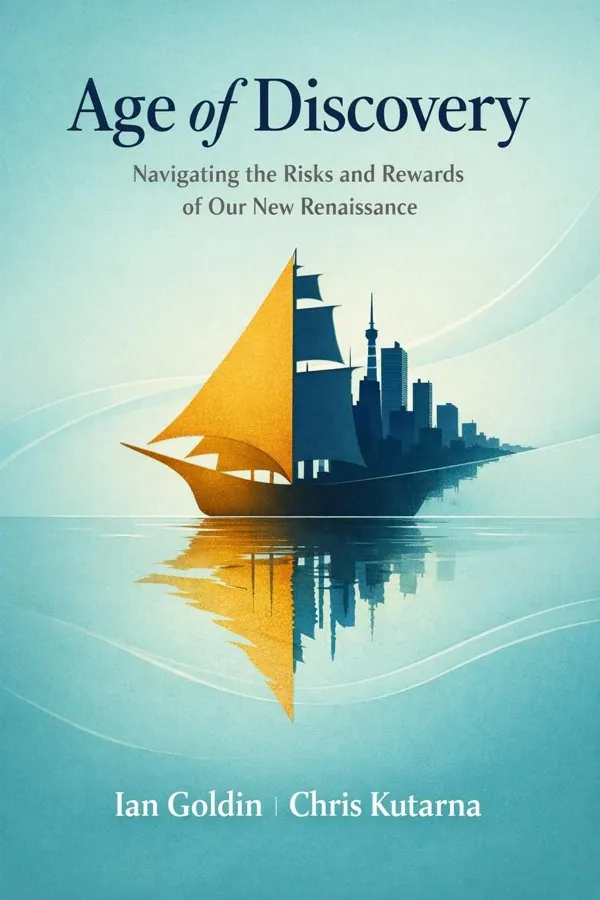
Age of Discovery: Navigating the Risks and Rewards of Our New Renaissance: Summary & Key Insights
 10 min9 chaptersAudio available
What Is Age of Discovery: Navigating the Risks and Rewards of Our New Renaissance About?
Age of Discovery: Navigating the Risks and Rewards of Our New Renaissance by Ian Goldin, Chris Kutarna is a future_trends book spanning 9 pages. In 'Age of Discovery', Ian Goldin and Chris Kutarna argue that the world today is experiencing a new Renaissance—a period of extraordinary innovation, globalization, and transformation comparable to the 15th and 16th centuries. The authors explore how technological advances, demographic shifts, and interconnected economies are reshaping societies, while also warning of the risks of inequality, political instability, and environmental stress. They call for renewed leadership and creativity to ensure that this new age of discovery benefits all humanity.
This FizzRead summary covers all 9 key chapters of Age of Discovery: Navigating the Risks and Rewards of Our New Renaissance in approximately 10 minutes, distilling the most important ideas, arguments, and takeaways from Ian Goldin, Chris Kutarna's work. Also available as an audio summary and Key Quotes Podcast.
Age of Discovery: Navigating the Risks and Rewards of Our New Renaissance
In 'Age of Discovery', Ian Goldin and Chris Kutarna argue that the world today is experiencing a new Renaissance—a period of extraordinary innovation, globalization, and transformation comparable to the 15th and 16th centuries. The authors explore how technological advances, demographic shifts, and interconnected economies are reshaping societies, while also warning of the risks of inequality, political instability, and environmental stress. They call for renewed leadership and creativity to ensure that this new age of discovery benefits all humanity.
Who Should Read Age of Discovery: Navigating the Risks and Rewards of Our New Renaissance?
This book is perfect for anyone interested in future_trends and looking to gain actionable insights in a short read. Whether you're a student, professional, or lifelong learner, the key ideas from Age of Discovery: Navigating the Risks and Rewards of Our New Renaissance by Ian Goldin, Chris Kutarna will help you think differently.
- ✓Readers who enjoy future_trends and want practical takeaways
- ✓Professionals looking to apply new ideas to their work and life
- ✓Anyone who wants the core insights of Age of Discovery: Navigating the Risks and Rewards of Our New Renaissance in just 10 minutes
Want the full summary?
Get instant access to this book summary and 100K+ more with Fizz Moment.
Get Free SummaryAvailable on App Store • Free to download
Key Chapters
To understand our own time, we first need to revisit the original Renaissance—Europe’s extraordinary awakening from medieval darkness into modern brilliance. In *Age of Discovery*, we draw vivid parallels between then and now. Fifteenth‑century Europe was a world in transition: feudal structures were crumbling, ancient texts were being rediscovered, and trade connected distant cultures. The printing press disrupted how knowledge was created and shared, much as the internet does today. Exploration opened the world to unprecedented exchanges of goods and ideas, but also unleashed conquest and disease. The new age was shimmering and shattering all at once.
What is crucial to recognize is that the Renaissance was not an easy birth. Its artists and inventors thrived amid uncertainty, backed by patrons who mixed greed with vision. Religious and political institutions struggled to respond to sudden pluralism. The old certainties dissolved, replaced by an ethic of questioning that both liberated and destabilized society. The same was true of economics: city‑states like Florence and Venice became hubs of finance and trade, precursors to our modern global economy.
This comparison matters because it reveals that radical progress and radical risk are inseparable. The Renaissance shows that human creativity, when unleashed, can reshape the world at every level. But it also warns us that those who fail to adapt to new knowledge or power can be left behind—or worse, consumed by conflict. We can glimpse our own reflection in that historical mirror: our technologies, like theirs, are rewriting the script of what humans can do; our institutions, like theirs, strain to keep pace. History reminds us that rebirth always feels chaotic while it is happening—and that the ultimate outcomes depend less on technology than on human choices.
If Gutenberg’s press was the spark of the first Renaissance, then the digital revolution is the engine of our own. Technology today accelerates discovery far beyond anything in the past. In *Age of Discovery*, we explore how artificial intelligence, biotechnology, nanotechnology, and digital platforms are fusing into a single transformative force that redefines not only how we work, but what we are. Information is now boundless; expertise can be shared instantly across oceans. The potential for knowledge creation has become universal, if we know how to harness it.
The transformative power of technology, however, cuts both ways. Algorithms amplify our reach but also our biases. Automation empowers and displaces. Gene editing can eradicate inherited diseases or engineer new inequalities. We stand on the cusp of possibilities once confined to myth: to design life, prolong it, perhaps even transcend it. Yet every possibility carries a moral price tag. We must learn to steer innovation, not let it steer us.
When I think of the Renaissance, I picture Da Vinci sketching flying machines centuries before engineers could ever realize them. Today’s innovators are our Da Vincis, though their laboratories are global and their tools digital. They extend human creative capacity in astonishing ways, making it possible to collaborate at planetary scale. But the challenge is one of wisdom. The Renaissance gave birth not only to art and science but also to empire and exploitation. Technology magnifies what we are. Without humanism to guide it, discovery becomes dangerous.
In this new technological landscape, the choice each society faces is whether to fear disruption or to shape it. The lesson we draw is that invention cannot be stopped—and nor should it be. Instead, we must deepen our understanding of what kind of world our discoveries are building. We can—and must—make technology serve life rather than autonomy, empathy rather than indifference.
+ 7 more chapters — available in the FizzRead app
All Chapters in Age of Discovery: Navigating the Risks and Rewards of Our New Renaissance
About the Authors
Ian Goldin is a Professor of Globalization and Development at the University of Oxford and a former Vice President of the World Bank. Chris Kutarna is a fellow at the Oxford Martin School and a researcher focused on global trends and strategic foresight.
Get This Summary in Your Preferred Format
Read or listen to the Age of Discovery: Navigating the Risks and Rewards of Our New Renaissance summary by Ian Goldin, Chris Kutarna anytime, anywhere. FizzRead offers multiple formats so you can learn on your terms — all free.
Available formats: App · Audio · PDF · EPUB — All included free with FizzRead
Download Age of Discovery: Navigating the Risks and Rewards of Our New Renaissance PDF and EPUB Summary
Key Quotes from Age of Discovery: Navigating the Risks and Rewards of Our New Renaissance
“To understand our own time, we first need to revisit the original Renaissance—Europe’s extraordinary awakening from medieval darkness into modern brilliance.”
“If Gutenberg’s press was the spark of the first Renaissance, then the digital revolution is the engine of our own.”
Frequently Asked Questions about Age of Discovery: Navigating the Risks and Rewards of Our New Renaissance
Age of Discovery: Navigating the Risks and Rewards of Our New Renaissance by Ian Goldin, Chris Kutarna is a future_trends book that explores key ideas across 9 chapters. In 'Age of Discovery', Ian Goldin and Chris Kutarna argue that the world today is experiencing a new Renaissance—a period of extraordinary innovation, globalization, and transformation comparable to the 15th and 16th centuries. The authors explore how technological advances, demographic shifts, and interconnected economies are reshaping societies, while also warning of the risks of inequality, political instability, and environmental stress. They call for renewed leadership and creativity to ensure that this new age of discovery benefits all humanity.
You Might Also Like
Futureproof: 9 Rules for Humans in the Age of Automation
Kevin Roose
10 min
The Third Wave
Alvin Toffler
10 min
2030: How Today's Biggest Trends Will Collide and Reshape the Future of Everything
Mauro F. Guillén
10 min
A Very Human Future: Enriching Humanity in a Digitized World
Rohit Talwar, Steve Wells, Alexandra Whittington
10 min
AI 2041: Ten Visions for Our Future
Kai-Fu Lee, Chen Qiufan
10 min
Abundance: The Future Is Better Than You Think
Peter H. Diamandis, Steven Kotler
10 minFeatured In
Browse by Category
Ready to read Age of Discovery: Navigating the Risks and Rewards of Our New Renaissance?
Get the full summary and 100K+ more books with Fizz Moment.