
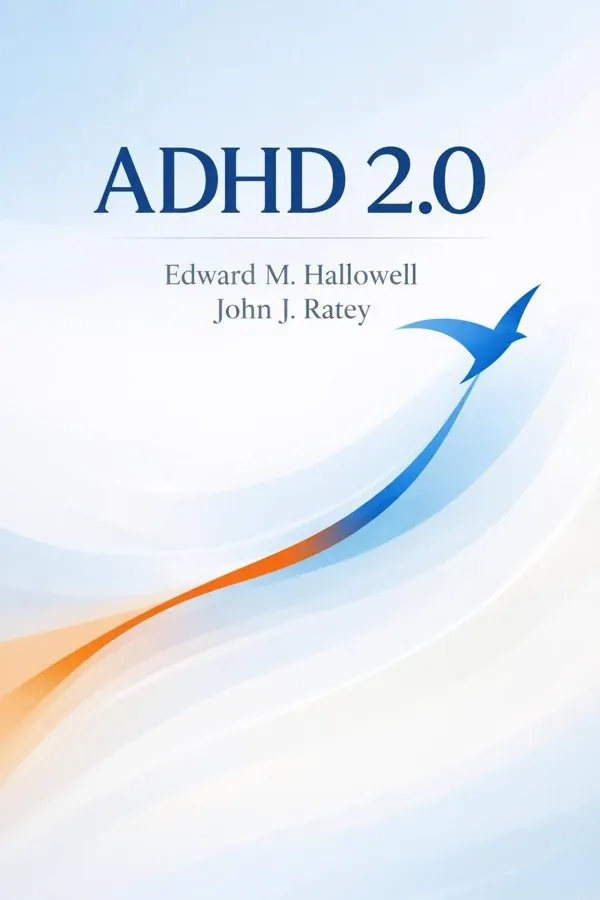
ADHD 2.0: New Science and Essential Strategies for Thriving with Distraction—from Childhood through Adulthood: Summary & Key Insights
by Edward M. Hallowell, John J. Ratey
 10 min9 chaptersAudio available
Key Takeaways from ADHD 2.0: New Science and Essential Strategies for Thriving with Distraction—from Childhood through Adulthood
The most damaging myth about ADHD is that it reflects laziness, weak character, or poor motivation.
One of the book’s most revealing insights is that people with ADHD do not have a simple deficit of attention; they have inconsistent control over attention.
0 is that human connection is not just emotionally helpful; it is neurologically stabilizing.
If ADHD is described only through its problems, an essential truth gets lost: many traits associated with ADHD can become major assets in the right setting.
ADHD does not look the same at every age, and one of the book’s useful contributions is showing how symptoms evolve over time.
What Is ADHD 2.0: New Science and Essential Strategies for Thriving with Distraction—from Childhood through Adulthood About?
ADHD 2.0: New Science and Essential Strategies for Thriving with Distraction—from Childhood through Adulthood by Edward M. Hallowell, John J. Ratey is a mental_health book spanning 11 pages. ADHD 2.0 is a fresh, humane, and science-informed guide to understanding attention deficit hyperactivity disorder across the lifespan. Rather than treating ADHD as a simple deficit or a failure of discipline, psychiatrists Edward M. Hallowell and John J. Ratey present it as a complex brain-based condition that includes real struggles but also distinctive strengths. Drawing on decades of clinical experience, neuroscience research, and patient stories, they explain why attention in ADHD is inconsistent rather than absent, why connection and encouragement matter so deeply, and how lifestyle habits can dramatically improve daily functioning. What makes this book especially valuable is its balance of compassion and practicality. The authors move beyond diagnosis labels to offer usable strategies for school, work, relationships, and self-management. They discuss exercise, sleep, medication, structure, emotional support, and the importance of finding environments where people with ADHD can thrive. Hallowell and Ratey are uniquely qualified to write this book: both are leading psychiatrists, widely known for translating brain science into clear advice. The result is an empowering roadmap for parents, adults with ADHD, educators, and anyone who wants a more modern and hopeful understanding of distraction.
This FizzRead summary covers all 9 key chapters of ADHD 2.0: New Science and Essential Strategies for Thriving with Distraction—from Childhood through Adulthood in approximately 10 minutes, distilling the most important ideas, arguments, and takeaways from Edward M. Hallowell, John J. Ratey's work. Also available as an audio summary and Key Quotes Podcast.
ADHD 2.0: New Science and Essential Strategies for Thriving with Distraction—from Childhood through Adulthood
ADHD 2.0 is a fresh, humane, and science-informed guide to understanding attention deficit hyperactivity disorder across the lifespan. Rather than treating ADHD as a simple deficit or a failure of discipline, psychiatrists Edward M. Hallowell and John J. Ratey present it as a complex brain-based condition that includes real struggles but also distinctive strengths. Drawing on decades of clinical experience, neuroscience research, and patient stories, they explain why attention in ADHD is inconsistent rather than absent, why connection and encouragement matter so deeply, and how lifestyle habits can dramatically improve daily functioning.
What makes this book especially valuable is its balance of compassion and practicality. The authors move beyond diagnosis labels to offer usable strategies for school, work, relationships, and self-management. They discuss exercise, sleep, medication, structure, emotional support, and the importance of finding environments where people with ADHD can thrive. Hallowell and Ratey are uniquely qualified to write this book: both are leading psychiatrists, widely known for translating brain science into clear advice. The result is an empowering roadmap for parents, adults with ADHD, educators, and anyone who wants a more modern and hopeful understanding of distraction.
Who Should Read ADHD 2.0: New Science and Essential Strategies for Thriving with Distraction—from Childhood through Adulthood?
This book is perfect for anyone interested in mental_health and looking to gain actionable insights in a short read. Whether you're a student, professional, or lifelong learner, the key ideas from ADHD 2.0: New Science and Essential Strategies for Thriving with Distraction—from Childhood through Adulthood by Edward M. Hallowell, John J. Ratey will help you think differently.
- ✓Readers who enjoy mental_health and want practical takeaways
- ✓Professionals looking to apply new ideas to their work and life
- ✓Anyone who wants the core insights of ADHD 2.0: New Science and Essential Strategies for Thriving with Distraction—from Childhood through Adulthood in just 10 minutes
Want the full summary?
Get instant access to this book summary and 100K+ more with Fizz Moment.
Get Free SummaryAvailable on App Store • Free to download
Key Chapters
The most damaging myth about ADHD is that it reflects laziness, weak character, or poor motivation. Hallowell and Ratey argue that this misconception has harmed millions of children and adults by making them feel ashamed of struggles that are rooted in brain function, not moral failure. ADHD is best understood as a neurodevelopmental condition involving differences in attention regulation, impulse control, emotional management, and executive functioning.
The authors explain that the ADHD brain is not broken; it is wired differently. Networks involved in prioritizing, organizing, shifting attention, and controlling impulses may operate less consistently. This can make everyday tasks feel harder than they appear to others. A child may know the homework matters but still fail to start. An adult may care deeply about a deadline but become overwhelmed, distracted, or pulled toward more stimulating activities. These patterns often confuse family members, teachers, and even the individual experiencing them.
At the same time, the book stresses that ADHD often coexists with curiosity, creativity, energy, intuition, and original thinking. The problem is not a lack of talent but a difficulty in directing that talent reliably. When people understand the brain basis of ADHD, they can stop framing every setback as a personal flaw and begin building effective support systems.
In practice, this means replacing blame with informed problem-solving. Teachers can break assignments into smaller steps. Managers can clarify priorities and deadlines. Adults with ADHD can use reminders, routines, and accountability to reduce friction. The first intervention is often accurate understanding.
Actionable takeaway: Stop asking, "Why can’t I just try harder?" and start asking, "How is my brain working here, and what structure would help me succeed?"
One of the book’s most revealing insights is that people with ADHD do not have a simple deficit of attention; they have inconsistent control over attention. This is why someone can seem unable to focus on a boring email yet become completely absorbed in a video game, creative project, or urgent crisis. The issue is not whether attention exists, but whether it can be directed on demand.
Hallowell and Ratey describe ADHD as a variable attention system. Attention may wander when stimulation is low, but lock in intensely when interest, novelty, challenge, or urgency is high. This pattern often leads others to say, "If you can focus on that, you should be able to focus on everything." But that assumption misses the central feature of ADHD: regulation. The person is not choosing inconsistency; their brain responds unevenly to different levels of stimulation.
Understanding this can reduce shame and improve strategy. If a student can concentrate only when the subject feels engaging, the solution may involve making study sessions more interactive, time-bound, or game-like. If an adult procrastinates until the last minute, the answer may be to create earlier checkpoints and external accountability rather than relying on internal motivation alone.
The idea of hyperfocus is also important. Intense concentration can be a strength when directed toward meaningful work, but it can become a problem when it leads someone to lose track of time, ignore obligations, or neglect basic needs. Learning to manage transitions becomes as important as learning to initiate tasks.
Actionable takeaway: Design tasks around stimulation by using short sprints, deadlines, movement, novelty, and visible rewards instead of depending on willpower alone.
A powerful theme in ADHD 2.0 is that human connection is not just emotionally helpful; it is neurologically stabilizing. The authors emphasize that people with ADHD often perform better when they feel understood, encouraged, and connected to others who believe in them. Isolation, criticism, and chronic misunderstanding tend to worsen symptoms by increasing stress, discouragement, and self-doubt.
This insight is especially important because many individuals with ADHD grow up hearing negative messages: "You’re careless," "You don’t apply yourself," or "You’re too much." Over time, these judgments can become internalized. A person may begin to expect failure, hide mistakes, or avoid challenges. Supportive relationships can interrupt that cycle by providing accountability without shame and guidance without contempt.
Connection matters in families, classrooms, workplaces, and friendships. A teacher who notices strengths before correcting weaknesses can help a student stay engaged. A partner who uses collaborative planning instead of repeated criticism can reduce conflict. A coach, therapist, or mentor can provide structure and encouragement that makes progress feel possible.
The authors also suggest that emotional connection improves cognitive performance. When people feel safe and seen, they are more able to regulate attention, recover from setbacks, and take practical steps forward. This does not mean support replaces treatment, but it does mean treatment works better in an atmosphere of trust.
For many readers, this is a liberating idea. The path to improvement is not only about fixing deficits; it is also about building relationships that bring out the best in the ADHD brain.
Actionable takeaway: Identify one person who can offer steady, nonjudgmental support, and build a regular check-in routine around goals, progress, and problem-solving.
If ADHD is described only through its problems, an essential truth gets lost: many traits associated with ADHD can become major assets in the right setting. Hallowell and Ratey challenge the deficit-only narrative by highlighting strengths such as imagination, spontaneity, entrepreneurial energy, resilience, enthusiasm, and the ability to think in nonlinear ways.
This strengths-based view does not deny the genuine difficulties of ADHD. Missed deadlines, impulsive decisions, emotional volatility, and chronic disorganization can be painful and disruptive. But the authors argue that treatment becomes more effective when it aims not merely to reduce impairment but to help people identify where they shine. Someone who struggles in rigid administrative work may thrive in fast-moving, creative, or people-oriented environments. A child who seems restless in a traditional classroom may be exceptionally inventive, observant, or charismatic.
The practical implication is that thriving with ADHD depends partly on fit. Instead of asking only how to force the person to conform, we should also ask what environments allow their strengths to emerge. This can mean choosing careers with novelty and movement, structuring projects around creativity, or developing hobbies that channel intense enthusiasm into mastery.
A strengths focus also changes self-talk. Rather than seeing every challenge as proof of inadequacy, people can begin to understand themselves more accurately: "I struggle with follow-through, but I’m excellent at generating ideas." That mindset invites strategic support instead of self-rejection.
The goal is not to romanticize ADHD but to recognize that a meaningful life is built by minimizing obstacles and amplifying gifts. When both happen together, confidence and performance improve.
Actionable takeaway: Make a written list of three recurring ADHD challenges and three recurring ADHD-related strengths, then redesign one part of your work or study life to use those strengths more intentionally.
ADHD does not look the same at every age, and one of the book’s useful contributions is showing how symptoms evolve over time. In childhood, ADHD may appear as obvious hyperactivity, trouble waiting turns, unfinished schoolwork, emotional outbursts, or frequent correction by adults. In adolescence, academic pressure, social complexity, and increasing independence may expose weaknesses in planning, time management, and self-control. In adulthood, the condition often shows up less as visible restlessness and more as chronic overwhelm, inconsistency, forgetfulness, relationship strain, and difficulty managing responsibilities.
Because the outward signs change, many people go undiagnosed for years. A bright child may compensate academically until the demands of life exceed their coping systems. An adult may appear successful from the outside while privately struggling with clutter, lateness, impulsive spending, or missed commitments. Women in particular have often been overlooked when their symptoms are quieter or expressed more through internal distress than disruptive behavior.
The authors emphasize that diagnosis at any age can be transformative. It offers a framework that explains long-standing patterns and opens the door to treatment, self-forgiveness, and more effective strategies. But they also warn against assuming that age alone solves ADHD. Maturity can help, yet most people still benefit from intentionally designed supports.
What works at one stage may need revision later. A parent’s reminders may help a child, but an adult may need digital calendars, coaching, or workplace accommodations. The underlying principle is adaptability: strategies must match the realities of the current life stage.
Actionable takeaway: Review how ADHD shows up in your present season of life, and update your systems instead of relying on solutions that worked years ago.
Among the book’s most practical and research-backed ideas is that lifestyle habits are not secondary to ADHD treatment; they are central to it. Hallowell and Ratey place special emphasis on exercise and sleep because both have direct effects on attention, mood, impulse control, and brain regulation.
Exercise is presented almost like medicine for the ADHD brain. Physical activity increases chemicals and processes associated with alertness, learning, emotional balance, and executive function. For many people, even a brisk walk, bike ride, dance session, or short strength workout can improve focus for hours. Children often concentrate better after moving their bodies. Adults may find that exercise reduces mental fog, restlessness, and emotional reactivity.
Sleep is equally crucial, yet often neglected. ADHD and poor sleep can feed each other in a destructive cycle. Racing thoughts, inconsistent routines, late-night screen use, and difficulty winding down can reduce sleep quality. Then, sleep deprivation worsens distractibility, irritability, memory problems, and impulsivity the next day. Many people mistakenly interpret this as worsening ADHD alone when sleep is a major hidden factor.
The authors encourage readers to treat these habits as nonnegotiable supports rather than optional wellness extras. That may mean scheduling movement before mentally demanding work, keeping a regular bedtime, reducing evening stimulation, or creating a wind-down routine that signals the brain to settle.
These changes can seem simple, but their effects are often profound. Medication and therapy may help, but they work better when the brain is physically cared for.
Actionable takeaway: Start with one week of consistent movement and sleep tracking, aiming for daily exercise and a repeatable bedtime routine before changing anything more complex.
One of the clearest lessons in ADHD 2.0 is that people with ADHD usually do not fail because they lack good intentions. They fail because intention without structure is unreliable. The authors repeatedly show that success comes from externalizing what others may manage internally: time, priorities, memory, sequencing, and follow-through.
This means using systems that reduce the burden on working memory and self-control. Calendars, alarms, visual cues, checklists, body doubling, written routines, and task breakdowns are not signs of weakness. They are tools that make the invisible visible. A person who keeps forgetting appointments may need three reminders, not more shame. Someone overwhelmed by a major project may need the first step defined so clearly that beginning becomes almost automatic.
The modern world makes this harder. Smartphones, open-plan workplaces, endless notifications, and constant digital novelty all compete for attention. For the ADHD brain, these distractions can be especially costly. The answer is not necessarily to reject technology, but to use it deliberately. A phone can distract, but it can also serve as a planner, timer, reminder system, or focus tool.
The authors encourage experimentation. Some people work best with noise-canceling headphones; others need background sound. Some need short work sprints with breaks; others need a co-working partner to stay on track. The key is to stop moralizing productivity and start engineering it.
Structure is freedom in disguise. By reducing chaos, it preserves energy for creativity, relationships, and meaningful work.
Actionable takeaway: Choose one recurring problem, such as lateness or task initiation, and build a specific external system for it instead of promising yourself you will "remember next time."
Few topics in ADHD generate more confusion than medication, and Hallowell and Ratey approach it with practical balance. They neither portray medication as a cure-all nor dismiss it as unnecessary. Instead, they describe it as one important treatment option that can, for many people, significantly improve focus, self-control, and daily functioning when properly prescribed and monitored.
The authors stress that medication should be individualized. Different people respond differently, and finding the right type, dose, and timing may require patience. For some, stimulants are highly effective. Others may do better with non-stimulant approaches or a combination of treatments. What matters is not ideology but fit.
Just as importantly, medication works best as part of a broader plan. Pills do not automatically create organization, healthy relationships, exercise habits, or self-understanding. Someone may be able to focus better on medication but still need coaching, therapy, academic accommodations, or environmental changes to translate that improved focus into real-life success.
The book also encourages readers to let go of stigma. Many people avoid treatment because they fear being judged or believe they should manage on their own. But refusing useful help out of shame can prolong avoidable struggle. At the same time, medication is not mandatory for everyone. The right treatment plan depends on severity, context, goals, and medical guidance.
The broader message is one of informed flexibility. Effective treatment is rarely one-size-fits-all; it is built through careful observation, experimentation, and collaboration.
Actionable takeaway: If ADHD symptoms significantly impair school, work, or relationships, discuss a full treatment plan with a qualified clinician that includes both medical and non-medical options.
Thriving with ADHD is rarely a solo achievement. Hallowell and Ratey show that long-term progress depends heavily on the quality of a person’s support system. Parents, teachers, partners, managers, clinicians, and friends can either intensify chaos or help create stability, confidence, and momentum.
A strong support system does more than offer sympathy. It provides practical scaffolding. That might include teachers who allow movement breaks, parents who use calm routines, partners who share planning tools, or supervisors who set explicit priorities. It also includes professionals such as therapists, coaches, and physicians who understand ADHD well enough to tailor advice rather than giving generic motivational slogans.
The emotional dimension matters too. People with ADHD often accumulate years of criticism, misunderstanding, and failure experiences. In that context, support must include recognition of effort and progress, not only correction of mistakes. Encouragement is not indulgence; it is fuel. When people feel capable, they are more likely to persist with systems that require repetition and adjustment.
The book also points toward the future of ADHD understanding. As research improves, public conversation is slowly moving away from simplistic stereotypes toward a more sophisticated model that includes neuroscience, environment, lifestyle, and strengths. That shift matters because people do better when the culture around them is informed.
Ultimately, the authors invite readers to think in ecosystems, not isolated symptoms. ADHD outcomes improve when individuals are surrounded by tools, relationships, and expectations that make success more likely.
Actionable takeaway: Map your current support network and identify one missing form of support, such as medical guidance, accountability, or emotional encouragement, then actively seek it out.
All Chapters in ADHD 2.0: New Science and Essential Strategies for Thriving with Distraction—from Childhood through Adulthood
About the Authors
Edward M. Hallowell, M.D., is a psychiatrist, speaker, and author best known for his work on ADHD and strengths-based mental health. A graduate of Harvard College and Tulane Medical School, he has spent decades helping children and adults better understand how their brains work and how to build lives that fit them. He is also the founder of the Hallowell Centers for Cognitive and Emotional Health. John J. Ratey, M.D., is an associate clinical professor of psychiatry at Harvard Medical School and an internationally respected expert on neuropsychiatry and brain function. He is especially known for exploring the relationship between exercise and mental performance. Together, Hallowell and Ratey have become two of the most influential voices in modern ADHD education.
Get This Summary in Your Preferred Format
Read or listen to the ADHD 2.0: New Science and Essential Strategies for Thriving with Distraction—from Childhood through Adulthood summary by Edward M. Hallowell, John J. Ratey anytime, anywhere. FizzRead offers multiple formats so you can learn on your terms — all free.
Available formats: App · Audio · PDF · EPUB — All included free with FizzRead
Download ADHD 2.0: New Science and Essential Strategies for Thriving with Distraction—from Childhood through Adulthood PDF and EPUB Summary
Key Quotes from ADHD 2.0: New Science and Essential Strategies for Thriving with Distraction—from Childhood through Adulthood
“The most damaging myth about ADHD is that it reflects laziness, weak character, or poor motivation.”
“One of the book’s most revealing insights is that people with ADHD do not have a simple deficit of attention; they have inconsistent control over attention.”
“0 is that human connection is not just emotionally helpful; it is neurologically stabilizing.”
“If ADHD is described only through its problems, an essential truth gets lost: many traits associated with ADHD can become major assets in the right setting.”
“ADHD does not look the same at every age, and one of the book’s useful contributions is showing how symptoms evolve over time.”
Frequently Asked Questions about ADHD 2.0: New Science and Essential Strategies for Thriving with Distraction—from Childhood through Adulthood
ADHD 2.0: New Science and Essential Strategies for Thriving with Distraction—from Childhood through Adulthood by Edward M. Hallowell, John J. Ratey is a mental_health book that explores key ideas across 9 chapters. ADHD 2.0 is a fresh, humane, and science-informed guide to understanding attention deficit hyperactivity disorder across the lifespan. Rather than treating ADHD as a simple deficit or a failure of discipline, psychiatrists Edward M. Hallowell and John J. Ratey present it as a complex brain-based condition that includes real struggles but also distinctive strengths. Drawing on decades of clinical experience, neuroscience research, and patient stories, they explain why attention in ADHD is inconsistent rather than absent, why connection and encouragement matter so deeply, and how lifestyle habits can dramatically improve daily functioning. What makes this book especially valuable is its balance of compassion and practicality. The authors move beyond diagnosis labels to offer usable strategies for school, work, relationships, and self-management. They discuss exercise, sleep, medication, structure, emotional support, and the importance of finding environments where people with ADHD can thrive. Hallowell and Ratey are uniquely qualified to write this book: both are leading psychiatrists, widely known for translating brain science into clear advice. The result is an empowering roadmap for parents, adults with ADHD, educators, and anyone who wants a more modern and hopeful understanding of distraction.
More by Edward M. Hallowell, John J. Ratey
Delivered from Distraction: Getting the Most out of Life with Attention Deficit Disorder
Edward M. Hallowell, John J. Ratey
10 min
Driven to Distraction: Recognizing and Coping with Attention Deficit Disorder from Childhood Through Adulthood
Edward M. Hallowell, John J. Ratey
10 minYou Might Also Like

Big Feelings: How to Be Okay When Things Are Not Okay
Liz Fosslien, Mollie West Duffy
10 min
Creative Arts Therapies Handbook: Art, Music and Dance Therapy Practices for Wellbeing
Susan I. Buchalter
10 min
Emotional First Aid: Healing Rejection, Guilt, Failure, and Other Everyday Hurts
Guy Winch
10 min
Lost Connections: Why You're Depressed and How to Find Hope
Johann Hari
10 min
No Time to Panic: How to Stop Worrying and Embrace Life
Matt Gutman
10 min
Overcoming Mobbing: A Recovery Guide for Workplace Aggression and Bullying
Maureen Duffy, Len Sperry
10 minFeatured In
Browse by Category
Ready to read ADHD 2.0: New Science and Essential Strategies for Thriving with Distraction—from Childhood through Adulthood?
Get the full summary and 100K+ more books with Fizz Moment.