
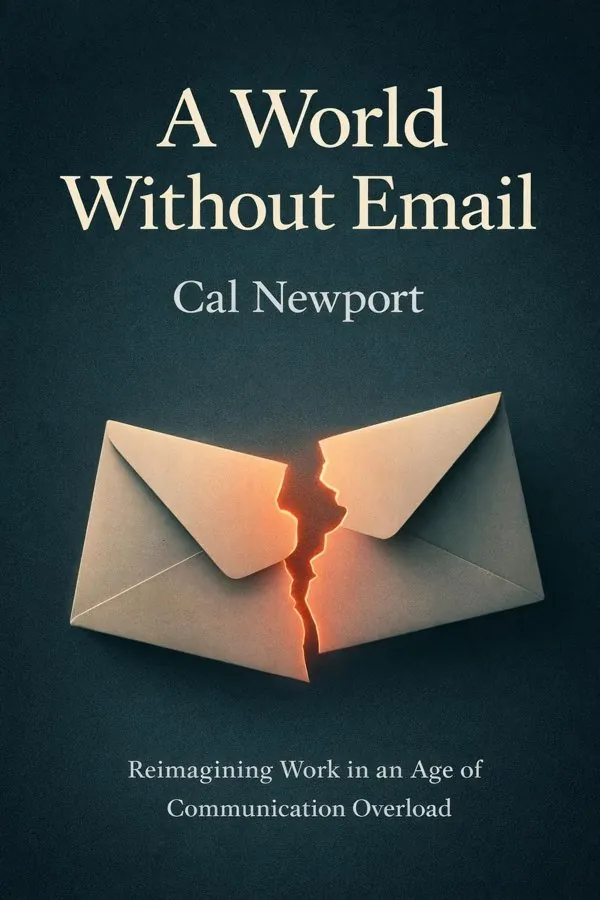
A World Without Email: Reimagining Work in an Age of Communication Overload: Summary & Key Insights
by Cal Newport
 10 min12 chaptersAudio available
What Is A World Without Email: Reimagining Work in an Age of Communication Overload About?
A World Without Email: Reimagining Work in an Age of Communication Overload by Cal Newport is a productivity book spanning 12 pages. In this book, Cal Newport argues that the modern workplace’s dependence on constant email communication has created a culture of distraction and inefficiency. He explores how organizations can adopt more structured workflows and communication systems to reduce cognitive overload, improve productivity, and restore focus to meaningful work.
This FizzRead summary covers all 12 key chapters of A World Without Email: Reimagining Work in an Age of Communication Overload in approximately 10 minutes, distilling the most important ideas, arguments, and takeaways from Cal Newport's work. Also available as an audio summary and Key Quotes Podcast.
A World Without Email: Reimagining Work in an Age of Communication Overload
In this book, Cal Newport argues that the modern workplace’s dependence on constant email communication has created a culture of distraction and inefficiency. He explores how organizations can adopt more structured workflows and communication systems to reduce cognitive overload, improve productivity, and restore focus to meaningful work.
Who Should Read A World Without Email: Reimagining Work in an Age of Communication Overload?
This book is perfect for anyone interested in productivity and looking to gain actionable insights in a short read. Whether you're a student, professional, or lifelong learner, the key ideas from A World Without Email: Reimagining Work in an Age of Communication Overload by Cal Newport will help you think differently.
- ✓Readers who enjoy productivity and want practical takeaways
- ✓Professionals looking to apply new ideas to their work and life
- ✓Anyone who wants the core insights of A World Without Email: Reimagining Work in an Age of Communication Overload in just 10 minutes
Want the full summary?
Get instant access to this book summary and 100K+ more with Fizz Moment.
Get Free SummaryAvailable on App Store • Free to download
Key Chapters
When email first appeared, it was revolutionary. It replaced phone calls and memos with something instantaneous and universal. But the convenience was deceptive. No one consciously decided that email should become the central nervous system of all office communication—it simply evolved that way, because it was easy. The technology advanced faster than our philosophy of work.
In the early computing era, communication was synchronous and scarce. You called or met someone when necessary. The introduction of email, however, blurred all boundaries. Suddenly every question, update, and coordination issue could be handled in seconds. Over time, the frictionless nature of email led to a silent revolution in workflow. Instead of process-based collaboration—where tasks and responsibilities flowed through defined systems—teams began coordinating in an ad hoc manner, relying on constant messages to keep projects moving. This shift was subtle but immense. It replaced clearly defined work boundaries with a chaotic swarm of conversations.
The reason this matters is because the human mind isn’t built for infinite connectivity. Early office designs assumed that communication happened during set times, not perpetually. The inbox introduced a psychological trap—because every small question could be easily asked, people stopped building systems to manage collaboration. They built reaction loops instead. The hyperactive hive mind was born, not through conscious decision, but through technological drift. Understanding this historical drift is the first step in recognizing that our current system wasn’t designed—it simply happened. And what happened can be deliberately redesigned.
Research consistently reveals that frequent context switching—jumping between tasks, conversations, and screens—dramatically reduces cognitive performance. Each email check incurs what psychologists call a 'residue' of attention. Even after you return to your main work, part of your mind lingers on the unfinished conversation you just saw. When multiplied across hundreds of daily interruptions, this residue shatters focus.
The consequences aren’t just productivity losses; they’re emotional. Professionals describe a constant sense of unease, as if they must always be monitoring the digital radar for new demands. Satisfaction with work declines because meaningful accomplishments become rarer. Instead of deep progress, there’s perpetual motion that feels busy but hollow. In organizations operating within a hive mind workflow, the hidden cost is massive—not in wasted time, but in wasted attention.
My own research and observation show that teams tend to believe communication intensity equals effectiveness. In reality, the opposite is true. The more messages exchanged, the more coordination effort goes into managing those messages, creating what economists would call diminishing returns. The emails don’t just consume time; they consume cognitive bandwidth that could have been devoted to innovation and craftsmanship.
Once we acknowledge these costs, it becomes clear that email overload is not a symptom of personal disorganization but of systemic dysfunction. You can’t fix it by checking less often or setting personal boundaries alone. The problem is structural, embedded in how work is coordinated. The way forward requires redesigning the architecture of collaboration itself.
+ 10 more chapters — available in the FizzRead app
All Chapters in A World Without Email: Reimagining Work in an Age of Communication Overload
About the Author
Cal Newport is an American computer science professor and author known for his work on productivity, technology, and the philosophy of work. He has written several bestselling books, including 'Deep Work' and 'Digital Minimalism', and is a professor at Georgetown University.
Get This Summary in Your Preferred Format
Read or listen to the A World Without Email: Reimagining Work in an Age of Communication Overload summary by Cal Newport anytime, anywhere. FizzRead offers multiple formats so you can learn on your terms — all free.
Available formats: App · Audio · PDF · EPUB — All included free with FizzRead
Download A World Without Email: Reimagining Work in an Age of Communication Overload PDF and EPUB Summary
Key Quotes from A World Without Email: Reimagining Work in an Age of Communication Overload
“When email first appeared, it was revolutionary.”
“Research consistently reveals that frequent context switching—jumping between tasks, conversations, and screens—dramatically reduces cognitive performance.”
Frequently Asked Questions about A World Without Email: Reimagining Work in an Age of Communication Overload
A World Without Email: Reimagining Work in an Age of Communication Overload by Cal Newport is a productivity book that explores key ideas across 12 chapters. In this book, Cal Newport argues that the modern workplace’s dependence on constant email communication has created a culture of distraction and inefficiency. He explores how organizations can adopt more structured workflows and communication systems to reduce cognitive overload, improve productivity, and restore focus to meaningful work.
More by Cal Newport

You Might Also Like


Featured In
Browse by Category
Ready to read A World Without Email: Reimagining Work in an Age of Communication Overload?
Get the full summary and 100K+ more books with Fizz Moment.