
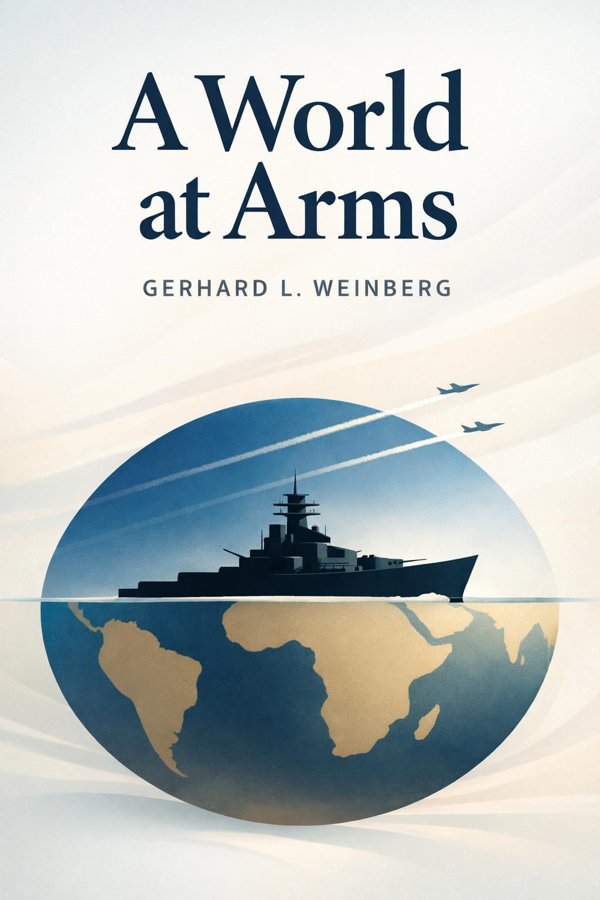
A World at Arms: A Global History of World War II: Summary & Key Insights
 10 min9 chapters
Key Takeaways from A World at Arms: A Global History of World War II
Wars rarely end when the shooting stops; they often continue as bitterness, instability, and revenge.
The road to war was not inevitable, but it was cleared step by step by leaders who mistook restraint for peace.
What began as a war over Poland quickly became a struggle spanning continents because the major powers were tied together by empire, resources, and strategy.
Battlefield courage matters, but wars of this scale are ultimately decided by fuel, steel, shipping, distance, and terrain.
Great wars often turn not at one single moment but through a series of blows that expose the limits of expansion.
What Is A World at Arms: A Global History of World War II About?
A World at Arms: A Global History of World War II by Gerhard L. Weinberg is a world_history book spanning 10 pages. World War II is often told in fragments: Hitler in Europe, Pearl Harbor in the Pacific, the Holocaust, D-Day, Hiroshima. Gerhard L. Weinberg’s A World at Arms brings those fragments together into one sweeping, unified history of a truly global conflict. Rather than treating the war as separate regional struggles, Weinberg shows how events in Europe, Asia, Africa, the Atlantic, and the Pacific continuously shaped one another. Decisions made in Berlin affected Burma; battles in the Soviet Union altered strategy in North Africa; American industrial output transformed every front. What makes this book so valuable is not only its scale but its balance. Weinberg examines grand strategy, diplomacy, ideology, economics, occupation, and civilian life, while giving attention to both major powers and smaller states caught in the storm. The result is a fuller understanding of how the war was fought, why it unfolded as it did, and how it remade the modern world. As one of the most respected historians of World War II, Weinberg writes with authority, clarity, and command of global sources, making this book an essential guide to the conflict’s true scope.
This FizzRead summary covers all 9 key chapters of A World at Arms: A Global History of World War II in approximately 10 minutes, distilling the most important ideas, arguments, and takeaways from Gerhard L. Weinberg's work.
A World at Arms: A Global History of World War II
World War II is often told in fragments: Hitler in Europe, Pearl Harbor in the Pacific, the Holocaust, D-Day, Hiroshima. Gerhard L. Weinberg’s A World at Arms brings those fragments together into one sweeping, unified history of a truly global conflict. Rather than treating the war as separate regional struggles, Weinberg shows how events in Europe, Asia, Africa, the Atlantic, and the Pacific continuously shaped one another. Decisions made in Berlin affected Burma; battles in the Soviet Union altered strategy in North Africa; American industrial output transformed every front.
What makes this book so valuable is not only its scale but its balance. Weinberg examines grand strategy, diplomacy, ideology, economics, occupation, and civilian life, while giving attention to both major powers and smaller states caught in the storm. The result is a fuller understanding of how the war was fought, why it unfolded as it did, and how it remade the modern world. As one of the most respected historians of World War II, Weinberg writes with authority, clarity, and command of global sources, making this book an essential guide to the conflict’s true scope.
Who Should Read A World at Arms: A Global History of World War II?
This book is perfect for anyone interested in world_history and looking to gain actionable insights in a short read. Whether you're a student, professional, or lifelong learner, the key ideas from A World at Arms: A Global History of World War II by Gerhard L. Weinberg will help you think differently.
- ✓Readers who enjoy world_history and want practical takeaways
- ✓Professionals looking to apply new ideas to their work and life
- ✓Anyone who wants the core insights of A World at Arms: A Global History of World War II in just 10 minutes
Want the full summary?
Get instant access to this book summary and 100K+ more with Fizz Moment.
Get Free SummaryAvailable on App Store • Free to download
Key Chapters
Wars rarely end when the shooting stops; they often continue as bitterness, instability, and revenge. Weinberg begins by showing that the roots of World War II lay deep in the unresolved tensions of the interwar years. The First World War did not produce a durable peace. Instead, it left Germany humiliated, Italy resentful, Japan dissatisfied, and many newer states insecure. Economic collapse, weak democratic institutions, and the global shock of the Great Depression made radical solutions seem attractive to millions.
The Treaty of Versailles mattered, but Weinberg does not reduce everything to one agreement. He shows how multiple failures combined: the inability of the League of Nations to enforce order, the reluctance of Britain and France to confront aggression early, and the appeal of ideologies that promised national rebirth through conquest. In Germany, Nazism fused grievance with expansionist ambition. In Japan, military leaders argued that empire was necessary for survival and status. In Italy, fascism pursued prestige through violence and territorial dreams.
A practical lesson emerges here for anyone studying international politics: instability grows when humiliation, economic pain, and weak institutions reinforce one another. Weinberg’s account helps readers understand why authoritarian regimes gained legitimacy by promising action where democracies seemed hesitant. This is useful not only for historians but for anyone trying to make sense of how fragile peace settlements can unravel.
Actionable takeaway: when evaluating any international crisis, look beyond immediate triggers and ask what unresolved grievances, economic pressures, and institutional weaknesses are quietly preparing the ground for future conflict.
The road to war was not inevitable, but it was cleared step by step by leaders who mistook restraint for peace. Weinberg traces how the late 1930s became a period in which bold aggressors repeatedly tested the world and found it hesitant. Japan expanded deeper into China. Mussolini invaded Ethiopia. Hitler remilitarized the Rhineland, absorbed Austria, and dismantled Czechoslovakia before turning on Poland. Each success increased the confidence of revisionist states and weakened the credibility of the international system.
Weinberg’s central point is that diplomacy failed not simply because leaders were naive, but because they faced real constraints: war weariness, domestic division, economic weakness, imperial commitments, and uncertainty about military readiness. Yet the effect of repeated concessions was disastrous. Appeasement did not moderate Hitler’s aims; it persuaded him that his enemies lacked the will to stop him. Similarly, the weakness of collective action in Asia encouraged Japanese militarists to believe that expansion could proceed without decisive outside intervention.
The story has practical relevance beyond this period. It demonstrates how authoritarian states often interpret compromise differently from democracies. A concession offered as a means of avoiding war may be read instead as confirmation that further pressure will work. Weinberg also highlights the danger of analyzing theaters separately. European hesitation and Asian aggression were part of one global pattern: the breakdown of deterrence.
Actionable takeaway: when judging negotiations with expansionist powers, distinguish between compromise that stabilizes relations and concession that rewards coercion, and always assess how the other side is likely to interpret restraint.
What began as a war over Poland quickly became a struggle spanning continents because the major powers were tied together by empire, resources, and strategy. Weinberg shows that World War II cannot be understood as a sequence of isolated campaigns. Germany’s victories in Europe affected Britain’s imperial defenses, Soviet calculations, American policy, and Japanese options. Once France fell and Britain stood alone, the conflict widened in both danger and scale.
The period from 1939 to 1941 revealed the extraordinary speed with which military success could transform political reality. Germany conquered Poland, Norway, the Low Countries, and France with shocking efficiency. Britain survived through air defense, sea power, and national endurance, but it could not defeat Germany alone. Hitler then made the colossal decision to invade the Soviet Union, opening the largest land war in history. Meanwhile, Japan weighed whether to strike north against the Soviet Union or south toward European colonial possessions and American power in the Pacific.
Weinberg’s global framework is especially powerful here. German choices in Europe influenced Japanese calculations in Asia. British survival mattered to Soviet strategy and American planning. Even before Pearl Harbor, the war was becoming structurally global because no major decision could remain local in its effects.
For modern readers, this is a reminder that systems matter as much as events. Supply chains, alliances, geography, ideology, and imperial commitments can rapidly turn a regional war into a global one. The lesson applies to contemporary geopolitical crises as well.
Actionable takeaway: whenever a conflict appears regional, map its alliance ties, economic dependencies, and strategic chokepoints to see how quickly it could widen beyond its original theater.
Battlefield courage matters, but wars of this scale are ultimately decided by fuel, steel, shipping, distance, and terrain. Weinberg repeatedly emphasizes that strategy in World War II was inseparable from geography and resources. Germany sought quick victories partly because it lacked the economic depth to sustain a prolonged global war against an industrial coalition. Japan pursued expansion because it depended on imported oil and raw materials. Britain fought as an island empire sustained by sea lanes. The Soviet Union traded space for survival, then mobilized immense manpower and relocated industry eastward. The United States became the arsenal that turned production into military power.
This perspective helps explain many decisions that otherwise seem ideological or impulsive. Germany’s drive toward the Caucasus had an economic logic tied to oil. Japan’s southern expansion was linked to embargoes and access to resources in Southeast Asia. Control of the Atlantic mattered because Britain had to eat, import, and arm itself. North Africa mattered not only symbolically but because of Mediterranean routes and imperial connections.
Weinberg also shows that logistics often defeated ambition. Long supply lines in the Soviet Union, submarine warfare in the Atlantic, and island warfare in the Pacific all proved that distance can become a weapon. Grand plans collapsed when armies outran fuel, navies lost shipping, or air power could not be sustained.
This idea is broadly useful: in business, politics, or military history, strategy fails when leaders confuse intention with capability. Goals are only meaningful when matched by material support.
Actionable takeaway: when assessing any large undertaking, ask not only what leaders want but what resources, transport systems, and geographic constraints will determine whether those goals are actually achievable.
Great wars often turn not at one single moment but through a series of blows that expose the limits of expansion. Weinberg identifies 1942 to 1943 as the decisive shift in World War II. The Axis powers still appeared formidable, yet their advance had reached its high-water mark. In the Soviet Union, Stalingrad shattered the myth of unstoppable German momentum. In North Africa, Allied victory at El Alamein and subsequent operations reversed Axis gains. In the Pacific, Midway crippled Japanese carrier strength, while Guadalcanal began the long process of strategic rollback.
What makes these turning points so important is that they were not merely military reversals. They changed expectations. Allied governments gained confidence that victory was possible. Occupied peoples saw that Axis power was not permanent. Neutral states recalculated. Meanwhile, Axis leaders faced a new reality: they could still fight fiercely, but they were increasingly reacting rather than shaping events.
Weinberg’s interpretation is especially convincing because he connects these turning points across theaters. Soviet resistance tied down Germany. American industrial growth sustained both European and Pacific offensives. British endurance preserved the base from which Allied operations could expand. No single battle won the war, but together these campaigns ended Axis strategic initiative.
For readers today, the lesson is that systems can absorb success for a while, but once momentum, credibility, and resources shift together, the balance changes rapidly. Turning points are often cumulative before they appear obvious.
Actionable takeaway: in any complex struggle, watch for combined shifts in morale, initiative, and material capacity; when all three begin moving in one direction, a true strategic turning point may be underway.
World War II was fought not only by armies at the front but by entire societies under enormous strain. Weinberg gives sustained attention to the home fronts of all major powers, showing that civilian endurance, state organization, propaganda, labor systems, and industrial output were central to victory or defeat. Governments rationed food, redirected factories, mobilized women into new forms of work, controlled information, and justified sacrifice through ideology and fear.
The war also exposed profound moral differences and contradictions. Allied societies fought for survival and liberation while still wrestling with colonial rule, racial discrimination, and civil liberties restrictions. Axis regimes mobilized populations through repression, militarized education, forced labor, and doctrines of racial hierarchy. Occupied territories became zones of exploitation, resistance, collaboration, and mass suffering. Weinberg does not allow readers to separate military history from civilian experience; bombing campaigns, famine, deportation, and labor coercion were integral to how the war was waged.
This broad lens helps explain why industrial democracies ultimately prevailed. They proved more adaptive in converting economic strength into sustained war production while preserving enough legitimacy to maintain mass participation. The United States and Soviet Union mobilized on staggering scales, though through very different systems. Britain balanced scarcity with organization and morale. Germany and Japan extracted heavily from conquered territories but could not solve the structural weaknesses of their war economies.
The practical insight is clear: resilience is not just about bravery. It depends on institutions, production, public trust, and the ability to sustain sacrifice over time.
Actionable takeaway: when judging the strength of any state or organization under pressure, look beyond frontline performance and examine how effectively its underlying social, economic, and administrative systems can absorb prolonged stress.
Winning a global war required more than defeating enemies; it required persuading allies with different priorities to act together. Weinberg highlights one of the most impressive achievements of the Allied powers: coalition warfare on a massive scale. Britain wanted imperial security and survival. The Soviet Union demanded immediate relief and territorial security. The United States aimed for total defeat of the Axis while balancing both European and Pacific commitments. China sought continued support in a brutal, long-running struggle against Japan. These interests overlapped, but they did not always align smoothly.
The genius of Allied strategy lay not in the absence of disagreement but in the ability to manage it. Weinberg shows how conferences, staff planning, shipping allocations, aid programs, and personal diplomacy created a working coalition despite recurring friction over second fronts, bombing policy, colonial questions, and postwar influence. By contrast, the Axis alliance was shallow and strategically incoherent. Germany, Italy, and Japan coordinated far less effectively and often pursued separate priorities without integrated planning.
This theme gives the book a timeless relevance. Coalitions succeed when they create mechanisms to handle disagreement without collapsing into paralysis. Shared enemies are not enough; allies need institutions, communication, and realistic compromises. Weinberg’s account of Allied coordination shows how large organizations can remain functional even when trust is incomplete and objectives differ.
The lesson applies far beyond war. In diplomacy, business partnerships, and political movements, durable cooperation depends on process as much as principle.
Actionable takeaway: when building or evaluating any alliance, focus on coordination mechanisms, burden sharing, and conflict-resolution channels, because partnerships endure through managed disagreement, not perfect unity.
Empires and dictatorships do not collapse all at once; they break apart through cumulative military defeat, internal exhaustion, and shrinking options. Weinberg’s account of 1944 to 1945 shows how the Axis powers unraveled at different speeds and for different reasons. Germany faced relentless pressure from east and west after the Soviet advance and the Allied invasion of France. Strategic bombing damaged production and infrastructure, even if it did not alone decide the war. Italy had already fractured, revealing the weakness beneath fascist pretensions. Japan, though increasingly isolated and devastated, fought on in expectation of a better bargaining position or a political miracle.
What stands out in Weinberg’s treatment is his resistance to simple narratives. Germany did not lose merely because of Hitler’s blunders, though those mattered enormously. It lost because it had launched a war against enemies with greater aggregate manpower, industrial power, and strategic depth. Japan did not surrender only because of atomic bombs; Soviet entry into the war, naval blockade, urban destruction, and the collapse of imperial prospects all shaped the decision.
This layered explanation is one of the book’s great strengths. It reminds readers that major outcomes are usually produced by converging causes rather than one dramatic event. It also clarifies why Axis resistance intensified even after defeat became likely: ideology, fear, coercion, and the hope of splitting the Allies prolonged the conflict.
Actionable takeaway: when analyzing the fall of any regime or system, avoid single-cause explanations and instead trace how military setbacks, economic exhaustion, internal fragmentation, and failed diplomacy combine to make collapse irreversible.
The end of fighting did not restore the old world; it opened a new and unstable era shaped by victory, devastation, and unfinished justice. Weinberg shows that 1945 was both a conclusion and a beginning. Europe and Asia emerged physically shattered, economically exhausted, and morally scarred. Millions were dead, displaced, imprisoned, or homeless. Occupation regimes, war crimes trials, border changes, and population transfers transformed societies long after the guns fell silent.
One of the book’s most important contributions is its insistence that the war’s aftermath must be understood globally. The defeat of Germany and Japan did more than remove aggressive regimes. It accelerated the decline of European empires, elevated the United States and Soviet Union into superpowers, and set the stage for the Cold War. At the same time, anti-colonial movements gained momentum in Asia, Africa, and the Middle East, often drawing lessons from the wartime weakening of imperial authority. The war also reshaped norms around genocide, international law, economic reconstruction, and the relationship between science and state power.
Weinberg makes clear that the conflict’s consequences were not confined to diplomacy. Memory, trauma, rebuilding, and accountability became defining features of postwar life. Understanding World War II therefore means understanding the world it created: divided, nuclear-armed, decolonizing, and institutionally transformed.
For contemporary readers, this is a powerful reminder that large crises continue to shape politics for generations after formal resolution.
Actionable takeaway: when studying the end of any major conflict, examine not just who won but how borders, institutions, ideas, and human lives were reordered, because the aftermath often matters as much as the war itself.
All Chapters in A World at Arms: A Global History of World War II
About the Author
Gerhard L. Weinberg is a German-born American historian and one of the most respected scholars of World War II and modern European history. Born in Hanover in 1928, he emigrated from Nazi Germany to the United States, an experience that gave his later work unusual moral and historical depth. He went on to build a distinguished academic career, serving as Professor of History at the University of North Carolina at Chapel Hill. Weinberg is especially known for his archival research on Nazi Germany, Adolf Hitler’s foreign policy, and the global conduct of World War II. His books, including A World at Arms, are widely praised for their breadth, precision, and ability to connect military events with diplomacy, ideology, economics, and international politics.
Get This Summary in Your Preferred Format
Read or listen to the A World at Arms: A Global History of World War II summary by Gerhard L. Weinberg anytime, anywhere. FizzRead offers multiple formats so you can learn on your terms — all free.
Available formats: App · Audio · PDF · EPUB — All included free with FizzRead
Download A World at Arms: A Global History of World War II PDF and EPUB Summary
Key Quotes from A World at Arms: A Global History of World War II
“Wars rarely end when the shooting stops; they often continue as bitterness, instability, and revenge.”
“The road to war was not inevitable, but it was cleared step by step by leaders who mistook restraint for peace.”
“What began as a war over Poland quickly became a struggle spanning continents because the major powers were tied together by empire, resources, and strategy.”
“Battlefield courage matters, but wars of this scale are ultimately decided by fuel, steel, shipping, distance, and terrain.”
“Great wars often turn not at one single moment but through a series of blows that expose the limits of expansion.”
Frequently Asked Questions about A World at Arms: A Global History of World War II
A World at Arms: A Global History of World War II by Gerhard L. Weinberg is a world_history book that explores key ideas across 9 chapters. World War II is often told in fragments: Hitler in Europe, Pearl Harbor in the Pacific, the Holocaust, D-Day, Hiroshima. Gerhard L. Weinberg’s A World at Arms brings those fragments together into one sweeping, unified history of a truly global conflict. Rather than treating the war as separate regional struggles, Weinberg shows how events in Europe, Asia, Africa, the Atlantic, and the Pacific continuously shaped one another. Decisions made in Berlin affected Burma; battles in the Soviet Union altered strategy in North Africa; American industrial output transformed every front. What makes this book so valuable is not only its scale but its balance. Weinberg examines grand strategy, diplomacy, ideology, economics, occupation, and civilian life, while giving attention to both major powers and smaller states caught in the storm. The result is a fuller understanding of how the war was fought, why it unfolded as it did, and how it remade the modern world. As one of the most respected historians of World War II, Weinberg writes with authority, clarity, and command of global sources, making this book an essential guide to the conflict’s true scope.
You Might Also Like
The Age of Capital
Eric Hobsbawm
10 min
The Gulag Archipelago
Aleksandr Solzhenitsyn
10 min
Jerusalem: The Biography
Simon Sebag Montefiore
10 min
The Anglo-Saxons
James Campbell
10 min
The Boer War
Thomas Pakenham
10 min
The Industrial Revolutionaries: The Making of the Modern World 1776–1914
Gavin Weightman
10 minFeatured In
Browse by Category
Ready to read A World at Arms: A Global History of World War II?
Get the full summary and 100K+ more books with Fizz Moment.