
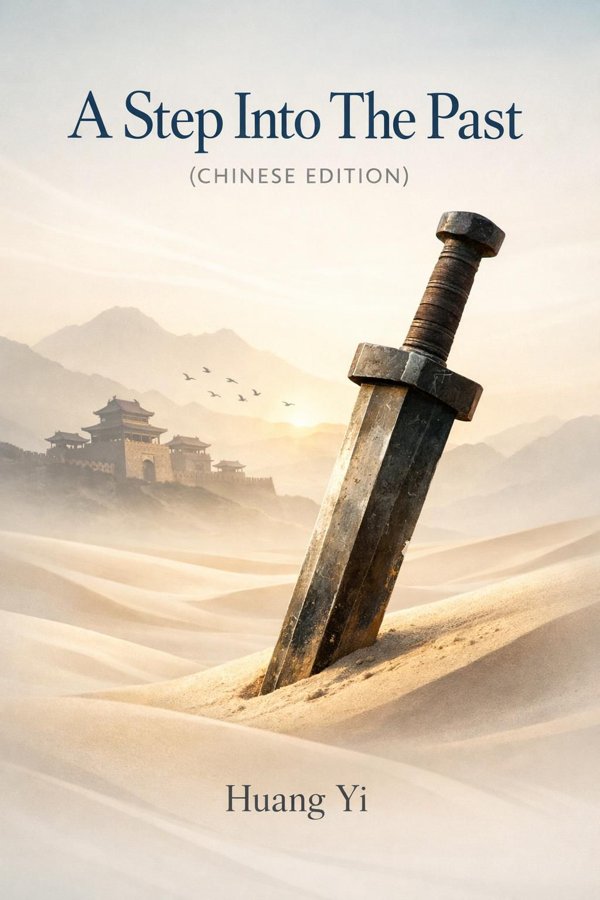
A Step Into The Past (Chinese Edition): Summary & Key Insights
by Huang Yi
 10 min9 chaptersAudio available
Key Takeaways from A Step Into The Past (Chinese Edition)
The fastest way to understand a civilization is to drop an outsider into its center.
In turbulent times, swords may win duels, but politics determines history.
The heart is often where grand historical novels become human.
Knowledge becomes truly interesting when it leaves the classroom and enters a world that resists it.
The most unsettling question in any time-travel story is not whether the past can be visited, but whether it can be changed.
What Is A Step Into The Past (Chinese Edition) About?
A Step Into The Past (Chinese Edition) by Huang Yi is a scifi_fantasy book spanning 5 pages. A Step Into The Past is one of the landmark novels of modern Chinese popular fiction: a thrilling fusion of time travel, historical intrigue, military strategy, romance, and wuxia adventure. First published in 1993, the novel follows Xiang Shaolong, a highly trained modern special forces officer who joins an experimental time-travel mission and is thrown into China’s Warring States period. What begins as a scientific breakthrough becomes a fight for survival as he enters a brutal age of assassination, court politics, shifting alliances, and the historical forces that will eventually produce Qin Shi Huang, the first emperor of a unified China. What makes the book endure is not just its ingenious premise, but its ability to turn history into living drama. Huang Yi uses a modern protagonist to illuminate ancient systems of power, asking whether knowledge can overcome destiny and whether one person can truly alter the course of history. Widely regarded as a pioneering work in the Chinese time-travel genre, the novel helped shape later web fiction and remains essential reading for anyone interested in speculative historical storytelling.
This FizzRead summary covers all 9 key chapters of A Step Into The Past (Chinese Edition) in approximately 10 minutes, distilling the most important ideas, arguments, and takeaways from Huang Yi's work. Also available as an audio summary and Key Quotes Podcast.
A Step Into The Past (Chinese Edition)
A Step Into The Past is one of the landmark novels of modern Chinese popular fiction: a thrilling fusion of time travel, historical intrigue, military strategy, romance, and wuxia adventure. First published in 1993, the novel follows Xiang Shaolong, a highly trained modern special forces officer who joins an experimental time-travel mission and is thrown into China’s Warring States period. What begins as a scientific breakthrough becomes a fight for survival as he enters a brutal age of assassination, court politics, shifting alliances, and the historical forces that will eventually produce Qin Shi Huang, the first emperor of a unified China. What makes the book endure is not just its ingenious premise, but its ability to turn history into living drama. Huang Yi uses a modern protagonist to illuminate ancient systems of power, asking whether knowledge can overcome destiny and whether one person can truly alter the course of history. Widely regarded as a pioneering work in the Chinese time-travel genre, the novel helped shape later web fiction and remains essential reading for anyone interested in speculative historical storytelling.
Who Should Read A Step Into The Past (Chinese Edition)?
This book is perfect for anyone interested in scifi_fantasy and looking to gain actionable insights in a short read. Whether you're a student, professional, or lifelong learner, the key ideas from A Step Into The Past (Chinese Edition) by Huang Yi will help you think differently.
- ✓Readers who enjoy scifi_fantasy and want practical takeaways
- ✓Professionals looking to apply new ideas to their work and life
- ✓Anyone who wants the core insights of A Step Into The Past (Chinese Edition) in just 10 minutes
Want the full summary?
Get instant access to this book summary and 100K+ more with Fizz Moment.
Get Free SummaryAvailable on App Store • Free to download
Key Chapters
The fastest way to understand a civilization is to drop an outsider into its center. That is the engine of A Step Into The Past. Xiang Shaolong begins as a disciplined modern special forces officer, trained to rely on technology, procedures, and rational planning. When a time-travel experiment sends him into the Warring States period, those advantages become both his greatest strengths and his greatest liabilities. He knows more than the people around him in some areas, but he lacks the instincts required to survive in a world structured by clan loyalty, ritual rank, and immediate violence. This tension creates the novel’s central dramatic pleasure: watching modern confidence tested by an ancient reality that refuses to behave like a textbook. Xiang cannot simply dominate the past through superior knowledge. He must adapt his speech, conceal his origins, interpret unfamiliar customs, and learn how power actually functions in a society without modern institutions. In practical terms, this idea mirrors any real-life transition into a new environment. A manager entering a different industry, an immigrant starting over in a new country, or a student moving into a radically different culture all face the same challenge: expertise does not automatically transfer. Context matters. Success depends on humility, observation, and selective adaptation. Xiang survives not because he remains unchanged, but because he combines what he knows with what he learns. The novel therefore turns time travel into a study of resilience. Its deeper message is that capability is never absolute; it is always shaped by setting. Actionable takeaway: when entering unfamiliar territory, treat your strengths as tools, not guarantees, and spend your first energy understanding the rules of the new world.
In turbulent times, swords may win duels, but politics determines history. One of Huang Yi’s greatest achievements is showing that Xiang Shaolong’s true battlefield is not only the open field or the assassin’s ambush, but the court itself. As he becomes entangled with the state of Qin and the people surrounding the future Qin Shi Huang, he discovers that influence is more dangerous than combat. In the Warring States world, a ruler’s favor can save a life or destroy a family, and every alliance carries hidden costs. Ministers maneuver, factions compete, and personal relationships often serve strategic ends. Xiang’s military talents matter, but they are insufficient unless paired with political judgment. He must learn whom to trust, when to reveal information, and how to survive the ambitions of people whose weapons are persuasion, deception, and timing. This is why the novel feels larger than a simple adventure story. It presents statecraft as a high-stakes game in which ideas, appearances, and loyalties are constantly negotiated. Modern readers can apply this insight beyond government. Offices, institutions, startups, and even social communities all contain visible tasks and invisible power structures. A technically excellent employee can fail if they ignore incentives, alliances, and organizational culture. Likewise, a brilliant plan can collapse if introduced without regard for stakeholders. Huang Yi reminds us that systems are human before they are abstract. Understanding motives is often more valuable than winning arguments. Xiang prospers when he sees politics not as corruption alone, but as a reality that must be read and managed. Actionable takeaway: whenever outcomes depend on other people, map the interests, fears, and alliances in the room before assuming skill alone will carry the day.
The heart is often where grand historical novels become human. A Step Into The Past is filled with military schemes and political calculations, yet its emotional power comes from the bonds Xiang Shaolong forms in a world that should have been temporary but becomes deeply personal. Romance in the novel is not decorative. It reveals the cost of survival, the burden of divided loyalties, and the way private feelings can collide with public duty. Xiang is a stranger in time, yet he develops attachments that anchor him to the era. These relationships complicate his mission and challenge his assumptions about identity. If he was only an observer, love makes him a participant. If he believed he could remain detached, loyalty proves otherwise. Huang Yi uses these emotional entanglements to show that history is not made solely by kings and generals. It is also shaped by affection, grief, jealousy, trust, sacrifice, and longing. In practical terms, this idea speaks to anyone balancing ambition with relationships. Careers, missions, and personal goals can tempt us to treat emotion as a distraction, but the novel argues the opposite: what we care about determines the meaning of our choices. Emotional bonds create vulnerability, but they also give courage, direction, and moral weight. Xiang’s decisions matter because people matter to him. This is why the story never becomes a cold exercise in historical manipulation. It remains intimate even at its grandest scale. Readers can take from this a useful reminder: emotional intelligence is not weakness but strategy of a deeper kind. Actionable takeaway: when making major decisions, ask not only what advances your objective, but also what protects the people and values that make the objective worth pursuing.
Knowledge becomes truly interesting when it leaves the classroom and enters a world that resists it. Xiang Shaolong’s modern background gives him advantages that range from military discipline to broader historical awareness, yet Huang Yi does not reduce the novel to fantasy wish-fulfillment. Innovation in A Step Into The Past is powerful, but it is constrained by culture, resources, and credibility. Xiang cannot simply reinvent modern civilization on command. He must translate what he knows into forms that the ancient world can use, accept, and sustain. This makes his ingenuity feel earned. Whether applying tactical insight, improving methods, or anticipating broader historical trends, he succeeds when he adapts knowledge to local conditions rather than imposing it wholesale. That lesson is highly practical. Many people assume that having the better idea is enough. In reality, innovation fails when it ignores implementation. A founder may understand digital systems but fail in a traditional industry if they dismiss custom and trust-building. A teacher may know superior methods but struggle if students are unprepared for them. A consultant may bring world-class frameworks that collapse because the organization lacks the capacity to absorb change. Xiang’s experience demonstrates that the value of knowledge depends on timing, communication, and fit. He does not merely know more; he learns how to make knowledge usable. Huang Yi thereby turns time travel into a meditation on applied intelligence. The modern mind is not magical because it is modern. It is effective only when disciplined enough to work within limits. Actionable takeaway: when introducing a new idea, focus less on proving that it is superior and more on translating it into a form people can understand, trust, and adopt.
The most unsettling question in any time-travel story is not whether the past can be visited, but whether it can be changed. A Step Into The Past constantly tests the boundary between free will and historical inevitability. Xiang Shaolong possesses knowledge of broad outcomes, including the eventual rise of Qin, yet he lives inside events that remain unstable, chaotic, and deeply personal. His interventions matter. He saves lives, influences alliances, and alters immediate circumstances. But the larger current of history keeps pressing forward, as if individual action and structural destiny are locked in permanent tension. Huang Yi uses this tension to create suspense at two levels. On one level, readers wonder what Xiang will do next. On another, they wonder whether those actions can truly redirect the path toward unification and empire. The result is a sophisticated historical imagination. The novel neither says that fate is absolute nor that human will is unlimited. Instead, it suggests that people act within constraints larger than themselves, and greatness often consists in how one moves inside those constraints. This idea has obvious relevance today. Individuals do not control markets, institutions, family histories, or social conditions entirely, but they are not powerless either. A person cannot change every external force, yet they can change their preparation, alliances, timing, and moral choices. Xiang’s struggle reflects the everyday reality of agency under pressure. We rarely choose our historical moment, but we always choose our response to it. Actionable takeaway: stop measuring your power by whether you can control everything; measure it by how effectively you can influence the part of the situation that is actually within your reach.
Facts become memorable when they are felt. One reason A Step Into The Past has lasted is that it does not present the Warring States period as a distant sequence of names and battles. Huang Yi transforms history into an inhabited world full of urgency, texture, danger, and moral ambiguity. Through Xiang Shaolong’s eyes, readers encounter not only famous historical trajectories but also the lived experience of uncertainty before history hardens into certainty. This matters because textbooks often flatten the past. They tell us what happened, but not what it felt like to live before the outcome was known. The novel restores that lost instability. The future first emperor is not yet an icon but a vulnerable figure embedded in risk. States are not neat labels but competing centers of ambition. Customs are not museum pieces but survival codes. This method gives historical fiction its educational force without turning it into a lecture. Readers absorb political structures, strategic pressures, and cultural details because those elements are dramatized through action and consequence. In modern terms, this approach reflects a powerful learning principle: narrative improves understanding. Leaders use case studies rather than abstract theory because stories preserve complexity. Teachers use scenarios because emotion aids memory. Professionals learn from examples because context reveals nuance. Huang Yi demonstrates that storytelling can be a serious mode of historical inquiry. By reanimating the past, he helps readers see that history was once open, contested, and human. Actionable takeaway: when trying to understand a complex subject, do not rely only on summaries of outcomes; immerse yourself in narratives, examples, and lived perspectives that reveal how decisions unfolded in real time.
A man’s identity is most visible when the world strips away his familiar status. Xiang Shaolong enters the past with elite training and modern confidence, but the journey forces him to reexamine what strength actually means. At first glance, he fits the mold of the capable action hero: physically skilled, mentally alert, and able to perform under pressure. Yet Huang Yi complicates that image by placing him in situations where brute competence is insufficient. Honor in the ancient world is tied to reputation, social expectation, and public conduct. Masculinity is not merely about force; it is about reliability, restraint, courage under scrutiny, and the ability to inspire trust among allies. Xiang must therefore reinvent himself. He cannot remain only a soldier. He must become strategist, diplomat, protector, lover, and symbol. This layered identity helps explain the novel’s enduring appeal. It offers a fantasy of competence, but not a simplistic one. Strength here includes adaptation, emotional seriousness, and ethical judgment. That has practical relevance today, especially in cultures that still confuse effectiveness with aggression. In work and life, people are often rewarded not just for direct skill but for steadiness, credibility, and their treatment of others under stress. A leader who wins every argument but loses trust eventually weakens his own position. A talented person who cannot mature beyond self-image remains limited. Xiang’s arc suggests that identity is not inherited from training alone; it is forged through response to responsibility. Actionable takeaway: if you want to become more formidable, do not focus only on appearing strong; build the broader traits that make others willing to follow, rely on, and respect you.
The decisive advantage in dangerous environments is often not superior force but superior perception. Throughout A Step Into The Past, Xiang Shaolong survives because he learns to read people with extraordinary care. In a world of uncertain loyalties, every conversation contains subtext. A gesture may conceal a warning, flattery may hide a test, and generosity may be the opening move of a trap. Huang Yi repeatedly shows that judgment is a survival skill equal to martial prowess. Xiang’s modern training gives him discipline, but his deeper growth comes from understanding personality: who is ruled by vanity, who by fear, who by ambition, who by genuine conviction. This psychological insight allows him to anticipate betrayal, negotiate alliances, and recognize when direct confrontation would be foolish. The lesson extends far beyond fiction. In careers, negotiations, partnerships, and friendships, outcomes often hinge on accurate human reading. People make avoidable mistakes when they listen only to words and ignore incentives, patterns, and emotional signals. A team member who misses political tension can be blindsided. A founder who misreads an investor’s priorities can lose leverage. A person in a relationship who ignores repeated behavior in favor of hopeful interpretation creates future pain. Xiang’s world dramatizes this at life-or-death scale, but the principle is universal: information about systems is useful, yet information about character is decisive. To understand people, one must observe what they do under pressure, what they protect, and what they consistently trade away. Actionable takeaway: in any high-stakes situation, spend as much effort studying motives and behavior patterns as you spend studying the formal rules, because people often determine outcomes more than procedures do.
Innovation in literature often begins by refusing to choose between categories. A Step Into The Past became influential not just because of its plot, but because Huang Yi combined forms that many writers would have kept separate: science fiction, historical epic, political thriller, romance, and wuxia adventure. This fusion allows the novel to satisfy multiple kinds of curiosity at once. The science-fiction premise supplies the central disruption. The historical setting offers grandeur and depth. The wuxia elements provide action and charisma. The political dimension adds strategic intelligence. The romantic strands supply emotional immediacy. Rather than competing, these elements reinforce one another. Time travel makes history vivid; historical stakes make action meaningful; personal relationships humanize strategy. The result is a work that feels expansive without losing momentum. Its broader significance lies in what it did for Chinese popular fiction. The novel helped legitimize the time-travel historical mode that later became enormously influential in web literature and television adaptation culture. It showed that readers welcomed stories capable of crossing boundaries if the emotional and narrative logic remained strong. This has a practical creative lesson. Many people hold back their best ideas because they assume they must fit cleanly into one box: business or art, tradition or innovation, expertise or entertainment. Huang Yi’s example suggests the opposite. Originality often appears when different frameworks are allowed to interact. In professional life, hybrid thinking also creates advantage, as when technology meets design, history meets strategy, or analysis meets storytelling. Actionable takeaway: when developing your own project, do not ask only which category it belongs to; ask what distinct strengths from multiple categories could be combined to make it more memorable and more useful.
All Chapters in A Step Into The Past (Chinese Edition)
About the Author
Huang Yi (1952–2017), born Wong Cho-keung, was a Hong Kong novelist celebrated for reinventing wuxia and historical fiction through bold genre fusion. Trained in the arts and deeply interested in history, philosophy, and speculative ideas, he wrote novels that combined martial arts adventure with political strategy, romance, and science-fiction concepts. His most famous works include A Step Into The Past, Twin Dragons of the Tang Dynasty, and Rain-Covering Clouds. Huang Yi became especially influential for showing that historical settings could support modern narrative experimentation, including time travel and psychological complexity. His fiction reached a wide readership across the Chinese-speaking world and inspired later waves of web novels, television adaptations, and cross-genre storytelling. Today, he is widely regarded as one of the most important figures in the evolution of late 20th-century Chinese popular fiction.
Get This Summary in Your Preferred Format
Read or listen to the A Step Into The Past (Chinese Edition) summary by Huang Yi anytime, anywhere. FizzRead offers multiple formats so you can learn on your terms — all free.
Available formats: App · Audio · PDF · EPUB — All included free with FizzRead
Download A Step Into The Past (Chinese Edition) PDF and EPUB Summary
Key Quotes from A Step Into The Past (Chinese Edition)
“The fastest way to understand a civilization is to drop an outsider into its center.”
“In turbulent times, swords may win duels, but politics determines history.”
“The heart is often where grand historical novels become human.”
“Knowledge becomes truly interesting when it leaves the classroom and enters a world that resists it.”
“The most unsettling question in any time-travel story is not whether the past can be visited, but whether it can be changed.”
Frequently Asked Questions about A Step Into The Past (Chinese Edition)
A Step Into The Past (Chinese Edition) by Huang Yi is a scifi_fantasy book that explores key ideas across 9 chapters. A Step Into The Past is one of the landmark novels of modern Chinese popular fiction: a thrilling fusion of time travel, historical intrigue, military strategy, romance, and wuxia adventure. First published in 1993, the novel follows Xiang Shaolong, a highly trained modern special forces officer who joins an experimental time-travel mission and is thrown into China’s Warring States period. What begins as a scientific breakthrough becomes a fight for survival as he enters a brutal age of assassination, court politics, shifting alliances, and the historical forces that will eventually produce Qin Shi Huang, the first emperor of a unified China. What makes the book endure is not just its ingenious premise, but its ability to turn history into living drama. Huang Yi uses a modern protagonist to illuminate ancient systems of power, asking whether knowledge can overcome destiny and whether one person can truly alter the course of history. Widely regarded as a pioneering work in the Chinese time-travel genre, the novel helped shape later web fiction and remains essential reading for anyone interested in speculative historical storytelling.
More by Huang Yi
You Might Also Like
Red Rising
Pierce Brown
10 min
Stranger in a Strange Land
Robert A. Heinlein
10 min
AI Valley
Chen Qiufan
10 min
Bloodchild
Octavia E. Butler
10 min
Do Androids Dream of Electric Sheep?
Philip K. Dick
10 min
Jujutsu Kaisen, Vol. 24
Gege Akutami
10 minBrowse by Category
Ready to read A Step Into The Past (Chinese Edition)?
Get the full summary and 100K+ more books with Fizz Moment.