
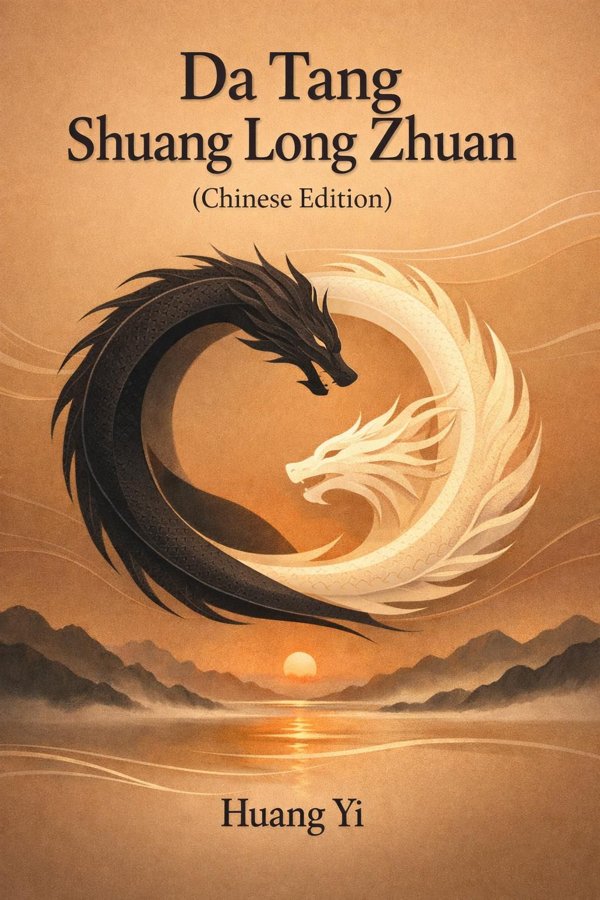
Da Tang Shuang Long Zhuan (Chinese Edition): Summary & Key Insights
by Huang Yi
 10 min8 chaptersAudio available
Key Takeaways from Da Tang Shuang Long Zhuan (Chinese Edition)
Great heroes often begin where society is breaking down.
Power becomes dangerous when it is pursued without self-transformation.
In times of regime change, neutrality becomes its own kind of choice.
The most important battles in the novel are not always fought with weapons.
History is often remembered through dynasties, but lived through relationships.
What Is Da Tang Shuang Long Zhuan (Chinese Edition) About?
Da Tang Shuang Long Zhuan (Chinese Edition) by Huang Yi is a bestsellers book spanning 5 pages. Da Tang Shuang Long Zhuan (The Twin Dragons of the Tang Dynasty) is one of Huang Yi’s most celebrated martial arts epics, a sweeping novel that transforms historical upheaval into a story of friendship, ambition, spiritual growth, and national destiny. Set during the collapse of the Sui dynasty and the rise of the Tang, it follows Kou Zhong and Xu Ziling, two streetwise orphans whose chance encounter with the legendary martial text Changsheng Jue thrusts them into the center of rebellion, politics, sect rivalry, and war. What begins as a survival tale quickly becomes something larger: a meditation on how ordinary people are remade by history. The novel matters because it does more than deliver thrilling duels and grand strategy. Huang Yi blends wuxia action with philosophy, Buddhist and Daoist reflection, and a deep fascination with fate, timing, and human choice. As a major Hong Kong novelist known for reinventing historical fantasy, Huang Yi brought unusual scale and intellectual ambition to modern wuxia. This book remains essential for readers who want a heroic saga that is as thoughtful as it is exciting.
This FizzRead summary covers all 8 key chapters of Da Tang Shuang Long Zhuan (Chinese Edition) in approximately 10 minutes, distilling the most important ideas, arguments, and takeaways from Huang Yi's work. Also available as an audio summary and Key Quotes Podcast.
Da Tang Shuang Long Zhuan (Chinese Edition)
Da Tang Shuang Long Zhuan (The Twin Dragons of the Tang Dynasty) is one of Huang Yi’s most celebrated martial arts epics, a sweeping novel that transforms historical upheaval into a story of friendship, ambition, spiritual growth, and national destiny. Set during the collapse of the Sui dynasty and the rise of the Tang, it follows Kou Zhong and Xu Ziling, two streetwise orphans whose chance encounter with the legendary martial text Changsheng Jue thrusts them into the center of rebellion, politics, sect rivalry, and war. What begins as a survival tale quickly becomes something larger: a meditation on how ordinary people are remade by history. The novel matters because it does more than deliver thrilling duels and grand strategy. Huang Yi blends wuxia action with philosophy, Buddhist and Daoist reflection, and a deep fascination with fate, timing, and human choice. As a major Hong Kong novelist known for reinventing historical fantasy, Huang Yi brought unusual scale and intellectual ambition to modern wuxia. This book remains essential for readers who want a heroic saga that is as thoughtful as it is exciting.
Who Should Read Da Tang Shuang Long Zhuan (Chinese Edition)?
This book is perfect for anyone interested in bestsellers and looking to gain actionable insights in a short read. Whether you're a student, professional, or lifelong learner, the key ideas from Da Tang Shuang Long Zhuan (Chinese Edition) by Huang Yi will help you think differently.
- ✓Readers who enjoy bestsellers and want practical takeaways
- ✓Professionals looking to apply new ideas to their work and life
- ✓Anyone who wants the core insights of Da Tang Shuang Long Zhuan (Chinese Edition) in just 10 minutes
Want the full summary?
Get instant access to this book summary and 100K+ more with Fizz Moment.
Get Free SummaryAvailable on App Store • Free to download
Key Chapters
Great heroes often begin where society is breaking down. Kou Zhong and Xu Ziling enter the story not as noble heirs or chosen prodigies, but as hustling boys from Yangzhou trying to survive in the ruins of late-Sui disorder. That starting point is crucial. Huang Yi uses their poverty and anonymity to show how turbulent eras create both danger and possibility. When institutions weaken, ordinary people are forced to become adaptable, observant, and morally inventive. The twins’ early life teaches them how to read people, bluff their way out of trouble, form alliances, and endure humiliation without losing their will to live.
This rise-from-nothing structure gives the novel emotional force. Their development feels earned because every step upward comes through risk, error, and painful learning. Kou Zhong’s daring and charisma grow from a street survivor’s instinct to seize opportunities. Xu Ziling’s calm intelligence and spiritual depth grow from hardship that teaches him to detach from vanity. Together they represent two ways of responding to chaos: active struggle and inward clarity.
The idea has practical resonance beyond fiction. In unstable environments, privilege matters less than adaptability, loyalty, and emotional resilience. Whether in business, education, or personal crisis, people who begin with little can still gain influence by learning quickly and staying flexible. The novel reminds us that beginnings do not determine endings. Hard conditions can sharpen judgment if they do not destroy hope.
Actionable takeaway: when facing uncertainty, focus less on what you lack and more on the survival strengths you already possess—adaptability, observation, courage, and trusted relationships.
Power becomes dangerous when it is pursued without self-transformation. The discovery of the Changsheng Jue, a legendary martial and spiritual manual, is the turning point that lifts Kou Zhong and Xu Ziling from petty obscurity into a larger destiny. Yet the manual is not merely a magical shortcut. In Huang Yi’s vision, true martial achievement is inseparable from inner awakening. The text challenges its readers not just to learn techniques, but to change how they breathe, sense, and understand the world.
What makes this idea compelling is that the Changsheng Jue cannot be mastered through force alone. It requires intuition, compatibility, patience, and the willingness to abandon rigid thinking. The two heroes each interpret and embody the manual differently, which reflects one of the novel’s key themes: the same source of knowledge can produce different outcomes depending on character. One person turns knowledge into ambition; another turns it into wisdom. Neither path is entirely right or wrong, but each has consequences.
In practical terms, the manual functions like any transformative discipline in real life. A prestigious degree, a powerful methodology, a spiritual tradition, or a technical skill set does not automatically elevate a person. Its value depends on how deeply it is absorbed and whether it reshapes perception. Superficial possession of knowledge creates imitation. Internalized understanding creates originality.
The novel also warns against fetishizing secret formulas. The manual opens the gate, but growth still demands suffering, experimentation, and ethical tests. No text can save someone who refuses to evolve.
Actionable takeaway: treat every powerful tool—education, status, technique, or insight—not as a shortcut to superiority, but as an invitation to become more disciplined, self-aware, and internally aligned.
In times of regime change, neutrality becomes its own kind of choice. As Kou Zhong and Xu Ziling move through the collapsing Sui world, they encounter rebels, warlords, imperial claimants, and sect leaders, all struggling to define the future. Huang Yi does not present power as a simple contest between good and evil. Instead, he portrays politics as a field of competing visions, personal ambitions, regional loyalties, and strategic compromises. This gives the novel unusual depth for wuxia: swordplay matters, but so do legitimacy, timing, and the ability to attract followers.
Kou Zhong is especially drawn into the practical dimensions of power. He understands that charisma without organization is useless, and bravery without strategy leads to waste. Xu Ziling, meanwhile, remains more skeptical of worldly ambition, which allows the novel to examine political involvement from both inside and outside. Their experiences show that history is not shaped only by emperors. Agile outsiders, information networks, and personal alliances can influence the direction of an age.
The broader insight is highly relevant. Modern institutions, companies, and governments also operate through layered power rather than abstract ideals alone. People often imagine that success comes from talent by itself, but Huang Yi suggests that influence requires reading systems, understanding incentives, and knowing when not to fight directly. Some battles are won by force; others by patience, coalition-building, or strategic retreat.
The novel’s political landscape teaches readers to ask sharper questions: Who benefits? Who commands loyalty? Which victories are sustainable? Which principles can survive compromise?
Actionable takeaway: when navigating complex systems, do not focus only on personal strength—study the structure of power, the motives of stakeholders, and the timing of intervention.
The most important battles in the novel are not always fought with weapons. As Kou Zhong and Xu Ziling mature, their paths increasingly diverge, not because their brotherhood breaks, but because their inner priorities differ. Kou Zhong is drawn toward worldly action: achievement, influence, love, and the intoxicating challenge of shaping events. Xu Ziling turns toward a more contemplative path, seeking understanding beyond fame and conquest. Huang Yi uses this divergence to explore one of the novel’s deepest tensions: must a person choose between desire and transcendence, or can both be honored in different ways?
This contrast gives the story psychological richness. Kou Zhong is not condemned for ambition, nor is Xu Ziling portrayed as detached in a simplistic, saintly way. Both men struggle. Ambition can become ego, but it can also become responsibility. Detachment can become wisdom, but it can also risk passivity. Their parallel journeys suggest that human growth is not uniform. Two people can share suffering, loyalty, and opportunity, yet become different kinds of heroes.
In ordinary life, the same tension appears constantly. One person pursues leadership, wealth, or creative impact; another seeks balance, spiritual clarity, or freedom from external recognition. Problems arise when people adopt goals they do not truly believe in. The novel invites readers to examine whether their striving comes from authentic calling or from comparison, fear, and vanity.
By refusing a simplistic answer, Huang Yi honors the complexity of human aspiration. There is dignity in worldly excellence and dignity in inner liberation, provided each is pursued honestly.
Actionable takeaway: define success in your own terms—then examine whether your current pursuits reflect your true values or merely the expectations of others.
History is often remembered through dynasties, but lived through relationships. One of the greatest strengths of Da Tang Shuang Long Zhuan is the way it connects the rise of the Tang dynasty to the intimate bond between Kou Zhong and Xu Ziling. Their brotherhood is not decorative sentiment; it is the emotional axis of the novel. In a world of betrayals, shifting allegiances, and large-scale warfare, their trust gives continuity to the story and moral weight to their decisions.
Huang Yi uses this bond to show that friendship can shape history as much as strategy does. The two heroes repeatedly protect, restrain, and inspire one another. They are not identical thinkers, and that is precisely why the relationship matters. Each serves as a corrective to the other. Kou Zhong’s audacity is grounded by Xu Ziling’s insight. Xu Ziling’s reserve is animated by Kou Zhong’s vitality. Their partnership demonstrates that strong alliances do not require sameness; they require mutual recognition and unwavering loyalty under pressure.
This theme has practical application in any high-stakes environment. Founders, leaders, activists, artists, and families all depend on trusted counterparts who supply what they lack. Success becomes more durable when built on complementary strengths rather than isolated brilliance. The novel also reminds readers that even noble causes can become corrupting if pursued alone. Brotherhood protects against self-deception.
As the Tang order emerges from chaos, the heroes’ relationship mirrors a broader hope: that amidst violence and change, human fidelity can still endure.
Actionable takeaway: identify the people whose strengths balance your weaknesses, and invest deliberately in those relationships before a crisis tests them.
A heroic life is rarely complicated by war alone; it is also shaped by love, longing, admiration, and loss. One reason Da Tang Shuang Long Zhuan feels expansive is that its women are not merely ornaments around male adventure. They often function as catalysts, rivals, moral challenges, emotional mirrors, and political actors. Through romance and interpersonal tension, Huang Yi broadens the novel beyond external conflict and reveals the vulnerabilities of even the strongest characters.
Love in this story is never simple reward. It can deepen a person, distract them, expose hidden motives, or force painful choices between private desire and public duty. Kou Zhong’s emotional life often reflects his energetic, ambitious temperament; he is drawn toward connection with intensity and risk. Xu Ziling’s relationships are filtered through his inward nature, making affection more reflective and spiritually charged. These differences reinforce the novel’s larger theme that character shapes destiny.
Importantly, romantic entanglements in the book often intersect with questions of loyalty, ideology, and political alignment. A personal attachment may carry strategic consequences. A moment of tenderness may reveal a deeper conflict of values. This makes the emotional dimension of the novel feel consequential rather than decorative.
In practical life, relationships also test identity. They reveal whether we seek partnership, validation, escape, or transformation. The novel suggests that maturity in love requires honesty about motives and the courage to accept that not all meaningful bonds can be possessed or sustained.
Actionable takeaway: in important relationships, ask not only what you feel, but what the relationship reveals about your values, blind spots, and readiness for sacrifice.
The finest combat scenes in wuxia are really arguments about reality. Huang Yi treats martial arts not merely as spectacle, but as the physical expression of worldview. Different techniques, schools, and masters embody different assumptions about force, perception, discipline, and the relationship between body and mind. A duel therefore becomes more than a contest of speed or strength; it becomes a clash of philosophies.
This is especially important in a novel shaped by the Changsheng Jue and by the heroes’ differing temperaments. Martial progress is linked to awareness. A fighter who is impatient, ego-driven, or spiritually divided will eventually meet limits that technique alone cannot overcome. Conversely, one who understands rhythm, emptiness, timing, and intention may defeat an apparently stronger opponent. The result is a martial world in which inner condition matters as much as external training.
Readers can apply this idea far beyond combat. Performance in any demanding field—sports, public speaking, leadership, negotiation, creative work—depends on the integration of skill and state of mind. People often overtrain technique while neglecting attention, emotional control, and strategic calm. Huang Yi suggests that mastery emerges when execution and consciousness are unified.
This helps explain why the novel’s fight scenes feel memorable: they reveal character. Every exchange uncovers fear, pride, adaptability, or enlightenment. Combat strips away pose and exposes truth.
Actionable takeaway: whatever your discipline, do not practice mechanics alone—train perception, emotional steadiness, and timing, because technique reaches its highest level only when mind and action become one.
Destiny matters in the novel, but it never fully excuses passivity. One of Huang Yi’s signature strengths is his fascination with timing: why certain people appear at historical turning points, why opportunities emerge when they do, and how seemingly accidental encounters redirect entire lives. Kou Zhong and Xu Ziling repeatedly find themselves at the intersection of chance and necessity. Yet the story does not reduce them to puppets of fate. Events open doors, but choice determines what happens after the threshold is crossed.
This balance between destiny and agency gives the novel philosophical tension. On one hand, the late-Sui chaos creates conditions larger than any individual. On the other, the heroes still bear responsibility for how they respond to danger, temptation, and opportunity. Huang Yi seems to suggest that history presents moments of unusual potential, but only those prepared in spirit and action can recognize and use them.
This insight is deeply practical. In real life, careers, relationships, and breakthroughs often depend on timing we cannot control: market shifts, introductions, crises, cultural change. But timing alone is not enough. Two people may face the same opening; only one acts decisively, learns fast, and persists through uncertainty. Good fortune favors readiness, not wishful thinking.
The novel therefore resists both arrogance and fatalism. We are not absolute authors of our circumstances, yet neither are we powerless. The wise response is to cultivate strength before opportunity arrives and humility once it does.
Actionable takeaway: stop waiting for perfect certainty—prepare consistently, watch for moments of leverage, and act when timing and readiness briefly align.
All Chapters in Da Tang Shuang Long Zhuan (Chinese Edition)
About the Author
Huang Yi (1952–2017), born Wong Cho-keung, was one of Hong Kong’s most influential popular novelists. He became renowned for reimagining wuxia and historical fiction through a distinctive blend of martial arts, political intrigue, philosophy, fantasy, and speculative thought. Rather than treating heroism as simple physical supremacy, Huang Yi explored consciousness, destiny, strategy, and the collision between personal desire and historical change. His major works include A Step into the Past and Da Tang Shuang Long Zhuan, both of which gained wide readership and helped shape modern Chinese genre storytelling across print, television, and online fan culture. His fiction remains admired for its narrative ambition, large historical scope, and willingness to combine entertainment with intellectual depth.
Get This Summary in Your Preferred Format
Read or listen to the Da Tang Shuang Long Zhuan (Chinese Edition) summary by Huang Yi anytime, anywhere. FizzRead offers multiple formats so you can learn on your terms — all free.
Available formats: App · Audio · PDF · EPUB — All included free with FizzRead
Download Da Tang Shuang Long Zhuan (Chinese Edition) PDF and EPUB Summary
Key Quotes from Da Tang Shuang Long Zhuan (Chinese Edition)
“Great heroes often begin where society is breaking down.”
“Power becomes dangerous when it is pursued without self-transformation.”
“In times of regime change, neutrality becomes its own kind of choice.”
“The most important battles in the novel are not always fought with weapons.”
“History is often remembered through dynasties, but lived through relationships.”
Frequently Asked Questions about Da Tang Shuang Long Zhuan (Chinese Edition)
Da Tang Shuang Long Zhuan (Chinese Edition) by Huang Yi is a bestsellers book that explores key ideas across 8 chapters. Da Tang Shuang Long Zhuan (The Twin Dragons of the Tang Dynasty) is one of Huang Yi’s most celebrated martial arts epics, a sweeping novel that transforms historical upheaval into a story of friendship, ambition, spiritual growth, and national destiny. Set during the collapse of the Sui dynasty and the rise of the Tang, it follows Kou Zhong and Xu Ziling, two streetwise orphans whose chance encounter with the legendary martial text Changsheng Jue thrusts them into the center of rebellion, politics, sect rivalry, and war. What begins as a survival tale quickly becomes something larger: a meditation on how ordinary people are remade by history. The novel matters because it does more than deliver thrilling duels and grand strategy. Huang Yi blends wuxia action with philosophy, Buddhist and Daoist reflection, and a deep fascination with fate, timing, and human choice. As a major Hong Kong novelist known for reinventing historical fantasy, Huang Yi brought unusual scale and intellectual ambition to modern wuxia. This book remains essential for readers who want a heroic saga that is as thoughtful as it is exciting.
More by Huang Yi
You Might Also Like
The Godfather
Mario Puzo
10 min
The Handmaid's Tale
Margaret Atwood
10 min
The Hunger Games
Suzanne Collins
10 min
The Nightingale
Kristin Hannah
10 min
The Seven Husbands of Evelyn Hugo
Taylor Jenkins Reid
10 min
Backwater Justice
Fern Michaels
10 minBrowse by Category
Ready to read Da Tang Shuang Long Zhuan (Chinese Edition)?
Get the full summary and 100K+ more books with Fizz Moment.