
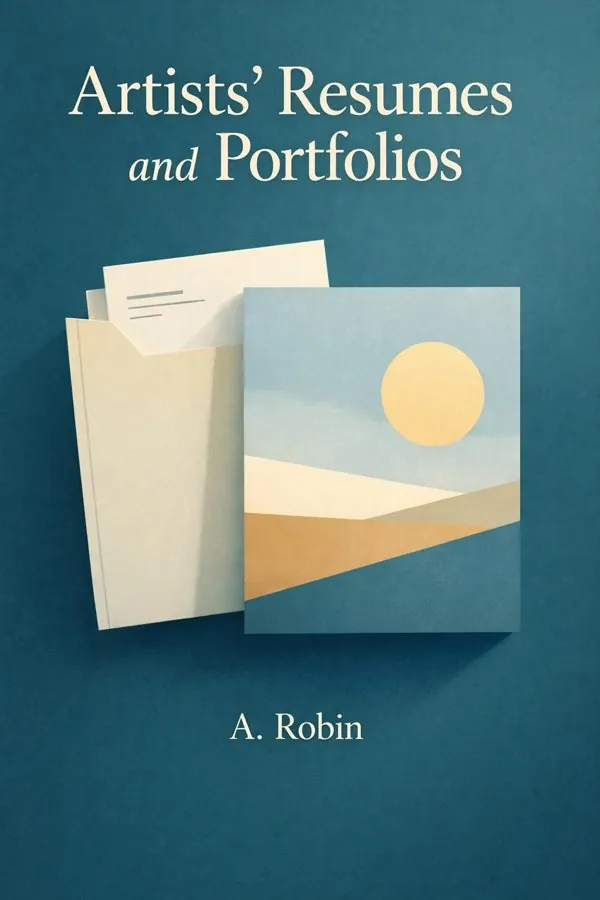
Artists' Resumes and Portfolios: Various Practical Guides: Summary & Key Insights
by A. Robin
 10 min5 chaptersAudio available
What Is Artists' Resumes and Portfolios: Various Practical Guides About?
Artists' Resumes and Portfolios: Various Practical Guides by A. Robin is a education book spanning 5 pages. A comprehensive guide for artists on how to create professional resumes, portfolios, and presentation materials. It provides practical advice on structuring artist statements, documenting artwork, and preparing submissions for galleries, grants, and residencies.
This FizzRead summary covers all 5 key chapters of Artists' Resumes and Portfolios: Various Practical Guides in approximately 10 minutes, distilling the most important ideas, arguments, and takeaways from A. Robin's work. Also available as an audio summary and Key Quotes Podcast.
Artists' Resumes and Portfolios: Various Practical Guides
A comprehensive guide for artists on how to create professional resumes, portfolios, and presentation materials. It provides practical advice on structuring artist statements, documenting artwork, and preparing submissions for galleries, grants, and residencies.
Who Should Read Artists' Resumes and Portfolios: Various Practical Guides?
This book is perfect for anyone interested in education and looking to gain actionable insights in a short read. Whether you're a student, professional, or lifelong learner, the key ideas from Artists' Resumes and Portfolios: Various Practical Guides by A. Robin will help you think differently.
- ✓Readers who enjoy education and want practical takeaways
- ✓Professionals looking to apply new ideas to their work and life
- ✓Anyone who wants the core insights of Artists' Resumes and Portfolios: Various Practical Guides in just 10 minutes
Want the full summary?
Get instant access to this book summary and 100K+ more with Fizz Moment.
Get Free SummaryAvailable on App Store • Free to download
Key Chapters
Every artist must eventually translate their creative path into the language of professional documentation, and that language begins with the resume. In this section, I introduce the different formats — chronological, functional, and combination — that artists can use depending on the story they need to tell. The chronological format works best for those whose careers show steady development, where exhibitions, education, and residencies can be elegantly arranged in order. The functional format, meanwhile, emphasizes skills instead of timelines — a valuable option for emerging artists or those whose creative trajectories have been less linear. The combination format offers flexibility, balancing professional history with artistic abilities.
Writing an artist resume requires sensitivity to both form and content. Every inclusion should serve a purpose. Exhibitions should be categorized thoughtfully — solo shows, group shows, juried events — revealing progression without overwhelming the reader. Awards, commissions, collections, and residencies serve as touchpoints of credibility. But I advocate for restraint; a resume cluttered with every possible accomplishment dilutes its focus. Curators, jurors, and directors read many resumes — brevity and organization communicate professionalism. The document should be both visually pleasing and logically structured, with consistent formatting and typographic clarity.
Underlying all these mechanics is identity. Your resume tells not just where you have been but who you are. When drafting it, think of audience and intent: what facet of your career do you wish to highlight? If you’re applying to a teaching position, your educational background and mentorship experience should take precedence. For a gallery invitation, exhibitions and collections should lead. I encourage artists to update their resumes regularly, not just as clerical maintenance but as an act of reflection — a periodic acknowledgment of how far one’s practice has come and the direction it continues to take.
The artist statement is one of the most dreaded yet most powerful tools in an artist’s professional life. It asks you to move from the visual to the verbal, from intuition to articulation. Many artists resist it, fearing that language cannot adequately hold the essence of visual expression. Yet words, when chosen with sincerity and precision, can become a bridge between your inner world and your audience’s perception. In this section, I help artists discover how to write statements that are engaging, clear, and personal.
An effective statement should communicate your artistic intent — the core ideas, methods, and motivations that drive your work. It is not a manifesto or a rhetorical flourish; it is a conversation in print. When I encourage artists to write, I ask them to speak from within their process: What materials do you use and why? What are you exploring conceptually or emotionally? How does your work connect with broader social, historical, or aesthetic contexts? These are not academic questions but windows into your practice.
I also emphasize tone. Your statement should sound like you, not like an art critic or a grant writer imitating art-speak. Simple, authentic language carries a deeper impact. Readers — whether curators, jurors, or collectors — respond to honesty. They seek insight into how you think, not jargon. Revision is key: write freely, then edit ruthlessly. Read it aloud; share it with peers. A well-honed artist statement clarifies your thinking as much as it informs others. It can transform uncertainty into coherence and give your work a sharper intellectual and emotional focus.
+ 3 more chapters — available in the FizzRead app
All Chapters in Artists' Resumes and Portfolios: Various Practical Guides
About the Author
Get This Summary in Your Preferred Format
Read or listen to the Artists' Resumes and Portfolios: Various Practical Guides summary by A. Robin anytime, anywhere. FizzRead offers multiple formats so you can learn on your terms — all free.
Available formats: App · Audio · PDF · EPUB — All included free with FizzRead
Download Artists' Resumes and Portfolios: Various Practical Guides PDF and EPUB Summary
Key Quotes from Artists' Resumes and Portfolios: Various Practical Guides
“Every artist must eventually translate their creative path into the language of professional documentation, and that language begins with the resume.”
“The artist statement is one of the most dreaded yet most powerful tools in an artist’s professional life.”
Frequently Asked Questions about Artists' Resumes and Portfolios: Various Practical Guides
Artists' Resumes and Portfolios: Various Practical Guides by A. Robin is a education book that explores key ideas across 5 chapters. A comprehensive guide for artists on how to create professional resumes, portfolios, and presentation materials. It provides practical advice on structuring artist statements, documenting artwork, and preparing submissions for galleries, grants, and residencies.
You Might Also Like
Bedtime Biography: Florence Nightingale
Isabel Thomas
10 min
Introduction To Museum Studies
Howard H. Hoyt
10 min
A Mind for Numbers: How to Excel at Math and Science (Even If You Flunked Algebra)
Barbara Oakley
10 min
AI for Educators: Learning Strategies, Teacher Empowerment, and the Future of Education
Matt Miller
10 min
Animation For Beginners
Morr Meroz
10 min
Artificial Intelligence for Learning
Donald Clark
10 minFeatured In
Browse by Category
Ready to read Artists' Resumes and Portfolios: Various Practical Guides?
Get the full summary and 100K+ more books with Fizz Moment.