
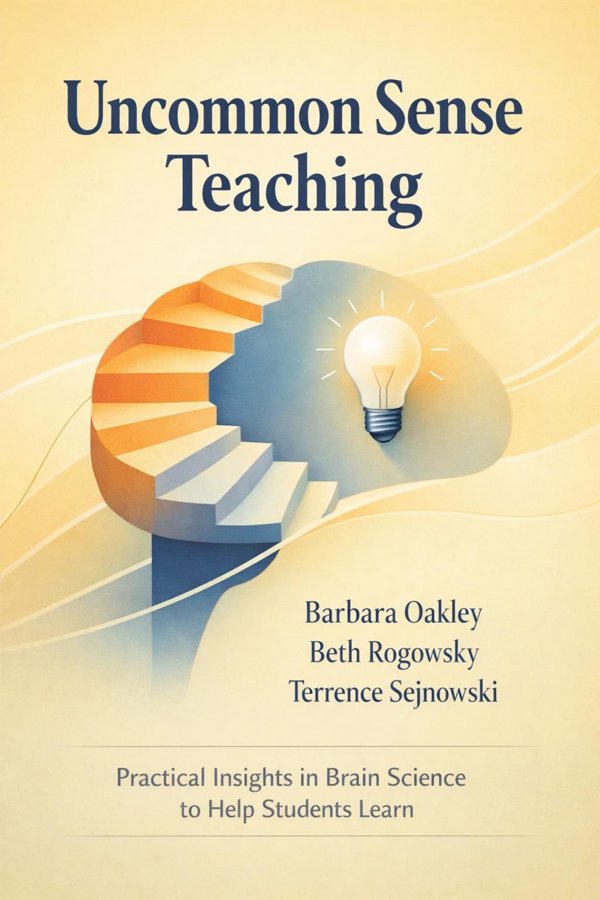
Uncommon Sense Teaching: Practical Insights in Brain Science to Help Students Learn: Summary & Key Insights
by Barbara Oakley, Beth Rogowsky, Terrence Sejnowski
 10 min7 chaptersAudio available
What Is Uncommon Sense Teaching: Practical Insights in Brain Science to Help Students Learn About?
Uncommon Sense Teaching: Practical Insights in Brain Science to Help Students Learn by Barbara Oakley, Beth Rogowsky, Terrence Sejnowski is a education book spanning 7 pages. Uncommon Sense Teaching offers educators practical strategies grounded in neuroscience to improve learning outcomes. The book explains how the brain processes information, why traditional teaching methods often fail, and how to design lessons that align with cognitive science principles. It provides actionable techniques for fostering attention, memory, and motivation in diverse classrooms.
This FizzRead summary covers all 7 key chapters of Uncommon Sense Teaching: Practical Insights in Brain Science to Help Students Learn in approximately 10 minutes, distilling the most important ideas, arguments, and takeaways from Barbara Oakley, Beth Rogowsky, Terrence Sejnowski's work. Also available as an audio summary and Key Quotes Podcast.
Uncommon Sense Teaching: Practical Insights in Brain Science to Help Students Learn
Uncommon Sense Teaching offers educators practical strategies grounded in neuroscience to improve learning outcomes. The book explains how the brain processes information, why traditional teaching methods often fail, and how to design lessons that align with cognitive science principles. It provides actionable techniques for fostering attention, memory, and motivation in diverse classrooms.
Who Should Read Uncommon Sense Teaching: Practical Insights in Brain Science to Help Students Learn?
This book is perfect for anyone interested in education and looking to gain actionable insights in a short read. Whether you're a student, professional, or lifelong learner, the key ideas from Uncommon Sense Teaching: Practical Insights in Brain Science to Help Students Learn by Barbara Oakley, Beth Rogowsky, Terrence Sejnowski will help you think differently.
- ✓Readers who enjoy education and want practical takeaways
- ✓Professionals looking to apply new ideas to their work and life
- ✓Anyone who wants the core insights of Uncommon Sense Teaching: Practical Insights in Brain Science to Help Students Learn in just 10 minutes
Want the full summary?
Get instant access to this book summary and 100K+ more with Fizz Moment.
Get Free SummaryAvailable on App Store • Free to download
Key Chapters
Every learner experiences two complementary modes of thinking: the focused mode and the diffuse mode. The focused mode is deliberate and analytical — like looking through a microscope, zeroing in on a single concept or problem. This is the mode we enter when we solve equations, memorize vocabulary, or concentrate intensely. The diffuse mode, on the other hand, is relaxed, associative, and creative. It’s the mind’s wide-angle lens — the state you slip into when you take a walk, shower, or daydream.
Neuroscience shows that genuine understanding arises when we alternate between these two modes. During focused work, you lay down clear neural traces; during diffuse thinking, you connect those traces in new ways. When students are taught to toggle intentionally between concentration and relaxation — for example, by taking short breaks, spacing study sessions, or engaging in creative reflection — their learning becomes both deeper and more flexible. Teachers often fear idle time, but the brain requires breathing room. It’s during that apparent ‘downtime’ that understanding crystalizes and insight appears.
In the classroom, this means creating rhythms of intensity and release. After explaining a concept, allow students to step back, discuss, doodle, or simply pause. Encourage them to recognize when their minds feel stuck; that’s the cue to switch modes. This oscillation between focus and diffusion transforms frustration into progress, turning difficulty into mastery.
Working memory is remarkably limited. Neuroscientist Terrence Sejnowski often likens it to a mental scratchpad, holding only a few items at once. Without conscious reinforcement, most information written there disappears within seconds. Long-term memory, in contrast, functions like a vast warehouse — but storing something there requires active effort. Two of the most powerful ways to move knowledge from short-term to long-term memory are spaced repetition and retrieval practice.
Spaced repetition takes advantage of the brain’s inclination to forget. By revisiting material at planned intervals, learners strengthen neural connections just as muscles grow through exercise. Retrieval practice complements this by forcing the brain to reconstruct knowledge. Rather than passively reviewing notes, students should test themselves, recite, or teach others. Each act of recall brands the memory trace deeper.
Teachers can design lessons around these principles by reviewing key ideas periodically, encouraging cumulative assignments, and framing assessments as learning opportunities rather than judgment. What’s revolutionary about these neuroscientific insights is their simplicity: remembering is not about repetition alone but about effortful recall spaced over time. The harder you work to retrieve knowledge, the stronger it becomes.
+ 5 more chapters — available in the FizzRead app
All Chapters in Uncommon Sense Teaching: Practical Insights in Brain Science to Help Students Learn
About the Authors
Barbara Oakley is an American educator and engineer known for her work in learning and cognitive science. She is a professor of engineering at Oakland University and co-creator of the popular online course 'Learning How to Learn'. Her research focuses on the neuroscience of learning and innovative teaching methods.
Get This Summary in Your Preferred Format
Read or listen to the Uncommon Sense Teaching: Practical Insights in Brain Science to Help Students Learn summary by Barbara Oakley, Beth Rogowsky, Terrence Sejnowski anytime, anywhere. FizzRead offers multiple formats so you can learn on your terms — all free.
Available formats: App · Audio · PDF · EPUB — All included free with FizzRead
Download Uncommon Sense Teaching: Practical Insights in Brain Science to Help Students Learn PDF and EPUB Summary
Key Quotes from Uncommon Sense Teaching: Practical Insights in Brain Science to Help Students Learn
“Every learner experiences two complementary modes of thinking: the focused mode and the diffuse mode.”
“Neuroscientist Terrence Sejnowski often likens it to a mental scratchpad, holding only a few items at once.”
Frequently Asked Questions about Uncommon Sense Teaching: Practical Insights in Brain Science to Help Students Learn
Uncommon Sense Teaching: Practical Insights in Brain Science to Help Students Learn by Barbara Oakley, Beth Rogowsky, Terrence Sejnowski is a education book that explores key ideas across 7 chapters. Uncommon Sense Teaching offers educators practical strategies grounded in neuroscience to improve learning outcomes. The book explains how the brain processes information, why traditional teaching methods often fail, and how to design lessons that align with cognitive science principles. It provides actionable techniques for fostering attention, memory, and motivation in diverse classrooms.
You Might Also Like

Bedtime Biography: Florence Nightingale
Isabel Thomas
10 min
Introduction To Museum Studies
Howard H. Hoyt
10 min
A Mind for Numbers: How to Excel at Math and Science (Even If You Flunked Algebra)
Barbara Oakley
10 min
AI for Educators: Learning Strategies, Teacher Empowerment, and the Future of Education
Matt Miller
10 min
Animation For Beginners
Morr Meroz
10 min
Artificial Intelligence for Learning
Donald Clark
10 minBrowse by Category
Ready to read Uncommon Sense Teaching: Practical Insights in Brain Science to Help Students Learn?
Get the full summary and 100K+ more books with Fizz Moment.