
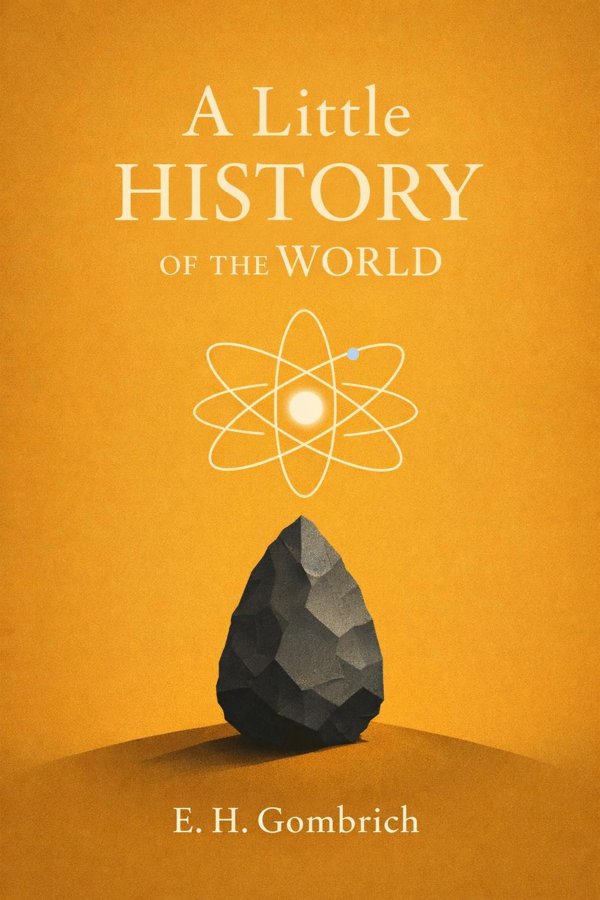
A Little History of the World: Summary & Key Insights
 10 min6 chaptersAudio available
What Is A Little History of the World About?
A Little History of the World by E. H. Gombrich is a world_history book spanning 6 pages. A Little History of the World is a concise and engaging account of human history, written originally in 1935 by Ernst Gombrich. In forty brief chapters, Gombrich narrates the story of humanity from the Stone Age to the atomic age, weaving together major events, cultural developments, and historical figures in a clear and accessible style. The book was translated into English and published by Yale University Press, bringing Gombrich’s vivid storytelling to a new generation of readers.
This FizzRead summary covers all 6 key chapters of A Little History of the World in approximately 10 minutes, distilling the most important ideas, arguments, and takeaways from E. H. Gombrich's work. Also available as an audio summary and Key Quotes Podcast.
A Little History of the World
A Little History of the World is a concise and engaging account of human history, written originally in 1935 by Ernst Gombrich. In forty brief chapters, Gombrich narrates the story of humanity from the Stone Age to the atomic age, weaving together major events, cultural developments, and historical figures in a clear and accessible style. The book was translated into English and published by Yale University Press, bringing Gombrich’s vivid storytelling to a new generation of readers.
Who Should Read A Little History of the World?
This book is perfect for anyone interested in world_history and looking to gain actionable insights in a short read. Whether you're a student, professional, or lifelong learner, the key ideas from A Little History of the World by E. H. Gombrich will help you think differently.
- ✓Readers who enjoy world_history and want practical takeaways
- ✓Professionals looking to apply new ideas to their work and life
- ✓Anyone who wants the core insights of A Little History of the World in just 10 minutes
Want the full summary?
Get instant access to this book summary and 100K+ more with Fizz Moment.
Get Free SummaryAvailable on App Store • Free to download
Key Chapters
When I introduce the Stone Age, I begin not with tools or caves, but with imagination. Picture our distant ancestors, living amid wild animals and dense forests, possessing only their hands, their wits, and an indomitable desire to survive. They chipped flints to make tools, tamed fire to keep away the darkness, and began to live together in groups — the first small communities. What distinguished human beings from other creatures was not strength or speed but curiosity: the urge to know, to test, to improve. Out of that curiosity came the first sparks of progress.
I dwell on the beauty of this stage because it contains the roots of everything that followed. When a child today learns how to light a fire or draw a picture, they are repeating something that has been done for tens of thousands of years. The Stone Age teaches us humility — we owe so much to people whose names we’ll never know. And it reminds us that civilization began not with palaces or kings, but with ordinary men and women learning how to make their world a little safer, a little warmer, a little more human.
From scattered tribes arose the first organized societies. I take my readers to Mesopotamia — the land between the rivers, where farming took root and cities began to grow. For the first time, people built temples, counted harvests, and devised a means to record their transactions: writing. It was an astonishing leap, transforming memory into permanence. Then to Egypt, where the Nile’s rhythm created a stable civilization that honoured order and the afterlife. The grandeur of the pyramids and the delicacy of hieroglyphs both speak of human creativity guided by faith in something enduring.
But every civilization, I remind readers, is a balancing act between order and imagination. Without rules, chaos reigns; without imagination, the human spirit stagnates. Mesopotamia and Egypt, each in their own way, showed the world how to sustain both — through law, art, faith, and story. They were our first teachers in the art of building worlds.
+ 4 more chapters — available in the FizzRead app
All Chapters in A Little History of the World
About the Author
E. H. Gombrich (1909–2001) was an Austrian-born British art historian and author. He is best known for his influential works on art history, including The Story of Art, and for his accessible writings that make complex subjects understandable to general audiences. Gombrich worked for many years at the Warburg Institute in London and was knighted for his contributions to scholarship.
Get This Summary in Your Preferred Format
Read or listen to the A Little History of the World summary by E. H. Gombrich anytime, anywhere. FizzRead offers multiple formats so you can learn on your terms — all free.
Available formats: App · Audio · PDF · EPUB — All included free with FizzRead
Download A Little History of the World PDF and EPUB Summary
Key Quotes from A Little History of the World
“When I introduce the Stone Age, I begin not with tools or caves, but with imagination.”
“From scattered tribes arose the first organized societies.”
Frequently Asked Questions about A Little History of the World
A Little History of the World by E. H. Gombrich is a world_history book that explores key ideas across 6 chapters. A Little History of the World is a concise and engaging account of human history, written originally in 1935 by Ernst Gombrich. In forty brief chapters, Gombrich narrates the story of humanity from the Stone Age to the atomic age, weaving together major events, cultural developments, and historical figures in a clear and accessible style. The book was translated into English and published by Yale University Press, bringing Gombrich’s vivid storytelling to a new generation of readers.
More by E. H. Gombrich
You Might Also Like
The Age of Capital
Eric Hobsbawm
10 min
The Gulag Archipelago
Aleksandr Solzhenitsyn
10 min
Jerusalem: The Biography
Simon Sebag Montefiore
10 min
The Anglo-Saxons
James Campbell
10 min
The Boer War
Thomas Pakenham
10 min
The Industrial Revolutionaries: The Making of the Modern World 1776–1914
Gavin Weightman
10 minFeatured In
Browse by Category
Ready to read A Little History of the World?
Get the full summary and 100K+ more books with Fizz Moment.