
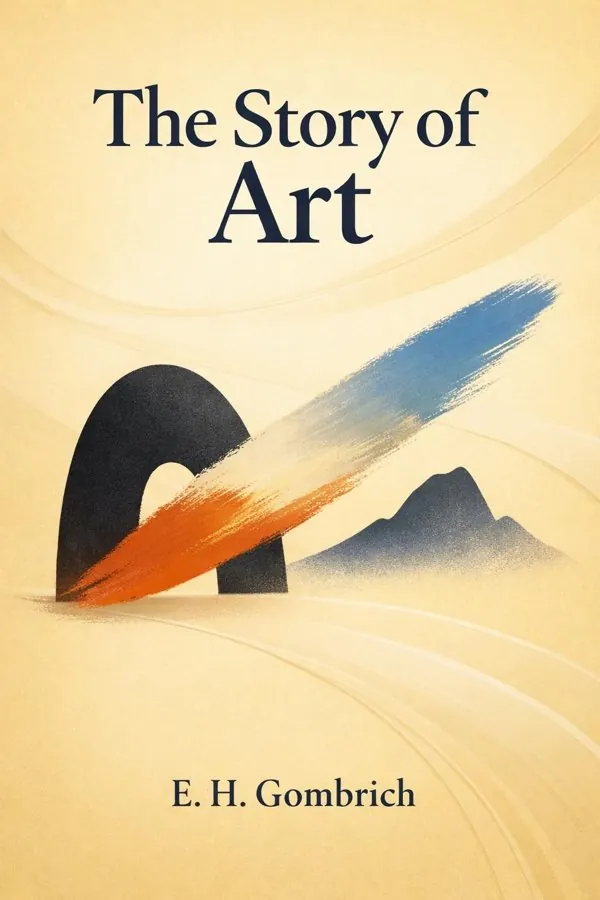
The Story of Art: Summary & Key Insights
 10 min12 chaptersAudio available
What Is The Story of Art About?
The Story of Art by E. H. Gombrich is a art_history book spanning 12 pages. First published in 1950, *The Story of Art* is one of the most famous and enduring introductions to the history of visual art. E. H. Gombrich traces the development of art from prehistoric cave paintings to modern movements, explaining artistic styles, techniques, and cultural contexts in clear and accessible language. The book emphasizes the continuity of artistic tradition and the human impulse to create beauty and meaning through visual expression.
This FizzRead summary covers all 12 key chapters of The Story of Art in approximately 10 minutes, distilling the most important ideas, arguments, and takeaways from E. H. Gombrich's work. Also available as an audio summary and Key Quotes Podcast.
The Story of Art
First published in 1950, *The Story of Art* is one of the most famous and enduring introductions to the history of visual art. E. H. Gombrich traces the development of art from prehistoric cave paintings to modern movements, explaining artistic styles, techniques, and cultural contexts in clear and accessible language. The book emphasizes the continuity of artistic tradition and the human impulse to create beauty and meaning through visual expression.
Who Should Read The Story of Art?
This book is perfect for anyone interested in art_history and looking to gain actionable insights in a short read. Whether you're a student, professional, or lifelong learner, the key ideas from The Story of Art by E. H. Gombrich will help you think differently.
- ✓Readers who enjoy art_history and want practical takeaways
- ✓Professionals looking to apply new ideas to their work and life
- ✓Anyone who wants the core insights of The Story of Art in just 10 minutes
Want the full summary?
Get instant access to this book summary and 100K+ more with Fizz Moment.
Get Free SummaryAvailable on App Store • Free to download
Key Chapters
When I contemplate the first images ever made by human hands—the horses galloping across the walls of Lascaux or the bison shaped in relief from clay—I sense the birth of a peculiar kind of magic. These early artists were not decorating their dwellings for pleasure. Their work was a means of grasping the mysterious forces of life and death, a way to influence the hunt, to render visible what could otherwise only be imagined. In that darkness lit by flickering fire, art was not a luxury but a necessity: a bridge between the human and the divine.
The lines drawn on rock or bone retrieved something from the unseen world. When we look at these forms today, we must resist the temptation to judge them by standards of refinement. To those who made them, precision meant power. The simplest outlines carried meaning; every curve stood for life itself. Here we witness the dawn of symbolism—the discovery that an image might embody belief, hope, or fear. In this lies the root of all later art.
Primitive societies across the globe shared this sense of art as ritual—a means to sustain cosmic balance. Masks, fetishes, and totems were not ornaments but vessels of energy, each shaped by an acute sensitivity to materials. It is this instinctive quality—the sense that art grows from the pulse of life—that we must never lose if we are to understand what came after.
Egypt teaches us a different lesson: here, art became the servant of eternity. The civilization of the Nile was obsessed with permanence, with ensuring that human existence might defy decay. Tomb paintings, statues of pharaohs, monumental temples—all were created within a rigid system of forms designed to preserve order. To us, their repetition may seem monotonous, but it was deliberate: change would have threatened cosmic stability.
Every figure was depicted according to strict conventions. The shoulders facing front, the face in profile, the eyes staring eternally forward—these were not shortcomings in observation but affirmations of ideal form. The Egyptian artist was a craftsman working from canonical rules that expressed the divine hierarchy of the universe. The same principle animated Mesopotamian art, where kings and gods were carved in relief upon stone walls. Again, art served might and faith. Yet within such confines, incredible sensitivity persisted: observe the delicate carving of an Egyptian scribe or the solemn majesty of Assyrian guardians at a palace gate, and you will sense individuality asserting itself within the bounds of order.
Thus, early civilizations showed that art could be the embodiment of social structure. It existed to record, to venerate, to fix the transient within eternal span. In understanding this, we begin to see how later artists, though working under different freedoms, continued to wrestle with the same tension between life’s movement and the longing for permanence.
+ 10 more chapters — available in the FizzRead app
All Chapters in The Story of Art
About the Author
Ernst Hans Josef Gombrich (1909–2001) was an Austrian-born art historian who became one of the most influential figures in the field of art history. After emigrating to Britain in 1936, he worked at the Warburg Institute in London, eventually becoming its director. Gombrich’s writings, including *The Story of Art* and *Art and Illusion*, are celebrated for their clarity, insight, and humanistic approach to understanding art.
Get This Summary in Your Preferred Format
Read or listen to the The Story of Art summary by E. H. Gombrich anytime, anywhere. FizzRead offers multiple formats so you can learn on your terms — all free.
Available formats: App · Audio · PDF · EPUB — All included free with FizzRead
Download The Story of Art PDF and EPUB Summary
Key Quotes from The Story of Art
“When I contemplate the first images ever made by human hands—the horses galloping across the walls of Lascaux or the bison shaped in relief from clay—I sense the birth of a peculiar kind of magic.”
“Egypt teaches us a different lesson: here, art became the servant of eternity.”
Frequently Asked Questions about The Story of Art
The Story of Art by E. H. Gombrich is a art_history book that explores key ideas across 12 chapters. First published in 1950, *The Story of Art* is one of the most famous and enduring introductions to the history of visual art. E. H. Gombrich traces the development of art from prehistoric cave paintings to modern movements, explaining artistic styles, techniques, and cultural contexts in clear and accessible language. The book emphasizes the continuity of artistic tradition and the human impulse to create beauty and meaning through visual expression.
More by E. H. Gombrich
You Might Also Like
Studies In Impressionism
John Rewald
10 min
Art Since 1900: Modernism, Antimodernism, Postmodernism
Hal Foster, Rosalind E. Krauss, Yve-Alain Bois, Benjamin H. D. Buchloh
10 min
Art Since 1940: Strategies of Being
Jonathan Fineberg
10 min
Color and Meaning: Art, Science, and Symbolism
John Gage
10 min
Color: Travels Through the Paintbox
Victoria Finlay
10 min
Curatorial Activism: Towards an Ethics of Curating
Maura Reilly
10 minBrowse by Category
Ready to read The Story of Art?
Get the full summary and 100K+ more books with Fizz Moment.