
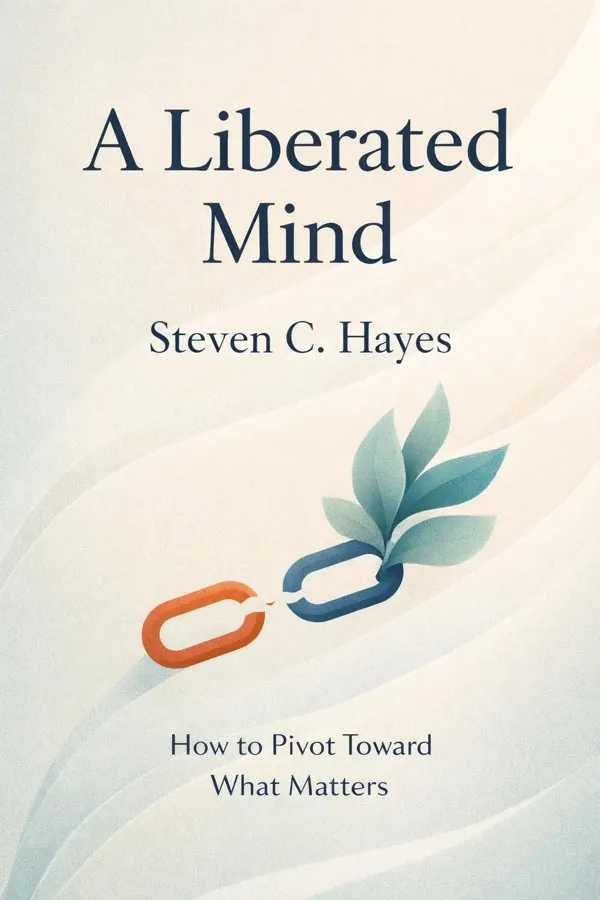
A Liberated Mind: How to Pivot Toward What Matters: Summary & Key Insights
 10 min5 chaptersAudio available
What Is A Liberated Mind: How to Pivot Toward What Matters About?
A Liberated Mind: How to Pivot Toward What Matters by Steven C. Hayes is a mental_health book spanning 5 pages. A Liberated Mind presents Acceptance and Commitment Therapy (ACT), a psychological approach that helps people overcome suffering and live a more meaningful life by embracing thoughts and feelings rather than avoiding them. Steven C. Hayes, the originator of ACT, explains how psychological flexibility can transform mental health, relationships, and personal growth.
This FizzRead summary covers all 5 key chapters of A Liberated Mind: How to Pivot Toward What Matters in approximately 10 minutes, distilling the most important ideas, arguments, and takeaways from Steven C. Hayes's work. Also available as an audio summary and Key Quotes Podcast.
A Liberated Mind: How to Pivot Toward What Matters
A Liberated Mind presents Acceptance and Commitment Therapy (ACT), a psychological approach that helps people overcome suffering and live a more meaningful life by embracing thoughts and feelings rather than avoiding them. Steven C. Hayes, the originator of ACT, explains how psychological flexibility can transform mental health, relationships, and personal growth.
Who Should Read A Liberated Mind: How to Pivot Toward What Matters?
This book is perfect for anyone interested in mental_health and looking to gain actionable insights in a short read. Whether you're a student, professional, or lifelong learner, the key ideas from A Liberated Mind: How to Pivot Toward What Matters by Steven C. Hayes will help you think differently.
- ✓Readers who enjoy mental_health and want practical takeaways
- ✓Professionals looking to apply new ideas to their work and life
- ✓Anyone who wants the core insights of A Liberated Mind: How to Pivot Toward What Matters in just 10 minutes
Want the full summary?
Get instant access to this book summary and 100K+ more with Fizz Moment.
Get Free SummaryAvailable on App Store • Free to download
Key Chapters
Language is one of humanity’s greatest evolutionary achievements, yet it also carries a hidden cost. As I explain in 'A Liberated Mind,' language allows us to plan, remember, and connect; it shapes civilizations and gives rise to culture. But it also binds us to our own thoughts in ways that can generate suffering. Our verbal mind creates evaluative networks—mental stories about who we are, what others think, and what must be avoided to prevent pain.
The problem begins when we take these verbal constructions literally. For instance, when you think ‘I’m not good enough,’ language makes that statement seem like a fact about reality, rather than a momentary mental event. This process, which I call relational frame theory (RFT), underlies much of human cognition. It’s both a gift and a trap. Our ability to relate ideas transforms into the ability to relate pain to self-identity: ‘I feel anxious’ becomes ‘I am anxious,’ and soon our entire sense of self shrinks around the story.
This linguistic fusion creates a vicious cycle. We begin to avoid unpleasant experiences—feelings, memories, situations—that remind us of those verbal evaluations. Over time, avoidance becomes a central strategy for living, yet it undermines the very vitality we seek. The language-based mind is ingenious in creating reasons to justify avoidance. ‘I’ll do that when I feel ready,’ it whispers, but readiness never comes.
Understanding this mechanism is not about condemning language but about seeing through its spell. Language is a tool, not a master. The goal of ACT is to loosen language’s grip so that you can see thoughts as what they are—patterns of sound and meaning rather than absolute truth. Once you can do that, you begin to reclaim the space in which life unfolds—not in the static stories your mind tells, but in the living, breathing reality of now.
Our minds evolved to protect us. The same mental faculties that once allowed our ancestors to remember dangerous places, predict threats, and cooperate socially are the ones that now fabricate continuous streams of self-criticism, worry, and comparison. In 'A Liberated Mind,' I guide you through the paradox of how an organ built for survival can become a source of suffering.
Evolution did not design the mind to make us happy—it designed it to keep us alive. The constant scanning for danger, the ruminative patterns of ‘what if,’ and the endless problem-solving are adaptive in a physical world of predators and scarcity. Yet, in our modern psychological world, those same processes trap us in anxiety and disconnection.
The mind says: ‘If I can just solve this feeling, I’ll be safe.’ But emotions are not problems to be solved. They are experiences to be felt. The more we try to control them, the larger they loom. The evolved mind’s attempt to dominate experience actually amplifies distress. This is the great irony of human consciousness: the mind that can imagine infinite futures also imagines infinite dangers.
In ACT, we learn to work with the evolutionary inheritance of our minds rather than against it. We can’t change that our minds produce thoughts or that pain is part of life, but we can change our relationship to both. Once we acknowledge that language and cognition evolved for utility, not for happiness, we can begin to orient our behavior toward vitality and meaning rather than mere survival. Freedom lies in this pivot—from a survival-based psychology to a values-based life.
+ 3 more chapters — available in the FizzRead app
All Chapters in A Liberated Mind: How to Pivot Toward What Matters
About the Author
Steven C. Hayes is an American psychologist and professor at the University of Nevada, Reno. He is best known as the founder of Acceptance and Commitment Therapy (ACT) and a leading researcher in behavioral psychology and relational frame theory.
Get This Summary in Your Preferred Format
Read or listen to the A Liberated Mind: How to Pivot Toward What Matters summary by Steven C. Hayes anytime, anywhere. FizzRead offers multiple formats so you can learn on your terms — all free.
Available formats: App · Audio · PDF · EPUB — All included free with FizzRead
Download A Liberated Mind: How to Pivot Toward What Matters PDF and EPUB Summary
Key Quotes from A Liberated Mind: How to Pivot Toward What Matters
“Language is one of humanity’s greatest evolutionary achievements, yet it also carries a hidden cost.”
Frequently Asked Questions about A Liberated Mind: How to Pivot Toward What Matters
A Liberated Mind: How to Pivot Toward What Matters by Steven C. Hayes is a mental_health book that explores key ideas across 5 chapters. A Liberated Mind presents Acceptance and Commitment Therapy (ACT), a psychological approach that helps people overcome suffering and live a more meaningful life by embracing thoughts and feelings rather than avoiding them. Steven C. Hayes, the originator of ACT, explains how psychological flexibility can transform mental health, relationships, and personal growth.
More by Steven C. Hayes
You Might Also Like

Big Feelings: How to Be Okay When Things Are Not Okay
Liz Fosslien, Mollie West Duffy
10 min
Creative Arts Therapies Handbook: Art, Music and Dance Therapy Practices for Wellbeing
Susan I. Buchalter
10 min
Emotional First Aid: Healing Rejection, Guilt, Failure, and Other Everyday Hurts
Guy Winch
10 min
Lost Connections: Why You're Depressed and How to Find Hope
Johann Hari
10 min
No Time to Panic: How to Stop Worrying and Embrace Life
Matt Gutman
10 min
Overcoming Mobbing: A Recovery Guide for Workplace Aggression and Bullying
Maureen Duffy, Len Sperry
10 minFeatured In
Browse by Category
Ready to read A Liberated Mind: How to Pivot Toward What Matters?
Get the full summary and 100K+ more books with Fizz Moment.