
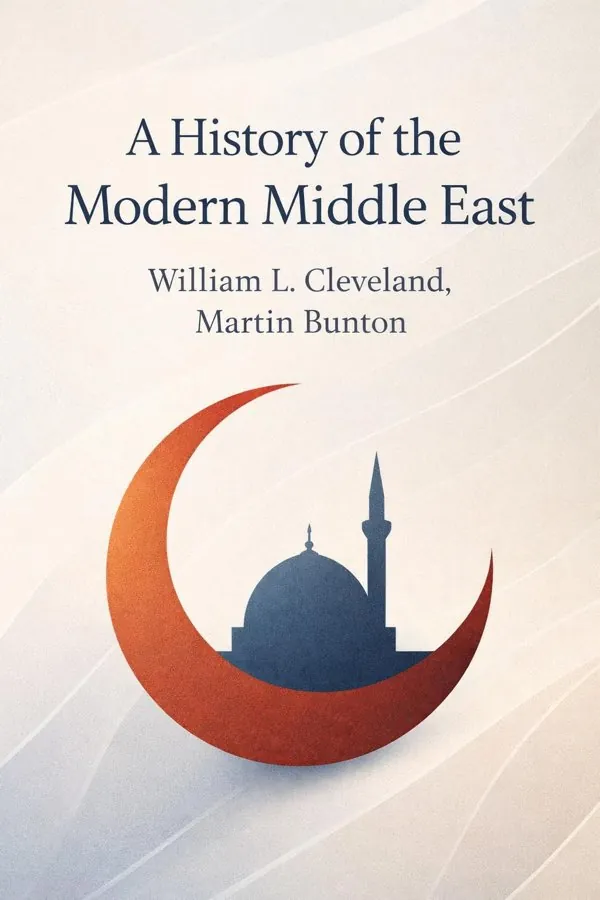
A History of the Modern Middle East: Summary & Key Insights
by William L. Cleveland, Martin Bunton
 10 min10 chaptersAudio available
Key Takeaways from A History of the Modern Middle East
A powerful way to understand the nineteenth-century Ottoman Empire is to stop thinking of it as a dying empire passively awaiting collapse.
Imperialism rarely begins with conquest alone; it often arrives through debt, trade, advisers, and strategic dependency.
Nations are not timeless inheritances; they are often forged in moments of imperial crisis.
Many modern Middle Eastern states were born not from fully sovereign national self-determination, but from an uneasy compromise between local aspirations and imperial design.
Independence did not settle the question of what Middle Eastern states should become; it made that question unavoidable.
What Is A History of the Modern Middle East About?
A History of the Modern Middle East by William L. Cleveland, Martin Bunton is a world_history book spanning 7 pages. Few regions are discussed as often and understood as poorly as the modern Middle East. In A History of the Modern Middle East, William L. Cleveland and Martin Bunton provide a sweeping, carefully balanced account of how the region moved from imperial rule to modern statehood, from reform movements to revolutions, and from colonial domination to contemporary geopolitical struggles. Rather than reducing Middle Eastern history to endless conflict, the book shows a dynamic world shaped by institutions, ideas, social change, economic pressures, and international power politics. The book matters because it explains how present-day crises emerged from long historical processes: the decline and reform of the Ottoman Empire, European imperial expansion, the rise of nationalism, the creation of new borders, the Arab-Israeli conflict, oil politics, authoritarian rule, and popular movements for change. Cleveland, a leading historian of Arab nationalism and modern Middle Eastern history, built the text into a standard academic reference, and Bunton updated it with clarity and scholarly rigor for newer generations of readers. The result is an accessible yet authoritative guide for anyone who wants to understand how the modern Middle East was made—and why its history continues to shape global affairs.
This FizzRead summary covers all 10 key chapters of A History of the Modern Middle East in approximately 10 minutes, distilling the most important ideas, arguments, and takeaways from William L. Cleveland, Martin Bunton's work. Also available as an audio summary and Key Quotes Podcast.
A History of the Modern Middle East
Few regions are discussed as often and understood as poorly as the modern Middle East. In A History of the Modern Middle East, William L. Cleveland and Martin Bunton provide a sweeping, carefully balanced account of how the region moved from imperial rule to modern statehood, from reform movements to revolutions, and from colonial domination to contemporary geopolitical struggles. Rather than reducing Middle Eastern history to endless conflict, the book shows a dynamic world shaped by institutions, ideas, social change, economic pressures, and international power politics.
The book matters because it explains how present-day crises emerged from long historical processes: the decline and reform of the Ottoman Empire, European imperial expansion, the rise of nationalism, the creation of new borders, the Arab-Israeli conflict, oil politics, authoritarian rule, and popular movements for change. Cleveland, a leading historian of Arab nationalism and modern Middle Eastern history, built the text into a standard academic reference, and Bunton updated it with clarity and scholarly rigor for newer generations of readers. The result is an accessible yet authoritative guide for anyone who wants to understand how the modern Middle East was made—and why its history continues to shape global affairs.
Who Should Read A History of the Modern Middle East?
This book is perfect for anyone interested in world_history and looking to gain actionable insights in a short read. Whether you're a student, professional, or lifelong learner, the key ideas from A History of the Modern Middle East by William L. Cleveland, Martin Bunton will help you think differently.
- ✓Readers who enjoy world_history and want practical takeaways
- ✓Professionals looking to apply new ideas to their work and life
- ✓Anyone who wants the core insights of A History of the Modern Middle East in just 10 minutes
Want the full summary?
Get instant access to this book summary and 100K+ more with Fizz Moment.
Get Free SummaryAvailable on App Store • Free to download
Key Chapters
A powerful way to understand the nineteenth-century Ottoman Empire is to stop thinking of it as a dying empire passively awaiting collapse. Cleveland and Bunton show that it was, instead, a state engaged in intense experimentation to preserve itself in a rapidly changing world. The Tanzimat reforms of 1839–1876 were not cosmetic gestures. They were efforts to centralize authority, modernize administration, improve tax collection, reorganize the military, and redefine relations between the state and its subjects.
These reforms emerged because Ottoman leaders recognized a hard truth: European military and economic power had dramatically outpaced them. To compete, the empire needed stronger institutions. New schools trained bureaucrats and officers. Legal codes were revised. Provincial governors faced greater scrutiny from Istanbul. The state also tried to create a shared Ottoman citizenship that could transcend ethnic and religious divisions.
Yet reform created new tensions. Greater centralization often weakened local notables and tribal authorities who had long exercised power in the provinces. Expanding bureaucracy and conscription drew ordinary people more directly into state structures, sometimes provoking resistance. Moreover, reform ideas raised expectations among Arab, Balkan, Armenian, and other communities about rights, representation, and equality.
A practical example is Egypt under Muhammad Ali and his successors, where state-led modernization showed both the promise and the cost of top-down reform. Ambitious military and economic policies expanded state power, but they also increased burdens on the population and deepened dependence on European capital.
The broader lesson is that modernization is never neutral. Administrative reform, legal change, and institutional strengthening can preserve a state, but they can also unsettle social contracts and awaken new political demands. Actionable takeaway: when examining any modern state reform project, ask not only what problems it solves, but also whose authority it strengthens, whose interests it threatens, and what new expectations it creates.
Imperialism rarely begins with conquest alone; it often arrives through debt, trade, advisers, and strategic dependency. Cleveland and Bunton emphasize that by the late nineteenth century, European powers had become deeply embedded in Middle Eastern affairs, often before formal colonial rule was established. Their influence transformed political institutions, economic priorities, and the very boundaries of future states.
Egypt is one of the clearest examples. The Khedive’s push for modernization, including major infrastructure projects such as the Suez Canal, relied heavily on foreign borrowing. Mounting debt opened the door to European financial supervision, and Britain’s occupation of Egypt in 1882 turned indirect leverage into direct domination. What looked like fiscal management became political control.
Elsewhere, French power in North Africa, British influence in the Gulf, and European commercial privileges in Ottoman territories all reflected the same pattern: local rulers and reformers operated in an international system rigged in favor of industrializing European states. Imperialism did not simply exploit resources; it reordered legal systems, transportation networks, education, and trade to serve outside interests.
At the same time, European intervention unintentionally stimulated new forms of political consciousness. Local elites, journalists, officers, and intellectuals began debating sovereignty, constitutionalism, and national identity in response to imperial encroachment. Anti-colonial politics did not emerge in isolation; it developed in direct conversation with the structures of empire.
This idea has practical relevance beyond history. External influence today still often works through finance, security partnerships, and infrastructure control rather than outright annexation. The Middle Eastern experience reminds us that economic dependence can shape political outcomes just as decisively as military occupation.
Actionable takeaway: when analyzing foreign involvement in any region, look beyond armies and treaties. Follow debt, infrastructure, trade routes, and legal privileges to see how power actually operates.
Nations are not timeless inheritances; they are often forged in moments of imperial crisis. One of the book’s core insights is that nationalism in the Middle East did not simply appear as an inevitable expression of ancient identity. It grew through schools, newspapers, military service, reformist debates, and the political pressures created by imperial decline.
In the late Ottoman period, multiple forms of belonging coexisted. People could identify with their city, tribe, religion, dynasty, empire, or language community. Ottomanism sought to unite these groups under a common political identity, but as the empire weakened, other alternatives gained strength. Arab intellectuals discussed cultural revival and administrative autonomy. Turkish nationalism hardened in response to territorial losses and foreign threats. Armenian and Balkan national movements advanced their own claims, often amid violence and repression.
World War I accelerated everything. The Ottoman Empire’s alliance with Germany, the Arab Revolt, and wartime devastation shattered old loyalties. After 1918, the empire’s dissolution created a vacuum in which nationalist claims became central to legitimacy. But these nationalisms were not uniform. Some were civic, some ethnic, some linguistic, and many were shaped by elite interests and colonial manipulation.
A practical example is the postwar Arab world, where leaders invoked Arab unity while also building distinct territorial states such as Iraq, Syria, Transjordan, and later others. National identity had to be taught through flags, schools, public ceremonies, and official histories. It was built, not merely inherited.
This matters because modern conflicts often involve competing national narratives that were consolidated in this era. Understanding their origins makes them less mysterious and more historically grounded.
Actionable takeaway: whenever nationalism appears self-evident, ask how it was produced—through institutions, education, war, language policy, and state power—not just how it is emotionally expressed.
Many modern Middle Eastern states were born not from fully sovereign national self-determination, but from an uneasy compromise between local aspirations and imperial design. Cleveland and Bunton show that the interwar mandate system, established after World War I, was presented as a civilizing and transitional arrangement. In practice, it extended British and French control while drawing borders and building institutions that often carried deep contradictions.
Britain administered Iraq, Transjordan, and Palestine; France controlled Syria and Lebanon. Mandatory authorities created bureaucracies, security forces, and political frameworks, but they did so while managing local elites, protecting imperial interests, and suppressing dissent. This meant state structures often developed before a shared national compact was secure.
Iraq illustrates the problem well. The British installed Faisal as king and assembled a state from former Ottoman provinces with different social compositions and political experiences. Sunni Arab elites often dominated administration, while Shi'a communities, Kurds, tribes, and urban groups had uneven relationships to the new order. In Syria, French divide-and-rule policies deepened fragmentation even as anti-colonial nationalism intensified. In Palestine, Britain’s contradictory commitments to Arab inhabitants and the Zionist movement planted the seeds of prolonged conflict.
The mandate period also normalized a political pattern that would echo across the region: strong central states with limited legitimacy, dependent security institutions, and constitutions constrained by external interests. While independence eventually came, many inherited institutions were not designed for broad participation.
For readers today, this helps explain why borders, constitutions, and state legitimacy remain contested in several Middle Eastern countries. Historical state formation matters long after flags are raised.
Actionable takeaway: to understand current instability, examine how a state was originally constructed—who designed its institutions, whose interests were prioritized, and which communities were left uncertain about their place within it.
Independence did not settle the question of what Middle Eastern states should become; it made that question unavoidable. Cleveland and Bunton show that the decades after World War II were defined by rival ideologies competing to shape the postcolonial future. Liberal constitutionalism, monarchy, Arab nationalism, socialism, military rule, and political Islam all claimed to offer the most authentic path to dignity, development, and sovereignty.
The appeal of Arab nationalism was especially powerful. Leaders such as Gamal Abdel Nasser framed political unity, anti-imperialism, and social reform as inseparable. The 1952 Egyptian revolution and the nationalization of the Suez Canal in 1956 turned Egypt into a symbol of postcolonial defiance. Across the Arab world, military officers and modernizing elites challenged old landholding classes and monarchies, promising social justice and national renewal.
Yet these projects produced mixed outcomes. Land reform, expanded education, and industrial planning transformed societies, but centralized states often narrowed political participation. Pan-Arab hopes, dramatized by the short-lived United Arab Republic between Egypt and Syria, struggled against local interests and state sovereignty. Meanwhile, conservative monarchies survived by adapting through patronage, external alliances, and selective reform.
The postwar era also saw decolonization in North Africa and the Gulf, where local conditions shaped distinct trajectories. Algeria’s brutal war of independence, for example, produced a different political culture from the negotiated transitions seen elsewhere.
The broader lesson is that ending foreign rule does not end political struggle. It often intensifies debates over identity, development, legitimacy, and the role of religion and the military.
Actionable takeaway: when studying postcolonial politics, separate the achievement of independence from the harder task of building inclusive institutions. Liberation movements win states; they do not automatically create stable political communities.
Some conflicts do more than divide adversaries; they reshape the political life of entire regions. Cleveland and Bunton treat the Arab-Israeli conflict as one of the central organizing forces of modern Middle Eastern history. Its roots lie in late Ottoman Palestine, the rise of Zionism, British imperial policy, and competing national movements, but its consequences extended far beyond Palestine itself.
The 1948 war was a transformative rupture. The creation of Israel and the displacement of hundreds of thousands of Palestinians produced not only a refugee crisis, but a lasting reconfiguration of regional politics. Arab regimes faced public anger and legitimacy crises. Palestinian dispossession became a defining issue in Arab political discourse. Border tensions, military spending, and ideological polarization intensified.
Subsequent wars deepened the pattern. The 1967 war was especially consequential: Israel captured the West Bank, Gaza Strip, Sinai Peninsula, and Golan Heights, altering the territorial map and crushing many assumptions about Arab military power. The defeat weakened Nasserism, strengthened Palestinian guerrilla movements, and accelerated political reassessments across the Arab world. The 1973 war, though militarily mixed, restored some Arab confidence and opened the way for diplomacy, culminating in the Egypt-Israel peace treaty.
The conflict also influenced domestic politics. Governments used the Palestine issue to build legitimacy, justify repression, or align with superpowers. Meanwhile, Palestinian political identity sharpened through exile, occupation, and resistance.
A practical application of this chapter is understanding why the conflict cannot be viewed only as a bilateral dispute. It has affected state formation, ideology, alliance systems, and public opinion across the region for generations.
Actionable takeaway: when assessing the Arab-Israeli conflict, examine its wider regional effects—on regime legitimacy, refugee politics, international alliances, and popular identity—not just battlefield outcomes or negotiation rounds.
Natural resources can enrich a state while distorting its politics. One of the book’s most important contributions is showing how oil transformed the modern Middle East economically, strategically, and institutionally. Oil revenues elevated certain states to global importance, financed ambitious modernization projects, and invited deep foreign involvement. But they also encouraged unequal development, external dependency, and political systems less accountable to citizens.
The Gulf monarchies provide the clearest examples. As oil income surged in the twentieth century, governments invested in infrastructure, healthcare, education, and urban development on a remarkable scale. States such as Saudi Arabia, Kuwait, the United Arab Emirates, and Qatar built modern economies and expanded their international influence. At the same time, ruling systems often relied on rentier dynamics: governments distributed benefits through salaries, subsidies, and patronage rather than taxation, reducing pressure for representative politics.
Oil also changed regional diplomacy. Major powers treated the Middle East not only as a strategic crossroads but as an energy heartland. This intensified military alliances, interventions, and competition for influence. The oil embargo of 1973 demonstrated how resource leverage could be used politically, while later price fluctuations revealed how vulnerable state budgets could become.
Importantly, oil wealth did not affect all countries equally. Resource-poor states such as Egypt, Jordan, Syria, Lebanon, and Yemen had to navigate migration, remittances, aid, and regional labor flows shaped by oil-rich neighbors. Thus oil reordered the entire regional system, not just the fortunes of producers.
The practical lesson is familiar in many contexts: windfall wealth can strengthen state capacity without necessarily broadening political participation or creating diversified economies.
Actionable takeaway: when evaluating resource-rich states, ask how revenues are converted into institutions. Wealth alone is not stability; durable development depends on diversification, accountability, and social inclusion.
Political Islam is often misrepresented as a rejection of modernity, but Cleveland and Bunton show that Islamic movements emerged from distinctly modern experiences: colonial rule, rapid urbanization, social dislocation, mass education, state failure, and ideological competition. They were not relics of the past; they were responses to the disappointments of the modern age.
Movements such as the Muslim Brotherhood in Egypt arose in societies where Western influence was visible, traditional institutions were under pressure, and nationalist elites seemed unable to deliver justice or authenticity. Islamist thinkers argued that moral renewal and political reform were inseparable. Their message appealed across classes because it connected ethical language with social services, anti-corruption themes, and grassroots organization.
Over time, Islamic activism diversified. Some groups worked within legal political systems, ran charities, and participated in elections. Others embraced revolutionary or militant strategies, especially after episodes of repression, foreign occupation, or ideological breakdown. The Iranian Revolution of 1979 marked a major turning point by demonstrating that an Islamic political movement could overthrow a monarchy and establish a new governing model. Elsewhere, the Afghan jihad, Algerian civil conflict, and later transnational jihadist movements revealed darker trajectories.
The key point is that political Islam cannot be treated as one thing. It includes reformists, conservatives, revolutionaries, parliamentarians, welfare networks, and violent extremists. Historical context determines which forms gain momentum.
This chapter helps readers avoid simplistic binaries between secular modernity and religious politics. In the Middle East, religion has remained a living language of legitimacy, justice, and social critique.
Actionable takeaway: when assessing Islamic movements, distinguish carefully among their goals, methods, social bases, and historical contexts. Treat them as political actors shaped by modern conditions, not as timeless expressions of faith alone.
Current Middle Eastern turmoil can feel overwhelming when viewed as a stream of disconnected emergencies. Cleveland and Bunton’s larger achievement is to reconnect today’s crises to the longer histories that produced them. Civil wars, foreign interventions, sectarian tensions, economic inequality, refugee flows, and demands for political dignity are not isolated phenomena; they are layered outcomes of state formation, imperial intervention, uneven development, and contested identity.
The late twentieth and early twenty-first centuries brought major shocks: the Iranian Revolution, the Iran-Iraq War, the Lebanese civil war, the Gulf Wars, the rise of US military intervention, the expansion of satellite media, neoliberal reforms, and the Arab uprisings. Each seemed novel, yet each unfolded through older structures. Weak institutions, exclusionary political systems, unresolved territorial disputes, and dependence on external powers repeatedly shaped the range of outcomes.
The Arab uprisings are an especially revealing example. They were driven by immediate grievances—corruption, unemployment, police brutality, and political exclusion—but also by decades of authoritarian stagnation and demographic change. Their mixed aftermaths, from reform to repression to state collapse, reflected the different institutional histories of Tunisia, Egypt, Libya, Syria, Yemen, and beyond.
This historical perspective has practical value. It discourages fatalism and sensationalism. The Middle East is not uniquely doomed to crisis; rather, it has been shaped by specific political choices, international interventions, and institutional inheritances that can be analyzed historically.
Actionable takeaway: when confronted with a current Middle Eastern crisis, trace at least three deeper layers behind it—colonial legacy, state-building history, and regional/international power dynamics. Historical depth is essential to informed judgment.
All Chapters in A History of the Modern Middle East
About the Authors
William L. Cleveland was an American historian best known for his influential scholarship on the modern Middle East, especially Arab nationalism and the political evolution of the Arab world. He taught for many years at Simon Fraser University and earned a reputation for combining rigorous research with clear, engaging prose. His work helped make Middle Eastern history more accessible to students and general readers alike. Martin Bunton is a Canadian historian at the University of Victoria whose research focuses on the modern Middle East, particularly Palestine, colonialism, land, and legal history. Bunton revised and updated Cleveland’s landmark text for later editions, ensuring that it remained current, balanced, and academically reliable. Together, they produced one of the most widely used introductions to modern Middle Eastern history.
Get This Summary in Your Preferred Format
Read or listen to the A History of the Modern Middle East summary by William L. Cleveland, Martin Bunton anytime, anywhere. FizzRead offers multiple formats so you can learn on your terms — all free.
Available formats: App · Audio · PDF · EPUB — All included free with FizzRead
Download A History of the Modern Middle East PDF and EPUB Summary
Key Quotes from A History of the Modern Middle East
“A powerful way to understand the nineteenth-century Ottoman Empire is to stop thinking of it as a dying empire passively awaiting collapse.”
“Imperialism rarely begins with conquest alone; it often arrives through debt, trade, advisers, and strategic dependency.”
“Nations are not timeless inheritances; they are often forged in moments of imperial crisis.”
“Many modern Middle Eastern states were born not from fully sovereign national self-determination, but from an uneasy compromise between local aspirations and imperial design.”
“Independence did not settle the question of what Middle Eastern states should become; it made that question unavoidable.”
Frequently Asked Questions about A History of the Modern Middle East
A History of the Modern Middle East by William L. Cleveland, Martin Bunton is a world_history book that explores key ideas across 10 chapters. Few regions are discussed as often and understood as poorly as the modern Middle East. In A History of the Modern Middle East, William L. Cleveland and Martin Bunton provide a sweeping, carefully balanced account of how the region moved from imperial rule to modern statehood, from reform movements to revolutions, and from colonial domination to contemporary geopolitical struggles. Rather than reducing Middle Eastern history to endless conflict, the book shows a dynamic world shaped by institutions, ideas, social change, economic pressures, and international power politics. The book matters because it explains how present-day crises emerged from long historical processes: the decline and reform of the Ottoman Empire, European imperial expansion, the rise of nationalism, the creation of new borders, the Arab-Israeli conflict, oil politics, authoritarian rule, and popular movements for change. Cleveland, a leading historian of Arab nationalism and modern Middle Eastern history, built the text into a standard academic reference, and Bunton updated it with clarity and scholarly rigor for newer generations of readers. The result is an accessible yet authoritative guide for anyone who wants to understand how the modern Middle East was made—and why its history continues to shape global affairs.
You Might Also Like
The Age of Capital
Eric Hobsbawm
10 min
The Gulag Archipelago
Aleksandr Solzhenitsyn
10 min
Jerusalem: The Biography
Simon Sebag Montefiore
10 min
The Anglo-Saxons
James Campbell
10 min
The Boer War
Thomas Pakenham
10 min
The Industrial Revolutionaries: The Making of the Modern World 1776–1914
Gavin Weightman
10 minFeatured In
Browse by Category
Ready to read A History of the Modern Middle East?
Get the full summary and 100K+ more books with Fizz Moment.