
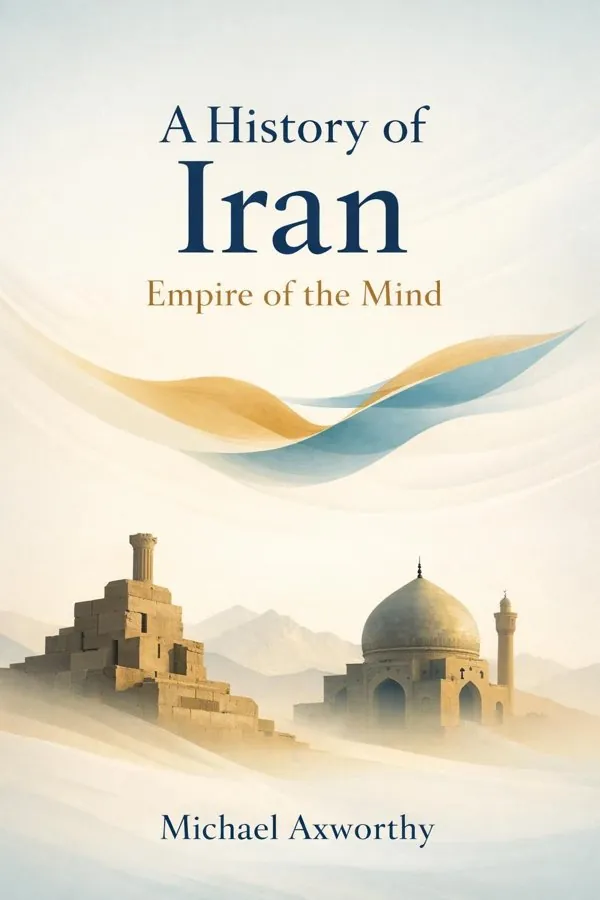
A History of Iran: Empire of the Mind: Summary & Key Insights
 10 min11 chaptersAudio available
What Is A History of Iran: Empire of the Mind About?
A History of Iran: Empire of the Mind by Michael Axworthy is a world_history book spanning 11 pages. In this comprehensive work, historian Michael Axworthy traces the evolution of Iranian civilization from the Achaemenid Empire of the sixth century BC through the rise of Islam and into the modern era. The book explores Iran’s cultural, political, and religious transformations, offering insight into how its ancient heritage continues to shape its identity and influence in the contemporary world.
This FizzRead summary covers all 11 key chapters of A History of Iran: Empire of the Mind in approximately 10 minutes, distilling the most important ideas, arguments, and takeaways from Michael Axworthy's work. Also available as an audio summary and Key Quotes Podcast.
A History of Iran: Empire of the Mind
In this comprehensive work, historian Michael Axworthy traces the evolution of Iranian civilization from the Achaemenid Empire of the sixth century BC through the rise of Islam and into the modern era. The book explores Iran’s cultural, political, and religious transformations, offering insight into how its ancient heritage continues to shape its identity and influence in the contemporary world.
Who Should Read A History of Iran: Empire of the Mind?
This book is perfect for anyone interested in world_history and looking to gain actionable insights in a short read. Whether you're a student, professional, or lifelong learner, the key ideas from A History of Iran: Empire of the Mind by Michael Axworthy will help you think differently.
- ✓Readers who enjoy world_history and want practical takeaways
- ✓Professionals looking to apply new ideas to their work and life
- ✓Anyone who wants the core insights of A History of Iran: Empire of the Mind in just 10 minutes
Want the full summary?
Get instant access to this book summary and 100K+ more with Fizz Moment.
Get Free SummaryAvailable on App Store • Free to download
Key Chapters
When we speak of Persia’s first empire under Cyrus the Great, we begin with a revolution — not just in power but in imagination. Cyrus’s achievement in the sixth century BCE was to forge together a mosaic of peoples and faiths into one polity, not by erasure but through respect. The Achaemenid Empire stretched from the Indus to the Aegean, yet it was united less by coercion than by an administrative genius that recognized difference as strength. The famous practice of allowing conquered peoples to keep their languages and religions was not mere tolerance; it was practical wisdom rooted in the Iranian concept of order — *asha* — as alignment between moral rightness and political stability.
As I explore in the book, Cyrus and his successors devised an administrative system that became a model for later empires. Satrapies granted local autonomy but required loyalty. Royal roads and standardized coinage bound the empire economically and logistically. Yet the ideological foundation — the king as champion of justice and divine order — reached deeper. The inscriptions of Darius at Behistun reveal not arrogance but a sophisticated sense of mission: that the king’s legitimacy depended on truth and justice, not mere conquest.
The Achaemenid heritage endured long after Alexander’s armies burned Persepolis. Its spirit informed how Iranians later absorbed and then transformed Greek, Arab, and Mongol influences. For Iranians, empire began with the idea that moral imagination is the strongest architecture — the first manifestation of what I call the 'Empire of the Mind.'
Alexander’s conquest seemed, at first glance, to sever Iran from itself. The Achaemenid order collapsed; Greek rule under the Seleucids imposed new political norms and urban designs. But beneath that Hellenistic veneer, Persian traditions remained alive. This period provides one of the earliest examples of Iran’s creative adaptation: rather than rejecting the conqueror’s culture, Persians gradually absorbed it — and in doing so, domesticated it.
The Parthians, emerging from the northeastern fringes, embodied this synthesis. Their governance revived Iranian patterns of local autonomy and aristocratic councils, even as they borrowed Hellenistic forms of court ritual. What fascinated me in their story was not their military success against Rome, but their ability to re-Iranize the landscape of power. They kept Greek art but translated its symbols into Persian idiom. They preserved Zoroastrian elements even as foreign religions mingled. The continuity of identity was subtle but profound: the Persian world could change its political skin without losing its intellectual core.
This era shows the first clear pattern repeated through Iran’s history: every foreign encounter becomes, over time, an Iranian encounter — assimilated, indigenized, made part of the continuing story.
+ 9 more chapters — available in the FizzRead app
All Chapters in A History of Iran: Empire of the Mind
About the Author
Michael Axworthy (1962–2019) was a British historian and author specializing in Iranian history and politics. He served as Head of the Iran Section at the UK Foreign and Commonwealth Office and later lectured at the University of Exeter. His works are known for their accessible yet scholarly approach to Iran’s complex historical narrative.
Get This Summary in Your Preferred Format
Read or listen to the A History of Iran: Empire of the Mind summary by Michael Axworthy anytime, anywhere. FizzRead offers multiple formats so you can learn on your terms — all free.
Available formats: App · Audio · PDF · EPUB — All included free with FizzRead
Download A History of Iran: Empire of the Mind PDF and EPUB Summary
Key Quotes from A History of Iran: Empire of the Mind
“When we speak of Persia’s first empire under Cyrus the Great, we begin with a revolution — not just in power but in imagination.”
“Alexander’s conquest seemed, at first glance, to sever Iran from itself.”
Frequently Asked Questions about A History of Iran: Empire of the Mind
A History of Iran: Empire of the Mind by Michael Axworthy is a world_history book that explores key ideas across 11 chapters. In this comprehensive work, historian Michael Axworthy traces the evolution of Iranian civilization from the Achaemenid Empire of the sixth century BC through the rise of Islam and into the modern era. The book explores Iran’s cultural, political, and religious transformations, offering insight into how its ancient heritage continues to shape its identity and influence in the contemporary world.
More by Michael Axworthy
You Might Also Like
The Age of Capital
Eric Hobsbawm
10 min
The Gulag Archipelago
Aleksandr Solzhenitsyn
10 min
Jerusalem: The Biography
Simon Sebag Montefiore
10 min
The Anglo-Saxons
James Campbell
10 min
The Boer War
Thomas Pakenham
10 min
The Industrial Revolutionaries: The Making of the Modern World 1776–1914
Gavin Weightman
10 minFeatured In
Browse by Category
Ready to read A History of Iran: Empire of the Mind?
Get the full summary and 100K+ more books with Fizz Moment.